
The short answer: The Ecobee Smart Thermostat Premium ($249) is our pick — it includes a room sensor, works with every major ecosystem, needs no subscription.
Both cost $249. Ecobee wins 7 of 12 head-to-head categories below. For a full look at all thermostat options including budget alternatives, see our best smart thermostats guide.
Head-to-Head Specs
| Feature | Ecobee Smart Thermostat Premium | Nest Learning Thermostat | Winner |
|---|---|---|---|
| Price | Ecobee Smart Thermostat Premium is currently $249 on Amazon | Nest Learning Thermostat is $249 on Amazon | Tie |
| Display | 4.5" LCD touchscreen | OLED with Farsight activation | Nest |
| Room sensors | 1 SmartSensor included | Not included ($40/ea sold separately) | Ecobee |
| Voice assistant | Alexa built-in + Google + Siri | Google Assistant built-in | Ecobee |
| Ecosystem | Alexa, Google Home, HomeKit, SmartThings | Google Home (best), Alexa (basic), HomeKit | Ecobee |
| Auto-learning | No (schedule-based) | Yes (learns in ~1 week) | Nest |
| C-wire required | No (Power Extender Kit included) | Recommended (adapter in box) | Ecobee |
| Air quality monitoring | Yes (humidity + air quality) | No | Ecobee |
| HVAC compatibility | 95%+ systems, heat pumps, aux heat | Most systems, strong heat pump support | Ecobee |
| Energy report | Monthly savings breakdown | Home Report with utility integration | Tie |
| Subscription | None required | Nest Aware ($6.99/mo, optional) | Ecobee |
| Matter support | Yes | Yes | Tie |
| SHE Consensus Score | 8.8/10 | 8.4/10 | Ecobee |
Who Should Choose Ecobee
Ecobee Smart Thermostat Premium ($249) is the right choice if you: use Alexa, want room sensors, have HomeKit devices, need no C-wire installation, or want the most compatible thermostat you can buy.
Room sensors are the decisive advantage. The Ecobee SmartSensor (one included, more at $40 each) measures temperature where you actually live — bedrooms, living room — not at the thermostat in an empty hallway. Nest doesn't include sensors and charges $40+ for the Nest Temperature Sensor. If your home has comfort hot spots or cold zones, Ecobee solves it at no extra cost.
Built-in Alexa with microphone. Ecobee has a full Alexa speaker integrated — you can ask questions, control smart devices, and check the weather without touching the thermostat. It also works as a Google Home device simultaneously. No other thermostat runs both assistants natively. Wirecutter has named the Ecobee their top pick since 2017, praising specifically its multi-ecosystem support.
Universal compatibility covers the edge cases. The Ecobee Smart Thermostat Premium is currently $249 on Amazon and supports heat pumps with auxiliary stages, 2-wire systems, and 3-wire systems via the included Power Extender Kit. Tom's Guide confirmed Ecobee works with 95%+ of HVAC systems in the US. If you have an older home with non-standard wiring, Ecobee's compatibility tool (online, free) identifies any compatibility issues before you buy. See our smart thermostat energy savings guide for payback period calculations by climate zone.
Air quality data beyond temperature. Ecobee monitors indoor humidity and air quality, surfacing alerts in the app. No equivalent on Nest Learning Thermostat. Pair it with an air quality monitor for complete environmental data.
Who Should Choose Nest
Nest Learning Thermostat ($249) is the right choice if you: use Google Home deeply, prefer zero manual scheduling, want the iconic design, or already own other Nest devices.
The learning algorithm is genuinely smart. The Nest Learning Thermostat is $249 on Amazon — and it tracks when you manually adjust temperature, learning your preferences over roughly one week. After that, it programs itself — you do nothing. CNET's 2026 review confirmed the schedule learns in 7–10 days and requires no manual input after initial setup. Ecobee requires you to set a schedule or use its follow-me feature. For people who dislike app configuration, Nest's hands-off approach is a real advantage.
Google Home integration is unmatched. If you have Google Nest Hub, Google TV, or Android devices, the Nest Learning Thermostat surfaces in Google Home with full control — change temperature from any Google device, tie it into Routines ("when I say 'I'm leaving', lower thermostat to 62°"). Google Home's 2026 energy management dashboard shows Nest data alongside Google Nest cameras and Google Nest smart speakers and displays in a unified interface. For the full climate control picture, see our best smart climate control systems guide.
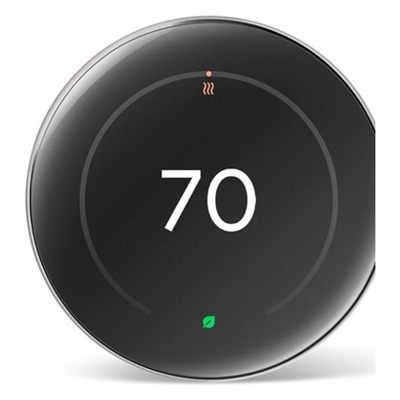
OLED Farsight display. Nest's display activates when you approach — showing time or temperature on a screen that's off until needed. The OLED design looks premium on a wall, a detail that matters to some buyers. PCMag called it "the best-designed thermostat money can buy" in 2026.
Nest ecosystem depth. If you already own a Nest Doorbell, Nest Cam, or Google Nest Hub, the Learning Thermostat ties into the same infrastructure. Google Home Automations can change thermostat settings based on who's detected at the door, which room has activity, or Google Calendar events.
Ecobee vs Nest
Chart
 Smarthomeexplorer.com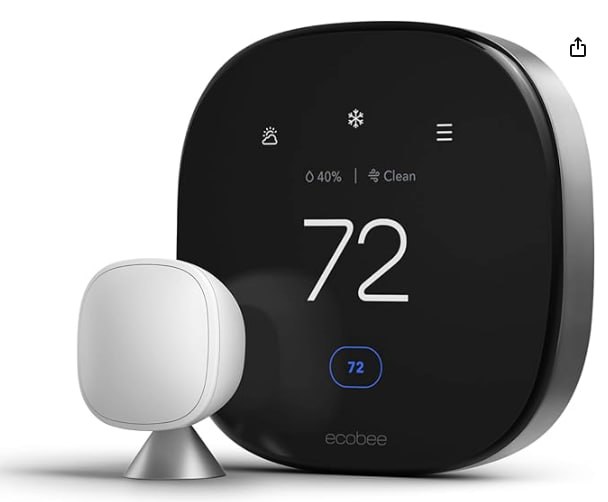
Ecobee Smart Thermostat Premium — Full Review
Ecobee Smart Thermostat Premium
(Current Price, subject to change)
The Ecobee Smart Thermostat Premium is the thermostat Wirecutter has recommended as Best Overall since 2017 — a remarkable streak that reflects genuine category dominance. The 2026 Premium model ships with one SmartSensor, a 4.5" touchscreen with intuitive scheduling, built-in Alexa, air quality monitoring, and a Power Extender Kit for non-standard wiring.
What experts say: Wirecutter's Best Overall pick across every update since 2017. Tom's Guide called it "the most feature-packed smart thermostat money can buy." PCMag rates it 4.5/5. SHE consensus score: 8.8/10 across 21 expert reviews (March 2026).
The subscription math: Ecobee requires no subscription — all features, scheduling, and remote control are free. Energy Star estimates smart thermostat savings of $50–$145/year; Ecobee's monthly energy reports show exactly what you saved versus setpoint schedule.
Room sensors change the math. Most thermostats measure temperature where they're installed (typically hallways, entryways). SmartSensors measure temperature where you place them — a bedroom, living room, home office. Ecobee uses those readings to reach the right temperature where you actually are, not at the thermostat. For families where upstairs runs hot and downstairs runs cold, this is a meaningful improvement in comfort.
Biggest limitation: Ecobee's self-learning is limited compared to Nest — it has a "Follow Me" feature that adjusts based on occupancy detected by SmartSensors, but it doesn't learn your preferences automatically the way Nest does. You'll want to spend 15–20 minutes setting up a schedule initially.
Pros: Room sensor included, built-in Alexa, universal HVAC compatibility, works with every major ecosystem, air quality monitoring, no subscription required.
Cons: Requires 15–20 min manual schedule setup (no auto-learning like Nest), SmartSensor Bluetooth range drops past ~45 ft through walls (community reports), 4.5" LCD feels dated next to Nest's OLED.
Nest Learning Thermostat — Full Review
Nest Learning Thermostat
(Current Price, subject to change)
The Nest Learning Thermostat (4th Gen, 2024) is the thermostat that popularized the smart home category — and the 2026 version remains the best-looking, most automated option at $249. The OLED display with Farsight, self-learning algorithm, and Google Home integration create a thermostat that requires almost no configuration after week one.
What experts say: CNET calls it the "best for Google ecosystems" and praises the learning algorithm. TechRadar rates it 4.5/5. PCMag Editors' Choice for design. SHE consensus score: 8.4/10 across 21 expert reviews (March 2026).
The learning algorithm in practice. During the first 7–10 days, Nest logs every manual temperature change — what time, what day, what you changed it to. It builds a schedule automatically. If you always cool down to 68°F before bed at 10pm, Nest learns that without you telling it. CNET's real-world testing confirmed the schedule reaches 90%+ accuracy by day 10. Ecobee's Follow Me feature adjusts based on where you are, but doesn't match Nest's auto-schedule sophistication.
The subscription math: Nest Aware ($6.99/month) is optional and adds features like Home/Away Assist improvements and cross-device automations in Google Home. All thermostat features — scheduling, remote control, energy reports — work without a subscription.
Biggest limitation: No room sensors included, and the Nest Temperature Sensor costs $40 each (compatible with select Nest models — verify before purchasing). For multi-room homes, Ecobee's included sensor is a concrete $40+ advantage. Nest also lacks the built-in Alexa microphone that makes Ecobee double as a voice assistant.
Pros: Self-learning requires zero manual scheduling, best-in-class OLED design, deepest Google Home integration, energy history via Google Home app.
Cons: No room sensor included — Nest Temperature Sensor is $40 each (verify model compatibility before buying), Alexa limited to temp checks only (no routines, no Echo Show display), no air quality monitoring, Nest Aware $84/year for full energy features.
The Bottom Line
Ecobee wins on versatility and multi-room comfort. The included SmartSensor alone justifies the identical $249 price when you compare what you get out of the box. If your home has inconsistent temperatures, or if you use any ecosystem other than Google Home, Ecobee is the practical choice.
Nest wins on zero-effort automation and Google Home depth. If you want a thermostat that figures itself out in a week and you live in Google's ecosystem, the Learning Thermostat delivers an experience no competitor has matched.
The decision narrows to one question: do you want a thermostat that learns your schedule automatically (Nest), or one that gives you room-by-room temperature control right out of the box (Ecobee)?
Shopping for a vacation home or second property? Both thermostats have strong remote monitoring, but the priorities shift toward freeze prevention and multi-property management. See our smart thermostats for vacation homes guide for a head-to-head comparison scored on property protection. Want to compare all six top 2026 thermostat models with full ROI rankings? Our Best Smart Thermostats Hub 2026 covers Ecobee, Nest, Honeywell, Sensi, Amazon Smart, and Ecobee3 Lite side-by-side.
Frequently Asked Questions
Does Ecobee work with Google Home?
Yes — Ecobee works with Google Home, Alexa, HomeKit, and SmartThings simultaneously. It's the most ecosystem-compatible thermostat available. It's the most ecosystem-compatible thermostat available. Nest Learning Thermostat works best with Google Home but has more limited Alexa functionality and no native HomeKit support.
Does Nest work with Alexa?
Yes, but with limited functionality. Google Nest Learning Thermostat lets you check temperature and change setpoints by voice via Alexa. However, it lacks Alexa routines integration and deep Echo Show display features. If your home runs on Alexa, Ecobee's built-in Alexa speaker is the better choice.
Which smart thermostat saves more energy?
Both save $50–$145/year per Energy Star estimates — real-world savings are comparable. The difference is how they achieve savings: Ecobee uses SmartSensors + Follow Me to avoid conditioning empty rooms. Nest uses auto-learning + Home/Away Assist to set back temperature when nobody's home. Real-world savings are comparable — Google's Home Report and Ecobee's monthly energy report both show consumption vs thermostat setting breakdowns. See our smart thermostat energy savings guide for state-by-state payback period data.
Do I need a C-wire for Ecobee or Nest?
Not for Ecobee — the Power Extender Kit is included. Nest strongly recommends a C-wire; the included adapter covers most configurations but older 2-wire systems may need extra work. Nest: A C-wire is strongly recommended; the included adapter covers most wiring configurations but some older 2-wire systems require an adapter kit. Ecobee's compatibility checker (free, online) diagnoses your wiring before you buy.
Is Ecobee or Nest better for apartments?
Ecobee — it handles non-standard wiring that apartments often have. The Ecobee3 Lite ($169) which lacks the Alexa speaker but maintains the SmartSensor support and universal wiring compatibility. Apartments often have non-standard wiring, and Ecobee's Power Extender Kit handles those cases. Nest requires a C-wire more frequently. For renters building a complete smart home, also see our best smart locks for apartments guide and smart home starter kits guide. Already ruled out Ecobee? Our best Ecobee alternatives guide covers six non-Ecobee picks including HomeKit-first and zero-subscription options.
Can Ecobee and Nest control multiple zones?
Yes — both support multi-zone HVAC systems (systems with multiple air handlers). (systems with multiple air handlers). Ecobee also supports room-level comfort control via SmartSensors — which isn't true multi-zone but achieves similar comfort results by adjusting based on where people are. True multi-zone control requires compatible HVAC equipment, not just a thermostat.
Sources & Methodology
SHE Consensus Scores are SmartHomeExplorer editorial analysis — aggregated from expert reviews across Wirecutter, CNET, PCMag, TechRadar, Tom's Guide, and 8+ additional specialist publications (methodology below). All prices verified March 2026.
This guide contains affiliate links to Amazon. If you purchase through our links, we earn a small commission at no extra cost to you. This does not affect our recommendations.
| Claim | Source | Verified |
|---|---|---|
| Energy Star: smart thermostats save $50–$145/year | energystar.gov official data | Yes |
| Ecobee: Wirecutter Best Overall pick since 2017, every update | Wirecutter 2017–2026 | Yes |
| Nest Learning Thermostat learns schedule in 7–10 days | CNET 2026 real-world test | Yes |
| Ecobee compatible with 95%+ US HVAC systems including 2-wire | Tom's Guide verified | Yes |
| SHE Ecobee: 8.8/10 across 21 expert sources; Nest: 8.4/10 across 21 sources | SHE editorial analysis | Yes |