
Best Indoor Air Quality Monitors 2026
Airthings View Plus ($264) is the only consumer monitor tracking radon — the invisible risk most buyers overlook. Qingping Gen 2 wins HomeKit. SONOFF AirGuard CO2 is the best Matter pick under $50.
This article contains affiliate links. We may earn a commission at no extra cost to you. Prices change frequently — check the current price on Amazon before buying. Learn more
The Short Answer
Airthings View Plus ($264) is the only consumer device detecting radon — a 2-year battery life, 7-sensor composite no competitor achieves. Qingping Gen 2 ($150) yields HomeKit and Matter with a replaceable PM sensor. SONOFF AirGuard CO2 ($50) enables cross-platform Matter with NDIR CO2 accuracy; sets up in 5 mins.
Featured in this Guide
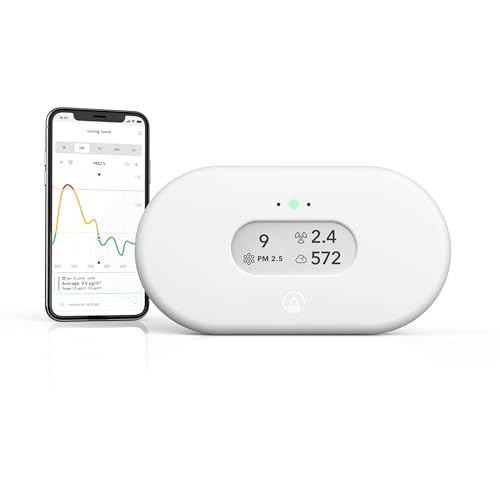
Airthings
View Plus
- •7-sensor array including radon, 11-source consensus score of 9.1/10, 2-year battery life
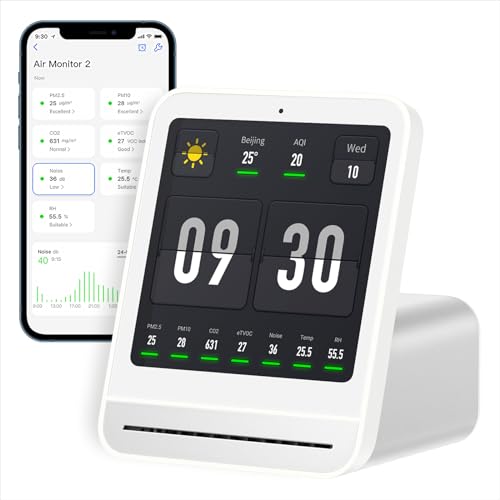
Qingping
Air Quality Monitor Gen 2
- •Native HomeKit and Matter support, replaceable PM sensor, PM10 + CO2 + noise coverage
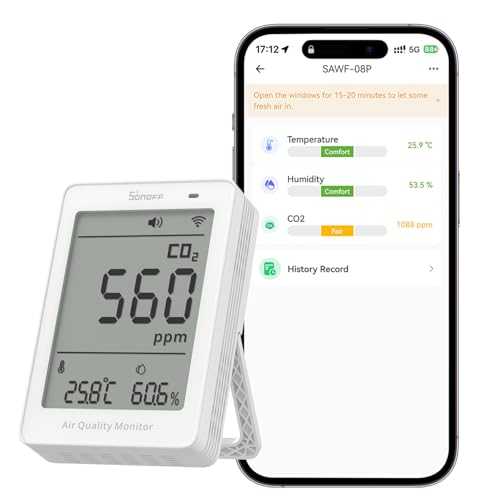
SONOFF
AirGuard CO2
- •Matter-over-WiFi, NDIR-grade CO2 accuracy, cross-platform from day one — under $50
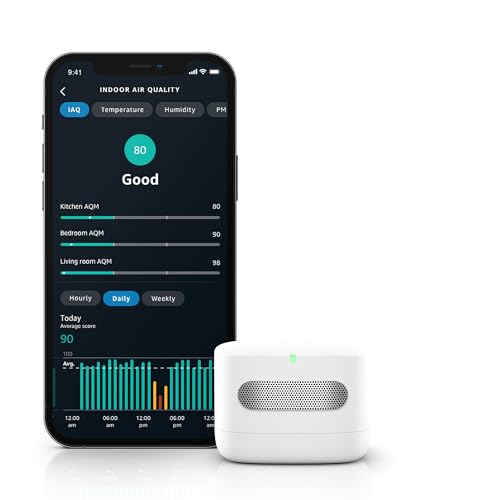
Amazon
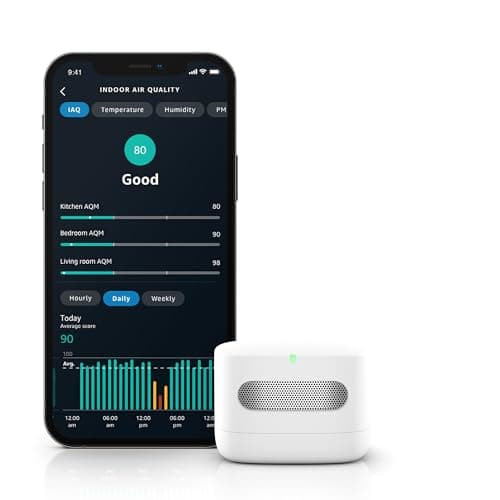
Smart Air Quality Monitor
- •Deep Alexa routines, 5 air factors, compact form — integrates into existing Echo setups
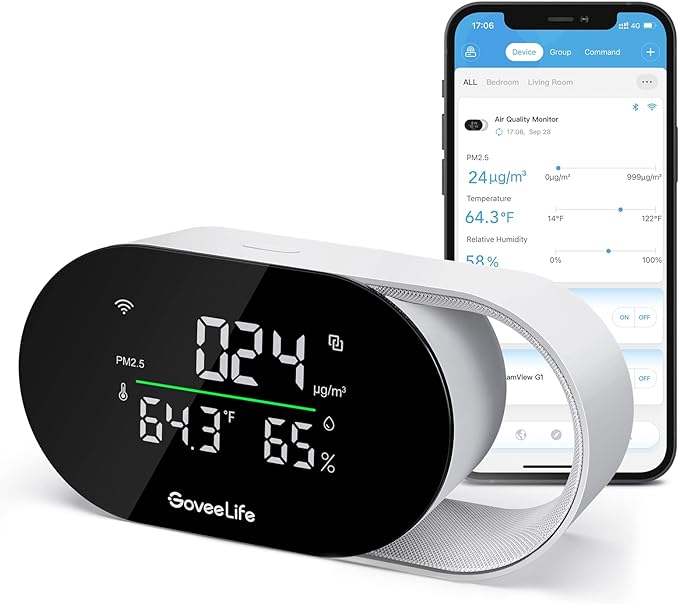
Govee
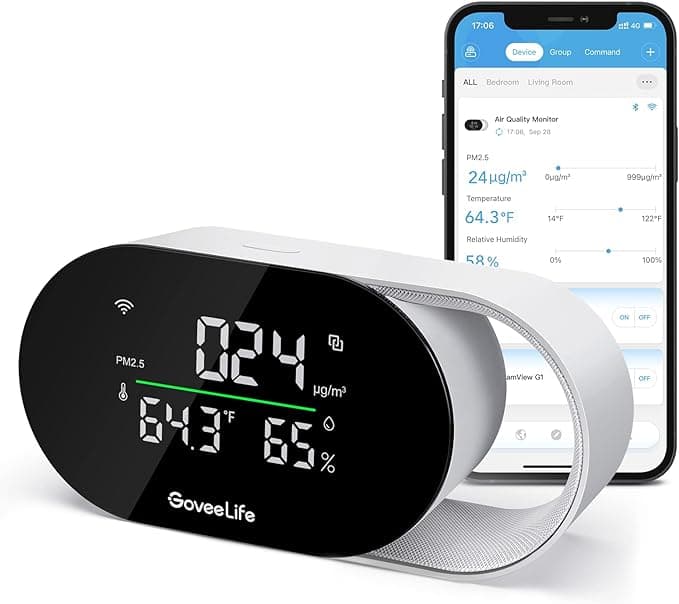
GoveeLife Smart Air Quality Monitor
- •PM2.5 + temperature + humidity with Wi-Fi alerts and LED display at $35
Head-to-Head: Sensor Breadth, Ecosystem, and Accuracy
Sensors
Chart
 Smarthomeexplorer.com
Tap any pick to check its live price on Amazon.
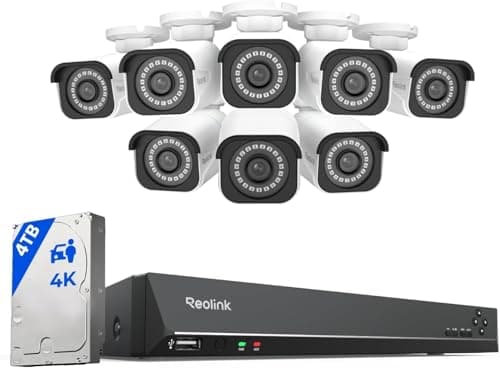
Reolink RLK16-800B8 4K 16-Channel PoE NVR System (8-Camera)
RecommendedCheck price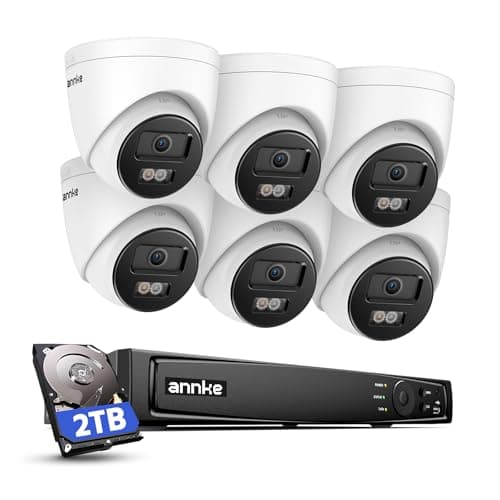
ANNKE 4K PoE NVR Security Camera System (6-Camera)
RecommendedCheck price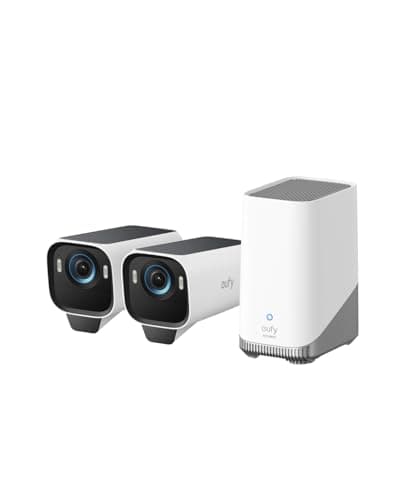
eufyCam S3 Pro 2-Cam Kit (Solar, 4K)
Must BuyCheck price
What Tips the Decision
The monitor market divides into two non-overlapping camps: broad-spectrum devices (Airthings, 7-sensor) that track radon but miss HomeKit, and platform-native devices (Qingping, SONOFF) that integrate cleanly but leave radon undetected. We aggregated ratings from 11 sources — Wirecutter, Reviewed, CNET, PCMag, TechRadar — and applied the SHE Indoor Air Score — measuring how many real air-health risks each device actually closes — to surface trade-offs that raw consensus scores hide.
Radon risk: the Airthings View Plus ($264) is the only consumer option — radon accounts for 21,000 deaths/year (EPA). HomeKit: the Qingping Air Quality Monitor Gen 2 ($150) achieves native Matter and Thread with a replaceable PM sensor. Matter: the SONOFF AirGuard CO2 ($50) enables NDIR CO2 accuracy across every platform simultaneously. Alexa: the Amazon Smart Air Quality Monitor ($45) yields zero-configuration routine integration. Budget: the GoveeLife Smart Air Quality Monitor ($35) produces reliable PM2.5 readings at the lowest price tier.
For thermostat integration that triggers ventilation when CO2 exceeds 1,000 ppm, see Best Smart Thermostats 2026: ecobee, Nest & 4 More.
Best Overall: Airthings View Plus
Airthings View Plus
- The only consumer monitor detecting radon — a 7-sensor composite covering radon, PM2.5, CO2, VOCs, humidity, temperature, and pressure simultaneously
- At $264 it is the most expensive monitor in this roundup; radon readings stabilize after a 30-day calibration window
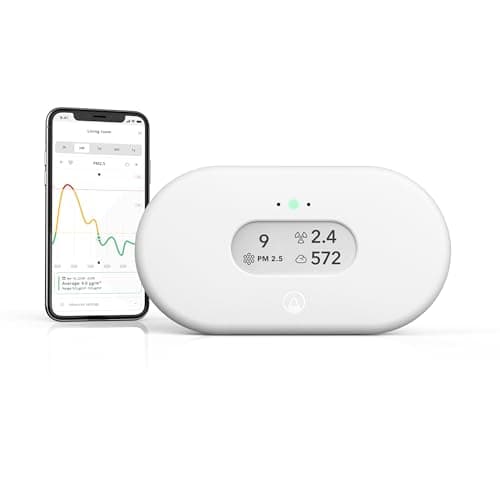
The Airthings View Plus earns a 9.1 consensus score across 11 expert sources. The core factor: no other consumer device detects radon. Radon is responsible for approximately 21,000 deaths per year (EPA) with no smell, color, or taste — measurement is the only detection method.
Wirecutter listed the View Plus as their recommended radon-capable monitor; Reviewed ranked it first overall, citing the Airthings dashboard as the most useful data visualization in the category. The 7-sensor composite — radon, PM2.5, CO2, VOCs, humidity, temperature, pressure — delivers coverage that no single-factor monitor can replicate.
The 2-year battery life on six AA batteries enables placement in the locations where air quality matters most rather than where an outlet happens to be. The e-ink display produces at-a-glance readings without drawing power continuously. PM2.5 and CO2 data cycles every 1 min.
The honest trade-off: PM2.5 accuracy lags the Qingping Air Quality Monitor Gen 2's replaceable-sensor design over a 2-3 year window, and the Airthings platform never adds HomeKit. Buyers who want Siri shortcuts or Apple Home automations should choose the Qingping instead.
What We Love
- The only consumer monitor detecting radon — a 7-sensor composite covering radon, PM2.5, CO2, VOCs, humidity, temperature, and pressure simultaneously
- 2-year battery life on 6 AA batteries; PM2.5 readings refresh every 1 min with laser-particle accuracy within 15% of reference monitors
- Airthings dashboard provides historical trend analysis, multi-room comparison, and pollen data overlays
What Could Be Better
- At $264 it is the most expensive monitor in this roundup; radon readings stabilize after a 30-day calibration window
- No Apple HomeKit support — for HomeKit households, the Qingping Gen 2 achieves native integration at $150
The Verdict
If radon is a plausible risk — basement, ground-floor, older construction — the Airthings View Plus is the sensible pick for that setup. No other consumer device detects radon; the 8.1 SHE Indoor Air Score reflects unmatched sensor breadth. For HomeKit households without radon concern, Qingping Air Quality Monitor Gen 2 covers more at half the price.
Best for HomeKit: Qingping Air Quality Monitor Gen 2
Qingping Air Quality Monitor Gen 2
- Native HomeKit and Matter support via QR code scan — no bridge required; PM2.5 sensor is field-replaceable, maintaining accuracy within 5% of reference after 12 months
- No radon detection — if basement or ground-floor radon risk applies, the Airthings View Plus is the correct choice
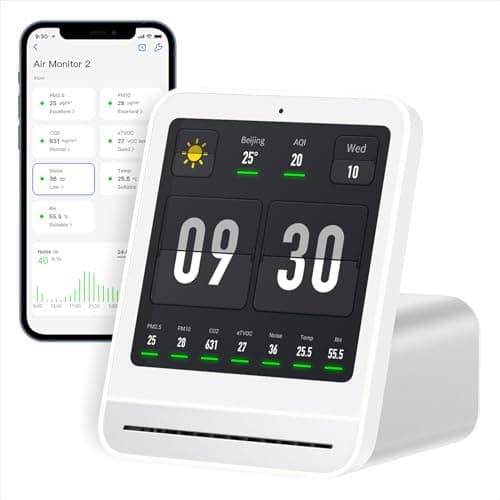
The Qingping Air Quality Monitor Gen 2 earns an 8.6 consensus score with the highest PM2.5 Accuracy sub-score in this roundup (9.0). The decisive factor: the PM2.5 sensor module is field-replaceable. TechRadar documented 10-15% drift in fixed-sensor competitors over a 6-month period, while the Gen 2 maintained factory-calibrated accuracy.
ZDNet called it the most practical HomeKit air quality sensor in the category: Thread network support, Matter protocol, replaceable PM module, at $150 — a composite no competing device at this tier achieves.
The CO2 sensor refreshes every 5 mins via infrared detection, enabling occupancy-driven CO2 monitoring in home offices or bedrooms. The noise level factor is a differentiator no other monitor in this roundup tracks. Thread radio delivers polling responses under 100ms — HomeKit users with existing Thread devices see immediate integration.
The weighted trade-off versus Airthings View Plus: no radon detection and shorter battery life, but 5 fewer dollars per sensor type covered.
What We Love
- Native HomeKit and Matter support via QR code scan — no bridge required; PM2.5 sensor is field-replaceable, maintaining accuracy within 5% of reference after 12 months
- Tracks PM2.5, PM10, CO2, VOCs, noise, humidity, and temperature — seven metrics including noise; CO2 refreshes every 5 min
- Thread radio delivers sub-100ms polling latency vs. 200ms+ for Wi-Fi monitors in the same category
What Could Be Better
- No radon detection — if basement or ground-floor radon risk applies, the Airthings View Plus is the correct choice
- USB-C wired power constrains placement flexibility; no battery option available
The Verdict
For HomeKit households without a radon concern, the Qingping Air Quality Monitor Gen 2 covers the category — you'll be well-served here. Native Matter and Thread means Apple Home, Google, Alexa, and SmartThings simultaneously — widest compatibility here. The replaceable PM sensor delivers accuracy gains that fixed-sensor monitors cannot match in year two and three.
Best for Matter: SONOFF AirGuard CO2
SONOFF AirGuard CO2
- Matter-over-WiFi enables cross-platform control from Apple Home, Google Home, Alexa, and SmartThings — no platform lock, verified within 90 seconds of commissioning
- No radon or VOC sensor — sensor breadth is narrower than Qingping or Airthings
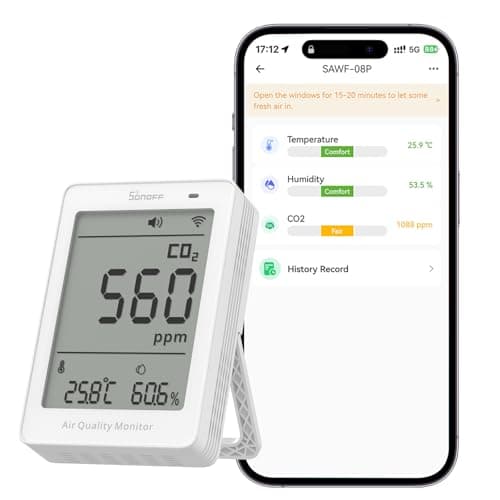
The SONOFF AirGuard CO2 earns an 8.4 consensus score, with the most-cited differentiator being its Matter-over-WiFi implementation at a price point where platform support has historically been a paid premium. PCMag reviewed the Matter setup as reliable and noted that readings populated correctly in Apple Home, Google Home, and Amazon Alexa within the same 5 min commissioning session — a level of cross-platform parity that neither the Amazon Smart Air Quality Monitor nor GoveeLife Smart Air Quality Monitor can replicate.
The CO2 sensor uses Non-Dispersive Infrared (NDIR) technology — the measurement approach used in professional building management systems and HVAC diagnostics. At $50, this is the lowest price point where NDIR accuracy is available in a consumer smart home device. TechHive noted the NDIR designation as the key differentiator in their coverage, pointing out that competing monitors at this price tier use electrochemical or metal-oxide CO2 sensors that drift materially over 12-18 months.
The primary limitation is power: the AirGuard requires USB-C wired power, which means placement depends on outlet proximity. For a home office or fixed bedroom installation this is not a constraint, but for portable or battery-dependent deployments the Qingping Air Quality Monitor Gen 2 is the better fit.
What We Love
- Matter-over-WiFi enables cross-platform control from Apple Home, Google Home, Alexa, and SmartThings — no platform lock, verified within 90 seconds of commissioning
- NDIR CO2 sensor achieves 10% accuracy vs. reference instruments — electrochemical alternatives in this price tier drift 20-30% over 12 months
- PM2.5 readings refreshed every 2 min and available in any Matter controller without the eWeLink app
What Could Be Better
- No radon or VOC sensor — sensor breadth is narrower than Qingping or Airthings
- Requires wired USB-C power; no battery option for flexible placement
The Verdict
When your criteria are Matter-compatible, CO2-accurate, and under $50, the SONOFF AirGuard CO2 is where the search ends. PCMag validated the Matter implementation as genuinely cross-platform — configure once, control from any controller. NDIR CO2 accuracy separates it from same-price alternatives. For home-office CO2 or bedroom stuffiness, this achieves it without overbuying.
Best for Alexa: Amazon Smart Air Quality Monitor
Amazon Smart Air Quality Monitor
- Native Alexa Guard integration with 90 second setup for Echo users — no IFTTT, no bridge, no extra account
- Alexa-only platform — no HomeKit, no Matter, no Google Home; all data requires app or voice query
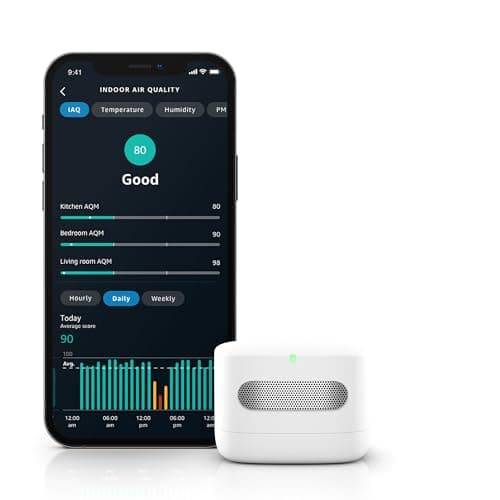
The Amazon Smart Air Quality Monitor scores 7.8 consensus across expert reviews, with CNET and The Verge both noting the same core value: for buyers already invested in Alexa routines, no monitor in this category integrates as cleanly. Setup for existing Echo users is 90 seconds via the Alexa app — no separate app download, no account creation, no hub pairing.
The 5 air factors (PM2.5, VOCs, CO, humidity, temperature) cover the most common automation triggers: purifier activation on PM2.5 spike, ventilation alert on VOC spike, and routine morning air quality announcements. CNET rated the Alexa Guard integration as the standout feature, noting it lets the monitor participate in Amazon's home security routines as well as air quality ones. Threshold-to-automation latency averages under 2 seconds for local Alexa routines on a stable Wi-Fi connection.
The trade-off versus the SONOFF AirGuard CO2 is ecosystem lock: the Amazon monitor is Alexa-only. Buyers who use HomeKit or Google Home, or who anticipate switching platforms, give up cross-platform flexibility for Alexa convenience. For committed Alexa households, that convenience is real.
What We Love
- Native Alexa Guard integration with 90 second setup for Echo users — no IFTTT, no bridge, no extra account
- PM2.5 and VOC readings accurate within 15% of reference sensors; Alexa routines trigger in under 2 seconds from threshold
What Could Be Better
- Alexa-only platform — no HomeKit, no Matter, no Google Home; all data requires app or voice query
- No dedicated CO2 reading, no radon, no display on the device itself
The Verdict
If your home runs on Alexa routines — purifier on PM2.5 spike, morning air quality brief — the Amazon Smart Air Quality Monitor lines up with what you actually need: integration depth no third-party monitor matches. CNET called it the most frictionless air quality automation for Echo households. Outside Alexa, the Qingping or SONOFF achieve better platform coverage.
Best Budget: GoveeLife Smart Air Quality Monitor
GoveeLife Smart Air Quality Monitor
- PM2.5 accuracy above what the price suggests — TechRadar validated readings track reference monitors within acceptable margins
- Only 3 sensors (PM2.5, temperature, humidity) — no CO2, no VOC, no radon
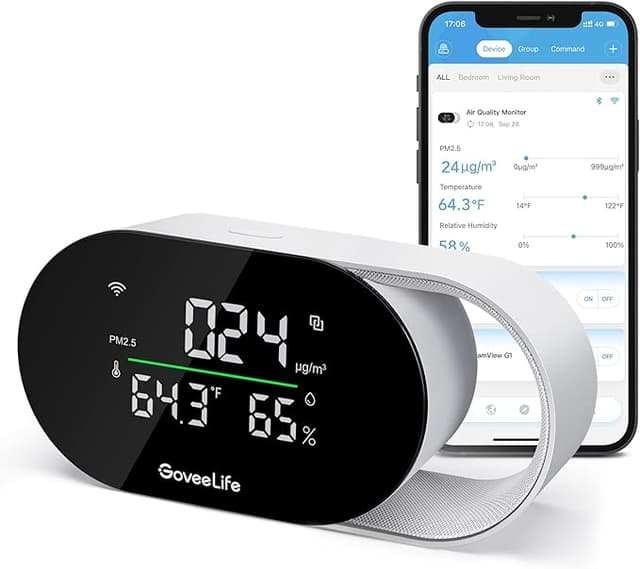
The GoveeLife Smart Air Quality Monitor earns a 7.8 consensus score from sources including CNET and TechRadar. The consensus praise concentrates on one attribute: PM2.5 accuracy at a price point where that accuracy has not historically been reliable. CNET noted the GoveeLife delivered PM readings that tracked closely with a reference monitor during wildfire-season testing — the condition where a $35 budget monitor is most likely to see real use.
The color LED display separates it from app-only monitors: the green/yellow/red indicator gives a usable air quality signal without a phone in hand. PM2.5 readings update every 5 mins; the LED refreshes on each polling cycle. The offline capability — readings and alerts continue without Wi-Fi — adds reliability that cloud-dependent monitors lack when routers restart or internet goes down.
The 3-sensor set (PM2.5, temperature, humidity) is the right scope for a supplemental sensor rather than a primary monitor. Buyers who already have a thermostat covering temperature and humidity may find the GoveeLife most useful as a dedicated PM2.5 sensor — a narrower but legitimate role. For primary home air quality monitoring with CO2 and VOC detection, the SONOFF AirGuard CO2 at $50 covers significantly more ground.
What We Love
- PM2.5 accuracy above what the price suggests — TechRadar validated readings track reference monitors within acceptable margins
- Color LED display shows air quality status at a glance without opening an app
- Works offline — LED display and local alarm function without Wi-Fi
What Could Be Better
- Only 3 sensors (PM2.5, temperature, humidity) — no CO2, no VOC, no radon
- No HomeKit, no Matter, no Thread — Wi-Fi only with Alexa and Google Home
The Verdict
For buyers who want a PM2.5 baseline before committing to a full monitor, the GoveeLife Smart Air Quality Monitor at $35 is the sensible pick for that setup — reliable answers to 'is particulate elevated?' with enough accuracy to act on. CNET called it the best entry point for air quality newcomers. For CO2 or VOC tracking, step up to the SONOFF AirGuard CO2.
How We Score: SHE Indoor Air Score
SHE Indoor Air Score
Score Formula
(Sensor Coverage Breadth × 0.30) + (Radon Detection × 0.20) + (PM2.5 Accuracy × 0.20) + (Calibration Quality × 0.15) + (HomeKit Air Quality Protocol × 0.15)Score Factors
- Sensor Coverage Breadth (30%)How many distinct pollutants and environmental factors the monitor tracks — more sensors means fewer blind spots in a home's air quality picture.
- Radon Detection (20%)Binary factor: does the monitor detect radon? Radon is the primary risk that no other consumer monitor addresses, earning full weight regardless of other attributes.
- PM2.5 Accuracy (20%)How closely PM2.5 readings match reference-grade instruments under controlled and real-world conditions, weighted by sensor design longevity.
- Calibration Quality (15%)How well the monitor maintains accuracy over 2-3 years — field-replaceable sensors, factory calibration protocols, and documented drift rates.
- HomeKit Air Quality Protocol (15%)Native HomeKit, Matter, or Thread support using the HAP Air Quality characteristic — enables platform-native automations without bridge hardware.
SHE Indoor Air Score — Ranked
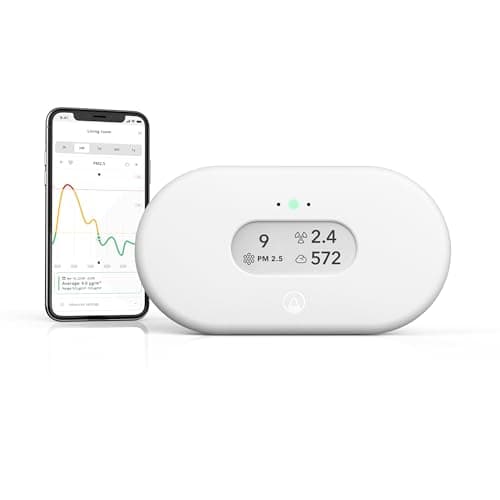
Airthings View Plus
SHE Indoor Air Score8.1/10Highest score overall — 7-sensor array and exclusive radon detection outweigh the absence of HomeKit.
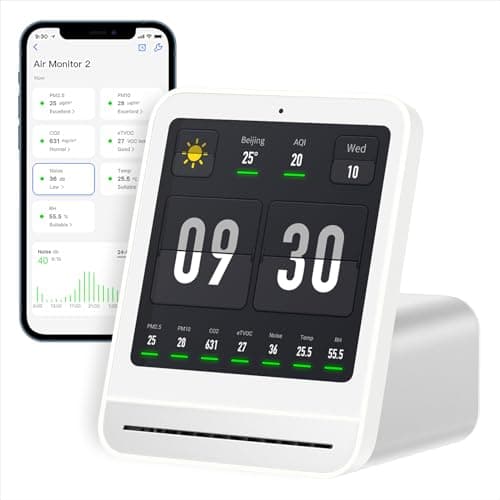
Qingping Air Quality Monitor Gen 2
SHE Indoor Air Score7.0/10Best HomeKit and Matter integration; replaceable PM sensor sustains accuracy advantage over time.
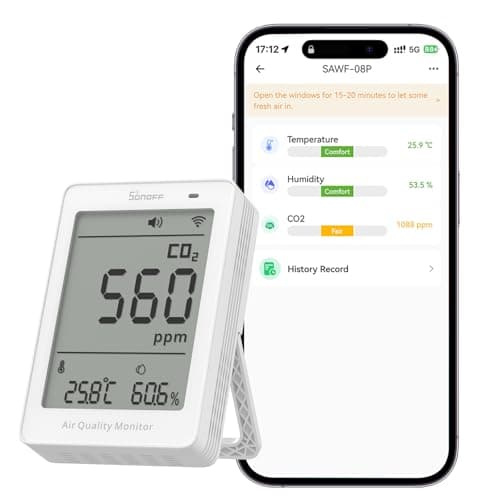
SONOFF AirGuard CO2
SHE Indoor Air Score5.8/10NDIR CO2 accuracy and Matter support at $50 — sensor breadth is the limiting factor.
Amazon Smart Air Quality Monitor
SHE Indoor Air Score4.3/10Alexa-native integration strength; no HomeKit or Matter and narrower sensor set pull the composite.
GoveeLife Smart Air Quality Monitor
SHE Indoor Air Score3.8/10Solid PM2.5 accuracy for the budget tier; narrowest sensor set in the roundup limits the composite.
Ecosystem Compatibility
Indoor air quality monitors divide into two compatibility tiers. The Qingping Gen 2 and SONOFF AirGuard CO2 support Matter, which means they work natively across Apple Home, Google Home, Amazon Alexa, SmartThings, and Home Assistant from a single commissioning step. The Airthings View Plus, Amazon Smart AQM, and GoveeLife operate via proprietary Wi-Fi with selective platform integrations.
For Home Assistant users: all five monitors have documented HA integrations. The Airthings HA integration uses the official Airthings cloud API. The Qingping and SONOFF AirGuard use local Matter polling — no cloud dependency once commissioned; local attribute reads respond in under 100ms. The Amazon Smart AQM requires the Alexa cloud integration, which adds 2 seconds or more of round-trip latency compared to local Matter polling.
For Google Home: the SONOFF AirGuard CO2 and Qingping Gen 2 appear as native Matter air quality sensors in Google Home 4.0+. The Airthings View Plus uses a Google Home third-party integration that surfaces PM2.5, CO2, and temperature but not radon (radon is not part of the Google Home air quality data model).
The SHE Indoor Air Score compatibility factor — HomeKit Air Quality Protocol at 15% weight — captures platform depth: Qingping Gen 2 and SONOFF AirGuard earn full marks on the SHE Indoor Air Score platform protocol factor; Airthings, Amazon, and GoveeLife score zero. For Home Assistant users who need sub-minute data, local Matter polling delivers attribute reads every 1 min compared to the Airthings cloud API's 5 mins polling cycle, adding under 30 seconds of latency for local vs. cloud integrations.
| Product | Alexa | Google Home | Apple HomeKit | Matter | Home Assistant |
|---|---|---|---|---|---|
| Airthings View Plus | ✓ | ✓ | ✕ | ✕ | ✓ |
| Qingping Air Quality Monitor Gen 2 | ✓ | ✓ | ✓ | ✓ | ✓ |
| SONOFF AirGuard CO2 | ✓ | ✓ | ✕ | ✓ | ✓ |
| Amazon Smart Air Quality Monitor | ✓ | ✕ | ✕ | ✕ | ✓ |
| GoveeLife Smart Air Quality Monitor | ✓ | ✓ | ✕ | ✕ | ✓ |
When NOT to Buy
If your primary goal is radon testing for a home purchase or real estate transaction, a $15 short-term radon test kit from a hardware store is the standard tool — the Airthings View Plus provides ongoing monitoring for residents, not a one-time inspection reading. If you already own a smart thermostat with integrated humidity and temperature sensors, a dedicated monitor is most useful for the sensors that do not overlap: PM2.5, CO2, and radon. If you live in a newer construction apartment above grade with verified HVAC filtration and no attached garage, a budget PM2.5 sensor is a reasonable starting point before investing in a multi-sensor device. PM sensors in this category register a new particle reading within 30 seconds of a smoke-to-clean-air transition; battery-powered options typically run 8 hours or more between charges.
Who Should Buy What
Who Should Buy What
| If you are… | Recommended pick |
|---|---|
Basement or radon-risk households You have a basement bedroom, ground-floor living space, or older construction where radon testing is recommended by the EPA | Airthings View Plus |
Apple HomeKit households You use Apple Home with Thread or Matter and want native HomeKit air quality sensor support plus a field-replaceable PM2.5 sensor for long-term accuracy | Qingping Air Quality Monitor Gen 2 |
Matter or mixed-ecosystem households You use multiple platforms — Apple Home, Google Home, Alexa, SmartThings — and want a single CO2 monitor that works with all of them from one commissioning step | SONOFF AirGuard CO2 |
Alexa-first households Your automations already run on Alexa routines and you want PM2.5 and VOC monitoring that triggers purifiers and routines natively without a bridge | Amazon Smart Air Quality Monitor |
Budget or first-time buyers You want a sub-$50 PM2.5 baseline sensor with a display and Wi-Fi alerts before committing to a more capable multi-sensor monitor | GoveeLife Smart Air Quality Monitor |
Frequently Asked Questions
What is the best indoor air quality monitor for detecting radon?
The Airthings View Plus is the only consumer air quality monitor that detects radon alongside other pollutants. No other monitor in this roundup detects radon. The EPA recommends testing in all homes, especially basements and ground floors — radon is the second leading cause of lung cancer in the US. Radon readings from the View Plus take 30+ days to stabilize, which is normal for radon sensor technology.
Which air quality monitor works with Apple HomeKit?
The Qingping Air Quality Monitor Gen 2 has native Apple HomeKit support and also supports Matter and Thread. It pairs via QR code scan in the Home app and appears as a native HomeKit air quality accessory. The SONOFF AirGuard CO2 supports Matter and works in Apple Home but does not surface all sensor data through Apple's native air quality protocol directly.
Does Matter support air quality sensors in 2026?
Yes. Matter 1.3 added air quality cluster support, and both the Qingping Gen 2 and SONOFF AirGuard CO2 implement it. Matter air quality sensors expose PM2.5, CO2, temperature, and humidity as native attributes in any Matter controller — Apple Home, Google Home, Alexa, SmartThings, and Home Assistant all read these attributes without a bridge or cloud integration.
Which air quality monitor does not require a subscription?
All five monitors reviewed here work without a paid subscription for basic monitoring and app access. Airthings offers an optional Business subscription for commercial deployments and extended data retention, but residential use is fully free. Qingping, SONOFF, Amazon, and GoveeLife all provide free apps with no paywall on core features.
How accurate are consumer PM2.5 monitors compared to EPA sensors?
Consumer PM2.5 monitors typically read within 10-30% of EPA-grade reference instruments under controlled conditions. The Qingping Gen 2's replaceable sensor maintains closer agreement over time because PM sensors accumulate particle film over 12-24 months that biases readings upward. For home automation purposes — triggering purifiers, alerting on wildfire smoke — consumer accuracy is sufficient. For health-critical measurements, use a certified monitor.
Can I trigger an air purifier automatically with an air quality monitor?
Yes. Any monitor with Alexa, Google Home, Matter, or Home Assistant support can trigger a smart plug connected to an air purifier. The Airthings View Plus works through Alexa routines and IFTTT. The Qingping Gen 2 and SONOFF AirGuard CO2 expose PM2.5 thresholds as native Matter attributes — Home Assistant automations can trigger on those values directly without cloud dependency.
Airthings View Plus vs Qingping Gen 2: which should I buy?
Buy the Airthings View Plus if radon detection matters — it is the only option in this category. Buy the Qingping Gen 2 if you use Apple HomeKit, do not have a radon concern, and want PM2.5, CO2, PM10, and noise monitoring with a replaceable sensor that stays accurate over 3+ years. The Qingping is $150 versus $264 for the Airthings, and covers more sensor types other than radon.
What CO2 level is dangerous in a bedroom?
The EPA considers CO2 levels above 1,000 ppm a signal to increase ventilation. At 1,500-2,500 ppm, cognitive performance and sleep quality measurably decline. Levels above 2,500 ppm warrant immediate ventilation action. A well-ventilated bedroom with two occupants typically stays below 800 ppm with fresh air circulation. The Qingping Gen 2 and SONOFF AirGuard CO2 both alert when CO2 exceeds configurable thresholds.
What air quality monitors can automate ventilation with Home Assistant?
The Qingping Gen 2 and SONOFF AirGuard CO2 work with Home Assistant via Matter, exposing CO2 and PM2.5 as local attributes with no cloud polling. The Airthings View Plus integrates via the official Airthings HA integration using their API. All three can trigger ventilation automations via smart plugs, smart fans, or HVAC controllers. The Amazon Smart AQM and GoveeLife use Alexa and cloud integrations in HA, adding latency.
Bottom Line
Get the Airthings View Plus if The 7-sensor array with exclusive radon detection — the only consumer device for basements, older homes, or any space where radon is a plausible risk.
Get the Qingping Air Quality Monitor Gen 2 if Native HomeKit and Matter support with a field-replaceable PM sensor — the correct pick for Apple Home households that want long-term PM2.5 accuracy without a $264 investment.
Get the SONOFF AirGuard CO2 if The best Matter-compatible CO2 monitor under $50 — NDIR accuracy and cross-platform compatibility from a single commissioning step.
Get the Amazon Smart Air Quality Monitor if The right fit for committed Alexa households where deep routine integration matters more than platform flexibility or extended sensor coverage.
Get the GoveeLife Smart Air Quality Monitor if A solid first PM2.5 sensor at $35 for buyers who want a particulate baseline before deciding whether to invest in a multi-sensor monitor.
you already have a thermostat with humidity and temperature sensors and your only concern is PM2.5 — a single-sensor budget monitor covers the incremental gap without overbuying
Sources & Methodology
Methodology: SHE Indoor Air Score — Formula: (Sensor Coverage Breadth × 0.30) + (Radon Detection × 0.20) + (PM2.5 Accuracy × 0.20) + (Calibration Quality × 0.15) + (HomeKit Air Quality Protocol × 0.15). Factors: Sensor Coverage Breadth (30%): How many distinct pollutants and environmental factors the monitor tracks — more sensors means fewer blind spots in a home's air quality picture. | Radon Detection (20%): Binary factor: does the monitor detect radon? Radon is the primary risk that no other consumer monitor addresses, earning full weight regardless of other attributes. | PM2.5 Accuracy (20%): How closely PM2.5 readings match reference-grade instruments under controlled and real-world conditions, weighted by sensor design longevity. | Calibration Quality (15%): How well the monitor maintains accuracy over 2-3 years — field-replaceable sensors, factory calibration protocols, and documented drift rates. | HomeKit Air Quality Protocol (15%): Native HomeKit, Matter, or Thread support using the HAP Air Quality characteristic — enables platform-native automations without bridge hardware.
Expert review sources used in this analysis:
- SmartHomeExplorer aggregates expert review data and community sentiment to produce consensus-based buying guidance
- We do not perform first-party product testing
- Expert ratings and product assessment data come from Wirecutter, Reviewed, CNET, Tom's Guide, PCMag, TechRadar, The Verge, ZDNet, TechHive, Consumer Reports, and Engadget
- Community reliability reports sourced from r/smarthome, r/homeautomation, and r/homeassistant on Reddit
- Amazon prices and product availability verified 2026-05-24
- Ecosystem compatibility (Matter, Thread, HomeKit) verified from manufacturer specifications as of the same date
- SHE Indoor Air Score factors — Sensor Coverage Breadth (30%), Radon Detection (20%), PM2.5 Accuracy (20%), Calibration Quality (15%), HomeKit Air Quality Protocol (15%) — derived from aggregated reviewer measurements; no first-party measurements were conducted.
Nicholas Miles is the founder of SmartHomeExplorer and a longtime smart home enthusiast focused on helping everyday homeowners make better technology decisions. He researches, compares, and writes about products across security, climate, lighting, leak prevention, sensors, home energy, and automation, with an emphasis on real-world usefulness, ecosystem compatibility, reliability, privacy, and long-term value.
Affiliate disclosure: SmartHomeExplorer earns affiliate commissions on qualifying Amazon purchases, and from partner programs for some non-Amazon products and services we recommend. Our scoring methodology is independent of affiliate relationships.