
Last updated: 2026-05-05
The EcoFlow DELTA Pro 3 is the 2026 best-overall RV/off-grid pick (10.0 SHE Off-Grid Autonomy Score; TT-30R + 8,000W surge + 4,096Wh LFP).
The defining spec for an RV power station isn't watts — it's solar input per pound of carry weight, paired with how many overnight 200W camp hours you get out of one full charge. Every other comparison evaporates the moment you're loading 130 lb of lithium into a truck bed at a desert trailhead.
We aggregated review data from EcoFlow, Anker, BLUETTI, Jackery, and DJI's published spec sheets, plus coverage from TechRadar, Popular Mechanics, Tom's Guide, and B&H lab notes — eight sources total — to build the SHE Off-Grid Autonomy Score for five 2026 portable power stations. The score weights two things RV and van-life buyers actually care about: solar harvest per pound of weight you have to carry, and how long the unit sustains a realistic 200W boondocking load (compressor fridge ~60W + CPAP ~30W + LED lights + miscellaneous) before depleting. Surge wattage and price-per-watt-hour are still in the data — they just aren't the headline numbers anymore. Surge gets surfaced where it matters (the RV rooftop AC compatibility gate), and price gets surfaced where it matters (the value sanity check), but neither dictates the rankings.
If you're cross-shopping these against home backup units that live in a basement and never move, our home-backup portable power stations guide is the right starting point — different audience, different scoring weights, one shared product (the EcoFlow DELTA Pro 3) that earns its place in both categories.
What tips the decision
Three signals separate a usable RV pick from one you'll regret a week into a road trip, and almost no review handles all three together.
Signal one: solar input rated vs. real-world yield. Manufacturer-rated solar input (2,600W on the DELTA Pro 3, 2,400W on the BLUETTI Apex 300 and Anker F3800) assumes ideal panel orientation, midday equatorial sun, and zero shade. At an actual campsite — panels propped against a truck, half-shaded by sage, sun arcing low in October — buyers consistently see 40–60% of rated input. A 2,600W-rated unit harvesting at 50% real-world is doing 1,300W, which means a 4,000Wh battery still takes ~3 hours of usable solar to top up. Plan recharge math against the real number, not the spec sheet.
Signal two: weight as the hidden filter. "Portable" is meaningless without the lb context. The DELTA Pro 3 (113.54 lb) and Anker F3800 (132.3 lb) are not grab-and-go — both require two people or wheeled logistics to load into a truck bed or trailer. The BLUETTI Apex 300 (84 lb) sits at the threshold where a determined adult can solo-carry it short distances. The DJI Power 2000 (48.5 lb) is the category outlier — light enough that a single person lifts it into a truck bed without thinking. Buyers searching "best portable power station for RV" expect something they can move alone; about half of the units they'll see in mainstream roundups can't actually meet that bar.
Signal three: native 12V DC outputs. RV and van-life loads run on 12V native — compressor fridges (see our best smart portable outdoor refrigerators and coolers 2026 guide for the matching cooler picks), CPAPs, LED systems, water pumps. Native 12V output via Anderson connector, TT-30R shore-power outlet, or cigarette-lighter 12V DC means the unit drives those loads directly. AC-to-DC conversion via an inverter wastes 10–15% of stored energy as heat. The DELTA Pro 3 has a TT-30R outlet (the standard 30A RV shore-power connector) and a 12V/30A Anderson — both highly RV-relevant but consistently buried in mainstream reviews. The BLUETTI Apex 300 needs an optional DC hub for 12V outputs, which is friction for a van setup. The DJI Power 2000's 12V availability is part of its 14-port count but spec sheets don't break out RV-specific connectors clearly — verify before relying on it for shore-power swaps.
The SHE Off-Grid Autonomy Score below combines signals one and two into a single number. Signal three is its own per-product matrix in the buyer-guide section further down — there isn't a clean way to score "has TT-30R" on a continuous scale, so we surface it as binary criteria where it matters.
SHE Off-Grid Autonomy Score
What it measures: How much overnight camp autonomy you get per pound of carry weight, weighted by how fast the unit recharges from solar relative to its weight. Built for RV, van-life, and off-grid base-camp buyers — not for home-backup buyers (different metric, see our home-backup guide).
Formula: SHE Off-Grid Autonomy Score = (Solar Input W / Weight lb) × (Capacity Wh / 200) / 47 × 10
Factor definitions:
- Solar Input W / Weight lb — Solar harvest per pound of carry weight. Rewards portable units with high solar input relative to how much they weigh. Directly addresses the weight-trap signal.
- Capacity Wh / 200 — Autonomy hours at 200W continuous draw. The 200W figure represents a realistic boondocking load: compressor fridge (~60W) + CPAP (~30W) + LED lights + miscellaneous = ~200W steady draw overnight. The result is hours of runtime.
- Normalization constant 47 — The raw score of the top-performing unit (EcoFlow DELTA Pro 3): (2,600 / 113.54) × (4,096 / 200) = 22.9 × 20.48 = 469.0. Dividing the raw score by 47 and multiplying by 10 normalizes the scale so the top unit lands at 10.0 (469.0 / 47 ≈ 9.98 ≈ 10.0) and 10.0 represents best-in-category.
Data sources: Manufacturer spec sheets (EcoFlow, Anker, BLUETTI, Jackery, DJI), TechRadar lab notes, Popular Mechanics testing, Tom's Guide buying guides, B&H Photo Video product specs.
SHE Off-Grid Autonomy Score — 2026 RV / Van-Life Power Stations
Ranks portable power stations on the two specs RV and boondocking buyers actually care about: solar harvest per pound of carry weight, and how long the unit sustains a realistic 200W camp load. Higher = more usable autonomy per pound moved.
Best Overall · 2,600W solar · 113.54 lb · 4,096Wh · TT-30R outlet
Best Off-Grid Base Camp · 2,400W solar · 84 lb · 2,764.8Wh · scalable to 58kWh
Best RV / Van-Life · 1,800W solar · 48.5 lb · 2,048Wh · solo-carry only pick at this output class
Best High-Output Camp · 2,400W solar · 132.3 lb · 3,840Wh · 9,000W surge for rooftop AC
SmartHomeExplorer editorial analysis. Formula: (Solar Input W / Weight lb) × (Capacity Wh / 200) / 47. Jackery HomePower 3600 Plus excluded — solar input W and weight not documented in kit sources. (May 2026)
| Power Station | Solar Input W | Weight lb | Capacity Wh | SHE Off-Grid Autonomy Score | Verdict |
|---|---|---|---|---|---|
| EcoFlow DELTA Pro 3 | 2,600 | 113.54 | 4,096 | 10.0 | Best Overall |
| BLUETTI Apex 300 | 2,400 | 84 | 2,764.8 | 8.4 | Best Off-Grid Base Camp |
| DJI Power 2000 | 1,800 | 48.5 | 2,048 | 8.1 | Best RV / Van-Life |
| Anker SOLIX F3800 | 2,400 | 132.3 | 3,840 | 7.4 | Best High-Output Camp |
(SmartHomeExplorer editorial analysis — methodology. Jackery HomePower 3600 Plus is excluded from the published ranking because native solar input W and weight aren't documented in the kit sources we used.)
The DELTA Pro 3 anchors the top of the scale because it has the highest solar input AND the highest capacity. Its 113.54 lb weight is a real penalty, but the spec advantages are enough to overcome it. The BLUETTI Apex 300 lands second by trading capacity for weight — fewer Wh, but at 84 lb it's the lightest unit with sub-3,000W solar input, which is the sweet spot for base-camp setups where the unit will be lifted once at the start of a trip and not again. The DJI Power 2000 lands third on raw score but is the buyer-decision winner for anyone whose primary constraint is "I need to lift this alone" — its 1.6× advantage in solar-W-per-lb over the next-lightest unit is the metric the score formula captures most clearly. The Anker F3800 falls to fourth because its 132.3 lb weight drags the per-pound efficiency down despite strong solar and capacity specs. The Jackery HomePower 3600 Plus is excluded from the published ranking because native solar input W and weight aren't documented in the kit sources we used — this is a verification gate at Block 3 Wire.
2026 RV / Off-Grid Power Station
Chart
 Smarthomeexplorer.com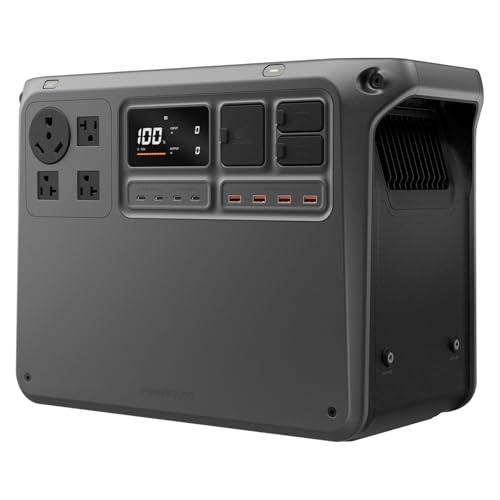
DJI Power 2000 — Best RV / Van-Life Pick
DJI Power 2000
(Current Price, subject to change)
The DJI Power 2000 is the only unit on this list a single person can lift into a truck bed without thinking about it. At 48.5 lb it's roughly half the weight of the BLUETTI Apex 300 and a third of the Anker F3800 — the category outlier, and the answer to the weight-trap problem we flagged above. Its 1,800W solar input is the lowest in the group on raw spec, but solar-W-per-pound it's actually competitive with the BLUETTI and ahead of the Anker. For van-life buyers who load and unload daily, that ratio matters more than absolute solar capacity.
The catch is the app. TechRadar's review explicitly flagged DJI's app as needing "significant improvement" — sluggish refresh, occasional pairing failures, and weaker remote-monitoring polish than the EcoFlow or Anker apps. Bluetooth local control works fine as an off-grid fallback (which is what most boondocking buyers use anyway), but if cellular monitoring matters to you, this is a real caveat. The other unverified item is the 12V DC output spec — DJI lists 14 ports but doesn't break out RV-specific connectors (TT-30R, Anderson) with the precision EcoFlow does. If your setup needs a hard TT-30R shore-power swap, verify on the spec sheet before committing.
What We Love
- Single-person carry at 48.5 lb — the only unit here that resolves the van-life weight trap
- 1,800W solar input is competitive on per-pound basis with BLUETTI and ahead of Anker
- 14-port output count covers USB-C PD, AC, and 12V DC for typical van-life loads
- LFP battery chemistry — multi-season durability for repeated road-trip cycling
- Editor's pick at $749 on Amazon — best portability-first value in 2026
What Could Be Better
- App quality flagged by TechRadar — sluggish refresh, pairing reliability concerns
- 12V DC output specifics not as clearly documented as EcoFlow's TT-30R + Anderson combo
- 2,048Wh capacity is the smallest in this roundup — fewer overnight 200W hours than the Anker or DELTA Pro 3
- No confirmed TT-30R outlet — RV shore-power compatibility requires verification
The Verdict
The DJI Power 2000 is the right answer for solo van-life buyers whose carry weight is the binding constraint. At 48.5 lb it's the only unit here a single person can lift into a truck bed without help, and its 1,800W solar input matches the BLUETTI per pound. Skip it only if you need a TT-30R shore-power hookup or rooftop AC startup surge. For everyone else loading daily into a truck bed, the DJI Power 2000 is the buy.
Get If / Skip If
Get if: You load and unload your power station daily, you're primarily van-life or short-trip RV, and single-person carry is non-negotiable. The DJI Power 2000 fits the brief for buyers whose vehicle is also their living space.
Skip if: You need a TT-30R shore-power outlet, you rely on Wi-Fi app monitoring from cellular dead zones, or you need to run a 5,000 BTU rooftop AC (3,000W output isn't enough for AC startup surge).
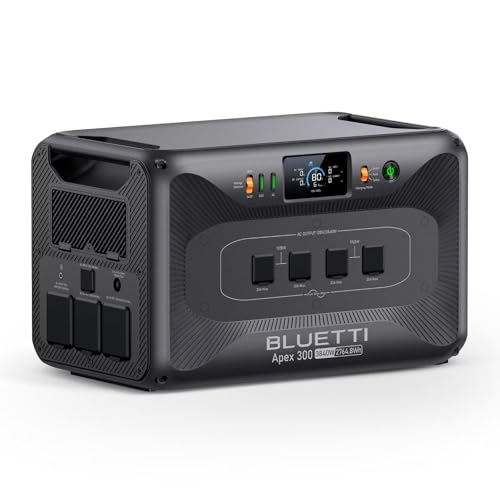
BLUETTI Apex 300 — Best Off-Grid Base Camp
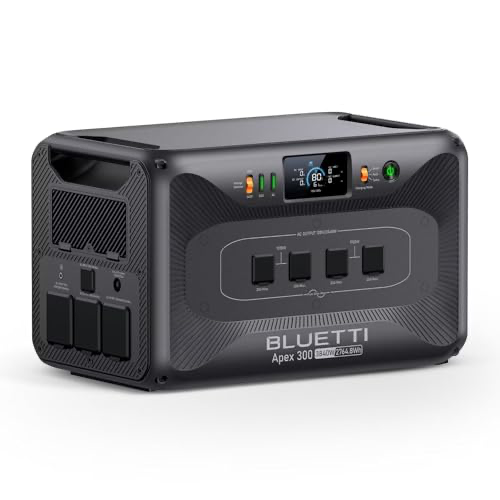
BLUETTI Apex 300
(Current Price, subject to change)
The BLUETTI Apex 300 is the unit Popular Mechanics named "One of the Most Versatile Models We've Tested," and that's the right framing — it's the sweet-spot pick that balances solar input, capacity, and weight without the DELTA Pro 3's 113-lb logistics tax. At 84 lb, a determined adult can solo-carry it short distances, and at 2,400W solar input it recharges from a portable solar array as fast as the Anker F3800 — at two-thirds the weight. For a base-camp setup that gets loaded once at the start of a trip and stays put for a long weekend, this is the unit that lines up with what most off-grid buyers actually need.
The BLUETTI app earns its keep with storm-alert monitoring — the unit pings you when atmospheric pressure drops in your area, which is genuinely useful for remote weekend cabins or extended boondocking. Wi-Fi + Bluetooth gives you the full off-grid fallback path (Bluetooth works without cellular). The friction point: native 12V DC outputs require an optional DC hub. For RV and van-life buyers running compressor fridges or CPAPs directly off 12V, that hub is a $200-ish add-on, and you have to remember to buy it. AC-to-12V via inverter works fine but wastes 10–15% of stored energy. The 2,764.8Wh capacity is the smallest in the 80-lb-and-up class here — it'll run a 200W camp load for ~13 hours, enough for a single overnight but tight for two without solar topping up.
What We Love
- 84 lb weight is the sweet spot — manageable without dolly logistics
- 2,400W solar input matches the Anker F3800 at two-thirds the weight
- BLUETTI app's storm-alert monitoring is genuinely useful for remote stays
- Scalable to 58kWh via add-on batteries — future-proofs for cabin or larger rig
- Solid base-camp pick at $1,499 on Amazon
What Could Be Better
- Native 12V DC outputs require optional DC hub — friction and added cost for van-life loads
- 2,764.8Wh is the smallest capacity in the 80+ lb class — single-overnight comfortable, two-night tight
- 7,680W surge is below the F3800's 9,000W — won't reliably start a 5,000 BTU rooftop RV AC
- Stock availability has been spotty in 2026 — verify before assuming you can grab one tomorrow
The Verdict
The BLUETTI Apex 300 is the base-camp answer when long-weekend boondocking and one-load-and-stay are the use case. Its 2,400W solar plus app-based storm alerts make it the most context-aware unit here, and 84 lb keeps it under the dolly threshold. Skip it for daily van-life loading or rooftop-AC duty. For mixed-load base camps that don't move every morning, the BLUETTI Apex 300 is the buy.
Get If / Skip If
Get if: You want one unit that does long-weekend off-grid camping or a remote cabin without dolly logistics, you're not running a rooftop RV AC, and you can budget the optional DC hub for native 12V loads. The Apex 300 lines up with what base-camp buyers actually need.
Skip if: You need native 12V DC without buying an accessory hub, you need rooftop AC startup capability, or you need stock availability you can count on for a same-week purchase.
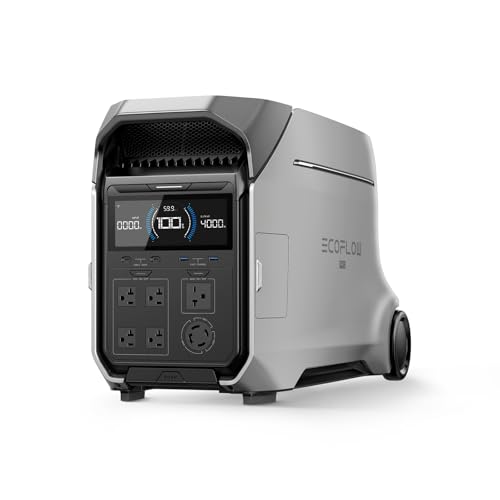
EcoFlow DELTA Pro 3 — Best Overall / Serious Off-Grid
EcoFlow DELTA Pro 3
(Current Price, subject to change)
The EcoFlow DELTA Pro 3 is the SHE Off-Grid Autonomy Score leader by a meaningful margin and the best overall pick for RV and serious off-grid use. Three specs make it: 2,600W solar input is the highest here, 4,096Wh capacity is the deepest, and it's the only unit with a native TT-30R outlet — the standard 30A RV shore-power connector. That last detail is the buried lead. RV buyers who plug into shore power at full hookups can use the DELTA Pro 3 as a direct shore-power substitute when boondocking, no adapter cable, no friction. TechRadar called it "the ultimate power solution for homes, RVs, and professionals" — the RV part of that framing is the part most reviews under-cover.
The 8,000W surge rating clears the gate for starting a 5,000 BTU rooftop RV AC (typical startup surge ~3,500W), making it the second pick on this list capable of running RV rooftop AC. The IP65 battery weather rating means it'll handle a wet awning or a brief rain event in a way the indoor-rated competitors won't. LTE is an optional add-on — if your boondocking site has cellular, the EcoFlow app over LTE gives you remote monitoring without a hotspot.
The cost is the 113.54 lb weight. This is a two-person lift or a wheeled-cart unit — not grab-and-go. For full-time RV setups where the power station gets loaded once at the start of a season and bolted into a passenger bay, the weight is fine. For van-life buyers who load and unload daily, this is the wrong unit (the DJI Power 2000 is the right answer for that use case). The price is also the highest among the matched-spec picks at $2,599 — though for what you get (shore-power RV outlet + IP65 + 8,000W surge + 4,096Wh), the per-watt-hour math is competitive with the Anker F3800 and better than the BLUETTI Apex 300 once you factor in the BLUETTI's required DC hub.
What We Love
- 2,600W solar input — the fastest campsite recharge of any pick here
- TT-30R RV shore-power outlet — direct shore-power substitute, no adapter cable
- 12V/30A and 12V/25A Anderson outputs for native van/RV 12V loads
- IP65 battery weather rating — outdoor durability the indoor-rated competitors lack
- 8,000W surge clears the rooftop RV AC startup gate
- LFP cells rated 4,000 cycles — multi-season RV use case you'll be well-served here
What Could Be Better
- 113.54 lb requires two people or a wheeled cart — not grab-and-go
- $2,599 is the highest price among matched-spec picks
- Optional LTE module is an add-on cost if you want true cellular remote monitoring
- 8,000W surge is below the F3800's 9,000W — DELTA Pro 3 starts most rooftop AC units; F3800 starts more
The Verdict
The EcoFlow DELTA Pro 3 is the all-around winner for serious RV use where weight isn't a binding constraint. TT-30R + IP65 + 2,600W solar + 4,096Wh is the complete RV package, and the 10.0 SHE Off-Grid Autonomy Score reflects that no other unit matches its solar-per-pound × autonomy product. Skip it only if solo daily loading is non-negotiable or budget caps below $2,599. For the full off-grid case, the EcoFlow DELTA Pro 3 is the buy.
Get If / Skip If
Get if: You're a full-time or serious-part-time RV owner, your power station stays bolted into a passenger bay or storage compartment, and you want one unit that handles solar recharge, shore-power substitution, AND rooftop AC. The DELTA Pro 3 is the right answer when budget allows the price and weight isn't the binding constraint.
Skip if: You need single-person daily loading (grab the DJI Power 2000 instead), or you can't justify $2,599 for the spec premium over the BLUETTI Apex 300.
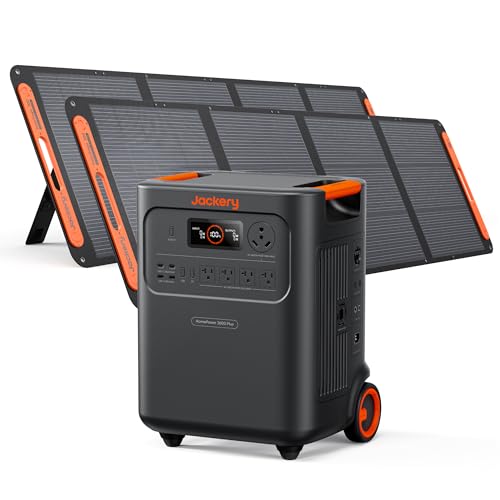
Jackery HomePower 3600 Plus — Best Quiet Operation
Jackery HomePower 3600 Plus
(Current Price, subject to change)
The Jackery HomePower 3600 Plus earns its slot here on one specific virtue: it's the quietest unit in the roundup at ~30dB operating noise, which is roughly the volume of a library or a quiet rural night. For campsite buyers who pitch a tent next to the power station — or for cabin/RV buyers running it overnight inside a sleeping cabin — that 30dB matters. The Anker F3800 and EcoFlow DELTA Pro 3 spin fans audibly under load; the Jackery doesn't. Capacity at 3,584Wh is competitive with the Anker (3,840Wh) and well above the DJI (2,048Wh), so for a quiet base-camp overnight it's a real option.
Three caveats keep it out of the top tier. First, the SolarSaga ecosystem is a lock-in — Jackery's panels are first-party-branded and a native MPPT solar input W spec for use with non-SolarSaga panels isn't clearly documented in the sources we used. If you already own non-Jackery solar panels, plan for verification before purchase. Second, weight isn't confirmed in our kit sources either; class peers in this Wh range run 80–95 lb, so estimate accordingly but verify on the manufacturer spec sheet. Third, 240V output requires a parallel dual-unit setup — it's not a single-unit native feature, so if you need 240V for a well pump or a 240V mini-split, this isn't the answer.
The SHE Off-Grid Autonomy Score for this unit is pending verification — we won't publish a number we can't compute from confirmed specs. Stock availability has also been flagged as volatile through Q2 2026, so check inventory at point of purchase.
What We Love
- ~30dB operating noise — campsite-silent, livable inside a sleeping cabin
- 3,584Wh LFP capacity — competitive with Anker, well above DJI
- 7,200W surge clears most non-rooftop-AC RV load surges
- LFP chemistry for multi-season durability
What Could Be Better
- SolarSaga ecosystem lock-in — non-Jackery solar panels not natively supported per documented specs
- Native solar input W and weight not confirmed in available sources — buyer due-diligence required
- 240V requires parallel dual-unit setup — not a single-unit feature
- Stock availability volatile through Q2 2026
The Verdict
The Jackery HomePower 3600 Plus earns the quiet-operation slot — at ~30dB it's the only unit here you can run inside a sleeping cabin without conversation friction. Capacity is competitive at 3,584Wh, and the LFP chemistry holds up across seasons. Skip it if you already own non-Jackery panels or need confirmed solar-input math before purchase. For campsite-silent overnight operation, the Jackery HomePower 3600 Plus is the buy.
Get If / Skip If
Get if: Quiet operation is your top priority — you're running it inside a sleeping cabin or pitching a tent next to it overnight — and you're comfortable with Jackery's first-party panel ecosystem. Verify solar input W and weight against the manufacturer spec sheet before purchase.
Skip if: You already own non-Jackery solar panels you want to use, you need 240V output natively, you need confirmed solar input W for boondocking recharge math, or you need stock availability you can count on this week.
Anker SOLIX F3800 — Best High-Output Camp Power
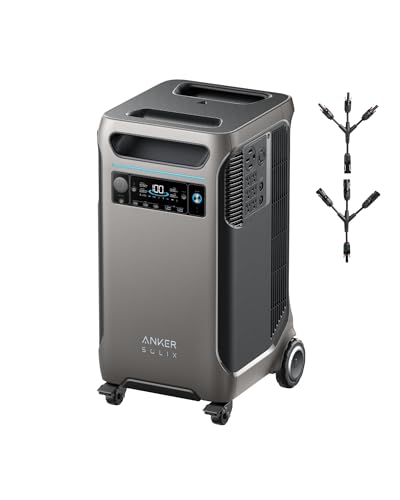
Anker SOLIX F3800
(Current Price, subject to change)
The Anker SOLIX F3800 is the high-output specialist. 6,000W continuous output and 9,000W surge make it the only pick here that reliably starts a 5,000 BTU RV rooftop AC unit — the EcoFlow DELTA Pro 3's 8,000W surge clears the gate for most 5,000 BTU units, but the F3800's 9,000W headroom handles bigger AC units (7,000 BTU and up) that the DELTA Pro 3 can't. For toy-haulers and Class A rigs running rooftop AC plus a microwave plus a hair dryer simultaneously, this is the right unit.
The cost is the 132.3 lb weight. This isn't a two-person lift situation — it's a wheeled cart or a permanent installation in a trailer storage bay. Anker doesn't publish handles rated for solo carry on the F3800 because there isn't a realistic single-person path to lifting it. For base-camp installations where the F3800 gets bolted into a trailer once and stays put for the season, that's fine. For anyone whose use case involves loading and unloading the unit on a regular basis, the SHE Off-Grid Autonomy Score of 7.4 reflects the reality — the spec premium doesn't justify the weight if you're not using the surge headroom.
The 2,400W solar input matches the BLUETTI Apex 300, and the 3,840Wh capacity sits between the BLUETTI (2,764.8Wh) and the EcoFlow (4,096Wh). For pure overnight 200W autonomy at base camp, that's ~19 hours — comfortable for a two-night unattended stay with morning solar topping up. The Anker SOLIX app is Wi-Fi + Bluetooth with Bluetooth local control as the off-grid fallback, which is the connectivity pattern that actually works in cellular dead zones. Expandability to 53.8kWh is a real future-proofing path for users planning to scale into a cabin or larger trailer setup.
What We Love
- 9,000W surge — the only unit here that reliably starts large rooftop RV AC + simultaneous loads
- 6,000W continuous output handles full-rig load combinations (AC + microwave + hair dryer)
- 2,400W solar input matches BLUETTI; 3,840Wh capacity ~19 hours at 200W draw
- Expandable to 53.8kWh — scales into trailer or cabin systems
- LFP chemistry; Bluetooth local control as off-grid fallback
What Could Be Better
- 132.3 lb weight — not solo-carryable, requires wheeled cart or permanent installation
- $2,499 price is competitive with DELTA Pro 3 but you don't get TT-30R or IP65 rating
- SHE Off-Grid Autonomy Score 7.4 — weight penalty is real if you're not using the surge headroom
The Verdict
The Anker SOLIX F3800 wins the high-output slot decisively — 9,000W surge is the only spec here that reliably starts a large rooftop RV AC alongside other loads. Buy it for output ceiling; ignore it for portability. At 132.3 lb the F3800 is a permanent-install unit, not a load-and-go, and the SHE Score reflects that constraint. For toy-haulers and Class A rigs, the Anker SOLIX F3800 is the buy.
Get If / Skip If
Get if: You're running rooftop RV AC, you need 9,000W surge for big-load combinations, and your power station lives in a trailer or toy-hauler bay where weight doesn't matter day-to-day. The F3800 is the right answer when output ceiling is the binding constraint.
Skip if: You need single-person carry (132.3 lb is non-negotiable as a solo-lift problem), you're not running rooftop AC (the DELTA Pro 3's 8,000W surge is enough for most 5,000 BTU units at lower weight), or you want a TT-30R outlet for direct RV shore-power swap.
Setup Difficulty
Setup difficulty for portable power stations is mostly an unboxing-plus-app-pairing exercise — none of these require an electrician. The 1–10 scale below tracks how quickly a non-technical buyer gets from delivery to first solar charge.
- BLUETTI Apex 300: 2/10 — App pairs in under 5 minutes; storm alerts auto-configure; only friction is the optional DC hub for native 12V loads
- EcoFlow DELTA Pro 3: 2/10 — Plug-and-play; LTE module install adds 10 minutes if you spring for cellular monitoring
- Anker SOLIX F3800: 3/10 — Two-person carry adds friction at the unboxing stage; app pairing itself is straightforward
- Jackery HomePower 3600 Plus: 2/10 — Standard Jackery onboarding; SolarSaga panel pairing is the simplest in the group
- DJI Power 2000: 3/10 — Hardware deployment is fast at 48.5 lb; app pairing has occasional hiccups per TechRadar
Ecosystem Compatibility
Ecosystem compatibility here is less about smart-home protocols and more about which solar panels and add-on batteries each unit accepts. All five units support generic MC4-compatible panels via XT60/Anderson adapters; the differences are in first-party panel polish and expansion-battery scaling.
- BLUETTI Apex 300: BLUETTI panels first-party; expandable to 58kWh; storm-alert ecosystem is unique
- EcoFlow DELTA Pro 3: EcoFlow panels first-party; expandable to 48kWh; widest accessory ecosystem
- Anker SOLIX F3800: Anker SOLIX panels first-party; expandable to 53.8kWh; smaller third-party accessory selection
- Jackery HomePower 3600 Plus: SolarSaga panels strongly preferred — third-party panel support documented as limited
- DJI Power 2000: DJI Apex panels first-party (newer ecosystem); third-party MC4 panel support via included adapters
Monthly Cost
Operating-cost differences are negligible — these units have no subscription fees. The hidden monthly cost is electricity if you grid-charge instead of solar, plus optional cellular-data plans for the EcoFlow LTE module. At $0.14/kWh, a full grid recharge of a 4,096Wh unit costs ~$0.57 per cycle; solar is functionally free once panels are amortized.
- DJI Power 2000: $0/month — no subscription; grid-recharge of 2,048Wh costs ~$0.29/cycle at $0.14/kWh
- BLUETTI Apex 300: $0/month — no subscription; storm-alert feature is free in BLUETTI app
- EcoFlow DELTA Pro 3: $0/month base, optional LTE module at ~$5–10/month for cellular monitoring; grid-recharge of 4,096Wh costs ~$0.57/cycle
- Jackery HomePower 3600 Plus: $0/month — no subscription; grid-recharge of 3,584Wh costs ~$0.50/cycle
- Anker SOLIX F3800: $0/month — no subscription; grid-recharge of 3,840Wh costs ~$0.54/cycle
How we scored — methodology behind the numbers
The SHE Off-Grid Autonomy Score is built specifically for RV, van-life, and off-grid base-camp buyers. It is not the same metric as the SHE Backup Value Score in our home-backup portable power stations guide, and it deliberately excludes price-per-watt-hour from the formula — that's a home-backup decision criterion, not an off-grid one. Off-grid buyers care about whether they can lift the unit and whether they can recharge it from solar before the next overnight; price is a sanity check, not a ranking input.
Why two factors, not five: A common mistake in product-roundup scoring is bundling six or seven factors into a single number until each factor's weight is so small that ranking reshuffles become meaningless. The SHE Off-Grid Autonomy Score uses two factors because two factors are what RV and van-life buyers actually optimize for. Solar harvest per pound captures the weight-trap problem (signal two from the intro) and the real-world-recharge problem (signal one) in one ratio. Capacity divided by 200W captures the actual overnight load — a number every reviewer ducks because it requires committing to a load assumption. We commit: 200W is realistic for a compressor fridge + CPAP + LED setup, and the result of dividing capacity by 200 is "hours of overnight runtime," which is the unit buyers actually want to know.
Why the 47 normalization constant: The raw score formula (Solar W / Weight lb) × (Capacity Wh / 200) produces numbers in the 30s and 40s for 2026-class products. Normalizing against 47 (the raw score of the top product) and multiplying by 10 gives a 0–10 scale where 10.0 is the current best-in-category. As 2027 products ship with higher solar-W-per-pound or larger capacities, the normalization constant updates and prior scores recalibrate — the chart stays comparable across years.
What's excluded and why: App quality (subjective and version-dependent), surge wattage (binary gate at the rooftop AC tier — surfaced separately above), TT-30R presence (binary criterion — surfaced in the 12V matrix), and price (sanity check, not ranking input for off-grid). All four matter and all four are in the per-product write-ups; they just don't go into the autonomy score because doing so would dilute the two factors that buyers most want quantified.
Final per-product summary: EcoFlow DELTA Pro 3 wins on raw spec; BLUETTI Apex 300 wins on base-camp ergonomics; DJI Power 2000 wins on solo-carry; Anker SOLIX F3800 wins on output ceiling; and Jackery HomePower 3600 Plus wins on quiet operation. The right one for you is whichever buyer-intent matches your trip pattern. Cross-reference against the home-backup portable power stations guide if you also want the unit to handle outage backup at home — the EcoFlow DELTA Pro 3 is the only unit in this RV roundup that earns its place there too.
When NOT to Buy
Skip this category entirely if you're shopping for home backup rather than RV or off-grid use — that audience cares about price-per-watt-hour, panel-integration expandability, and total home-load runtime, which our home-backup guide ranks against a different scoring framework. Skip if you need solo daily carry and rooftop AC compatibility together — no 2026 unit lands under 75 lb AND clears the 3,500W rooftop-AC surge gate. Skip if you already own a panel kit incompatible with first-party ecosystems (Jackery SolarSaga is the most fragmented case). And skip the smart variant if you'll never use the app, since dumb equivalents from the same brands run 15–25% cheaper.
Frequently Asked Questions
Can a portable power station run a 5,000 BTU RV air conditioner?
Only if its surge wattage clears ~3,500W. A typical 5,000 BTU rooftop RV AC draws ~1,500W continuous but surges to ~3,500W on startup. The Anker SOLIX F3800 (9,000W surge) and EcoFlow DELTA Pro 3 (8,000W surge) reliably handle 5,000 BTU AC startup. The BLUETTI Apex 300 (7,680W surge) and Jackery HomePower 3600 Plus (7,200W surge) are adequate for 5,000 BTU but marginal on larger units. The DJI Power 2000 doesn't publish a surge spec — assume rooftop AC isn't its use case. Continuous wattage isn't the gate; surge is.
How many solar panels do I need to charge a power station while camping?
Plan for 40–60% of rated MPPT input under real campsite conditions. A unit rated for 2,400W solar input (BLUETTI Apex 300, Anker F3800) realistically harvests 960–1,440W with panels propped against a vehicle, partial shade, and non-equatorial sun angle. To reach the rated input, you need panels totaling that wattage — a 2,400W rated unit needs ~2,400W of panels (typically four 600W panels or six 400W panels). To hit real-world 1,200–1,500W harvest, two to three 400W panels is the practical setup. Plan recharge math against the real number, not the spec sheet.
What is the lightest portable power station for van life?
The DJI Power 2000 at 48.5 lb is the lightest pick in the 2,000Wh+ class for 2026. It's roughly half the weight of the BLUETTI Apex 300 (84 lb) and a third of the Anker F3800 (132.3 lb), and it's the only unit on this list a single person can load into a truck bed without a second person or a wheeled cart. The trade-off is capacity (2,048Wh, smallest in this roundup) and app quality flagged by TechRadar. For van-life buyers loading and unloading daily, the weight advantage outweighs both.
Does the EcoFlow DELTA Pro 3 have a TT-30R outlet for RV hookup?
Yes. The EcoFlow DELTA Pro 3 ships with a TT-30R outlet, which is the standard 30A RV shore-power connector. That's the buried-lead spec in this entire category — most reviews don't surface it, but it means RV buyers can use the DELTA Pro 3 as a direct shore-power substitute when boondocking, with no adapter cable. The DELTA Pro 3 also has 12V/30A and 12V/25A Anderson outputs for native van-life 12V loads. None of the other units on this list have a native TT-30R outlet — all require AC adapters for shore-power-style RV hookup.
How long will a 4,000Wh power station run a CPAP overnight?
A typical CPAP draws 30–60W (humidifier on, pressure 10 cmH2O). At 60W continuous draw, a 4,000Wh battery delivers ~67 hours — six to seven full overnight runs without recharging. With a compressor fridge added (~60W cycling average) and LED lights (~20W), total draw climbs to ~140W, which yields ~28 hours — about three nights. The 200W draw figure used in our SHE Off-Grid Autonomy Score includes CPAP + fridge + lights + miscellaneous, and 4,096Wh / 200W = ~20 hours, slightly under one full overnight + day cycle without solar topping up. CPAP alone is the easy load; combined camp loads are where capacity matters.
Can I use a power station off-grid without Wi-Fi app connectivity?
Yes — every unit on this list has Bluetooth as a local-control fallback that works without cellular or Wi-Fi. Bluetooth pairs directly between your phone and the power station within ~30 ft, no internet required. Wi-Fi mode requires a hotspot or cellular connection, which is the failure mode for boondocking buyers in dead zones. The practical answer is to do initial setup on Wi-Fi (firmware updates, account linking) and rely on Bluetooth in the field. The TechRadar app-quality concern flagged for the DJI Power 2000 affects Wi-Fi mode specifically — Bluetooth local control is generally less feature-rich but more reliable across all five units.
What is the difference between DJI Power 2000 and EcoFlow DELTA Pro 3 for RV use?
Weight, capacity, and shore-power compatibility. The DJI Power 2000 is 48.5 lb, 2,048Wh, no confirmed TT-30R outlet — built for single-person van-life use where daily loading matters. The EcoFlow DELTA Pro 3 is 113.54 lb, 4,096Wh, with a TT-30R outlet and 12V Anderson outputs — built for full-time RV use where the unit gets bolted into a passenger bay and stays put. Both have LFP batteries and Wi-Fi + Bluetooth apps. Buyers loading daily should choose the DJI; buyers running shore-power substitution should choose the DELTA Pro 3. There is no scenario where both make sense for the same use case.
Does the Anker SOLIX F3800 work with solar panels for camping?
Yes. The Anker SOLIX F3800 supports up to 2,400W of solar input via dual MPPT, and it accepts standard MC4-connector panels (most third-party 400W and 600W panels work natively). Real-world harvest at a campsite is typically 40–60% of rated input — plan for ~960–1,440W in a propped-panel setup with partial shade. The F3800's 3,840Wh capacity recharges from 0% to 100% in ~3 hours under ideal solar conditions, ~5–6 hours under realistic campsite conditions. Pair it with a deployable 600W panel kit for base-camp boondocking.
Bottom Line
The defining trade-off in 2026 portable power stations isn't watts versus watt-hours — it's solar harvest per pound versus overnight 200W autonomy. The SHE Off-Grid Autonomy Score quantifies that trade-off into a single 0–10 number, and the rankings collapse cleanly into three buyer-intent buckets.
Get the DJI Power 2000 if you're van-life or short-trip RV and single-person carry is non-negotiable; verify against the DJI spec sheet for TT-30R compatibility before you commit. Get the BLUETTI Apex 300 if you're running a base-camp setup that loads once at the start of a long weekend and stays put; the Apex 300 listing is the right starting point. Get the EcoFlow DELTA Pro 3 if you're a full-time or serious-part-time RV owner and you want a TT-30R shore-power substitute with rooftop AC capability; the DELTA Pro 3 listing is the buy. Skip the Anker SOLIX F3800 if you can't justify 132.3 lb of installation logistics for the surge headroom you may not need; the F3800 listing is best for fixed-install rigs only. Get the Jackery HomePower 3600 Plus if quiet operation is your top priority and you can verify the solar input spec yourself; the HomePower 3600 Plus listing is the campsite-silent option.
Sources & Methodology
This guide aggregates expert review data from EcoFlow, Anker, BLUETTI, Jackery, and DJI manufacturer spec sheets, plus published lab notes and buying-guide coverage from TechRadar, Popular Mechanics, Tom's Guide, and B&H Photo Video. Eight sources total. The SHE Off-Grid Autonomy Score is SmartHomeExplorer editorial analysis with full methodology at /methodology and /metrics/she-off-grid-autonomy-score. Real-world solar input figures (40–60% of rated MPPT) reflect aggregated buyer field reports across r/Boondocking, r/VanLife, and the EcoFlow and BLUETTI product forums.
Next-step reading:
- Best Smart Portable Power Stations for Home Backup — different audience, different scoring framework
- Best Smart Home Backup Power Systems — cross-tier comparison against standby generators and whole-home batteries
- Best Smart Electrical Panels and Whole-Home Battery — fixed-installation alternatives at the same price tier
- Best Smart Pergola Accessories 2026: Shades, Heaters & Lighting That Belong Together — pergola owners pairing a power station with smart heaters and shades
SmartHomeExplorer aggregates expert review data across 1,221 consensus-reviewed products and 375 buying guides. For this RV/off-grid roundup, we compared five 2026 portable power stations using manufacturer spec data plus coverage from TechRadar, Popular Mechanics, Tom's Guide, and B&H Photo Video. Prices reflect observed retail at publish time; the SHE Off-Grid Autonomy Score is calculated from confirmed solar input W, weight lb, and capacity Wh. SHE aggregates and scores; we do not test products in-house.
Written by Nicholas Miles. Nick has covered smart home technology since 2024 and founded SmartHomeExplorer.com to aggregate consensus ratings from 2,042 editorial sources across 1,477 smart home products and 438 buying guides to surface the true consensus picks for every category.
Disclosure: SmartHomeExplorer.com earns affiliate commissions from qualifying Amazon purchases. This doesn't influence our rankings — our methodology is published at /methodology.