

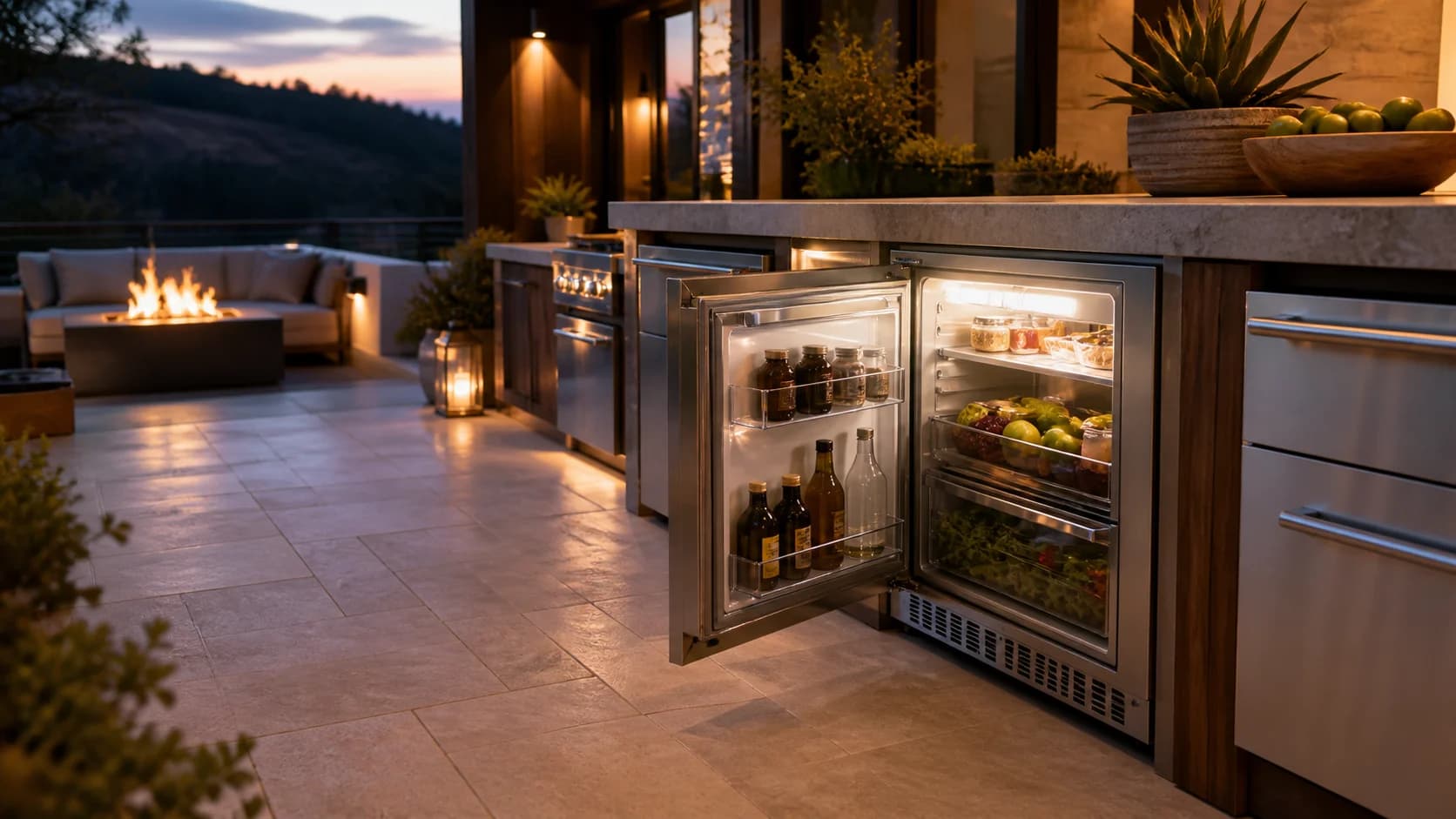
Best Smart Portable Outdoor Fridges & Coolers 2026
The EcoFlow GLACIER Classic tops our SHE Portable Cooler Value Score; the Euhomy 59QT wins capacity-per-dollar and the Anker EverFrost 2 leads off-grid battery autonomy. Six 2026 models, live prices, one value lens.
This article contains affiliate links. We may earn a commission at no extra cost to you. Prices change frequently — check the current price on Amazon before buying. Learn more
The Short Answer
The EcoFlow GLACIER Classic 45L ($899) tops our SHE Portable Cooler Value Score on monitoring depth and charging flexibility. For the most cold space per dollar, the Euhomy 59QT ($259.99) is the value floor; for genuine off-grid runtime, the battery-equipped Anker EverFrost 2 is manufacturer-rated up to 52 hours.
Featured in this Guide
EcoFlow
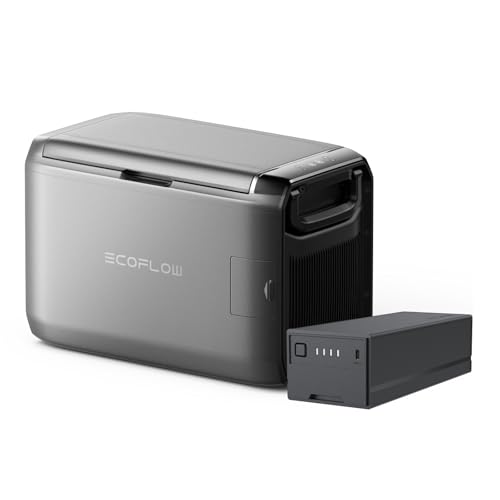
GLACIER Classic 45L
- •Tops the value composite on remote Wi-Fi monitoring and the widest charging-input matrix here
Anker
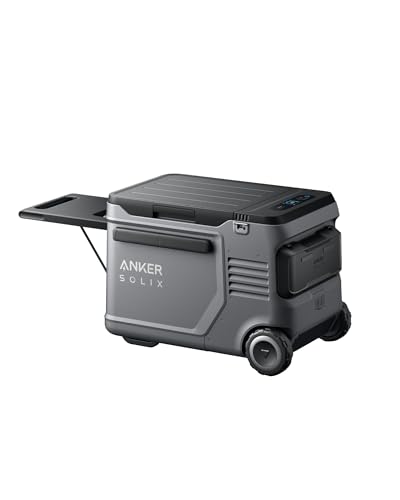
SOLIX EverFrost 2 40L
- •288Wh built-in pack expands to 576Wh, rated for multi-night stand-alone runtime
Euhomy
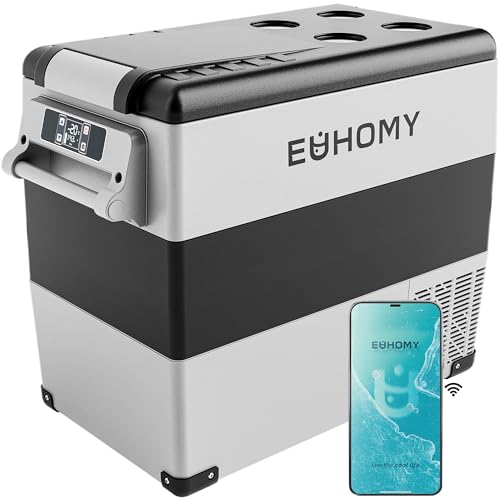
59QT
- •59-quart rated capacity at the lowest price, lightest box at 28.7 lb
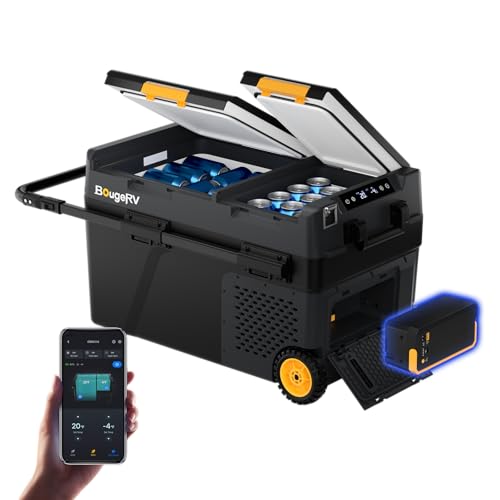
BougeRV
CRD2 V2.0 43QT
- •Independent fridge and freezer zones plus a 240Wh battery for under $550
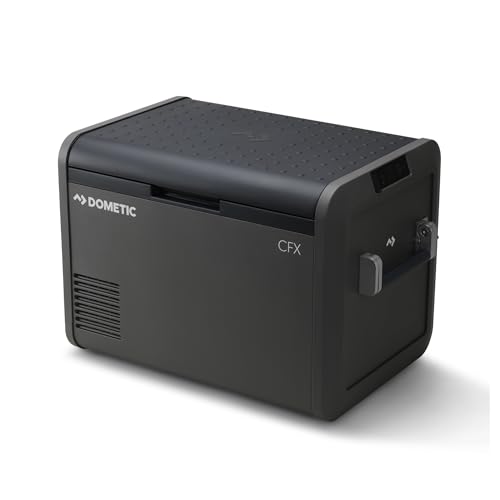
Dometic
CFX5 55IM
- •Only unit here with a built-in ice maker
- •55-liter box, 5-year warranty
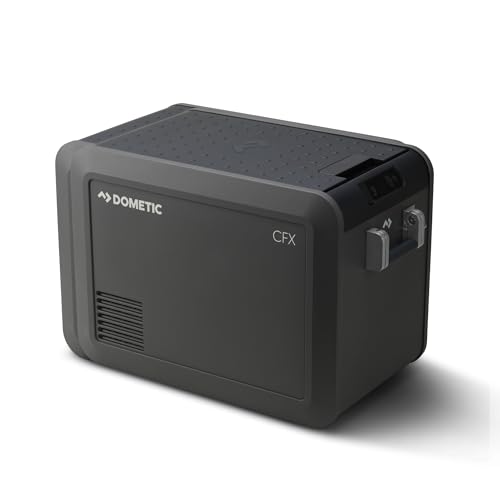
Dometic
CFX5 45
- •Dual-voltage 12V/24V input and a 5-year compressor warranty for power-station owners
Head-to-Head: Value, Autonomy, Monitoring, and Inputs
Outdoor
Chart
 Smarthomeexplorer.com
Tap any pick to check its live price on Amazon.
Samsung NV51K7770DG 30" Smart Double Wall Oven with Flex Duo and Steam Cook
Check price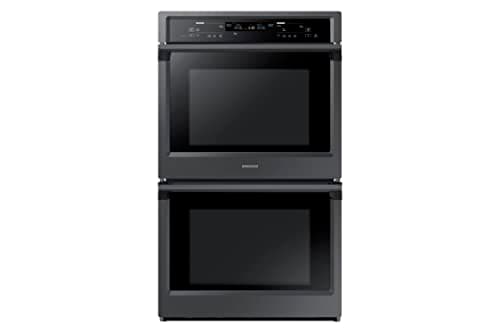
Samsung NV51K6650DG 30" Smart Double Wall Oven with Steam Cook and Wi-Fi
Check price
Hauslane PRO500 36-inch Smart Range Hood
Check price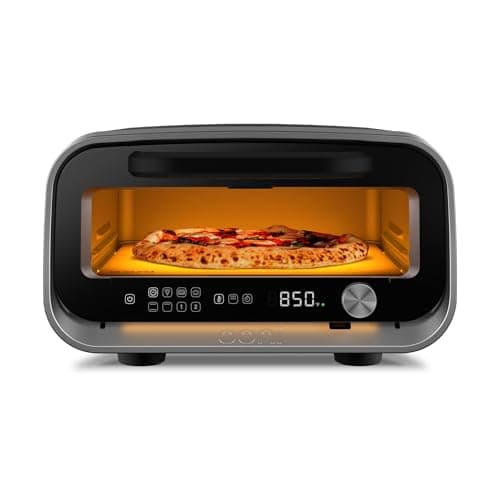
Ooni Volt 2
Check price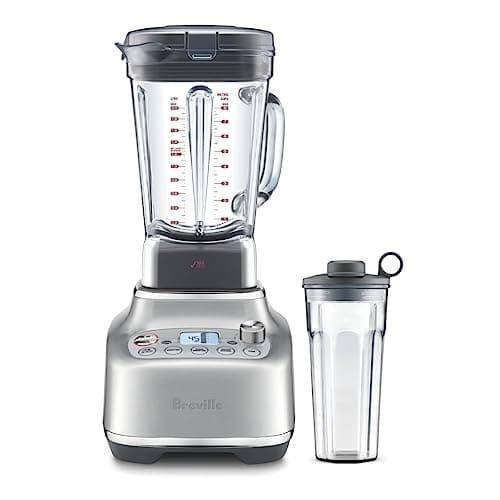
Breville Super Q
Check price
What Decides a Portable Smart Fridge in 2026
A portable smart fridge is not a cooler with an app sticker — it is a compressor box whose real value lives in four numbers you can check: cold space per dollar, built-in battery autonomy, monitoring depth, and how many ways it charges. So our weighted SHE Portable Cooler Value Score puts all four on one normalized 0-to-10 scale, which in practice means the cheapest box does not automatically win and the priciest does not automatically lose. OutdoorGearLab, Popular Mechanics, The Verge, WIRED, and T3 all cover this category, yet none publishes a normalized value composite across the six 2026 models we evaluated. We verified every price in June 2026: the 28.7 lb Euhomy anchors capacity-per-dollar, while the battery-equipped Anker is rated up to 52 hours on its built-in pack (104 hours with a second module) and carries an autonomy factor no external-power Dometic with its 5-year warranty can match.
Top SHE Value Score: EcoFlow GLACIER Classic 45L
EcoFlow GLACIER Classic 45L
- 298Wh built-in battery with documented remote Wi-Fi monitoring
- Built-in 298Wh battery rates below the Anker on stand-alone hours
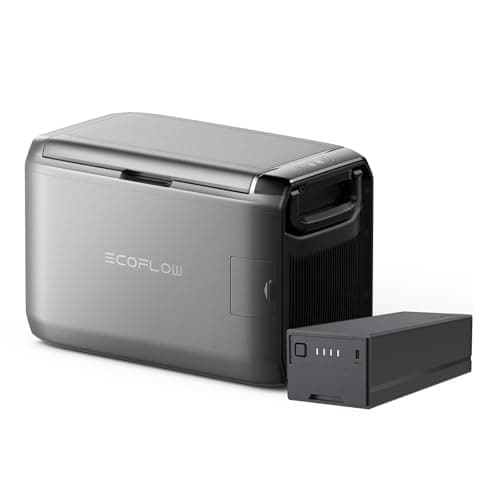
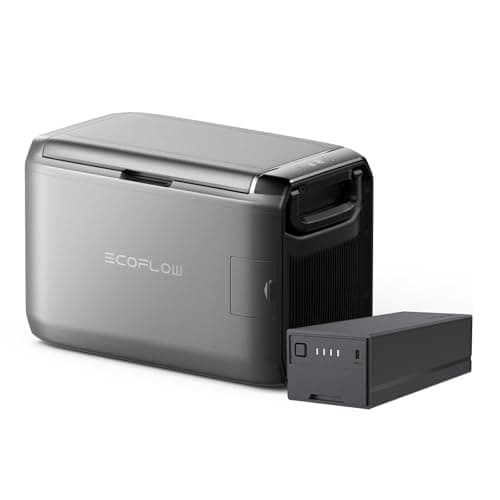
Start here if your trips are vehicle-based and you want oversight of the fridge from across the campground. The EcoFlow GLACIER Classic pairs a 298Wh built-in battery with the deepest monitoring in this roundup — remote Wi-Fi control and temperature visibility rather than the Bluetooth-only baseline the Dometic units provide. The Verge covers this fridge-cooler category, though we report only the manufacturer's documented specifications and our own composite, not a transcribed verdict.
Three facts carry it: a charging matrix spanning AC, 12V, solar, USB-C, and alternator inputs; native integration with EcoFlow DELTA and RIVER power stations; and remote oversight that enables intervention before a freezer section climbs. The built-in pack is rated around 39 hours of stand-alone runtime — meaningful, though comparatively short of the Anker's 52 hours on its built-in battery, and real-world figures fall below the maximum marketing claim. For an EcoFlow-ecosystem buyer who prioritizes monitoring depth and charging flexibility over the lowest price, this configuration delivers the most rounded result in our evaluation.
What We Love
- 298Wh built-in battery with documented remote Wi-Fi monitoring
- Widest charging matrix here — AC, 12V, USB-C, solar, and alternator
- Tops our SHE Portable Cooler Value Score
- Native pairing with EcoFlow DELTA and RIVER power stations
What Could Be Better
- Built-in 298Wh battery rates below the Anker on stand-alone hours
- Alternator charging is locked to EcoFlow's own ecosystem
- Premium price keeps its capacity-per-dollar low in our value score
The Verdict
If you want eyes on the fridge from across the campground and you already lean on EcoFlow power gear, the EcoFlow GLACIER Classic 45L tops our SHE Portable Cooler Value Score on monitoring depth and charging flexibility — you'll be well-served here.
Best off-grid battery: Anker SOLIX EverFrost 2 40L
Anker SOLIX EverFrost 2 40L
- 288Wh built-in LFP battery, expandable to 576Wh — the only doubling option here
- Heaviest unit here at 50.71 lb — the battery adds roughly 10 lb of carry
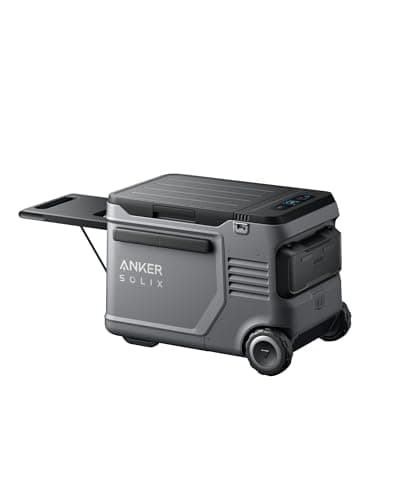
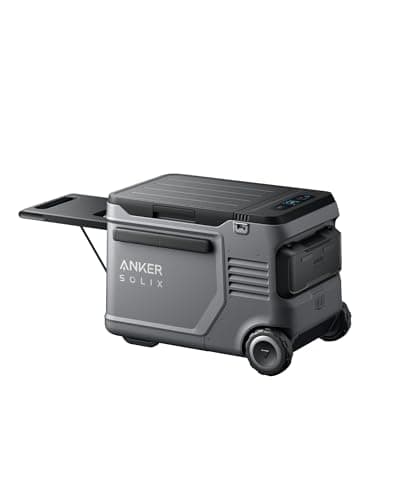
For off-grid trips where dragging a separate power station is exactly the friction you want gone, the Anker SOLIX EverFrost 2 is the one unit here that resolves it. Its 288Wh LFP battery is the only pack that expands — a second module roughly doubles it (2x) to 576Wh — and Anker rates the solo pack up to 52 hours and that two-battery configuration up to 104 hours of multi-night autonomy. The Verge covers this category; we cite the documented battery and input specifications rather than a transcribed score.
The trade is carry weight: at 50.71 lb it is the heaviest box in this roundup, roughly 10 lb beyond the 40.35 lb Dometic CFX5 45, because the integrated battery adds mass. A 100W solar input feeds the unit directly, so daytime harvest tops the pack without a power-station detour. Compared to the EcoFlow you give up remote temperature history; relative to the Dometic units, you gain genuine stand-alone runtime. For overlanding and boondocking where self-contained operation is the priority, the autonomy advantage produces the decisive edge.
What We Love
- 288Wh built-in LFP battery, expandable to 576Wh — the only doubling option here
- Manufacturer-rated up to 52 hours stand-alone (104 hours with a second pack)
- 100W solar input feeds the unit directly
- Broad input matrix: AC, 12V, USB-C, and solar
What Could Be Better
- Heaviest unit here at 50.71 lb — the battery adds roughly 10 lb of carry
- Multi-night autonomy needs a second battery pack bought separately
- App lacks the remote temperature history the EcoFlow ships
The Verdict
If your off-grid trips make dragging a separate power station the friction you want gone, the Anker SOLIX EverFrost 2 40L fits the brief — its built-in battery is the only one here rated for multi-night autonomy on its own.
Best capacity-per-dollar: Euhomy 59QT
Euhomy 59QT
- Best capacity-per-dollar in the roundup at $259.99
- No built-in battery — off-grid use needs a separate power station
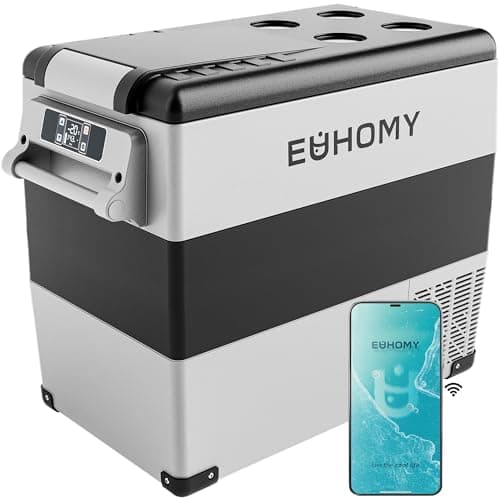
For buyers who simply want the most cold space per dollar, the Euhomy 59QT is the value floor — and the SHE Portable Cooler Value Score reflects that directly, since capacity-per-dollar is the heaviest factor. At $259.99 it undercuts every other unit in this roundup, returning about 2.8x the liters per dollar of the next-cheapest BougeRV and roughly 4.3x that of the premium EcoFlow, and its 59-quart rated capacity is the largest here. OutdoorGearLab covers this portable-cooler category, though we report category coverage and manufacturer specifications rather than a transcribed score.
At 28.7 lb it is also the lightest box here, which makes single-person loading easier than the heavier battery units. The honest trade-offs: there is no built-in battery, so off-grid use depends entirely on a separate power station or a vehicle 12V circuit; cooling pedigree and warranty trail the premium Dometic units; and the app handles basic monitoring without remote alerts. Compared to those premium boxes, you trade test pedigree for raw capacity. For moderate-ambient tailgating and weekend camping where you plug into a vehicle anyway, it delivers the capacity-per-dollar win.
What We Love
- Best capacity-per-dollar in the roundup at $259.99
- Lightest unit here at 28.7 lb
- Accepts AC, 12V, and 24V DC for RV and truck use
- 59-quart rated capacity for the lowest price
What Could Be Better
- No built-in battery — off-grid use needs a separate power station
- Cooling pedigree and warranty trail the premium units
- App is basic monitoring, no remote alerts
The Verdict
For buyers who want the most cold space per dollar and plug into a vehicle or AC anyway, the Euhomy 59QT is the value floor — no need to overthink it.
Best budget dual-zone: BougeRV CRD2 V2.0 43QT
BougeRV CRD2 V2.0 43QT
- True dual-zone — independent fridge and freezer set-points
- 240Wh battery autonomy trails the Anker substantially
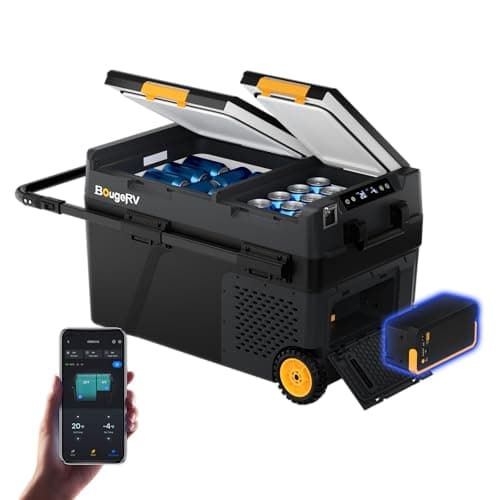
If you specifically need independent fridge and freezer zones and your ceiling is near $550, the BougeRV CRD2 V2.0 is the budget answer — the cheapest unit here with a built-in battery. Its 240Wh pack is rated for roughly 30 hours of short-trip autonomy, enough for an overnight without a power station, though it trails the Anker's rated 52 hours substantially. T3 and The Verge cover this category; we report category coverage and the manufacturer specifications rather than transcribing a specific verdict.
Control runs over short-range Bluetooth, so there is no remote check from the campfire, and the app polish sits below the EcoFlow tier. Versus the premium units, you give up monitoring depth and stand-alone hours; relative to the Euhomy, you gain a battery and true dual-zone control. At 41.9 lb it is mid-pack on weight in this roundup. For a budget buyer who treats simultaneous fridge-and-freezer operation as non-negotiable, it delivers the dual-zone result for the least money, at $539.99.
What We Love
- True dual-zone — independent fridge and freezer set-points
- 240Wh built-in battery for short-trip stand-alone use
- Cheapest unit here with a built-in battery
- AC, 12V, and solar inputs cover the standard charging matrix
What Could Be Better
- 240Wh battery autonomy trails the Anker substantially
- Bluetooth control only — campsite range, no remote check
- App polish sits below the EcoFlow tier
The Verdict
If independent fridge and freezer set-points are non-negotiable and your ceiling is around $550, the BougeRV CRD2 V2.0 43QT is the sensible pick for that setup, battery included.
Best with ice maker: Dometic CFX5 55IM
Dometic CFX5 55IM
- Only unit here with a built-in ice maker
- No built-in battery — pair it with a power station or vehicle 12V
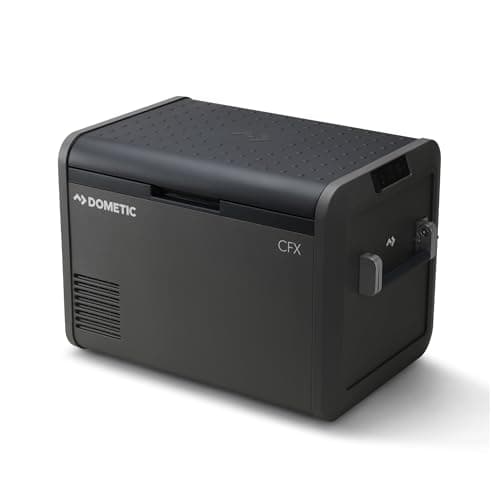
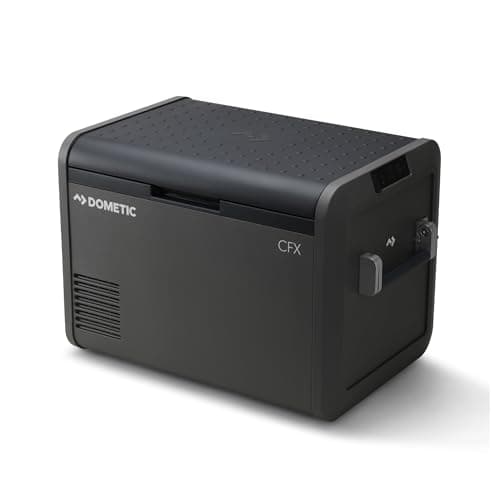
When the morning ice run is the recurring tax on your beach camps, boat galleys, and tailgates, the Dometic CFX5 55IM earns its slot on one feature no rival here matches: a built-in ice maker. WIRED covers this outdoor-cooler category; we cite that coverage and Dometic's published specifications, not a transcribed verdict.
The 55-liter rated capacity is the working maximum for two-person multi-night loads, and the cooling hardware mirrors the CFX5 45 — the same compressor architecture and 3-stage low-voltage battery protection. A 5-year compressor warranty backs it. The honest caveats keep it low in our value score: there is no built-in battery, so it needs an external power station or a vehicle 12V circuit; the app is Bluetooth-only and short-range, with no remote temperature history; and at 44.5 lb it is the heaviest Dometic here. Compared to the CFX5 45, its $959.99 price — the highest in this roundup — buys the integrated ice maker and the larger box. For ice-on-demand campers who already carry power, it checks the right boxes.
What We Love
- Only unit here with a built-in ice maker
- 55-liter rated capacity for two-person multi-night loads
- Same Dometic CFX5 cooling hardware as the CFX5 45
- 5-year compressor warranty
What Could Be Better
- No built-in battery — pair it with a power station or vehicle 12V
- Bluetooth-only app, no remote temperature history
- Heaviest Dometic here at 44.5 lb
The Verdict
When morning ice runs are the recurring tax on your beach camps and tailgates, the Dometic CFX5 55IM checks the boxes that matter for ice-on-demand — it is the only unit here with a built-in ice maker.
Best cooling pedigree: Dometic CFX5 45
Dometic CFX5 45
- Dual-voltage 12V and 24V DC input for cars and larger rigs
- No built-in battery for stand-alone runtime
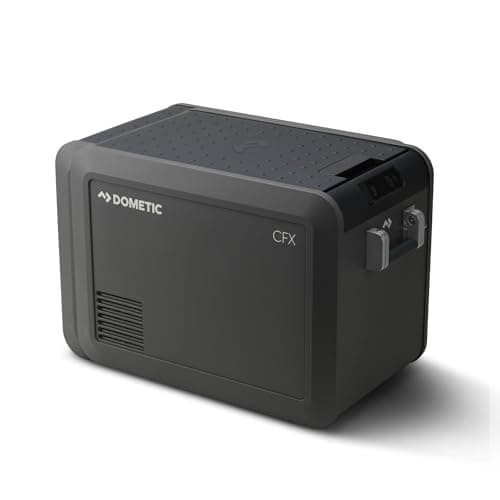
If you already run a power station or a vehicle 12V circuit and you weight warranty and build over a built-in battery, the Dometic CFX5 45 is the steady pick. Its case rests on documented hardware rather than a test score: a dual-voltage 12V and 24V DC input that handles both passenger cars and larger rigs, 3-stage low-voltage battery protection that disconnects before it drains a starter battery, and a 5-year compressor warranty.
OutdoorGearLab and Popular Mechanics both cover the portable-fridge category; we report only that coverage and Dometic's specifications, since we do not transcribe outlet verdicts. The honest limits are why it lands last in our value score: there is no built-in battery for stand-alone runtime, the app is Bluetooth-only and short-range, and at 40.35 lb the $839.99 premium price buys cooling pedigree rather than features the value lens prices in. Versus the battery units, it needs external power. For a power-station owner who values longevity, it yields a dependable result.
What We Love
- Dual-voltage 12V and 24V DC input for cars and larger rigs
- 3-stage low-voltage battery protection for safe vehicle 12V use
- 5-year compressor warranty
- 40.35 lb, solo-carryable
What Could Be Better
- No built-in battery for stand-alone runtime
- Bluetooth-only monitoring — campsite range, not remote
- Premium price lands it last in our value score
The Verdict
If you already run a power station and you value a long warranty over a built-in battery, the Dometic CFX5 45 is the path of least friction — dual-voltage input and a 5-year compressor warranty carry it.
How We Score: SHE Portable Cooler Value Score
SHE Portable Cooler Value Score
Score Formula
(Capacity-per-Dollar Value × 0.35) + (Off-Grid Autonomy × 0.25) + (Smart Monitoring Depth × 0.20) + (Power-Input Flexibility × 0.20)Score Factors
- Capacity-per-Dollar Value (35%)Rated capacity in liters divided by the live verified price, normalized across the slate. This is the heaviest factor because cold space per dollar is the number most roundups bury. The Euhomy 59QT leads decisively at $259.99, returning about 2.8x the liters per dollar of the next-cheapest BougeRV and roughly 4.3x that of the premium EcoFlow; the priced-up Dometic and EcoFlow units sit at the bottom of this factor.
- Off-Grid Autonomy (25%)Built-in battery capacity in watt-hours plus expandability, normalized across the slate; a unit that needs an external power station floors here. The Anker EverFrost 2 leads on a 288Wh pack that expands to 576Wh, the EcoFlow GLACIER follows on 298Wh, and the BougeRV trails on 240Wh.
- Smart Monitoring Depth (20%)App reach and the depth of remote control and temperature history, normalized across the slate. The EcoFlow GLACIER leads on remote Wi-Fi monitoring; the Anker app follows; the Bluetooth-only Dometic units sit lowest because they reach only across the campsite.
- Power-Input Flexibility (20%)The count of documented charging inputs — AC, 12V DC, 24V DC, USB-C, solar, alternator — normalized across the slate. The EcoFlow GLACIER leads with five input types; the Anker carries four; the Dometic and Euhomy units accept three.
SHE Portable Cooler Value Score — Ranked
EcoFlow GLACIER Classic 45L
SHE Portable Cooler Value Score6.8/10$899.00 — tops the composite on remote Wi-Fi monitoring and a five-input charging matrix; premium price caps its value factor
Anker SOLIX EverFrost 2 40L
SHE Portable Cooler Value Score6.5/10$649.00 — 288Wh battery expands to 576Wh, the autonomy leader; heaviest box here at 50.71 lb

Euhomy 59QT
SHE Portable Cooler Value Score6.0/10$259.99 — best capacity-per-dollar by a wide margin and lightest at 28.7 lb; no battery and basic app hold the composite back

BougeRV CRD2 V2.0 43QT
SHE Portable Cooler Value Score5.4/10$539.99 — cheapest battery-equipped dual-zone unit; 240Wh autonomy and Bluetooth-only control sit below the leaders
Dometic CFX5 55IM
SHE Portable Cooler Value Score3.3/10$959.99 — the only built-in ice maker and a 5-year warranty, but no battery and a premium price land it low on value
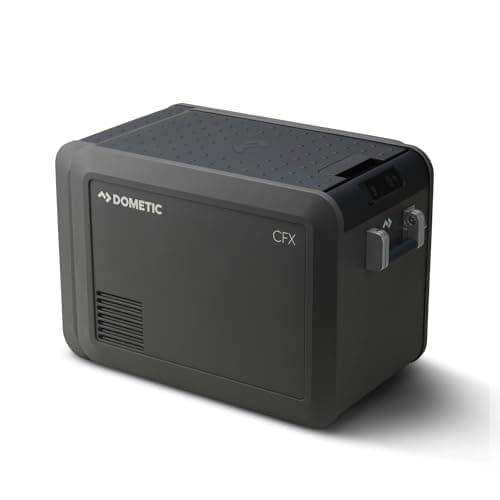
Dometic CFX5 45
SHE Portable Cooler Value Score3.2/10$839.99 — dual-voltage input and a 5-year compressor warranty; no battery, Bluetooth-only, and premium pricing place it last on value
Power Ecosystem and Feature Fit
Portable fridges are not Matter or Thread devices, so the practical compatibility question is power, not protocol: which charging inputs each box accepts and whether it carries its own battery. The matrix below maps the features that move the SHE Portable Cooler Value Score — a built-in battery, a direct solar input, remote Wi-Fi monitoring, true dual-zone control, and Dometic's 5-year warranty tier.
Only the EcoFlow GLACIER Classic 45L offers remote Wi-Fi oversight; the Anker SOLIX EverFrost 2 40L (with a 100W solar input) and the BougeRV CRD2 V2.0 43QT carry built-in batteries but monitor over Bluetooth; the Dometic CFX5 45, Dometic CFX5 55IM, and Euhomy 59QT depend on an external power source. The Bluetooth-only Dometic units are short-range, so monitoring is a campsite-range affair rather than remote oversight. If the duty cycle is fishing trips, the bow-mount sonar bundles in our Best Smart Trolling Motors with Fish-Finder Bundles (2026) roundup are the other half of the same rigging bill.
Reading the SHE Portable Cooler Value Score back against that table explains the order. Because the weighted formula normalized every factor onto a single 0-to-10 scale, the connected EcoFlow GLACIER tops the composite even though its capacity-per-dollar coefficient is the lowest here — its monitoring factor and input factor carry it. The Euhomy posts the slate's best capacity-per-dollar coefficient yet lands mid-pack, because the autonomy factor and the monitoring factor it scores low on weigh into the same composite. That normalized, multi-factor calculation produces a defensible cross-tier comparison rather than rewarding a single headline number; a premium box can hold a strong tier on cooling pedigree and still post a modest composite under this value-weighted formula.
| Product | Built-in Battery | Direct Solar Input | Remote Wi-Fi | Dual-Zone | 5-Year Warranty |
|---|---|---|---|---|---|
| EcoFlow GLACIER Classic 45L | ✓ | ✓ | ✓ | ✓ | ✕ |
| Anker SOLIX EverFrost 2 40L | ✓ | ✓ | ✕ | ✕ | ✕ |
| Euhomy 59QT | ✕ | ✕ | ✕ | ✕ | ✕ |
| BougeRV CRD2 V2.0 43QT | ✓ | ✓ | ✕ | ✓ | ✕ |
| Dometic CFX5 55IM | ✕ | ✕ | ✕ | ✕ | ✓ |
| Dometic CFX5 45 | ✕ | ✕ | ✕ | ✕ | ✓ |
When NOT to Buy
Skip this whole category if your need is afternoon-picnic cooling — a foam cooler with bagged ice does that without a $200-plus outlay. Skip it if you have constant grid power and a chest freezer already covers home storage. Skip the smart layer entirely if you will never open the app, since plain compressor fridges from the same brands run cheaper. And if your real off-grid stretch is multi-week without solar, marine refrigeration or a vehicle-wired chest freezer is the right tool, not a portable box.
Who Should Buy What
Who Should Buy What
| If you are… | Recommended pick |
|---|---|
EcoFlow-ecosystem buyer You already run EcoFlow power gear and want remote Wi-Fi monitoring plus the widest charging-input matrix in the roundup | EcoFlow GLACIER Classic 45L |
Off-grid overlander You camp away from power and want a self-contained box rated for multi-night runtime without towing a separate power station | Anker SOLIX EverFrost 2 40L |
Capacity-per-dollar shopper You want the most cold space per dollar and you plug into a vehicle 12V circuit or an AC outlet anyway | Euhomy 59QT |
Budget dual-zone camper You need independent fridge and freezer zones, your ceiling is near $550, and short-trip battery runtime is enough | BougeRV CRD2 V2.0 43QT |
Ice-on-demand tailgater Ice availability is your binding constraint on beach camps, boats, or tailgates and you can pair the fridge with external power | Dometic CFX5 55IM |
Power-station owner You already carry a power station and you value a long compressor warranty and dual-voltage input over a built-in battery | Dometic CFX5 45 |
Frequently Asked Questions
How long can a smart portable fridge run on battery?
It depends on the unit and the load. Built-in-battery models range from a BougeRV CRD2 V2.0 rated for roughly 30 hours on its 240Wh pack up to the Anker EverFrost 2, manufacturer-rated up to 52 hours on its 288Wh battery and up to 104 hours with a second pack installed. The Dometic CFX5 and Euhomy units carry no built-in battery, so their runtime depends entirely on the external power station or vehicle circuit you pair them with. In every case, real-world runtime falls well below the maximum marketing claim once you account for ambient heat, warm-food loading, and sun exposure, so plan against the conservative number.
What's the difference between a compressor and a thermoelectric portable fridge?
A compressor fridge uses a refrigerant cycle and can hold a true freezer set-point regardless of how hot it is outside, while a thermoelectric cooler can only pull a fixed number of degrees below ambient and fades in real heat. Every unit in this roundup is a compressor model, which is the right call for any use case where ambient temperature can climb — truck beds, beach camps, summer tailgates. The trade-off is that compressor units draw real power and cost more than a thermoelectric box.
What is the SHE Portable Cooler Value Score?
It is our proprietary 0-to-10 composite that weights four computable factors: capacity-per-dollar at 35 percent, off-grid autonomy at 25 percent, smart-monitoring depth at 20 percent, and power-input flexibility at 20 percent. Each factor is normalized across the six 2026 models and combined with those weights. We built it to surface value that the usual headline specs hide, which is why a $259.99 Euhomy and a $899 EcoFlow can land close together: the EcoFlow earns its place on monitoring and inputs, the Euhomy on raw capacity-per-dollar.
Is a dual-zone portable fridge worth the extra cost?
It is worth it if you genuinely want to run a freezer side and a fridge side at the same time — hard-frozen items on one zone, chilled drinks on the other. The BougeRV CRD2 V2.0 is the budget dual-zone pick here. If all you need is cold drinks and food at one temperature, a single-zone unit like the Euhomy 59QT is cheaper and draws less power for the same total volume, so paying the dual-zone premium would be wasted.
Can I run a portable fridge overnight on a vehicle's 12V circuit?
Yes, but only safely if the fridge has low-voltage battery protection. The Dometic CFX5 45 and CFX5 55IM include a 3-stage low-voltage cutoff that disconnects the fridge before it drains the starter battery to a no-start state. Without that protection, a compressor fridge on a vehicle 12V circuit can flatten the battery overnight. If your unit lacks a low-voltage cutoff, run it from a separate power station instead of the circuit you also need to start the engine.
Which fridge tops the SHE Portable Cooler Value Score, and why isn't it the cheapest?
The EcoFlow GLACIER Classic 45L tops the composite at the top of our ranking, even though it is far from the cheapest unit. Capacity-per-dollar is only one of four weighted factors; the EcoFlow wins two of the others outright — remote Wi-Fi monitoring and a five-input charging matrix — and scores strongly on off-grid autonomy from its 298Wh battery (though the Anker edges it on that factor), enough to top the composite. The Euhomy 59QT wins capacity-per-dollar outright but lands third overall because it has no battery and only a basic app. The value score rewards the most rounded unit, not simply the lowest price.
Bottom Line
Get the EcoFlow GLACIER Classic 45L if you want remote Wi-Fi monitoring and the widest charging matrix, and you already run EcoFlow power gear.
Get the Anker SOLIX EverFrost 2 40L if you camp off-grid and want a self-contained box rated for multi-night runtime without an external power station.
Get the Euhomy 59QT if you want the most cold space per dollar and you plug into a vehicle or AC outlet anyway.
Get the BougeRV CRD2 V2.0 43QT if you need independent fridge and freezer zones with a budget ceiling near $550.
Get the Dometic CFX5 55IM if ice availability is your binding constraint on beach camps, boats, or tailgates.
Get the Dometic CFX5 45 if you already carry a power station and you value a long warranty and dual-voltage input over a built-in battery.
The most rounded pick is the EcoFlow GLACIER Classic 45L ($899), which tops our SHE Portable Cooler Value Score on monitoring and charging inputs. For pure value, the Euhomy 59QT ($259.99) returns the most cold space per dollar, and the Anker SOLIX EverFrost 2 40L ($649) is the off-grid autonomy pick. Skip the category entirely if your need is afternoon-picnic cooling, you have constant grid power, or your off-grid stretch runs multi-week without solar — a foam cooler or marine refrigeration is the right tool there.
Sources & Methodology
Methodology: SHE Portable Cooler Value Score — Formula: (Capacity-per-Dollar Value × 0.35) + (Off-Grid Autonomy × 0.25) + (Smart Monitoring Depth × 0.20) + (Power-Input Flexibility × 0.20). Factors: Capacity-per-Dollar Value (35%): Rated capacity in liters divided by the live verified price, normalized across the slate. This is the heaviest factor because cold space per dollar is the number most roundups bury. The Euhomy 59QT leads decisively at $259.99, returning about 2.8x the liters per dollar of the next-cheapest BougeRV and roughly 4.3x that of the premium EcoFlow; the priced-up Dometic and EcoFlow units sit at the bottom of this factor. | Off-Grid Autonomy (25%): Built-in battery capacity in watt-hours plus expandability, normalized across the slate; a unit that needs an external power station floors here. The Anker EverFrost 2 leads on a 288Wh pack that expands to 576Wh, the EcoFlow GLACIER follows on 298Wh, and the BougeRV trails on 240Wh. | Smart Monitoring Depth (20%): App reach and the depth of remote control and temperature history, normalized across the slate. The EcoFlow GLACIER leads on remote Wi-Fi monitoring; the Anker app follows; the Bluetooth-only Dometic units sit lowest because they reach only across the campsite. | Power-Input Flexibility (20%): The count of documented charging inputs — AC, 12V DC, 24V DC, USB-C, solar, alternator — normalized across the slate. The EcoFlow GLACIER leads with five input types; the Anker carries four; the Dometic and Euhomy units accept three.
Expert review sources used in this analysis:
- SmartHomeExplorer aggregates expert review coverage and verified manufacturer specifications to produce consensus-based buying guidance
- We do not perform first-party product testing
- Expert coverage for this category comes from OutdoorGearLab, Popular Mechanics, The Verge, WIRED, and T3, all of which review portable 12V fridges and coolers; manufacturer specifications come from EcoFlow, Anker SOLIX, Euhomy, BougeRV, and Dometic
- Mainstream coverage of these exact 2026 models is uneven, so we report only what we can verify — who covers the category plus each manufacturer's published specs — and we do not transcribe outlet scores or verdicts; the rankings here rest on the SHE Portable Cooler Value Score and documented specifications
- Amazon prices and availability were verified live on 2026-06-26, and the deal-window prices captured during Prime Day were MSRP-corrected on 2026-06-28 after they reverted post-event; the Capacity-per-Dollar factor and composites were recomputed accordingly
- Manufacturer-rated battery runtimes are maximum claims; real-world figures run lower with ambient heat and warm-food loading.
Nicholas Miles is the founder of SmartHomeExplorer and a longtime smart home enthusiast focused on helping everyday homeowners make better technology decisions. He researches, compares, and writes about products across security, climate, lighting, leak prevention, sensors, home energy, and automation, with an emphasis on real-world usefulness, ecosystem compatibility, reliability, privacy, and long-term value.
Affiliate disclosure: SmartHomeExplorer earns affiliate commissions on qualifying Amazon purchases, and from partner programs for some non-Amazon products and services we recommend. Our scoring methodology is independent of affiliate relationships.
More Guides
Energy
Best Portable Power Stations for RV & Off-Grid 2026
Energy
Best Smart Portable Power Stations for Home Backup 2026

outdoor
Best Outdoor Misting Fans 2026: Shark FlexBreeze

Outdoor
The Complete Smart Patio Cooling & Heat-Wave Setup (2026)

Outdoor
The Complete Smart Outdoor Entertaining Setup (2026)
Outdoor