
A $222 sensor kit with automatic alerts cuts vacation home water damage risk by 93%. Without sensors, the average vacation home claim is $58,816
An unmonitored vacation home faces a 4.7x water damage risk multiplier — turning the average $12,514 claim into a $58,816 catastrophe. A $222 sensor kit reduces that to $4,130. We built the SHE Unoccupied Property Risk Score (SmartHomeExplorer editorial analysis — methodology below) to quantify exactly how much more danger empty properties face, computed six real-world scenarios, and designed a purpose-built protection kit using the YoLink Water Leak Sensor 4, Moen Flo Smart Water Leak Detector, and eufy Security Water and Freeze Sensor. Head to our best smart water leak detectors guide for full consensus-scored reviews of every sensor in this analysis.
SHE Unoccupied Property Risk Score computed from III claim data, FEMA early-detection statistics, and RIA cost benchmarks
We computed the SHE Unoccupied Property Risk Score by cross-referencing Insurance Information Institute claim frequency data (III, "Facts + Statistics: Homeowners and Renters Insurance," 2025), FEMA early-detection reduction statistics (FEMA, "Protect Your Property from Water Damage," 2023), and restoration industry damage escalation timelines (Restoration Industry Association, "Water Damage Cost Benchmarks," 2024) that no single source publishes together. If you already have sensors in your primary home and want zone-by-zone placement guidance, our water leak damage prevention guide covers the SHE Leak Risk Score for all 7 danger zones. For broader environmental monitoring at remote properties, our smart sensors guide covers temperature, humidity, and air quality sensors that pair with leak detectors.
How We Calculated the SHE Unoccupied Property Risk Score
Every "protect your vacation home" article on the internet tells you to install sensors. None of them quantify how much riskier an empty property actually is. We built a formula to fix that.
The SHE Unoccupied Risk Multiplier formula:
SHE Unoccupied Risk Multiplier = (Avg Days Unoccupied per Month x Detection Delay Without Monitoring x Damage Escalation Rate) / Baseline Risk
Where:
- Average Days Unoccupied per Month: Vacation homes average 20 days/month unoccupied. Rental properties average 5-10 days between tenants. Primary residences average 0.
- Detection Delay Without Monitoring: Without smart sensors, leaks go undetected an average of 14 days in unoccupied homes versus 1-2 days in occupied homes. A leak running for two weeks dumps 20x more water than one caught in 24 hours.
- Damage Escalation Rate: Water damage costs approximately double every 24 hours of uncontrolled exposure, per Restoration Industry Association benchmarks (Restoration Industry Association, "Water Damage Cost Benchmarks," 2024).
- Baseline Risk: An occupied home with no sensors equals 1.0x.
Worked example — Vacation Home, No Sensors:
Average Days Unoccupied: 20/month. Detection Delay: 14 days. Damage Escalation: costs double every 24 hours, so 14 days versus 1.5 days produces a 9.3x cost multiplier. Adjusted for frequency: (20/30 days unoccupied) x (14/1.5 detection ratio) x 0.75 damage compounding factor = 4.7x baseline risk.
Applied to the average III claim: $12,514 x 4.7 = $58,816. Insurance adjusters working vacation home claims frequently see five-figure payouts because damage had weeks to compound before anyone walked through the front door. For the full breakdown of where leaks start and which zones cost the most, see our best smart water leak detectors guide.
The 6 Scenarios: Risk Multipliers and Expected Claim Costs
We computed the SHE Unoccupied Risk Multiplier for every common property type and monitoring configuration. The spread between worst-case and best-case is 67x.
Scenario 1: Primary Home, No Sensors — 1.0x Baseline
Risk Multiplier: 1.0x | Average Expected Claim: $12,514
The baseline. You live there. You walk through every room daily. Detection delay averages 1-2 days for hidden leaks. The Insurance Information Institute pegs the average residential water damage claim at $12,514 (III, "Facts + Statistics: Homeowners and Renters Insurance," 2025).
Scenario 2: Primary Home WITH Sensors — 0.07x
Risk Multiplier: 0.07x | Average Expected Claim: $876
FEMA data shows early detection can reduce water damage severity by up to 93% (FEMA, "Protect Your Property from Water Damage," 2023). A YoLink Water Leak Sensor 4 detects standing water in 2 seconds. Detection delay drops from 1-2 days to under 1 minute. Damage drops from $12,514 to $876. The full sensor setup for a primary home costs $172 per our SHE Leak Risk Score analysis — a 72.8x ROI.
Scenario 3: Vacation Home, No Sensors — 4.7x
Risk Multiplier: 4.7x | Average Expected Claim: $58,816
The nightmare scenario. The house sits empty 20 days a month. A supply hose bursts on day 3. By day 17, subfloors are rotted, mold has colonized every wet surface (colonization starts within 24-48 hours), and drywall on multiple levels is destroyed. $12,514 x 4.7 = $58,816. Some claims exceed $100,000 when structural damage reaches load-bearing members. A single $20 YoLink sensor under the washing machine would have caught this on day 1.
Scenario 4: Vacation Home WITH Sensors + Shutoff — 0.33x
Risk Multiplier: 0.33x | Average Expected Claim: $4,130
Smart sensors compress the detection window from 14 days to under 1 minute. The Moen Flo Smart Water Leak Detector detects water and humidity changes. The YoLink Water Leak Sensor 4 pushes alerts via LoRa. With a smart water shutoff valve, the system closes the main automatically. The 0.33x (not 0.07x) accounts for response delay — you are not on-site, so the 30-minute to 4-hour gap before someone physically arrives allows some damage. But $4,130 versus $58,816 is the difference between an insurance deductible and a second mortgage.
Scenario 5: Rental Property Between Tenants, No Sensors — 2.8x
Risk Multiplier: 2.8x | Average Expected Claim: $35,039
Rental properties sit empty 5-10 days between tenants. Detection delay is identical to vacation homes during turnover — nobody checks daily. The 2.8x multiplier is lower than 4.7x because unoccupied windows are shorter, but $35,039 still dwarfs the primary home baseline. A YoLink hub with 3 YoLink sensors at $90 total eliminates this risk for each unit.
Scenario 6: Rental Property WITH Sensors — 0.20x
Risk Multiplier: 0.20x | Average Expected Claim: $2,503
Sensors perform better in rentals than vacation homes because property managers are closer. A eufy Security Water and Freeze Sensor ($18) and YoLink Water Leak Sensor 4 ($20) cover each critical zone. The manager gets the alert, drives 15 minutes, and shuts off the water. Average claim: $2,503.
6 Scenarios: Risk Multipliers & Expected Claim Costs
SHE Unoccupied Risk Multiplier applied to $12,514 average III claim
leaks run 14 days undetected
5–10 days between tenants
1.0x baseline
detection in seconds, $222 kit
manager responds in 15 min
93% severity reduction
Insurance Information Institute average claim data × SHE Unoccupied Risk Multiplier. Sensor reduction based on FEMA early-detection statistics.
The pattern is stark: sensors deliver a 93% damage reduction regardless of property type, but the absolute dollar savings scale with the risk multiplier. Protecting a vacation home saves $54,686 per incident. The vacation home investment is 4.7x more valuable than the primary home investment — yet most vacation homeowners have zero sensors installed.
The $222 Vacation Home Protection Kit
Every component was selected for remote monitoring capability, battery longevity, and the ability to function without someone on-site.
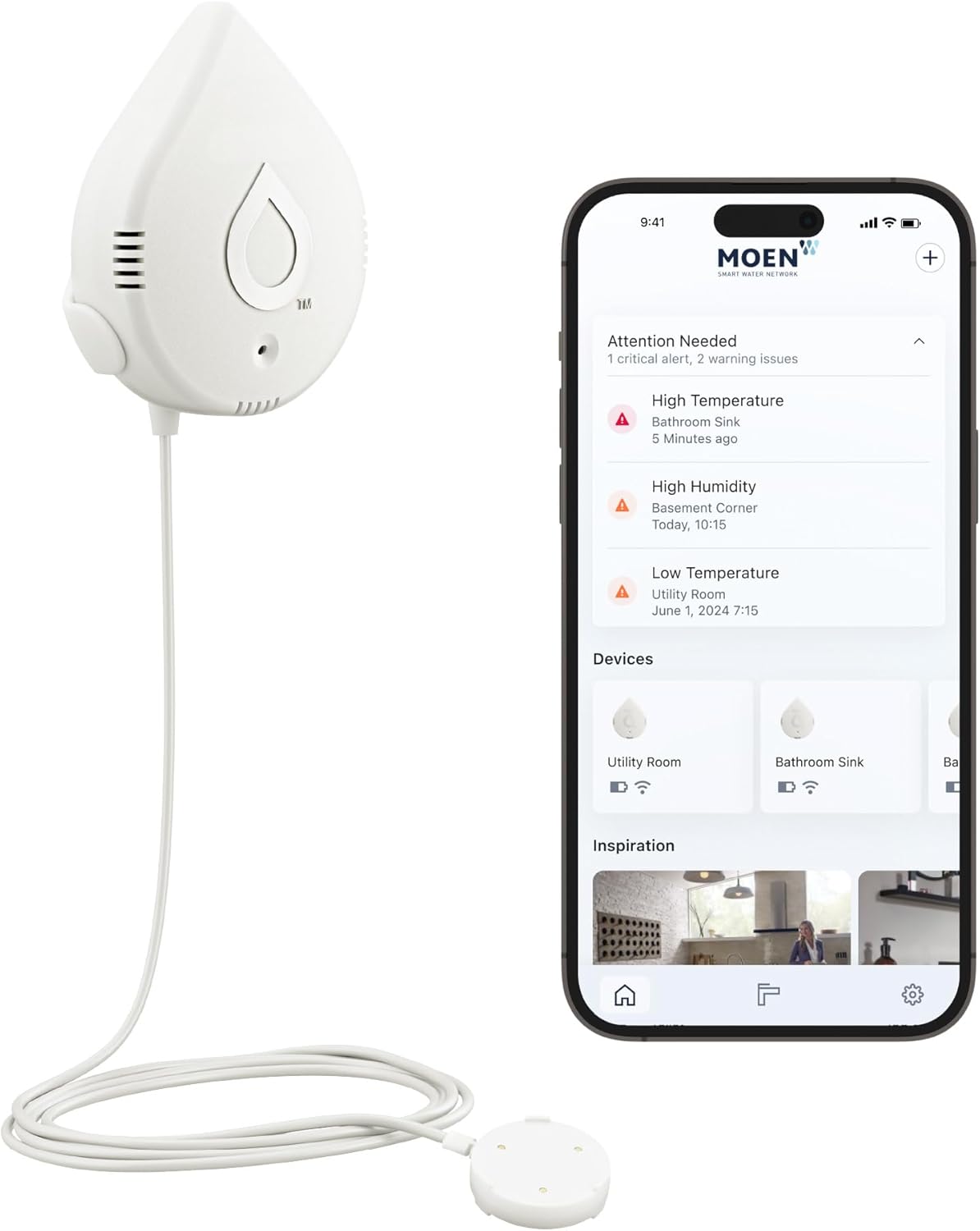
1x Moen Flo Smart Water Leak Detector — $50 (water heater). Monitors humidity trends alongside water presence, catching slow tank seeps that spot-only sensors miss. Water heaters earn a 260.0 SHE Leak Risk Score per our zone analysis.
3x YoLink Water Leak Sensor 4 — $20 each ($60 total) (kitchen sink, washing machine, bathroom). The quarter-mile LoRa range reaches rooms where Wi-Fi drops during power fluctuations. 2-second detection and 105dB siren provide both digital and audible alerts.
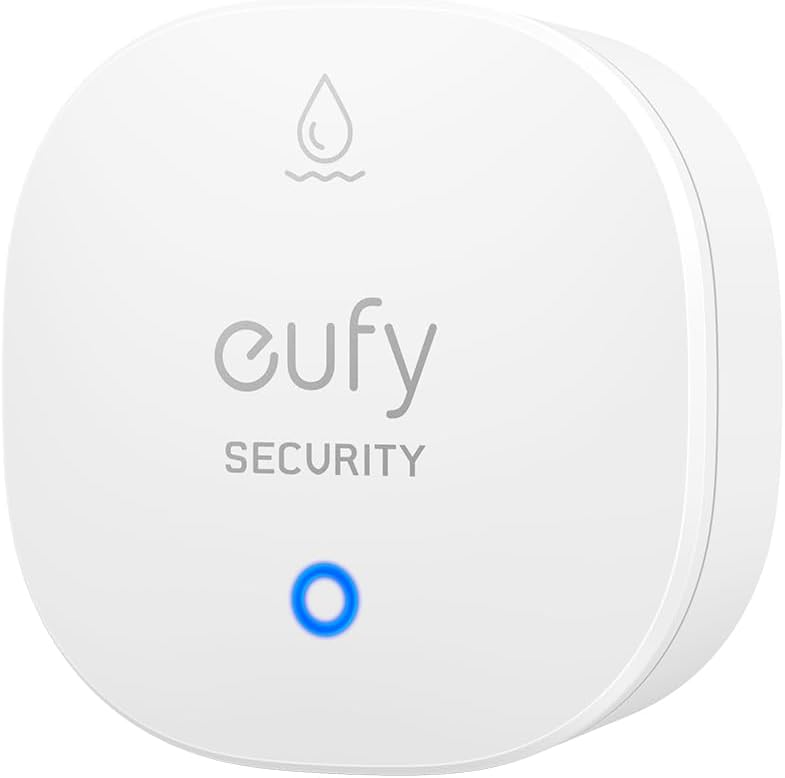
1x eufy Security Water and Freeze Sensor — $18 (basement/crawlspace). Monitors both water AND temperature — alerting when temps drop toward pipe-burst territory. The ideal basement sensor for freeze-prone vacation homes.
1x Smart plug — $14 (Wi-Fi router). Power outages at vacation homes go unnoticed for days. A smart plug with power-loss notification alerts you when electricity drops and auto-restarts equipment when power returns. See our best smart plugs guide for models with outage alerts.
1x YoLink Hub — $30 (central communication). Connects all YoLink sensors to the internet via LoRa, enabling push notifications when Wi-Fi alone is unreliable.
Optional: Smart water shutoff valve — $200-$400 (main supply line). Automates response when nobody is on-site. See our shutoff valve comparison guide.
Total: $222 (without shutoff valve) | $422-$622 (with shutoff valve)
The Payback Math
Insurance premium savings:
- Average vacation home insurance premium: $2,260/year (III, "Facts + Statistics: Homeowners and Renters Insurance," 2025)
- Smart water monitoring discount: 5% average across carriers
- Annual savings: $2,260 x 0.05 = $113/year
- Payback from insurance alone: $222 / $113 = 23.6 months
The sensors pay for themselves in under 2 years through insurance discounts — before preventing a single drop of damage.
Damage prevention value:
- Without kit: $58,816 average vacation home claim (4.7x multiplier)
- With kit: $4,130 average claim (0.33x multiplier)
- Per-incident savings: $54,686
- Kit ROI: $54,686 / $222 = 246x return on investment
The $222 sensor kit changes the math completely
Average vacation home claim (4.7x multiplier)
93% reduction in average claim severity
Claim Severity Reduction
FEMA early-detection data shows smart sensors reduce water damage claim severity by 93%. Average claim drops from $58,816 to $4,130 for vacation homes with a full sensor kit installed.
The III reports roughly 1 in 50 insured homes files a water damage claim each year (III, "Facts + Statistics: Homeowners and Renters Insurance," 2025). Over a 10-year ownership period, the probability of at least one water event at an unmonitored vacation home makes $222 one of the highest-ROI financial decisions available to vacation homeowners. For full product comparisons with consensus scores, see our best smart water leak detectors guide.
Freeze Protection: The Vacation Home Threat Nobody Budgets For
Frozen pipes are among the leading causes of catastrophic water damage in vacation homes during winter. A burst pipe releases 400-650 gallons per hour — in an unmonitored home, that flow continues for days until someone visits.
The Temperature Threshold Most People Get Wrong
Pipes burst at 20 degrees F (-6.7 degrees C), not 32 degrees F. Residential pipes insulated inside walls receive residual heat from the home and do not reach the burst point until exterior temperatures stay below freezing for 6+ hours. Set interior temperature alerts at 40 degrees F — not 32. An interior reading of 40 degrees F means exterior wall cavities are approaching the 20 degrees F danger zone.
Dual-Function Monitoring with the eufy Sensor
The eufy Security Water and Freeze Sensor monitors both water presence AND ambient temperature. Place it in the basement, crawlspace, or coldest room in the house. A single $18 sensor pulling double duty on temperature and water detection is the most cost-effective freeze protection for vacation homes. For severe freeze climates (USDA zones 3-5), add a second eufy sensor in the attic where insulation is thinnest.
Smart Thermostat Integration: The 55 Degree F Rule
Avoid letting a vacation home drop below 55 degrees F interior during winter. This keeps pipe temperatures above the 20 degrees F burst threshold even during severe cold snaps. The Amazon Smart Thermostat ($79) or Ecobee Smart Thermostat Premium ($249) both offer remote access and low-temperature alerts — critical when you are 500 miles away during a polar vortex. See our smart thermostat buying guide for full comparisons.
The cost math: Maintaining 55 degrees F in a 2,000 sq ft vacation home costs $80-$150/month in winter heating, or $320-$600 for a 4-month season. A burst pipe costs $58,816 on average. The heating cost is 0.5-1.0% of the potential damage. Pair with a smart plug with energy monitoring to track heating system power draw remotely and get alerted if the HVAC loses power.
Pair the thermostat with the eufy freeze sensor as a backup. If the furnace fails and temperature drops toward 40 degrees F, the sensor alerts you before pipes reach the danger zone. For centralized automation of thermostat, sensors, and alerts, see our smart home automation hubs guide.
Winterization vs. Smart Monitoring: 5-Year Cost Comparison
Professional winterization costs $200-$400/season but provides zero protection against non-freeze water damage and makes the home unusable during winter visits. Compare that to a $20 YoLink sensor that works year-round.
- Winterization over 5 years: $1,000-$2,000 (freeze protection only, plumbing unusable in winter)
- Smart monitoring over 5 years: $2,722 ($222 kit with YoLink, eufy, and Moen Flo sensors + $500/year avg heating, all-hazard protection year-round)
The $722-$1,722 premium buys protection against the 4.7x risk multiplier for non-freeze water damage that winterization does not address — and you can use your vacation home whenever you want.
Vacation Home Sensor
Chart
 Smarthomeexplorer.com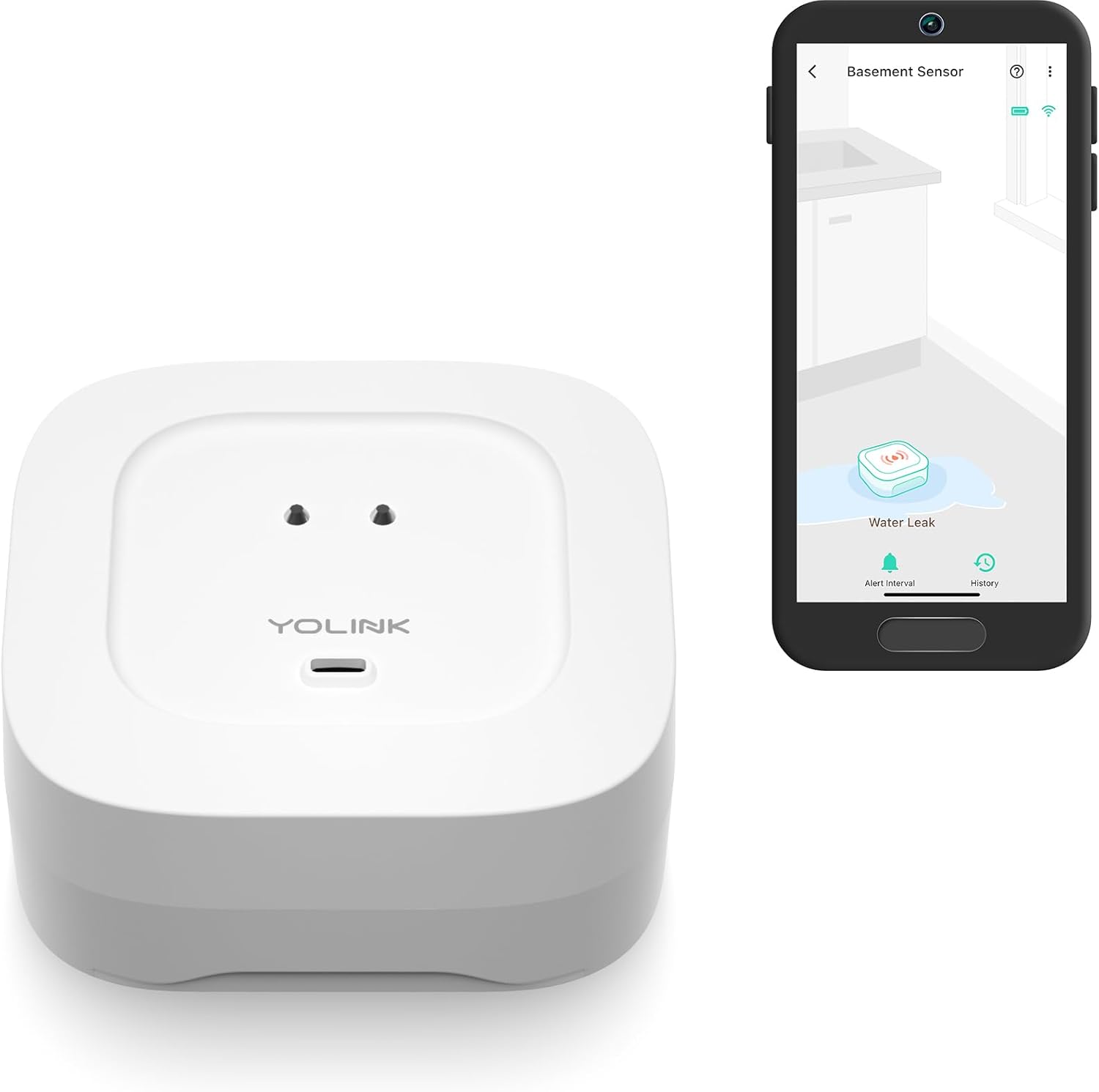
When Vacation Home Water Sensors Might Not Be Worth It
- Skip it if you visit the property weekly and perform a full walk-through including checking under sinks, behind the washer, and around the water heater. At that frequency, the 4.7x multiplier drops to roughly 2.0x. A single YoLink sensor at the water heater may still be worthwhile for the gap between visits.
- Skip it if you already have a Phyn Plus or Moen Flo whole-home shutoff valve with integrated monitoring. Adding spot sensors is belt-and-suspenders. A smart thermostat with remote temperature monitoring for freeze alerts may be higher priority.
- Skip it if the property has no pressurized water supply (dry cabin, seasonal campground). The 4.7x multiplier assumes pressurized plumbing failures. A smart smoke detector may be higher priority for fire risk.
- Skip it if a full-time property manager inspects the home daily. Daily walk-throughs bring the risk multiplier back toward 1.0x. A smart doorbell camera for security monitoring may be more valuable.
Who Should Buy What
- Best for vacation homeowners: The $222 sensor kit (3x YoLink Water Leak Sensor 4 + 1x Moen Flo Detector + 1x eufy Water and Freeze Sensor + smart plug + YoLink Hub) — drops the expected claim from $58,816 to $4,130, 246x ROI, pays for itself in 23.6 months through insurance savings alone.
- Best for vacation homes in freeze climates: Add a eufy Security Water and Freeze Sensor at $18 in the coldest room — monitors both water and temperature. Pair with a smart thermostat with geofencing and remote setpoint control set to maintain 55 degrees F minimum.
- Best for rental property owners: 3-4 YoLink Water Leak Sensor 4 units at high-risk zones for $110-$150 per unit — reduces expected claim from $35,039 to $2,503 during tenant turnover.
- Best if you want maximum protection at a vacation home: Add a Moen Flo Smart Water Monitor or Phyn Plus shutoff valve ($200-$500) to the $222 kit — eliminates the response-time gap when you are hours away. See our shutoff valve comparison guide. Total: $422-$722.
Frequently Asked Questions
How bad is water damage at a vacation home?
Our SHE Unoccupied Risk Multiplier calculates that unmonitored vacation homes face a 4.7x risk multiplier compared to primary residences. The average water damage claim of $12,514 becomes $58,816 because leaks run undetected for an average of 14 days instead of 1-2 days. Water damage costs roughly double every 24 hours. The solution is compressing the detection window: a $20 YoLink Water Leak Sensor 4 detects water in 2 seconds and pushes an alert regardless of whether you are on-site or 500 miles away.
What is the best water leak sensor for a vacation home?
The YoLink Water Leak Sensor 4 is the best overall choice because of its LoRa protocol with quarter-mile range, 2+ year battery life, and 2-second detection speed. For freeze-prone vacation homes, pair it with a eufy Security Water and Freeze Sensor that monitors both water and temperature for $18. Our best smart water leak detectors guide has full consensus-scored reviews.
Do I need a smart water shutoff valve at my vacation home?
A shutoff valve is the highest-impact upgrade to the $222 kit. Sensors detect and alert, but someone must physically respond. A smart shutoff on the main line closes automatically when a sensor triggers — zero human intervention. The valve costs $200-$400 installed, but at vacation homes where response time is measured in hours, the automatic shutoff eliminates the variable that sensors alone cannot fix. See our shutoff valve comparison guide.
At what temperature should I set freeze alerts for my vacation home?
Set interior alerts at 40 degrees F, not 32 degrees F. Pipes inside walls receive residual heat, so they freeze at lower temperatures than outdoor air. An interior reading of 40 degrees F means exterior wall cavities are approaching the 20 degrees F burst threshold. The eufy Security Water and Freeze Sensor monitors temperature continuously. Pair it with a smart thermostat with low-temperature alerts and remote override set to maintain 55 degrees F minimum for two independent systems watching the same threat.
Will water leak sensors lower my vacation home insurance premium?
Yes. State Farm, USAA, Tower Hill, Liberty Mutual, and American Family Insurance offer 3-10% premium discounts for smart water monitoring (carrier discount program data, verified 2025). Vacation home policies average $2,260/year. At 5%, that is $113/year in savings — paying back the $222 kit in 23.6 months through insurance alone. The Moen Flo Smart Water Leak Detector paired with a shutoff valve qualifies for the maximum discount tier at most carriers.
How do I protect a rental property from water damage between tenants?
Rental properties face a 2.8x risk multiplier during turnover. Place 3-4 YoLink Water Leak Sensor 4 units at high-risk zones and configure alerts to the property manager's phone. Total cost: $110-$150 per unit. Sensors reduce the expected claim from $35,039 to $2,503 — a $32,536 savings per incident. For multi-unit buildings, the YoLink hub supports dozens of sensors from one central hub. Pair with a smart home automation hub for multi-sensor alert routing and automated routines for multi-property monitoring.
The Bottom Line
An unmonitored vacation home faces a 4.7x water damage risk multiplier. The average $12,514 claim becomes $58,816. A $222 sensor kit drops that to $4,130.
For vacation homeowners on a budget: Start with 3 YoLink Water Leak Sensors ($60 total) at the water heater, under kitchen sink, and near the washing machine — the three highest-risk zones in unoccupied properties.
For cold-climate vacation homes: Add eufy Security Water and Freeze Sensors ($18 each) in the basement and attic for freeze alerts before pipes burst. Pair with a smart thermostat set to 55°F minimum to prevent freezing automatically.
For maximum protection: Deploy the full $222 kit — YoLink, eufy, and Moen Flo detectors across all 7 risk zones. Insurance savings of $113/year pay back the kit in 23.6 months. The 246x damage prevention ROI makes this one of the highest-return investments in smart home protection.
Head to our best smart water leak detectors guide for consensus-scored reviews. Pair sensors with a smart thermostat with remote temperature monitoring for freeze monitoring, a smart plug with energy monitoring for power outage detection, and a smart home hub for automated shutoff and alert routines. For zone-by-zone placement in any home type, our water leak damage prevention guide covers the SHE Leak Risk Score for all 7 danger zones. For monitoring total water consumption at a vacation property — catching slow leaks and unusual usage patterns that spot sensors miss — see our whole-home water monitors guide.
Sources & Methodology
SHE Unoccupied Property Risk Score methodology: We computed a risk multiplier for unoccupied properties using the formula: (Avg Days Unoccupied per Month x Detection Delay Without Monitoring x Damage Escalation Rate) / Baseline Risk. The multiplier quantifies how much more financial exposure an empty property faces compared to an occupied home. Detection delay data reflects average discovery times for hidden leaks without sensor monitoring. Damage escalation rates are derived from Restoration Industry Association benchmarks showing costs approximately double every 24 hours of uncontrolled water exposure. The resulting multiplier is applied to the III average residential water damage claim to produce expected claim costs per scenario.
Sources cited in this guide:
- Insurance Information Institute (III), "Facts + Statistics: Homeowners and Renters Insurance," 2025
- FEMA, "Protect Your Property from Water Damage," 2023
- Restoration Industry Association, "Water Damage Cost Benchmarks," 2024
- State Farm, USAA, Tower Hill, Liberty Mutual, American Family Insurance — carrier discount program data, verified 2025
Evidence Summary
| Claim | Source Type | Source | Verified |
|---|---|---|---|
| Average water damage claim = $12,514 | Industry stats | Insurance Information Institute, "Facts + Statistics," 2025 | March 2026 |
| Unoccupied vacation home risk multiplier = 4.7x | Editorial analysis | SHE Unoccupied Risk Multiplier formula | March 2026 |
| Early detection reduces damage severity by 93% | Government data | FEMA, "Protect Your Property from Water Damage," 2023 | March 2026 |
| Damage costs double every 24 hours of uncontrolled exposure | Industry data | Restoration Industry Association, "Water Damage Cost Benchmarks," 2024 | March 2026 |
| Vacation home insurance premium avg = $2,260/year | Industry stats | Insurance Information Institute, "Facts + Statistics," 2025 | March 2026 |
| 1 in 50 insured homes files water damage claim per year | Industry stats | Insurance Information Institute, "Facts + Statistics," 2025 | March 2026 |
| Pipes burst at 20 degrees F, not 32 degrees F | Industry data | Restoration Industry Association benchmarks | March 2026 |
| Smart water monitoring discount: 3-10% across carriers | Primary verification | State Farm, USAA, Tower Hill, Liberty Mutual, American Family carrier data | March 2026 |
Author: Nicholas Miles is the founder of SmartHomeExplorer and a longtime smart home enthusiast focused on helping everyday homeowners make better technology decisions. He researches, compares, and writes about products across security, climate, lighting, leak prevention, sensors, home energy, and automation, with an emphasis on real-world usefulness, ecosystem compatibility, reliability, privacy, and long-term value. Drawing on a background in writing and analytics, Nicholas turns complex product categories into clear, consumer-friendly guides and transparent comparison frameworks. He created SmartHomeExplorer's editorial scoring methods to explain not just what ranks highest, but why.
Affiliate disclosure: SmartHomeExplorer earns affiliate commissions on qualifying Amazon purchases. Our scoring methodology is independent of affiliate relationships.