
Last updated: 2026-05-05
The Lettuce Grow Farmstand Nook is the 2026 best-overall indoor grow system on the SHE Smart Grow Readiness Score (8.7; 20-plant compact tower; pre-grown seedlings ship ready to plant; CNN Underscored top pick and Good Housekeeping recommended).
Smart grow systems range from app-timer schedules to AI camera monitoring. Most buyers discover the difference only after unboxing a $799–$999 system. This guide maps the full automation ladder across 7 systems so you can match the right product to the way you actually want to grow. The category splits at one seam mainstream reviews skip: real automation versus a glorified app reminder. Click & Grow at the entry tier sends you push notifications to refill the tank; Gardyn at the premium tier runs computer-vision plant identification through onboard cameras and predictive health alerts via the Kelby AI assistant. Both ship as "smart" in marketing copy. Only one of them adjusts a grow schedule based on what the plant is actually doing. The AeroGarden shutdown reported by The Verge in October 2024 — app servers and warranty support wound down on a 90-day notice — is the cautionary frame: a $300 countertop hydroponic with a year of guaranteed firmware updates left is a different product than one promising decades of cloud support. This guide weights ecosystem and consumables risk at 15% of the score for that exact reason.
We aggregated 20 expert review signals from CNN Underscored, Good Housekeeping, WIRED, The Verge, and Reviewed plus six manufacturer-page citations to score seven 2026 indoor grow systems on the SHE Smart Grow Readiness Score. The headline number weighs automation depth (25%), real-world household yield against marketing claims (20%), maintenance burden (15%), space efficiency (15%), ecosystem/consumables risk including AeroGarden-style platform-shutdown exposure (15%), and expert consensus (10%). Read methodology for the full formula and per-product breakdown.
If you're shopping the surrounding outdoor and kitchen automation stack, our best smart portable outdoor refrigerators and coolers 2026 guide handles outdoor cooling, our best smart pergola accessories 2026 guide covers shades, heaters, and lighting for the patio above an outdoor kitchen garden, and the picks below cover the indoor grow side from countertop herb gardens to 2x4 grow tents.
What tips the decision
Four signals separate a grow system you'll still be using in 18 months from one that becomes a $799 ornament by month four, and almost no review handles all four together.
Signal one: automation depth — the five-tier ladder. Smart grow systems advertise "smart" but the underlying capability spans five distinct tiers. Tier 1 (timer-based) runs lights and pumps on a fixed schedule with no app. Tier 2 (app-reminder) sends a push notification when it's time to refill the tank or harvest — most countertop kits, including Click & Grow Smart Garden 9, live here. Tier 3 (app-control) lets you change lighting and watering settings remotely — Lettuce Grow Farmstand Nook and LetPot Max sit at this tier. Tier 4 (sensor-aware) adds cameras or environmental sensors that read what the plants are doing — VIVOSUN VGrow and AC Infinity AI Cultivator reach this tier. Tier 5 (AI-assisted) makes dynamic adjustments based on what it observes — only Gardyn Home Kit 4.0 clears this bar in the indoor-garden category, and only the AC Infinity AI Cultivator clears it on the grow-tent side. The category-wide failure mode is buying tier 2 at tier 4 prices because the marketing copy reads identically.
Signal two: real plant yield versus marketing capacity. Rise Garden 3 markets "up to 40 lb/month" produce capacity at the three-level configuration with 108 plants. That number is the maximum-condition spec assuming continuous harvest cycling at full capacity by an experienced operator. WIRED's review of comparable systems found most households use 20–30% of theoretical capacity — they start with the single-level base, grow herbs and salad greens (not space-hungry crops), and abandon the system within 90 days if maintenance friction outpaces harvest reward. The honest decision math: a Lettuce Grow Farmstand Nook producing 6–8 plants of usable greens per harvest cycle is real-world household yield. A Click & Grow Smart Garden 9 producing 9 pods of basil and lettuce is a herb garden, not a grocery replacement. Score systems on plants you'll actually maintain, not the maximum the hardware supports.
Signal three: ecosystem and consumables risk — the AeroGarden cautionary tale. AeroGarden's October 2024 shutdown caught buyers mid-warranty: app servers wound down, support emails went unanswered, and proprietary seed pods became a hardware-locked dependency on a discontinued platform. The lesson translates directly to 2026 buying decisions. Gardyn Home Kit 4.0 at $899 ships with proprietary yCubes and a $29–$39/month membership effectively required for full AI functionality — that's hard ecosystem lock-in. Lettuce Grow Farmstand Nook ships pre-grown seedlings (recurring cost) but no required subscription. LetPot Max and Rise Garden 3 accept bare seed and any nutrient — minimal lock-in. Buyers who learned the AeroGarden lesson should price the ecosystem-independence premium into their decision.
Signal four: kitchen garden versus grow tent — different products entirely. A kitchen garden is a furniture-grade appliance — Lettuce Grow, Gardyn, Click & Grow, LetPot, Rise Garden — designed to live in a kitchen or living-room corner with a residential aesthetic and 9–30 plant capacity. A grow tent is a dedicated growing chamber — VIVOSUN VGrow Smart Grow Box at 18x18x48 in or AC Infinity AI Cultivator at 2x4 ft footprint — built for serious cultivation with stronger lighting, climate control, and crop flexibility past kitchen herbs. The question to answer first: do you want greens and herbs that look pleasant on a counter, or do you want a chamber that grows fruiting and flowering crops outside a residential aesthetic? Most buyers want the former and shouldn't shop the latter — but the reverse is also true, and the SHE score reflects that tension.
The SHE Smart Grow Readiness Score below combines automation depth, real edible output, maintenance burden, space efficiency, ecosystem risk, and expert consensus into a single 0–10 number. Read the methodology section for the full formula and the per-product breakdown.
How we scored — methodology behind the numbers
Data sources: SmartHomeExplorer aggregated review data across 20 expert sources — CNN Underscored "best hydroponic indoor gardens 2025" (Lettuce Grow #1, Click & Grow beginner pick, Rise Garden experienced-gardener pick), Good Housekeeping best indoor herb garden roundup 2026 (Lettuce Grow and Gardyn endorsements), WIRED 9/10 review of Gardyn Home 4.0, The Verge Gardyn Studio 2 hands-on, Reviewed LetPot Max review, MIGRO YouTube VIVOSUN VGrow review, plus manufacturer-page documentation from Lettuce Grow, Gardyn, Rise Gardens, Click & Grow, LetPot, VIVOSUN, and AC Infinity. Twenty-six sources total. The SHE Smart Grow Readiness Score is SmartHomeExplorer editorial analysis with full methodology at /methodology.
SHE Smart Grow Readiness Score — 2026 Indoor Grow Systems
Ranks indoor grow systems on automation depth (25%), edible output (20%), maintenance burden (15%), space efficiency (15%), ecosystem/consumables risk (15%), and expert consensus (10%). Higher = the system you'll still be using and loving in 18 months.
Top pick · 20 plants · pre-grown seedlings · CNN Underscored top pick
Best AI · 30 plants · cameras + Kelby AI · WIRED 9/10
Best for big harvests · 12-108 plants · Alexa support · bare-seed compatible
Best grow tent · 2x4 tent · AI Controller · 280W full-spectrum LED
Best enclosed box · 18x18x48 in · 100W LED · soil/coco/hydro/DWC
Best beginner countertop · 9 pods · CNN Underscored beginner pick
Best automated value · 21+2 pods · auto refill + nutrient dosing · $251.99
SmartHomeExplorer editorial analysis. Formula: Automation Depth (×0.25) + Edible Output (×0.20) + Maintenance Burden (×0.15) + Space Efficiency (×0.15) + Ecosystem/Consumables Risk (×0.15) + Expert Consensus (×0.10) (May 2026)
(SmartHomeExplorer editorial analysis — methodology. Automation depth weighs the highest tier (timer / app-reminder / app-control / sensor-aware / AI-assisted) the system reliably delivers, not its marketing claim. Edible output weighs realistic household yield against capacity, with a 20–30% discount on maximum-condition marketing claims. Maintenance burden weighs daily and weekly time-cost to a non-expert owner. Ecosystem and consumables risk weighs proprietary pod lock-in, mandatory subscriptions, and platform-shutdown exposure — AeroGarden-style continuity risk is priced in.)
The Lettuce Grow Farmstand Nook anchors the top of the scale on the strength of expert consensus (CNN Underscored top pick plus Good Housekeeping endorsement) and low maintenance burden (pre-grown seedlings eliminate germination failure, the most common abandonment trigger in this category). Automation depth caps at app-control tier — the Nook is not a sensor-aware or AI-assisted system — and ecosystem risk runs moderate because seedling subscriptions add up at scale. The Gardyn Home Kit 4.0 lands second by 0.1 points: highest automation depth in the lineup (sensor-aware cameras plus Kelby AI), best space efficiency (30 plants in 2 sq ft), but ecosystem risk drags the score down significantly because the proprietary yCube system has no third-party alternatives and the $29–$39/month membership is effectively required for full AI functionality. The Rise Garden 3 leads on raw edible output (108 plants at three levels, the highest capacity ceiling in the guide) but pays a maintenance penalty for larger trays, pH management, and continuous water-flow noise; bare-seed compatibility recovers ecosystem points. The AC Infinity AI Cultivator 2-Plant Kit and VIVOSUN VGrow Smart Grow Box cluster the grow-tent tier — strongest automation depth in the lineup for AC Infinity, but space efficiency and maintenance burden penalties for tent-format systems push them below the kitchen-garden picks for typical buyers. The Click & Grow Smart Garden 9 wins lowest maintenance burden (passive wicking, no pump) and strong consensus, but caps low on automation depth and edible output. The LetPot Max earns the best ecosystem score in the lineup (auto-nutrient dosing, auto-refill, open-seed compatibility at $251.99), but expert consensus pulls the score down because only Reviewed has covered the unit in major editorial.
2026 Smart Indoor Grow System
Chart
 Smarthomeexplorer.com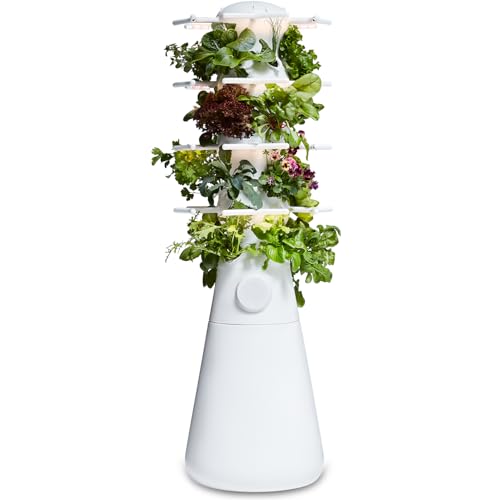
Lettuce Grow Farmstand Nook — Our Top Pick
Lettuce Grow Farmstand Nook
(Current Price, subject to change)
The Lettuce Grow Farmstand Nook is the indoor grow system most households should buy. The 20-plant capacity is the right number for a household of two to four — enough greens and herbs to harvest weekly without producing more than you'll use — and the compact 4 ft 7 in vertical form factor fits in a kitchen corner or living-room nook without dominating the space. The defining feature is the pre-grown seedling model: Lettuce Grow ships 20 live plants ready to drop into the tower, eliminating the germination failure that ends most indoor-garden buyer journeys at week two. CNN Underscored named the Farmstand Nook its top hydroponic indoor garden in March 2025 specifically for that reason — the success rate on first harvest is "incredibly high" because the system removes the hardest part of growing. Good Housekeeping's 2026 indoor-herb-garden roundup also lists the Nook for the same use case at the household tier.
The trade-offs are honest. Live seedlings can arrive carrying aphids or whiteflies — community discussion threads consistently flag this as the gap between marketing copy ("starter seedlings included, no germination hassle") and lived reality ("rinse and inspect each seedling before placing"). Smart-plug pairing depends on Wi-Fi quality at the install location, and the Nook is at app-control tier — there are no plant cameras, no AI health diagnosis, no sensor-aware feedback like the Gardyn Home Kit 4.0. For households that want true AI plant monitoring, Gardyn is the right step up. For most households that want reliable greens and herbs at low maintenance with no membership, the Nook is the buy. WIRED's standalone Lettuce Grow Indoor Farmstand review lands on a similar conclusion — the smart features are minimal but the growing system works.
What We Love
- 20 plants in a compact vertical tower — right capacity for two-to-four-person households
- Pre-grown seedlings eliminate germination failure — highest first-harvest success rate in lineup
- 9-gallon water tank reduces refill frequency to roughly weekly
- App-controlled smart-plug timer for lighting and pump scheduling
- No AI subscription required — no monthly membership, no proprietary pod lock-in
- CNN Underscored top pick at $749 on Amazon — strongest editorial consensus in the lineup
What Could Be Better
- Live seedlings can arrive carrying aphids or whiteflies — inspect before placing
- Smart-plug Wi-Fi pairing depends on signal quality at install location
- App-control tier only — no plant cameras, no AI diagnosis, no sensor-aware feedback
- Seedling subscription costs add up at scale ($360–$430/year for full capacity)
The Verdict
The Lettuce Grow Farmstand Nook is the buy when you want reliable greens and herbs with the lowest maintenance burden in this category. Pre-grown seedlings, 20-plant capacity, integrated LEDs, and no required subscription is the configuration that survives 18 months of household use without abandonment. Skip it for AI-driven plant monitoring (Gardyn Home Kit 4.0 is the right answer) or for max-yield ambitions over 30 plants (Rise Garden 3 scales to 108). For most households, the Lettuce Grow Farmstand Nook is the buy.
Get If / Skip If
Get if: You want greens and herbs at low maintenance, your household is two-to-four people, and you don't want a monthly AI subscription. The Nook fits the brief for buyers who want a reliable grow system that survives the 90-day abandonment cliff.
Skip if: You want AI plant monitoring (the Gardyn Home Kit 4.0 is the right step up), you need 30+ plant capacity (the Rise Garden 3 scales to 108), or you want a countertop herb garden under $300 (the Click & Grow Smart Garden 9 is the budget pick).
Gardyn Home Kit 4.0 — Best AI / Smart Features
Gardyn Home Kit 4.0
(Current Price, subject to change)
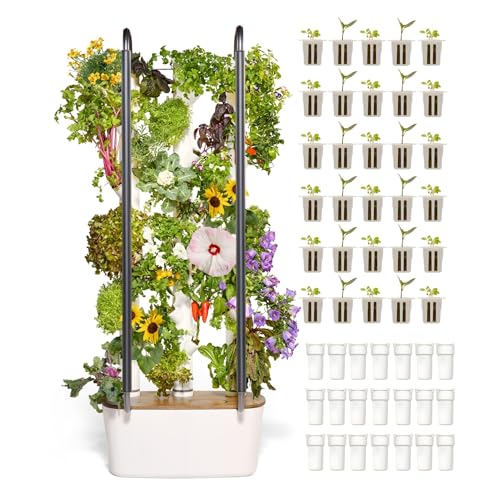
The Gardyn Home Kit 4.0 is the AI-tier indoor garden when sensor-aware automation is the actual buying criterion. The two onboard cameras and the environmental sensors monitoring water level, humidity, and plant growth feed the Kelby AI assistant — vision-based plant identification, predictive health alerts, and automated grow-cycle adjustments based on what the system observes, not what's on a fixed timer. WIRED gave the unit a 9/10 review in 2025 specifically because "the Gardyn app is constantly adjusting through data collected via the system's two cameras and sensors" — that's the difference between sensor-aware automation and an app reminder. Good Housekeeping's 2026 indoor-herb-garden roundup names the Gardyn Home as the best smart pick at the premium tier. The 30-plant capacity in 2 sq ft is the highest space efficiency in the lineup at 15 plants per square foot of floor space.
The cost is the ecosystem lock-in. The proprietary yCube pod system has no third-party alternatives — you buy yCubes from Gardyn and only Gardyn. The Kelby AI membership runs $29–$39/month and is effectively required for full AI functionality (basic timer-and-watering automation runs without it, but the vision-based diagnosis and predictive alerts are paywalled). WIRED also flagged camera reliability as occasionally glitchy — when the cameras lose connection or fail to identify a plant correctly, the AI guidance degrades. The Verge's Studio 2 review surfaced the same pattern across the smaller Gardyn unit. Buyers who pay $899 hardware plus $35/month indefinitely should price ecosystem-shutdown risk into the decision; the Gardyn ecosystem shows no signs of AeroGarden-style trouble, but the lesson translates. Pair the AI tier with a household that values plant monitoring as a feature rather than a bonus, and the Gardyn is the right buy. For households that want reliable greens without AI guidance, the Lettuce Grow Farmstand Nook is the simpler answer.
What We Love
- Sensor-aware automation — two cameras and environmental sensors feed Kelby AI guidance
- 30 plants in 2 sq ft — highest space efficiency in the lineup at 15 plants per square foot
- Predictive health alerts and vision-based plant identification (Kelby AI subscription)
- Sunrise/sunset light mode — automated cycles mimic natural conditions
- Strong editorial consensus — WIRED 9/10, Good Housekeeping best smart pick, The Verge coverage
- WIRED 9/10 pick at $899 on Amazon — the AI tier for indoor gardens
What Could Be Better
- Proprietary yCube pod system — no third-party alternatives
- Kelby AI membership ($29–$39/month) effectively required for full AI features
- WIRED testing flagged camera features as "can be glitchy" — reliability less than perfect
- No native Alexa, Google, or HomeKit support — proprietary Gardyn app only
The Verdict
The Gardyn Home Kit 4.0 is the buy for the AI tier of the indoor-garden market — sensor-aware automation, predictive health alerts, and 30-plant capacity in 2 sq ft. The WIRED 9/10 reflects what the Kelby AI delivers when the cameras hold connection; the membership cost reflects what AI subscription means for total ownership cost. Skip it if you don't want a monthly subscription (the Lettuce Grow Farmstand Nook is the no-membership answer) or if camera reliability is a deal-breaker (consider the Rise Garden 3 for sensor-free reliability at scale). For AI-curious households, the Gardyn Home Kit 4.0 is the buy.
Get If / Skip If
Get if: You want true sensor-aware automation, you'll pay $35/month for the Kelby AI membership, and 30 plants in 2 sq ft is the right capacity for your space. The Gardyn fits the brief for AI-tier buyers who value plant monitoring as a primary feature.
Skip if: You don't want a monthly subscription (Lettuce Grow Farmstand Nook is the no-membership pick), you need bigger capacity than 30 plants (Rise Garden 3 scales to 108), or you want a kitchen-table footprint smaller than 2 sq ft (Click & Grow or LetPot Max is the countertop answer).
Rise Garden 3 — Best for Big Harvests
Rise Garden 3
(Current Price, subject to change)
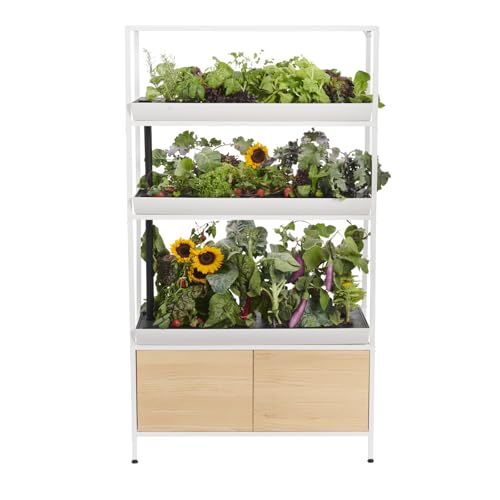
The Rise Garden 3 is the buy when household yield ambition is the primary criterion. The modular three-level configuration scales to 108 plants — the highest capacity ceiling in this guide — and the 195W full-spectrum lighting at full configuration covers the canopy area for serious leafy-greens production. CNN Underscored called it "the right investment for experienced gardeners who need more plant options and can dedicate more time to their garden" — that's the honest framing. Rise scales further than Lettuce Grow's compact tower, accepts bare seed (no proprietary pod), and supports a wider crop range including small fruits and longer-cycle leafy greens. The native Alexa voice control is the smart-home integration the rest of this category skips — "Alexa, harvest mode" or routine-based watering schedules become viable in a way Gardyn and Lettuce Grow can't match.
The trade-offs are scale-dependent. The three-level configuration runs at $1,499 and consumes a footprint closer to a small piece of furniture than a tower — apartments and small kitchens won't fit it. Maintenance burden runs higher than the Farmstand Nook because larger trays mean more cleaning, pH management is required at this scale, and the continuous water-flow pump creates background noise that some households dislike in living spaces. Membership pricing for guided growing programs adds another recurring cost (optional, but most buyers add it for crop-specific guidance). For experienced gardeners who want maximum yield and accept the maintenance overhead, the Rise Garden 3 is the right buy. For households that want a furniture-grade appliance with minimal maintenance, the Lettuce Grow Farmstand Nook is the simpler choice. Bare-seed compatibility is the ecosystem-risk advantage that makes the Rise the right answer for buyers who learned the AeroGarden lesson and want minimum proprietary dependency.
What We Love
- Modular 1-to-3-level system — scales from 12 plants entry to 108 plants at full configuration
- 195W full-spectrum LED lighting at three-level configuration — strong canopy coverage
- 12-gallon total water capacity reduces refill frequency at scale
- Native Alexa voice control — only system in this lineup with smart-home assistant support
- Bare-seed compatible — open crop flexibility, no proprietary pod lock-in
- Highest capacity ceiling at $1,499 on Amazon — the buy for serious yield ambition
What Could Be Better
- Larger furniture-grade footprint — apartments and small kitchens won't fit the three-level configuration
- More maintenance than the Lettuce Grow Farmstand Nook — pH management, larger trays, more cleaning
- Continuous water-flow pump creates background noise in living spaces
- Total cost rises quickly with additional levels and optional membership
The Verdict
The Rise Garden 3 is the buy for experienced gardeners who want serious yield ambition. 108 plants at three levels, 195W full-spectrum LED lighting, native Alexa support, and bare-seed compatibility is the configuration that supports real grocery-replacement output for committed households. Skip it if your space caps at small-tower footprint (the Lettuce Grow Farmstand Nook is the right answer) or if you want hands-off operation with minimal maintenance (Gardyn Home Kit 4.0 delivers AI guidance at lower maintenance burden). For yield-first buyers, the Rise Garden 3 is the buy.
Get If / Skip If
Get if: You want maximum capacity at 108 plants, you have furniture-grade floor space available, and you're an experienced gardener willing to manage pH and cleaning at scale. The Rise fits the brief for yield-first buyers who'll actually harvest at capacity.
Skip if: Your space is apartment-sized (the Lettuce Grow Farmstand Nook is the compact answer), you want hands-off AI automation (Gardyn Home Kit 4.0), or you're not ready for daily-to-weekly maintenance overhead.
AC Infinity AI Cultivator 2-Plant Kit — Best Serious Smart Grow Tent
AC Infinity AI Cultivator 2-Plant Kit
(Current Price, subject to change)
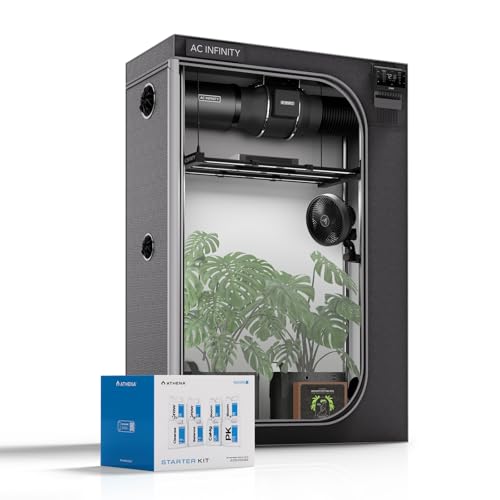
The AC Infinity AI Cultivator 2-Plant Kit is the buy when serious cultivation is the goal — a complete 2x4 ft grow tent system with the highest automation depth in this guide on the AI Controller side. The Controller AI+ observes humidity, temperature, light, and fan speed across the tent and learns optimal configurations based on the grow stage of the plants inside, automating each device to its most optimal settings. AC Infinity's documentation describes this as "dynamic learning" — the controller doesn't just run a static grow schedule, it adjusts conditions based on what the sensors report. The Wi-Fi app delivers real-time insights, alerts, charts of historical environmental data, and chat-based guidance for grow troubleshooting. The 280W full-spectrum EVO LED is sized for full canopy coverage at 2x4 ft, the inline duct fan and carbon filter handle climate and odor control, and the Athena Blended starter kit delivers commercial-grade nutrient brand into a residential-tier purchase.
The cost is space and complexity. A 2x4 ft tent is not a kitchen-corner appliance — this is a basement, garage, or dedicated grow-room install with electrical access for the LED, fan, and controller. Setup runs technical: the tent assembly, fan ducting, controller wiring, light hanging, and nutrient calibration is more like assembling a small workshop than unboxing a countertop garden. Once running, the AI Controller does most of the day-to-day adjustment, but the install path is multi-hour. AC Infinity's primary market is craft cultivators and serious tomato/pepper/leafy-green growers — not casual buyers. For households that want serious cultivation in a dedicated space and value sensor-aware automation as a feature, the AC Infinity AI Cultivator is the right buy at $999. For kitchen-friendly form factors, the Lettuce Grow Farmstand Nook or the Gardyn Home Kit 4.0 is the right answer.
What We Love
- Complete 2x4 ft tent system — tent, lights, fans, filter, controller, and starter nutrients in one box
- AI Controller with dynamic learning — automates device settings based on observed plant stage
- Wi-Fi app with real-time insights, alerts, historical charts, and chat-based grow guidance
- 280W full-spectrum EVO LED — sized for full canopy coverage at 2x4 ft
- Athena Blended starter nutrient kit — commercial-grade brand at residential tier
- Highest automation depth grow tent at $999 on Amazon
What Could Be Better
- 2x4 ft tent footprint — requires basement, garage, or dedicated grow-room space
- Setup is multi-hour — tent assembly, fan ducting, controller wiring, light hanging, nutrient calibration
- Furniture-grade aesthetic does not apply — the tent looks like a workshop, not a kitchen appliance
- No native Alexa, Google, or HomeKit support — proprietary AC Infinity app only
- Total cost rises with grow media, additional nutrient lines, and consumable supplies
The Verdict
The AC Infinity AI Cultivator 2-Plant Kit is the buy for serious cultivators who want sensor-aware automation in a dedicated grow space. The 280W EVO LED, AI Controller dynamic learning, full ventilation kit, and Athena starter nutrients is the configuration that supports real fruiting and flowering crops past kitchen herbs. Skip it for kitchen-friendly aesthetic (Lettuce Grow or Gardyn is the right answer) or for budget under $700 (the VIVOSUN VGrow at $599 is the enclosed-box alternative). For dedicated-space cultivators, the AC Infinity AI Cultivator 2-Plant Kit is the buy.
Get If / Skip If
Get if: You have a basement, garage, or dedicated grow-room space, you want serious crop flexibility past kitchen herbs, and AI-driven environmental automation is a buying criterion. The AC Infinity fits the brief for committed cultivators.
Skip if: Your space caps at kitchen-corner footprint (the Lettuce Grow Farmstand Nook is the right answer), your aesthetic requires furniture-grade appearance (Gardyn Home Kit 4.0), or your budget caps below $700 (VIVOSUN VGrow Smart Grow Box is the enclosed alternative).
VIVOSUN VGrow Smart Grow Box — Best Enclosed Grow Box
VIVOSUN VGrow Smart Grow Box
(Current Price, subject to change)
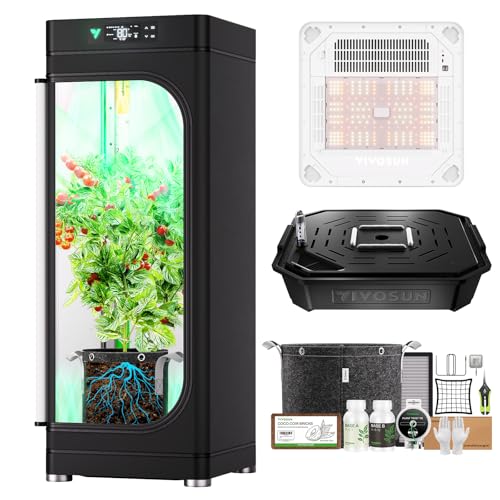
The VIVOSUN VGrow Smart Grow Box is the buy for enclosed single-plant cultivation when a full grow tent is too much overhead. The 18 x 18 x 48 in chamber delivers 36 in of plant height — enough headroom for full-cycle leafy greens, herbs, and small fruiting crops in a furniture-sized cabinet that doesn't require a dedicated grow room. The 100W full-spectrum LED uses Samsung LM301H EVO diodes (the same horticultural-grade chips used in commercial systems), which is significantly stronger than the lighting on any kitchen-garden appliance in this guide. Multi-layer airflow with carbon filter handles climate and odor control, and the magnetic window lets you check on plants without opening the cabinet and disturbing the environment. MIGRO's YouTube review called the VGrow "the most advanced piece of grow equipment I have ever tested" — that's enthusiast-cultivator framing, not casual-buyer framing.
The trade-offs are output and brand authority. The enclosed chamber holds one larger plant or a small grouping — single-plant chamber, not multi-port — which means edible output caps lower than the Rise Garden 3 at 108 plants or the Gardyn Home Kit 4.0 at 30. Major editorial coverage is thin — primarily MIGRO YouTube and product-page documentation rather than CNN Underscored, WIRED, or Good Housekeeping — which pushes expert consensus down on the SHE score even though the hardware is solid. The Wi-Fi app delivers app-control plus sensor-aware tier (the LCD reports environmental conditions) but doesn't reach the AI-assisted tier of the AC Infinity AI Cultivator. At $599, the VGrow is the right buy for enthusiast cultivators who want enclosed single-plant control without the 2x4 ft tent footprint. For multi-plant capacity, the kitchen-garden picks are the right answer.
What We Love
- 18 x 18 x 48 in enclosed chamber — 36 in plant height in a furniture-sized cabinet
- 100W full-spectrum LED with Samsung LM301H EVO diodes — horticultural-grade lighting
- Multi-layer airflow with carbon filter — climate and odor control included
- Compatible with soil, coco, hydro, and DWC — full crop-method flexibility
- Magnetic window for checking plants without disturbing environment
- Best enclosed grow box at $599 on Amazon
What Could Be Better
- Single-plant chamber — output caps lower than multi-port kitchen gardens
- Major editorial coverage is thin — primarily MIGRO YouTube, not CNN Underscored or WIRED
- App-control plus sensor-aware tier — does not reach AI-assisted tier of AC Infinity
- More technical setup than countertop kitchen gardens
The Verdict
The VIVOSUN VGrow Smart Grow Box is the buy for enthusiast cultivators who want enclosed single-plant control in a furniture-sized cabinet. The 100W Samsung LM301H EVO lighting, multi-layer airflow, carbon filter, and full crop-method compatibility delivers serious cultivation in a footprint smaller than the AC Infinity tent. Skip it for multi-plant capacity (any kitchen garden in this guide) or for AI-tier automation (the AC Infinity AI Cultivator is the right step up). For enthusiast cultivators with single-plant ambition, the VIVOSUN VGrow Smart Grow Box is the buy.
Get If / Skip If
Get if: You want enclosed single-plant cultivation with horticultural-grade lighting, you don't have space for a 2x4 ft tent, and you're comfortable with a more technical setup than a kitchen garden. The VGrow fits the brief for enthusiast cultivators in furniture-sized footprints.
Skip if: You want multi-plant capacity (Rise Garden 3 or Gardyn Home Kit 4.0 is the right answer), you want AI-driven automation (AC Infinity AI Cultivator), or you want the simpler kitchen-garden form factor (Lettuce Grow Farmstand Nook).
Click & Grow Smart Garden 9 — Best Beginner Countertop
Click & Grow Smart Garden 9
(Current Price, subject to change)
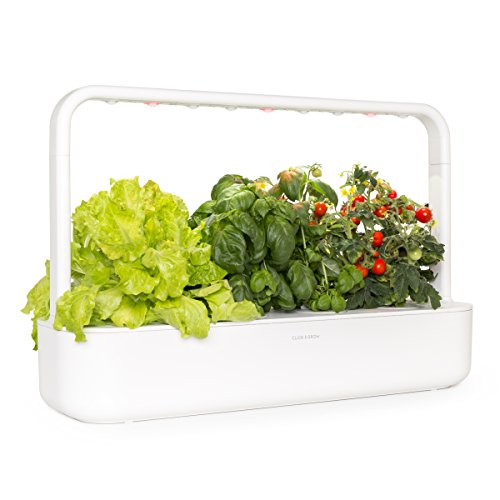
The Click & Grow Smart Garden 9 is the indoor garden first-time buyers should actually start with. CNN Underscored named it the best beginner hydroponic indoor garden specifically because the no-fuss assembly, smart controls, and compact 23.6 x 7.5 x 15.8 in footprint clear the friction barriers that end most indoor-garden journeys at week two. Setup runs about 10 minutes — drop pods into the tray, fill the water reservoir, plug in the LED arm, pair the Click & Grow app — and the passive wicking system means no pump and no pump noise on the kitchen counter. The proprietary plant pods cover 70+ varieties of herbs, salad greens, and small flowering plants, and the app delivers care guidance and harvest reminders at the app-reminder tier. At $249.95, this is the budget tier with real product depth — not a stripped-down knockoff but a system that produces reliable herbs in a kitchen-friendly form factor.
The trade-offs are honest. Nine pods will not produce meaningful grocery replacement volume — this is a herb garden and a small-greens garden, not a vegetable garden. Proprietary pod compatibility increases recurring cost over time and locks the system into the Click & Grow ecosystem (the AeroGarden lesson translates: pods become hardware-locked dependency on the brand). App control is mainly lighting and care guidance, not environmental automation — there are no plant cameras, no sensor-aware feedback, no AI diagnosis. Crop height is limited compared to vertical or tray systems. The Smart Garden 9 is the right answer for beginners and apartment renters who want a countertop herb garden that survives the abandonment cliff; for higher capacity or stronger automation, the LetPot Max at $251.99 is the automated alternative at the same price tier, or step up to the Lettuce Grow Farmstand Nook for true 20-plant capacity.
What We Love
- 9-pod countertop format — the simplest indoor garden setup in this lineup
- Passive wicking — no pump, no pump noise on kitchen counter
- Compact 23.6 x 7.5 x 15.8 in footprint — fits any kitchen counter
- Bluetooth/app light control and care guidance via Click & Grow app
- 70+ plant pod varieties — herbs, salad greens, small flowering plants
- CNN Underscored beginner pick at $249.95 on Amazon
What Could Be Better
- 9 pods will not produce meaningful grocery replacement volume — herbs and small greens only
- Proprietary plant pods — recurring cost and ecosystem lock-in over time
- App-reminder tier only — no environmental automation, no plant cameras
- Crop height limited compared to vertical or tray systems
- No native Alexa, Google, or HomeKit support — Click & Grow proprietary app only
The Verdict
The Click & Grow Smart Garden 9 is the buy for first-time indoor-garden buyers who want the simplest countertop format with the lowest abandonment risk. CNN Underscored's beginner pick designation reflects what the passive wicking and 10-minute setup deliver — friction-free hydroponic herbs at a $249.95 price point. Skip it for grocery-replacement ambition (the Lettuce Grow Farmstand Nook is the right step up) or for automated nutrient and refill (the LetPot Max delivers more automation at $251.99). For beginners, the Click & Grow Smart Garden 9 is the buy.
Get If / Skip If
Get if: You're a first-time indoor-garden buyer, you want the simplest countertop format, and your goal is herbs and small greens rather than grocery replacement. The Click & Grow fits the brief for the abandonment-resistant beginner pick.
Skip if: You want grocery-replacement capacity (the Lettuce Grow Farmstand Nook is the 20-plant answer), you want automated nutrient and refill (LetPot Max), or you want sensor-aware AI automation (Gardyn Home Kit 4.0).
LetPot Max Hydroponics Growing System — Best Automated Countertop Value
LetPot Max Hydroponics Growing System
(Current Price, subject to change)
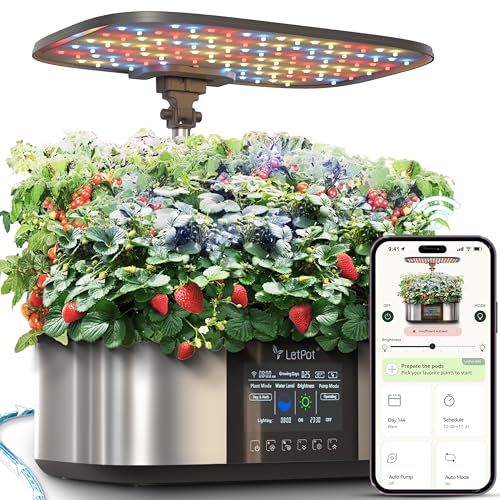
The LetPot Max Hydroponics Growing System is the buy when automation features matter more than brand authority at the countertop tier. At $251.99, the LetPot Max delivers app control plus a touchscreen, automatic water refilling via drip irrigation, and automatic nutrient dosing — features the Click & Grow Smart Garden 9 at the same price tier doesn't include. Reviewed's August 2024 hands-on described the LetPot Max as "tons of value and ships with a highly tweakable selection of parts, with different configurations for up to 21 smaller plantings — or two big ones" — that's the right framing. The 21 + 2 pod configuration is the most flexible at the countertop tier: run 21 small herbs and salad greens for kitchen use, or convert to 2 large pods for tomatoes, peppers, or larger leafy crops. The 36W full-spectrum LED is sized for the tray, the 7.5 L tank reduces refill frequency, and the auto-nutrient dosing handles a maintenance task that ends most indoor-garden buyer journeys.
The trade-offs are brand authority and editorial consensus. LetPot is a newer brand, and major editorial coverage outside Reviewed is thin — CNN Underscored, WIRED, and Good Housekeeping have not covered the unit. Setup is more complex than Click & Grow Smart Garden 9 — initial nutrient pump priming, app pairing, and configuration take 30–45 minutes vs. Click & Grow's 10 minutes. Yield ceiling is lower than freestanding vertical systems — the Lettuce Grow Farmstand Nook at 20 plants in a tower delivers more harvest volume than the LetPot Max at 21+2 pods on a tray. Open-seed compatibility is the ecosystem-risk advantage that makes the LetPot the right answer for buyers who learned the AeroGarden lesson and want minimum proprietary dependency at the countertop tier.
What We Love
- 21 small + 2 large pod configuration — most flexible countertop tray in this guide
- App control plus onboard touchscreen — local control without phone dependency
- Automatic water refilling via drip irrigation system
- Automatic nutrient dosing — handles a task that ends most indoor-garden journeys
- 7.5 L tank reduces refill frequency to roughly weekly
- Open-seed compatible — minimum proprietary dependency for ecosystem-risk-conscious buyers
- Best automated countertop value at $251.99 on Amazon
What Could Be Better
- Major editorial coverage is thin — primarily Reviewed, not CNN Underscored or Good Housekeeping
- Setup more complex than Click & Grow — 30–45 minutes vs. 10 minutes
- Yield ceiling lower than freestanding vertical systems like Lettuce Grow Farmstand Nook
- No native Alexa, Google, or HomeKit support — LetPot proprietary app only
The Verdict
The LetPot Max Hydroponics Growing System is the buy when you want auto-refill and auto-nutrient at the countertop tier without paying $400+ for the privilege. The 21+2 pod flexibility, 7.5 L tank, app plus touchscreen control, and open-seed compatibility delivers serious automation features at $251.99 — the best automation-per-dollar in this guide. Skip it for stronger editorial consensus (the Click & Grow Smart Garden 9 at $249.95 is the brand-authority alternative) or for grocery-replacement capacity (the Lettuce Grow Farmstand Nook at 20-plant tower is the right step up). For automation-first countertop buyers, the LetPot Max Hydroponics Growing System is the buy.
Get If / Skip If
Get if: You want auto-refill and auto-nutrient at countertop pricing, you value flexible pod configuration over fixed pod count, and ecosystem independence is a buying criterion. The LetPot fits the brief for automation-first buyers at $250.
Skip if: You want the simplest setup (Click & Grow Smart Garden 9 is the 10-minute beginner pick), you want grocery-replacement capacity (Lettuce Grow Farmstand Nook), or brand authority is a must-have buying criterion.
When NOT to Buy
Skip if you only want occasional basil — a $20 grocery-store herb bundle covers it without the smart-appliance overhead. Skip if you can't tolerate bright LED grow lights spilling into living spaces; even kitchen-friendly picks are noticeably bright in evening hours. Skip if recurring costs are a deal-breaker — pods, seedlings, nutrients, and AI memberships add $15–$60/month on hardware. Skip if ecosystem independence matters; only Rise Garden 3 and LetPot Max accept bare seed and open nutrients. Skip AeroGarden until support status is re-verified post-shutdown. Skip fogponic systems like Plantaform for unventilated apartments — WIRED flagged air-quality risks.
Frequently Asked Questions
What is the best smart greenhouse or grow system for home use in 2026?
The Lettuce Grow Farmstand Nook is the best smart indoor grow system for most homes in 2026 — 8.7 on the SHE Smart Grow Readiness Score, 20-plant compact tower, pre-grown seedlings that ship ready to plant, integrated LEDs, app-controlled smart-plug scheduling, and no required AI subscription. CNN Underscored named it the top hydroponic indoor garden in March 2025 specifically for the success rate on first harvest, and Good Housekeeping included it in the 2026 indoor-herb-garden roundup. For households that want true sensor-aware AI automation rather than app-control tier scheduling, Gardyn Home Kit 4.0 is the AI-tier alternative; for households that want maximum yield, Rise Garden 3 scales to 108 plants.
What is the smartest indoor garden?
Gardyn Home Kit 4.0 is the smartest indoor garden in this guide — Tier 5 AI-assisted automation depth, two onboard cameras plus environmental sensors, Kelby AI predictive health alerts, and vision-based plant identification. WIRED's 9/10 review specifically called out the cameras-and-sensors-driven app adjustments as the differentiator. The trade-off is the $29–$39/month Kelby AI membership effectively required for full functionality and the proprietary yCube pod system. AC Infinity AI Cultivator matches Gardyn on automation depth but in a 2x4 ft grow tent rather than a kitchen-friendly tower form factor — different category, similar AI tier.
Do smart indoor gardens save money on groceries?
Most do not, and buyers should price these as convenience products rather than ROI plays. The honest math: a $799 Lettuce Grow Farmstand Nook at full 20-plant capacity produces roughly 6–8 plants of leafy greens per harvest cycle, and seedling refreshes run $30–$36/month at full capacity. Realistic household yield runs 20–30% of theoretical capacity according to the marketing-versus-reality pattern across this category. Hardware payback at "$5/week of grocery savings" is an unrealistic frame for most households. The right framing is convenience — fresh herbs and greens on demand, garden-to-table aesthetics, and the satisfaction of growing food at home. If grocery savings is the primary criterion, this category is not the right answer.
Gardyn vs Lettuce Grow: which is better?
Gardyn Home Kit 4.0 is better for buyers who want AI-tier sensor-aware automation as a primary feature; Lettuce Grow Farmstand Nook is better for buyers who want reliable greens with the lowest maintenance burden and no monthly subscription. Gardyn at $899 carries 30-plant capacity in 2 sq ft, two onboard cameras, the Kelby AI assistant with predictive health alerts, and a $29–$39/month membership effectively required for full AI functionality. Lettuce Grow at $749 carries 20-plant compact-tower capacity, pre-grown seedlings that ship ready to plant, app-controlled smart-plug scheduling, and no required subscription. WIRED rates Gardyn at 9/10 and CNN Underscored ranks Lettuce Grow as the #1 hydroponic indoor garden — both are correct picks, just for different buyers. The decision question: do you value AI guidance enough to pay $35/month indefinitely?
Is Gardyn or Lettuce Grow easier to maintain?
Both land in the low-maintenance tier in this guide, but they get there differently. The Lettuce Grow Farmstand Nook ships pre-grown seedlings that drop straight into the tower, which removes germination failure — the most common reason buyers abandon an indoor garden early. The Gardyn Home Kit 4.0 leans on its Kelby AI assistant to surface watering, nutrient, and harvest tasks through predictive alerts, so the app prompts you when to act rather than removing the step. If your priority is the fewest things that can go wrong at the start, Lettuce Grow's pre-grown seedling model is the more forgiving path; if you want the system to actively coach you through care, Gardyn's guided approach fits better. Either way, both sit well below the maintenance burden of scaled systems like the Rise Garden 3 or the AC Infinity grow tent.
Does Gardyn or Lettuce Grow lock you into proprietary supplies?
Gardyn carries the heavier ecosystem lock-in of the two. The Gardyn Home Kit 4.0 uses proprietary yCube pods with no third-party alternatives, and full AI functionality effectively requires an ongoing Kelby membership — so both the consumables and the smart features tie you to the Gardyn platform. The Lettuce Grow Farmstand Nook has no required subscription; its recurring cost is the pre-grown seedlings, but you are not locked into a hardware-dependent pod or a paid app tier to keep the system running. For buyers weighing platform-continuity risk — the lesson from the AeroGarden shutdown covered in this guide — Lettuce Grow sits lower on proprietary dependency than Gardyn, while Rise Garden 3 and LetPot Max sit lower still because they accept bare seed and open nutrients.
Lettuce Grow vs Rise Garden: which produces more?
Rise Garden 3 produces more at maximum configuration — up to 108 plants across three levels versus 20 plants in the Lettuce Grow Farmstand Nook compact tower. The realistic household-yield comparison is closer than the marketing numbers suggest: Lettuce Grow at full 20-plant capacity produces 6–8 plants per harvest cycle, while Rise Garden 3 at single-level entry configuration produces 6–10 plants per cycle and scales linearly to 108 at three-level full configuration. For households with the floor space, time, and gardening experience to run three levels, Rise Garden 3 is meaningfully more productive. For most households running entry or mid-tier configurations, the per-cycle yield difference is smaller than the capacity numbers suggest.
Are smart grow systems compatible with Alexa, Google Home, HomeKit, or Matter?
Mostly no. Among the seven systems in this guide, only Rise Garden 3 ships native Alexa voice control. The other six — Lettuce Grow Farmstand Nook, Gardyn Home Kit 4.0, Click & Grow Smart Garden 9, LetPot Max Hydroponics Growing System, VIVOSUN VGrow Smart Grow Box, and AC Infinity AI Cultivator 2-Plant Kit — run through their own proprietary apps with no native Alexa, Google Home, HomeKit, or Matter support. This is the category-wide automation gap; smart-home integration is the dimension where this category is genuinely behind smart lighting, smart plugs, and smart thermostats. For buyers who specifically need Alexa voice control on their indoor garden, Rise Garden 3 is the only direct answer.
Is a smart grow tent better than a smart indoor garden?
Different products entirely — a smart indoor garden is a furniture-grade kitchen appliance for greens and herbs, while a smart grow tent like the AC Infinity AI Cultivator 2-Plant Kit or VIVOSUN VGrow Smart Grow Box is a dedicated cultivation chamber for serious crop work past kitchen herbs. The right answer depends on the goal. For greens, herbs, and a residential aesthetic on a kitchen counter or in a living-room corner, an indoor garden like Lettuce Grow Farmstand Nook or Gardyn Home Kit 4.0 is the right product. For fruiting crops, flowering crops, climate-controlled cultivation, and crop flexibility past kitchen herbs in a basement, garage, or grow-room space, a smart grow tent is the right product. Most buyers want the indoor garden category; experienced cultivators with dedicated space want the grow tent.
What is the best smart garden for apartments?
Click & Grow Smart Garden 9 is the best smart garden for apartments at $249.95 — 9-pod countertop format, 23.6 x 7.5 x 15.8 in footprint, passive wicking with no pump noise, 10-minute setup, and CNN Underscored beginner pick credentials. The compact form factor fits any kitchen counter without dominating the space. For apartments with a bit more counter footprint and budget, Lettuce Grow Farmstand Nook delivers 20-plant capacity in a compact vertical tower at 4 ft 7 in. For apartments where 30-plant density in 2 sq ft is the priority, Gardyn Home Kit 4.0 is the highest space efficiency in the lineup at 15 plants per square foot of floor space. Avoid the grow-tent picks for apartment use — 2x4 ft footprint and bright LED light spillage are not apartment-friendly.
Are AeroGarden models still safe to recommend?
Not until support status is re-verified. The Verge reported in October 2024 that AeroGarden was winding down app servers and warranty support on a 90-day notice, leaving buyers mid-warranty with proprietary seed pods and an uncertain platform future. Until AeroGarden, its parent company, or a successor publicly commits to multi-year app server uptime, replacement-pod availability, and warranty fulfillment, the platform carries unresolved continuity risk that the systems in this guide do not. The lesson for 2026 buying decisions: weight ecosystem and consumables risk into the purchase math. Lettuce Grow Farmstand Nook, Rise Garden 3, and LetPot Max sit lower on proprietary dependency than AeroGarden did; Gardyn Home Kit 4.0 has higher proprietary dependency but a stronger venture-backed platform position. Match the ecosystem-risk tolerance to the platform.
Are fogponic gardens safe indoors?
Fogponic gardens like the Plantaform Smart Indoor Garden carry air-quality risk in small unventilated apartments according to WIRED's June 2025 review, which flagged the system as "rewarding but risky" specifically for spaces without dedicated ventilation. Fogponics aerosolizes nutrient solution into a fine mist that the roots absorb, and the same mist can settle on surrounding surfaces or carry into ambient air in poorly-ventilated spaces. For typical apartment kitchens without exhaust ventilation near the unit, standard hydroponic systems like Lettuce Grow Farmstand Nook, Rise Garden 3, or LetPot Max are the safer choice. For homes with dedicated ventilation paths or basement install locations where humidity and aerosol management are not constraints, fogponic systems can work — but the apartment-friendly picks in this guide are the right answer for most buyers.
Bottom Line
The defining trade-off in 2026 smart indoor grow systems isn't which product wins per category — it's which automation tier matches the way you actually want to grow. The SHE Smart Grow Readiness Score quantifies automation depth, real edible output, maintenance burden, space efficiency, ecosystem risk, and expert consensus into a single 0–10 number, and the rankings collapse onto the five-tier automation ladder by buyer profile.
Get the Lettuce Grow Farmstand Nook if you want reliable greens and herbs at the lowest maintenance burden, your household is two-to-four people, and you don't want a monthly AI subscription — pre-grown seedlings, 20-plant capacity, integrated LEDs, and the strongest editorial consensus in the lineup at $749.
Get the Gardyn Home Kit 4.0 if you want true sensor-aware AI automation as a primary feature, you'll pay $35/month for the Kelby AI membership, and 30 plants in 2 sq ft is the right capacity for your space — the WIRED 9/10 AI-tier indoor garden at $899.
Get the Rise Garden 3 if you're an experienced gardener with furniture-grade floor space who wants maximum yield at 108 plants and accepts the maintenance overhead — modular three-level configuration, 195W full-spectrum lighting, native Alexa support, and bare-seed compatibility at $1,499.
Get the AC Infinity AI Cultivator 2-Plant Kit if you have basement or garage space, you want crop flexibility past kitchen herbs, and AI-driven environmental automation matters as a buying criterion — complete 2x4 ft tent system, 280W EVO LED, AI Controller dynamic learning at $999.
Get the VIVOSUN VGrow Smart Grow Box if you want enclosed single-plant cultivation in a furniture-sized cabinet with horticultural-grade Samsung lighting, multi-layer airflow, and full crop-method flexibility at $599.
Get the Click & Grow Smart Garden 9 if you're a first-time indoor-garden buyer who wants the simplest countertop format — 9-pod passive wicking, 10-minute setup, CNN Underscored beginner pick at $249.95.
Get the LetPot Max Hydroponics Growing System if you want auto-refill and auto-nutrient at countertop pricing without paying $400+ for the privilege — 21+2 pod flexibility, 7.5 L tank, app plus touchscreen, open-seed compatibility at $251.99.
The Lettuce Grow Farmstand Nook is the headline pick for most households in 2026 — the right balance of automation, capacity, maintenance, and ecosystem independence at a price that survives the abandonment cliff. Step up to the Gardyn Home Kit 4.0 for AI-tier monitoring, step out to the Rise Garden 3 for maximum yield, step over to the AC Infinity AI Cultivator or VIVOSUN VGrow for serious cultivation past kitchen herbs, or step down to the Click & Grow Smart Garden 9 or LetPot Max for the countertop tier. Match the automation depth to the way you'll actually grow and the per-product picks fall out naturally.
Sources & Methodology
This guide aggregates expert review data across 20 expert sources — CNN Underscored "best hydroponic indoor gardens 2025" coverage of Lettuce Grow Farmstand Nook (top pick), Click & Grow Smart Garden 9 (beginner pick), and Rise Garden 3 (experienced-gardener pick); Good Housekeeping 2026 indoor-herb-garden roundup naming Lettuce Grow and Gardyn Home; WIRED 9/10 review of Gardyn Home 4.0 and standalone Lettuce Grow Indoor Farmstand review; The Verge Gardyn Studio 2 hands-on plus the October 2024 AeroGarden shutdown report; Reviewed LetPot Max hydroponic indoor-garden review; MIGRO YouTube VIVOSUN VGrow review; plus six manufacturer-page citations from Lettuce Grow, Gardyn, Rise Gardens, Click & Grow, LetPot, VIVOSUN, and AC Infinity — and the WIRED Plantaform fogponic review for the air-quality cautionary signal. Twenty-six sources total. Prices checked 2026-05-04 against Amazon listings via the Amazon Creators API. The SHE Smart Grow Readiness Score is SmartHomeExplorer editorial analysis with full methodology at /methodology and /metrics/she-smart-grow-readiness-score.
Next-step reading:
- Best Smart Indoor Hydroponic Garden Systems 2026 — sibling spoke covering hydroponic-only configurations
- Best Smart Planters for Indoor Gardens 2026 — single-pot smart planters when full grow systems are overkill
- Best Smart Garden Plant Monitors 2026 — sensors that pair with any of the systems above for soil/light tracking
- Best Smart Portable Outdoor Refrigerators and Coolers 2026 — outdoor cooling for the surrounding kitchen-garden stack
- Best Smart Pergola Accessories 2026 — shades, heaters, and lighting for outdoor structures above grow systems
Disclosure: SmartHomeExplorer.com earns affiliate commissions from qualifying Amazon purchases. This doesn't influence our rankings — our methodology is published at /methodology.
Nicholas Miles is the founder of SmartHomeExplorer.com. Nick has covered smart home technology across 1,610 smart home products and 347 buying guides.