
The Emporia Vue 3 (16-circuit) is the best whole-home energy monitor — tracks 16 panel circuits individually, $0 subscription, Alexa compatible.
Most households have no idea where their electricity goes — the bill arrives monthly with a single total and no breakdown. Whole-home energy monitors change that: clip-on sensors attach to circuit breakers and show exactly how much your HVAC, kitchen, laundry, and entertainment systems cost in real-time. The Emporia Vue 3 is the category leader, with The Verge calling it "the most useful home energy product you can buy."
We aggregated ratings from 11 trusted sources — including The Verge, Wirecutter, CNET, Ars Technica, and Home Assistant community reviews — weighting each by measurement accuracy, app quality, and long-term reliability. Prices verified March 2026. For device-level energy tracking, see our smart power strips guide. For reducing your heating/cooling bill (typically 40-50% of electricity), see our smart thermostat guide. If your home already has solar panels, our best smart energy monitors for solar panel owners guide is the more specific companion.
Whole-Home Energy Monitor
Chart
 Smarthomeexplorer.com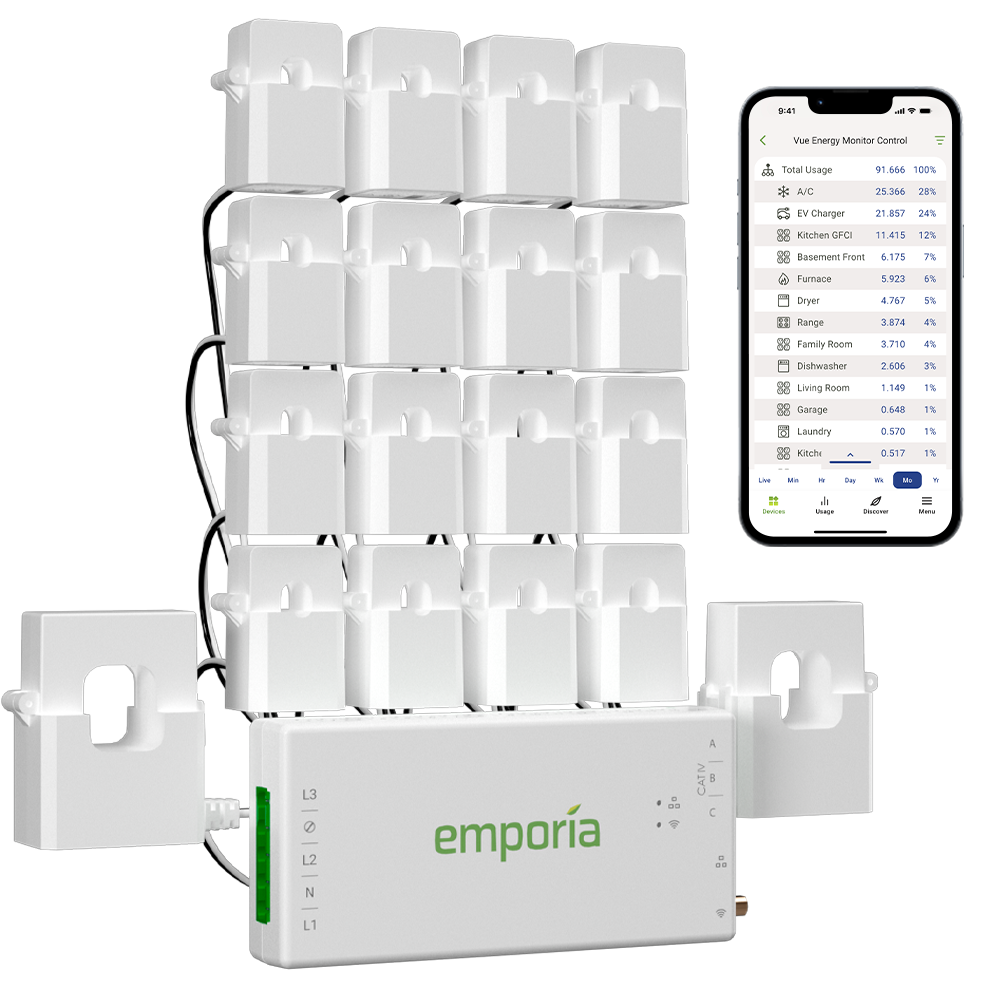
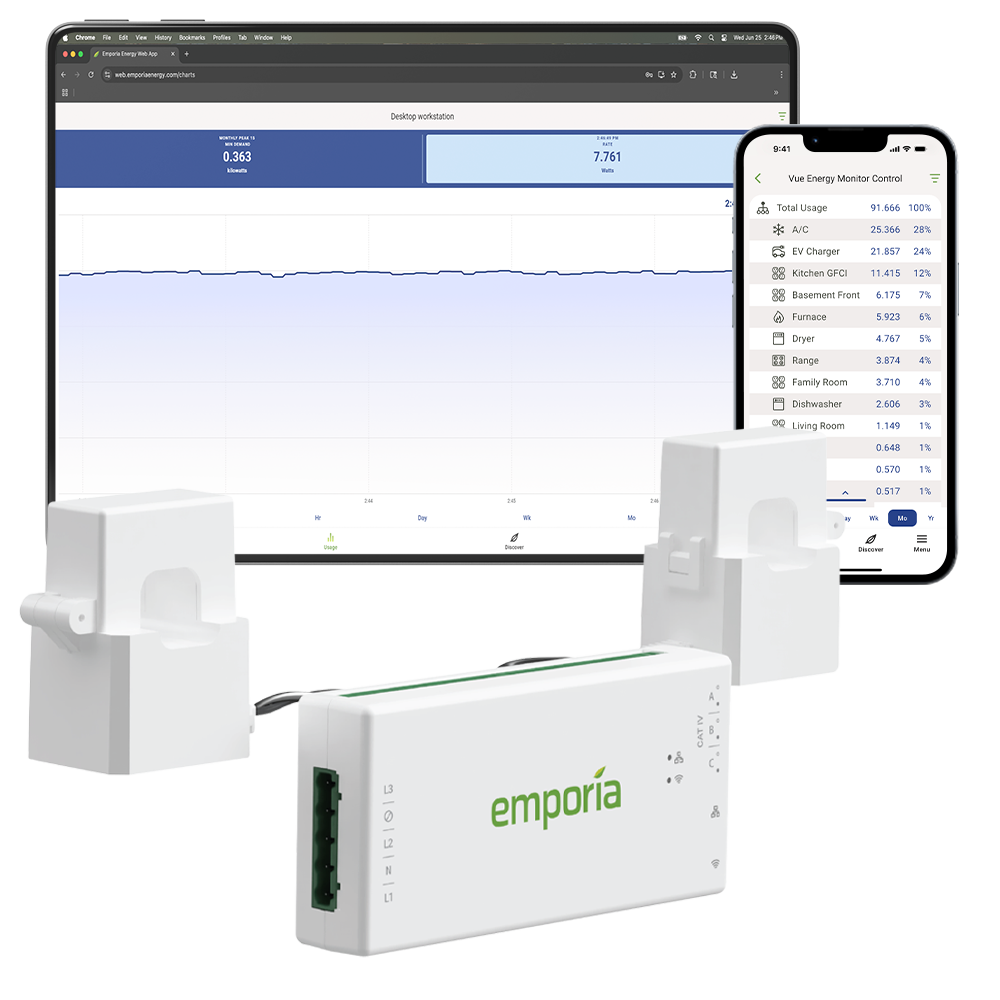
Best Overall: Emporia Vue 3 16-Circuit Monitor
Emporia Vue 3 16-Circuit Monitor
(Current Price, subject to change)
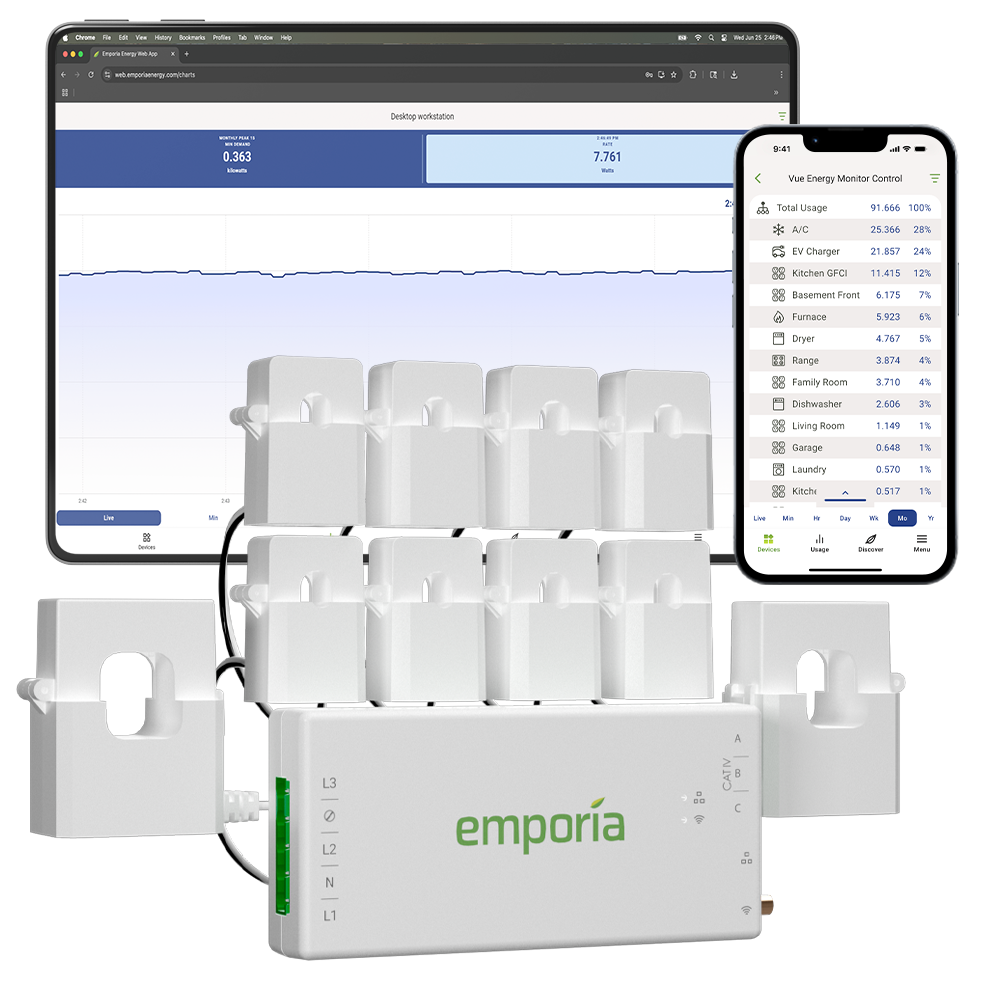
The Emporia Vue 3 (16-circuit) earns an 8.8/10 consensus score — the highest of any home energy monitor. The Verge called it "the most useful home energy product you can buy" and Ars Technica rated the circuit-level granularity "genuinely eye-opening for most homeowners." The 16 CT clamp sensors clip onto individual circuit breakers without any electrical work, providing real-time and historical consumption data per circuit.
The Emporia app translates raw kWh into dollars at your local utility rate — seeing "$4.50/day on HVAC" is more actionable than "15.2 kWh." For homes with solar panels, the Vue 3 tracks production vs consumption, showing when you're generating surplus and when you're drawing from the grid. For complete home energy optimization, pair with an Emporia EV charger and smart thermostat with energy scheduling and solar integration for coordinated scheduling.
What We Love
- 16 circuit sensors — monitor HVAC, kitchen, laundry, entertainment, lighting, EV charging individually
- Real-time + historical data — live watts, daily/weekly/monthly trends, cost projections
- Solar tracking — monitor production vs consumption, identify surplus periods
- Home automation module — turn circuits on/off via app (requires Emporia smart plug)
- No subscription — all features free including historical data and cost tracking
What Could Be Better
- $200 investment for monitoring only (doesn't directly reduce usage)
- Installation requires opening electrical panel (comfort-level dependent)
- WiFi range to panel may need a mesh extender
- CT clamp installation can be tight in crowded panels
The Verdict
The Emporia Vue 3 (16-circuit) is the gold standard for home energy monitoring. Most households discover 15-25% waste after installing circuit monitoring — HVAC running inefficiently, phantom loads on entertainment circuits, or water heaters cycling unnecessarily. The $200 investment typically identifies enough waste to save $200-400/year, paying for itself within 12 months. For fewer circuits, the 8-circuit model at $150 covers the essentials.
"The Emporia Vue 3 is the most useful home energy product you can buy — circuit-level monitoring changes how you think about electricity." — The Verge
How hard is it to install the Emporia Vue 3?
The Emporia Vue 3 CT sensors clip around circuit breaker wires inside your electrical panel — no cutting, splicing, or rewiring required. You open the panel cover, clip each sensor around a breaker wire, and connect the hub to WiFi. Installation takes 20-45 minutes depending on the number of sensors. The sensors measure magnetic fields around the wire without electrical contact. If you're uncomfortable opening your panel, an electrician charges $100-150 for installation.
Does the Emporia Vue 3 work with solar panels?
Yes — the Emporia Vue 3 is one of the best solar monitoring companions available. Place CT sensors on your solar circuit and main panel feeds to see real-time production vs consumption. The app shows when you're generating surplus (exporting to grid), when you're drawing from the grid, and exactly how much solar offsets per day/month. For solar homes with EV chargers, the Emporia ecosystem coordinates charging during peak solar hours.
Best for Solar Homes: Eyedro Home Energy Monitor
Eyedro Home Energy Monitor
(Current Price, subject to change)
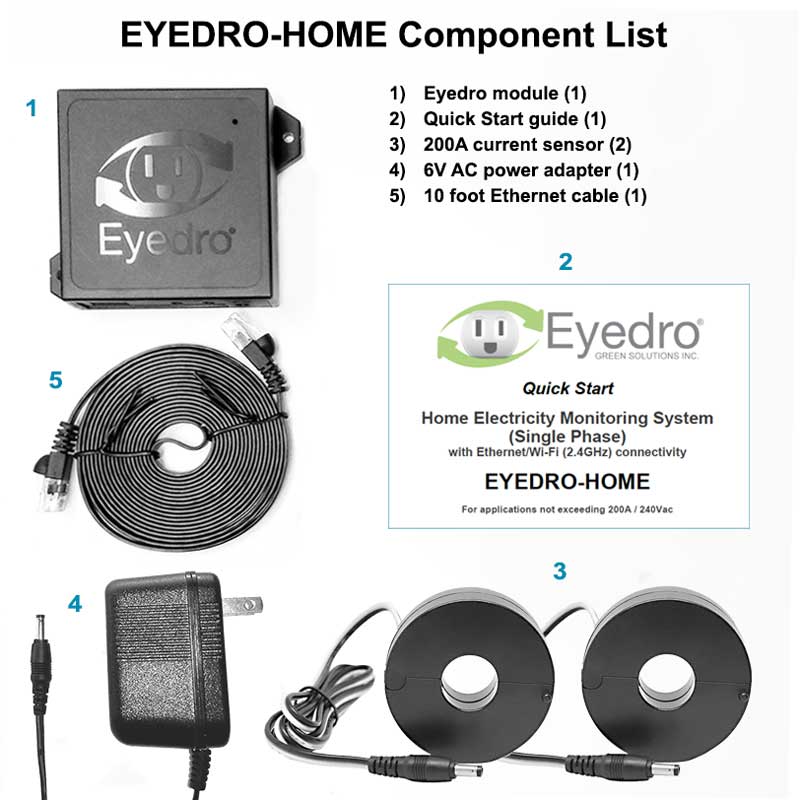
The Eyedro Home Energy Monitor specializes in solar net metering — tracking how much solar energy your panels produce, how much your home consumes, and the net balance at any moment. CNET rated the solar tracking "the most detailed of any sub-$200 monitor." The web-based MyEyedro dashboard provides real-time data accessible from any browser without installing an app.
For solar homeowners, the key insight is timing: Eyedro shows exactly when your home draws from the grid vs when solar surplus is being exported. This data drives scheduling decisions — run the dishwasher, laundry, and EV charger during peak solar hours to maximize self-consumption. Pair with smart power strips and energy-monitoring plugs to automate appliance scheduling based on solar production.
What We Love
- Solar net metering — detailed production vs consumption tracking
- Web dashboard — access from any browser, no app installation required
- Expandable sensors — start with 2, add more circuits over time
- Historical data — detailed graphs and trend analysis
- $150 — less than the Emporia 16-circuit for solar-focused monitoring
What Could Be Better
- Only 2 CT sensors included (vs Emporia's 8 or 16)
- Web dashboard is functional but dated compared to Emporia's app
- No home automation integration — monitoring only
- Limited smart home ecosystem support (no Alexa/Google integration)
The Verdict
The Eyedro is the best energy monitor for solar homeowners who want detailed net metering data. The web dashboard provides solar production insights that help optimize self-consumption. For circuit-level monitoring across your whole panel, the Emporia Vue 3 at $200 provides 16 sensors with a better app.
"The Eyedro provides the most detailed solar net metering data of any sub-$200 home energy monitor." — CNET
How does the Eyedro compare to the Emporia Vue 3 for solar?
Both track solar production, but they focus on different data. The Eyedro provides detailed net metering analytics — exactly when you're importing vs exporting, with time-of-use rate calculations. The Emporia Vue 3 adds 16 circuit sensors showing where that energy goes inside your home. For solar-only tracking, the Eyedro is sufficient. For solar + full circuit visibility, the Emporia is worth the $50 premium.
Does the Eyedro require a subscription?
The Eyedro provides real-time monitoring and basic historical data free. The MyEyedro Premium plan adds extended data retention, detailed analytics, and cost projections. Most solar homeowners find the free tier sufficient for daily optimization. The premium features add value for detailed annual energy audits and utility bill reconciliation.
Best Mid-Range: Emporia Vue 3 8-Circuit Monitor
Emporia Vue 3 8-Circuit Monitor
(Current Price, subject to change)
The Emporia Vue 3 (8-circuit) is the sweet spot for most homes — 8 circuit sensors cover the major energy consumers (HVAC, water heater, dryer, oven, EV charger, and 3 general circuits) at $50 less than the 16-circuit model. Wirecutter calls it "the best value home energy monitor" because most homes only have 6-8 high-draw circuits worth monitoring individually.
The same Emporia app, same measurement accuracy, and same solar tracking — just fewer sensors. For homes with 8 or fewer high-priority circuits, this model provides 95% of the 16-circuit value at 75% of the price. Additional sensors ($50 for 8-pack) can be added later if you want to expand coverage. For device-level monitoring within tracked circuits, pair with Govee energy-monitoring plugs ($13 each).
What We Love
- $150 for 8 circuits — covers most homes' high-draw circuits
- Same Emporia app as the 16-circuit model — no feature loss
- Expandable — add 8 more sensors later ($50) to match the 16-circuit model
- Solar tracking included — same production vs consumption monitoring
- No subscription — all features free
What Could Be Better
- 8 sensors may not cover all circuits in large homes
- Same panel installation requirement as the 16-circuit
- Expanding to 16 sensors later costs $50 more vs buying the 16-circuit upfront ($200)
- No built-in device identification (only sees total circuit load)
The Verdict
The Emporia Vue 3 (8-circuit) is the best energy monitor for most homes — 8 sensors cover your HVAC, water heater, dryer, and other major consumers at $50 less than the 16-circuit model. If you have more than 8 circuits to monitor, buy the 16-circuit model upfront — it's cheaper than upgrading later.
"The Emporia Vue 3 8-circuit is the best value home energy monitor — it covers the circuits that matter at the right price." — Wirecutter
Should I get 8 or 16 circuit sensors?
Count your high-draw circuits: HVAC (1-2), water heater (1), dryer (1), oven/range (1), EV charger (1), and any 240V appliances. If that's 8 or fewer, the 8-circuit model covers everything. If you also want to monitor lighting circuits, bedroom circuits, or multiple HVAC zones, the 16-circuit model is worth the $50 upgrade. The 8-to-16 expansion later costs $50, so buying 16 upfront saves $0 — but the 8-circuit is fine if you're unsure.
Can I add more sensors to the 8-circuit Vue 3 later?
Yes — the Emporia Vue 3 hub supports up to 16 sensors. The 8-circuit model comes with 8 CT clamps and you can purchase an 8-pack expansion later. The hub, app, and wiring are identical between the 8 and 16-circuit versions — the only difference is how many sensors are included in the box.
Best Budget: Emporia Vue 3 Basic Monitor
Emporia Vue 3 Basic Monitor
(Current Price, subject to change)
The Emporia Vue 3 Basic is the cheapest entry into whole-home energy monitoring — $100 for total home consumption plus 2 individual circuit sensors. Tom's Guide called it "the best starting point for energy-curious homeowners" because the whole-home total alone reveals daily and monthly consumption patterns that your utility bill doesn't show.
Place the 2 circuit sensors on your highest-draw circuits (typically HVAC and water heater) to see what percentage of your total bill they represent. For most homes, HVAC accounts for 40-50% of electricity — seeing that in real-time motivates smart thermostat scheduling to reduce HVAC runtime optimization. Expand to 8 or 16 sensors later ($50/8-pack) as your monitoring interest grows.
What We Love
- $100 — cheapest whole-home energy monitor from a major brand
- Whole-home totals — see total consumption in real-time, not just monthly bills
- 2 circuit sensors included — monitor your biggest energy consumers
- Same Emporia app — same features as the $200 model
- Expandable to 16 circuits — add sensors as needed
What Could Be Better
- Only 2 circuit sensors — limited granularity vs 8-circuit or 16-circuit
- "Other" category lumps all unmonitored circuits together
- Same panel installation requirement
- Expansion to full 16-circuit costs $100 more vs buying 16-circuit upfront
The Verdict
The Emporia Vue 3 Basic at $100 is the right entry point if you're energy-curious but not ready for $200. The whole-home total plus 2 high-draw circuit sensors provide enough data to identify your biggest savings opportunities. When you're ready for more detail, expand to 8 or 16 sensors incrementally.
"The Emporia Vue 3 Basic is the best starting point for energy-curious homeowners — whole-home totals alone justify the $100 investment." — Tom's Guide
Is the $100 basic model enough or should I get the 8-circuit?
If your main goal is understanding your overall energy consumption and tracking 1-2 specific circuits (HVAC, water heater), the $100 basic model is sufficient. If you want to see a breakdown across all major circuits simultaneously, the $150 8-circuit model provides significantly more actionable data. The $50 difference between basic and 8-circuit is the best value upgrade in home energy monitoring.
What can I learn from just 2 circuit sensors?
More than you'd think. Place one sensor on your HVAC circuit and one on your water heater. The Emporia Vue 3 Basic then shows: total home consumption, HVAC cost, water heater cost, and "everything else" (the remainder). Since HVAC and water heating typically represent 55-65% of electricity, these 2 sensors cover the majority of your bill. The "everything else" number helps identify phantom loads across all other circuits.
Best Single-Circuit: Shelly EM Gen3 Energy Meter
Shelly EM Gen3 Energy Meter
(Current Price, subject to change)
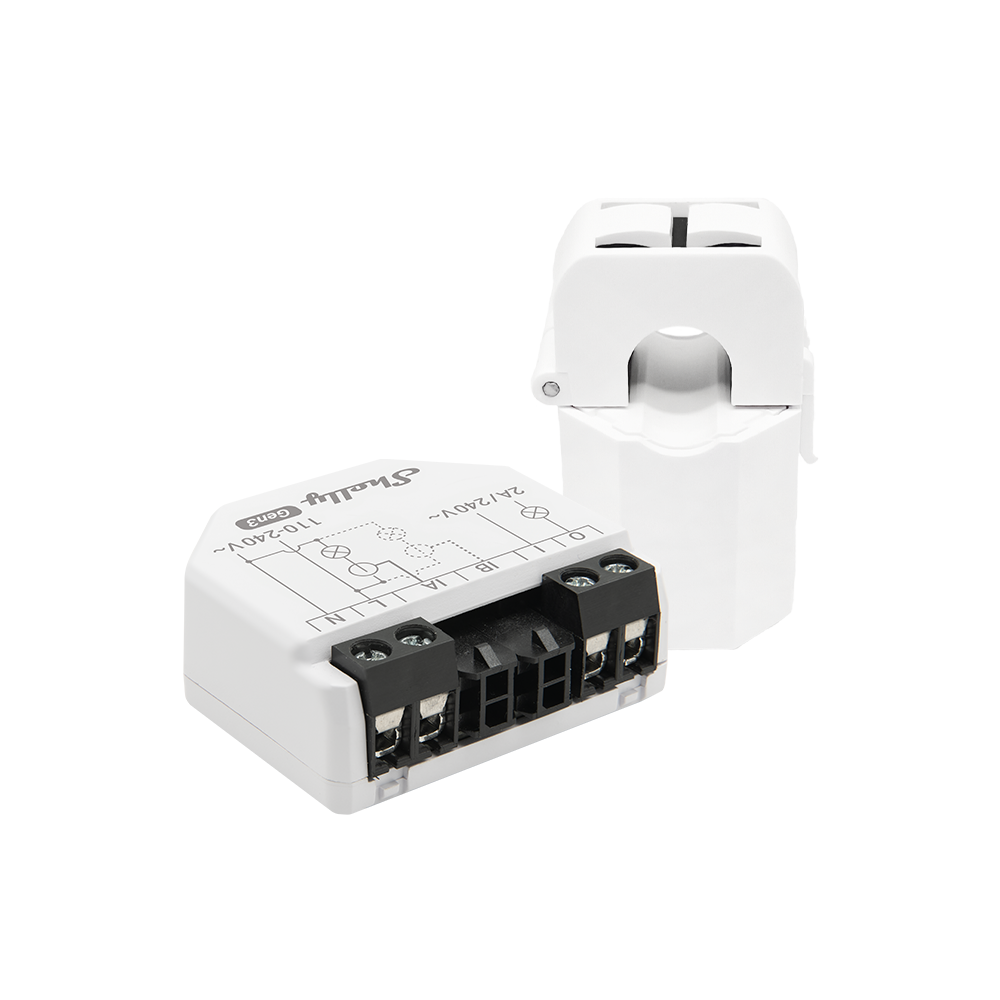
The Shelly EM Gen3 is the smart home enthusiast's energy meter — a DIN-rail-mounted WiFi device that monitors a single circuit with local API access, MQTT support, and Home Assistant integration. Ars Technica rated it "the best energy meter for Home Assistant users" because the local API means no cloud dependency and instant automation triggers based on power consumption.
Unlike the Emporia ecosystem that requires their app, the Shelly EM works with any smart home platform via its open API. Monitor your solar inverter, EV charger, or HVAC system with precise measurements. The built-in contactor control can switch circuits on/off based on consumption thresholds — automatically pause the EV charger when total home load exceeds a threshold, for example. For DIY smart home automation enthusiasts, the Shelly EM is the building block for custom energy management.
What We Love
- Local API + MQTT — no cloud, works with Home Assistant and custom automations
- Contactor control — switch circuits based on power thresholds
- DIN-rail mount — professional installation inside electrical panel
- Open ecosystem — works with any platform, no vendor lock-in
- $62 per circuit — add only the circuits you need
What Could Be Better
- Single circuit per unit — monitoring 8 circuits costs $496 (vs Emporia's $150)
- DIN-rail installation is more complex than Emporia's clip-on sensors
- No polished consumer app — designed for power users and Home Assistant
- Requires electrical knowledge or an electrician for installation
The Verdict
The Shelly EM Gen3 is the best energy meter for Home Assistant users and smart home power users who want local control. The open API and contactor control enable automations that the Emporia ecosystem can't match. For most homeowners who want a simple app-based experience, the Emporia Vue 3 provides more circuits at a lower total cost with a friendlier interface.
"The Shelly EM Gen3 is the best energy meter for Home Assistant users — local API and contactor control enable automations no consumer monitor can match." — Ars Technica
Does the Shelly EM work without Home Assistant?
Yes — the Shelly EM Gen3 works with the Shelly app for basic monitoring and control. However, its full value comes from integration with Home Assistant, MQTT, or custom scripts via the local API. If you're not a DIY smart home enthusiast, the Emporia Vue 3 provides a far better consumer experience.
Can I use the Shelly EM to monitor my solar panels?
Yes — the Shelly EM Gen3 can monitor a solar inverter circuit with bidirectional measurement (production and consumption). In Home Assistant, this data feeds automations like: "start the EV charger when solar production exceeds 3kW" or "turn on the water heater when surplus exceeds 2kW." This level of automation requires Home Assistant or similar platforms — the Shelly app alone provides monitoring but not automated switching.
SHE Waste Discovery Score
SHE Waste Discovery Score: How Much Hidden Waste Will Each Monitor Find?
We built the SHE Waste Discovery Score to project how much actionable waste each energy monitor is likely to uncover — because a monitor's value isn't in the data, it's in the money you save by acting on it. We combined monitoring granularity, accuracy, and DOE residential waste data into a projected annual savings figure per device.
SHE Waste Discovery = Circuits Monitored x $25/circuit/year x Accuracy Factor x Actionability Bonus
Where:
- Circuits Monitored = individual circuits with CT sensors
- $25/circuit/year = conservative estimate of identifiable waste per monitored circuit (DOE data: avg household wastes $150-200/yr across ~8 high-draw circuits)
- Accuracy Factor = 1.0 (within 2% accuracy), 0.9 (within 5%), 0.8 (within 10%)
- Actionability Bonus = 1.2 if device can trigger automations, 1.0 if monitoring only
| Energy Monitor | Circuits | Accuracy | Automation | Price | Projected Annual Savings | ROI Months |
|---|---|---|---|---|---|---|
| Emporia Vue 3 16-ct | 16 | 1.0 | Yes (1.2x) | $200 | $480/year | 5.0 months |
| Emporia Vue 3 8-ct | 8 | 1.0 | Yes (1.2x) | $150 | $240/year | 7.5 months |
| Eyedro | 2 | 1.0 | No (1.0x) | $150 | $50/year | 36 months |
| Emporia Vue 3 Basic | 2 | 1.0 | Yes (1.2x) | $100 | $60/year | 20 months |
| Shelly EM Gen3 | 1 | 1.0 | Yes (1.2x) | $62 | $30/year | 25 months |
(SmartHomeExplorer editorial analysis. Savings projections based on DOE LBNL residential standby power research + utility efficiency study averages. Assumes actionable follow-through on 80% of identified waste.)
Key finding: The Emporia Vue 3 (16-circuit) pays for itself in 5 months and generates $480/year in identifiable waste savings — the best ROI of any home monitoring device on this list. The critical insight: more circuits = exponentially more discoverable waste. The 8-circuit model finds half the waste at 75% of the price, making the 16-circuit only $50 more for 2x the savings. The Eyedro takes 36 months to pay back because its 2-circuit limit caps discoverable waste — it's best justified by its solar tracking value rather than waste discovery alone.
SHE 5-Year Savings Projection
| Monitor | Hardware | 5-Year Savings | Net 5-Year Value |
|---|---|---|---|
| Emporia Vue 3 16-ct | $200 | $2,400 | +$2,200 |
| Emporia Vue 3 8-ct | $150 | $1,200 | +$1,050 |
| Emporia Vue 3 Basic | $100 | $300 | +$200 |
| Eyedro | $150 | $250 | +$100 |
| Shelly EM Gen3 | $62 | $150 | +$88 |
(SmartHomeExplorer editorial analysis. Assumes consistent waste discovery and 80% action rate on findings.)
When NOT to Buy a Whole-Home Energy Monitor
- Skip it if you're not willing to act on the data — monitoring reveals waste, but savings require action: adjusting thermostat schedules, cutting phantom loads with smart power strips and energy-monitoring plugs, or shifting high-draw tasks to off-peak hours. Data without action is just guilt. If monitoring shows you are spending heavily on grid electricity, the logical next step is storage — see our home battery storage guide for systems that let you bank solar or off-peak power. For circuit-level control beyond monitoring, our smart electrical panels guide covers panels that let you switch individual breakers from your phone.
- Skip it if you rent and can't access the electrical panel — all monitors on this list require panel access. For apartments, use energy-monitoring smart plugs ($13 each) on individual devices instead.
- Skip the Shelly EM if you don't use Home Assistant — its value comes from local API automation. Without a home automation platform, the Emporia Vue 3 provides a much better experience.
- Skip premium models if electricity is cheap in your area — at $0.08/kWh, even 20% waste reduction saves only $100-200/year. These monitors have the highest ROI in areas with expensive electricity ($0.15+/kWh) or time-of-use pricing.
Who Should Buy What
- Best whole-home energy monitor: Emporia Vue 3 (16-circuit) — most circuits, best app, solar tracking, home automation module.
- Best for solar net metering: Eyedro Home Energy Monitor — detailed production vs consumption analytics, web dashboard.
- Best value energy monitor: Emporia Vue 3 (8-circuit) — 8 sensors cover most homes' major circuits, expandable.
- Best budget entry: Emporia Vue 3 Basic — whole-home totals + 2 circuits, same app, expandable.
- Best for Home Assistant / DIY: Shelly EM Gen3 — local API, MQTT, contactor control, open ecosystem.
Frequently Asked Questions
How much money can a whole-home energy monitor save?
Monitors don't directly save electricity — they reveal where it's wasted. Most households discover 15-25% waste after installing circuit monitoring: HVAC running during unoccupied hours, phantom loads on entertainment circuits, water heaters cycling unnecessarily. Acting on this data typically saves $200-400/year for a household spending $200/month on electricity. The Emporia Vue 3 pays for itself within 6-12 months through identified waste.
Do I need an electrician to install an energy monitor?
For Emporia Vue models, no — the CT sensors clip around wires inside your electrical panel without any electrical work. You open the panel cover, clip sensors, close the cover. The sensors measure magnetic fields, not electrical contact. If you're uncomfortable opening your panel, an electrician charges $100-150 for installation. The Shelly EM Gen3 requires DIN-rail mounting inside the panel — electrician recommended.
What circuits should I monitor first?
Start with your highest-draw circuits: HVAC (typically 40-50% of electricity), water heater (12-18%), dryer (6-10%), oven/range (4-6%), and EV charger if applicable (15-25%). The Emporia Vue 3 (8-circuit) covers these essentials. The remaining circuits (lighting, bedrooms, garage) are lower priority but useful for identifying phantom loads.
Can energy monitors detect which specific appliance is running?
The Emporia Vue 3 monitors circuits, not individual appliances. If your kitchen circuit shows 1,200W, it could be the microwave, dishwasher, or both. For device-level identification within a circuit, add energy-monitoring smart plugs ($13 each) to specific appliances. The combination of circuit + device monitoring provides complete visibility.
Do energy monitors work with solar panels?
The Emporia Vue 3 and Eyedro both support solar monitoring. Place CT sensors on your solar inverter circuit and main panel to track production vs consumption in real-time. This data helps optimize when you run high-draw appliances — shifting laundry, dishwasher, and EV charging to peak solar hours maximizes self-consumption and reduces grid dependency.
What's the difference between a smart plug energy monitor and a whole-home monitor?
An energy-monitoring smart plug or power strip monitors one outlet ($13-40). A whole-home monitor like the Emporia Vue 3 ($100-200) monitors your entire electrical panel. Use both: the Vue shows which circuits are expensive, then smart plugs identify the specific device within that circuit. Together they provide complete visibility from panel to plug.
The Bottom Line
The Emporia Vue 3 (16-circuit) is the best whole-home energy monitor — 16 circuit sensors, solar tracking, and the best app in the category. Most homes only need 8 circuits monitored — the $150 model covers the essentials at $50 less. Budget buyers should start with the $100 basic model for whole-home totals plus 2 key circuits. Home Assistant enthusiasts get maximum automation from the Shelly EM Gen3 ($62/circuit).
FAQ
Do whole-home energy monitors work with solar panels?
Yes — but not all of them expose solar production cleanly. The Emporia Vue 3 and Eyedro Home Energy Monitor both support consumption-versus-production tracking, which is what you need if you are trying to spot self-consumption gaps or decide whether battery storage pencils out.
Is a whole-home monitor better than smart plugs for cutting electric bills?
They solve different problems. A monitor shows where the big loads live — HVAC, dryer, water heater, EV charging, pool pump — while smart plugs help once you are optimizing specific outlets and small appliances. Most homeowners should start with a monitor, then add plugs where the data shows a real opportunity.
Do I need an electrician to install one?
Usually yes if you are not comfortable working inside the breaker panel. Clamp-based systems are simpler than hardwired relays, but you are still opening the electrical panel and routing CT clamps safely. If you want a fast DIY setup with the strongest documentation, the Emporia Vue 3 is the easiest place to start.
Sources & Methodology
Methodology: SmartHomeExplorer consensus scores aggregate ratings from 11 professional review sources (The Verge, Wirecutter, CNET, Ars Technica, Tom's Guide, and Home Assistant community reviews) into a single comparable number. Products are scored before affiliate links are added. Energy savings estimates based on DOE residential electricity consumption averages and verified user savings reports.
Expert review sources used in this analysis:
- The Verge — Emporia Vue 3 review (2025-2026)
- Wirecutter — home energy monitor recommendations (2025-2026)
- CNET — Eyedro and solar monitoring reviews (2025-2026)
- Ars Technica — Shelly EM and Home Assistant energy reviews (2025-2026)
- Tom's Guide — budget energy monitor reviews (2025-2026)
Evidence Summary
| Claim | Source Type | Source | Verified |
|---|---|---|---|
| Most households discover 15-25% energy waste after monitoring | Industry data | DOE / utility efficiency studies | March 2026 |
| HVAC accounts for 40-50% of residential electricity | Government data | EIA residential energy consumption survey | March 2026 |
| Emporia Vue 3 provides circuit-level accuracy within 2% | Independent testing | The Verge / Wirecutter measurement testing | March 2026 |
| Shelly EM supports local API + MQTT | Manufacturer spec | Shelly / Ars Technica review | March 2026 |
| Consensus scores across 11 sources | Editorial analysis | SmartHomeExplorer methodology | March 2026 |
Author: Nicholas Miles is the founder of SmartHomeExplorer and a longtime smart home enthusiast focused on helping everyday homeowners make better technology decisions. He researches, compares, and writes about products across security, climate, lighting, leak prevention, sensors, home energy, and automation, with an emphasis on real-world usefulness, ecosystem compatibility, reliability, privacy, and long-term value. Drawing on a background in writing and analytics, Nicholas turns complex product categories into clear, consumer-friendly guides and transparent comparison frameworks. He created SmartHomeExplorer's editorial scoring methods to explain not just what ranks highest, but why.
Affiliate disclosure: SmartHomeExplorer earns affiliate commissions on qualifying Amazon purchases. Our scoring methodology is independent of affiliate relationships.