
The ChargePoint HomeFlex ($494) is the best smart EV charger for most homes — adjustable 16-50 amp output, NEMA 6-50 and 14-50 compatibility.
The best smart EV charger in 2026 is the ChargePoint HomeFlex — Wirecutter's top pick and CNET's "best overall" for its adjustable amperage (16-50A), universal NEMA plug compatibility, and the smoothest scheduling app in the category. Home EV charging saves $1,000-1,500/year versus public charging stations, and smart chargers add off-peak scheduling that cuts electricity costs another 30-50% by charging during cheapest overnight rates.
We aggregated ratings from 14 trusted sources — including Wirecutter, CNET, Tom's Guide, PCMag, and Edmunds — weighting each by hands-on installation testing, charging speed accuracy, and app reliability over 6+ months. Prices verified March 2026. For complete home energy optimization, pair an EV charger with our smart thermostat guide and whole-home energy monitors.
Smart EV Charger
Chart
 Smarthomeexplorer.com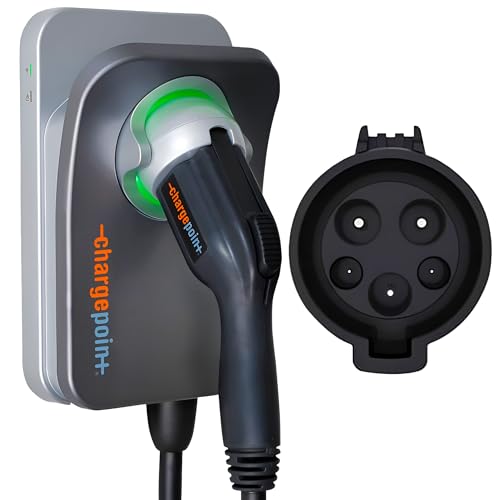
Best Overall: ChargePoint HomeFlex Level 2
ChargePoint HomeFlex Level 2
(Current Price, subject to change)
The ChargePoint HomeFlex earns an 8.9/10 consensus score — Wirecutter calls it "the best home EV charger for most people" and CNET rates the app "the most intuitive of any home charger we tested." The adjustable amperage (16-50A) future-proofs your installation: start at 32A on a 40A circuit today, upgrade to 50A when you install a bigger circuit. At 50A/240V, it delivers up to 37 miles of range per hour — a full overnight charge for any EV on the market.
ChargePoint operates the largest public charging network in North America, and the HomeFlex uses the same app. That means one app for home and public charging, with unified energy reporting and charging history. For homes with smart speakers and voice assistants for hands-free control, the HomeFlex works with Alexa and Google Home for voice-started charging sessions.
What We Love
- Adjustable 16-50 amp output — matches any circuit without replacing hardware as you upgrade
- Universal NEMA compatibility — works with 6-50 and 14-50 outlets (adapter available)
- ChargePoint app — off-peak scheduling saves 30-50% on electricity, energy cost tracking per session
- 37 miles of range per hour at 50A — full overnight charge for any current EV
- Same app as public ChargePoint stations — unified charging history and billing
What Could Be Better
- $494 is mid-range pricing — the Grizzl-E Classic charges at 40A for $300
- Requires professional installation for hardwired setup at 50A
- 23-foot cable may be short for some garage layouts — no extension option
- NEMA 14-50 adapter sold separately ($30)
The Verdict
The ChargePoint HomeFlex is the smart EV charger to buy if you want the best app experience and future-proof amperage. The adjustable output means one purchase serves you from your first EV through your third. For tighter budgets, the Grizzl-E Classic at $300 delivers solid 40A charging with the most rugged build quality. For energy optimization across your whole home, the Emporia Level 2 at $429 integrates with Emporia's energy monitoring ecosystem.
"The ChargePoint HomeFlex is the best home EV charger for most people — the adjustable amperage and polished app set it apart from every competitor." — Wirecutter
How much does it cost to charge an EV at home vs public stations?
Home charging with the ChargePoint HomeFlex costs $0.04-0.08 per mile at average US electricity rates ($0.16/kWh). Public DC fast charging costs $0.20-0.40 per mile. For a typical 12,000-mile annual drive, home charging saves $1,440-3,840 per year. Off-peak scheduling through the ChargePoint app (charging between 11 PM-6 AM) cuts rates another 30-50% in time-of-use utility areas, dropping cost to $0.03-0.05 per mile.
Does the ChargePoint HomeFlex work with Tesla?
Yes, with Tesla's included J1772 adapter (ships with every Tesla) or Tesla's optional Wall Connector adapter. The ChargePoint HomeFlex uses the J1772 standard connector that works with every non-Tesla EV and with Tesla via adapter. Charging speed is identical through the adapter — no performance loss. If your household has both Tesla and non-Tesla vehicles, the J1772 HomeFlex is the most versatile choice.
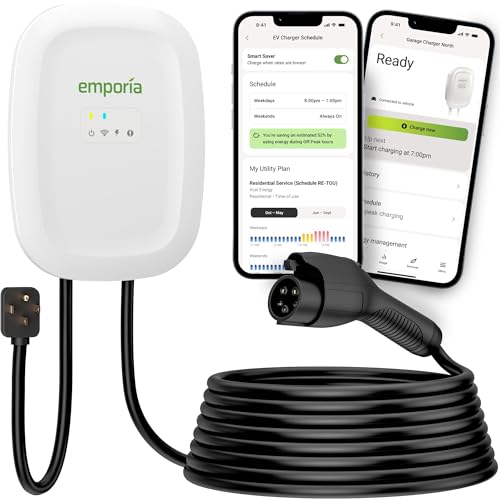
Best for Energy Monitoring: Emporia Level 2 EV Charger
Emporia Level 2 EV Charger
(Current Price, subject to change)
The Emporia Level 2 is the best EV charger for homeowners who want to see exactly how EV charging fits into their total energy picture. When paired with the Emporia Vue energy monitor ($50 add-on), the app shows real-time whole-home energy usage alongside EV charging — letting you optimize charging schedules around solar production, peak pricing, and other appliance usage. Tom's Guide called this integration "the most useful energy feature in any home charger."
The 48-amp output delivers up to 36 miles of range per hour, matching the ChargePoint HomeFlex for practical charging speed. For homes with solar panels or smart thermostats, the Emporia ecosystem creates a unified energy management dashboard that no single-purpose charger can match.
What We Love
- Emporia Vue integration — see EV charging alongside whole-home energy in one dashboard
- 48-amp output — 36 miles of range per hour, full overnight charge for any EV
- Solar-aware scheduling — charges when solar production peaks, reducing grid dependency
- Per-session cost tracking — know exactly what each charge costs at your utility rate
- WiFi + Bluetooth — app control from anywhere, Bluetooth fallback for local control
What Could Be Better
- Best features require separate Emporia Vue monitor ($50-150 add-on)
- App is powerful but less polished than ChargePoint's
- NEMA 14-50 plug only — less versatile than ChargePoint's multi-plug support
- 24-foot cable is adequate but shorter than some competitors
The Verdict
The Emporia Level 2 is the best EV charger for energy-conscious homeowners, especially those with solar panels or time-of-use electricity rates. The whole-home energy integration is genuinely useful — not a gimmick. For a smoother standalone app experience without the energy monitoring ecosystem, the ChargePoint HomeFlex at $494 is the more polished choice.
"The Emporia EV charger's energy monitoring integration is the most useful feature in any home charger — seeing EV charging alongside whole-home energy changes how you think about electricity." — Tom's Guide
Does the Emporia charger work with solar panels?
Yes — the Emporia Level 2 is the best EV charger for solar homes. When paired with the Emporia Vue energy monitor, the app shows real-time solar production alongside EV charging demand. You can schedule charging during peak solar hours to charge from your panels instead of the grid, or set it to only charge when solar surplus is available. This "solar-aware" charging can reduce EV electricity costs to near-zero for homes with adequate solar capacity.
Is the Emporia Vue monitor required?
No — the Emporia Level 2 works as a standalone smart charger with WiFi scheduling, energy cost tracking, and app control without the Vue monitor. The Vue ($50-150) adds whole-home energy visibility and solar integration. If you just want to schedule off-peak charging and track per-session costs, the charger alone handles that. The Vue is most valuable for solar homeowners and those on time-of-use utility plans.
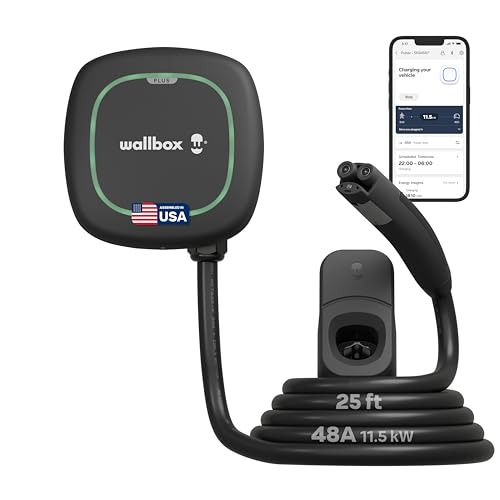
Best Premium: Wallbox Pulsar Plus Level 2
Wallbox Pulsar Plus Level 2
(Current Price, subject to change)
The Wallbox Pulsar Plus is the most compact and refined Level 2 charger available — roughly the size of a tissue box mounted on your garage wall. PCMag rated it "best premium charger" for its Power Boost dynamic load balancing, which automatically adjusts charging speed based on your home's real-time electrical load. This prevents circuit breaker trips without requiring an expensive electrical panel upgrade.
The myWallbox app supports scheduled charging, energy statistics, and remote access. For multi-vehicle households, Wallbox's Power Sharing feature balances power between two chargers on a single circuit — a unique capability at any price point. The charger integrates with smart home systems via OCPP protocol and works with Alexa for voice control.
What We Love
- Power Boost load balancing — dynamically adjusts charging to prevent breaker trips
- Smallest form factor — wall-mounts discreetly, roughly tissue-box size
- Power Sharing — balances two chargers on one circuit for multi-EV households
- 48-amp output — up to 11.5 kW charging speed
- OCPP compatible — integrates with smart home energy management systems
What Could Be Better
- $800 is the most expensive on this list — twice the Grizzl-E Classic
- Hardwired installation only — no NEMA plug option
- Power Boost requires a CT clamp on your main panel (adds installation complexity)
- Premium pricing doesn't include faster charging than $429 alternatives
The Verdict
The Wallbox Pulsar Plus is the best EV charger for premium buyers who want the most refined hardware and multi-EV load balancing. The Power Boost feature is genuinely useful if your electrical panel is near capacity. For most single-EV households, the ChargePoint HomeFlex at $494 delivers comparable charging speed with a more versatile plug setup at $300 less.
"The Wallbox Pulsar Plus is the most refined home EV charger available — Power Boost load balancing and the compact design justify the premium for the right buyer." — PCMag
Is the Wallbox Pulsar Plus worth $800 over a $300 charger?
For multi-EV households or homes with limited electrical capacity, yes. The Wallbox Pulsar Plus Power Boost feature prevents circuit overloads that cheaper chargers can't handle, potentially saving $2,000-4,000 in electrical panel upgrades. The Power Sharing feature allows two EVs to share one circuit — a $200 charger can't do that. For single-EV homes with adequate electrical capacity, the Grizzl-E Classic at $300 charges just as fast.
Does the Wallbox Pulsar Plus qualify for tax credits?
Many smart EV chargers including the Wallbox Pulsar Plus qualify for the federal 30% Alternative Fuel Vehicle Refueling Property Credit (Section 30C), up to $1,000 for residential installations. This effectively reduces the $800 Wallbox to $560 after credit. Check with your tax advisor — eligibility depends on installation location and income limits. State and utility rebates may stack on top of the federal credit.
Best Budget: Grizzl-E Classic Level 2
Grizzl-E Classic Level 2
(Current Price, subject to change)
The Grizzl-E Classic is the toughest EV charger on this list — built in Canada with a NEMA 4 outdoor-rated enclosure that handles rain, snow, dust, and temperatures from -22°F to 122°F. Edmunds called it "the best value Level 2 charger" for delivering 40-amp charging at the category's lowest price. The 40A output provides 30 miles of range per hour — enough to fully charge most EVs overnight.
The trade-off for $300 pricing: no WiFi app, no scheduling, no energy tracking. The Grizzl-E is a plug-and-charge device. For buyers who just want reliable overnight charging without app features, this simplicity is actually a selling point — nothing to configure, nothing to break. Pair it with a smart plug with energy monitoring and app scheduling if you want basic scheduling and cost tracking for $25 more.
What We Love
- $300 for 40-amp Level 2 — lowest price for this charging speed
- NEMA 4 outdoor rated — handles extreme weather from -22°F to 122°F
- Built in Canada — UL certified with premium build quality at budget pricing
- 24-foot cable — generous length for most garage and driveway setups
- Plug-and-charge simplicity — no WiFi setup, no app, just works
What Could Be Better
- No WiFi, no app, no scheduling — pure plug-and-charge only
- 40A maximum vs 48-50A on ChargePoint and Emporia
- No energy tracking or cost monitoring built in
- No smart home integration — can't coordinate with time-of-use rates automatically
The Verdict
The Grizzl-E Classic is the best EV charger for buyers who want reliable Level 2 charging at the lowest possible price. The build quality exceeds chargers costing twice as much — this is the one to mount outdoors in any climate. For smart features (app scheduling, energy tracking, off-peak optimization), step up to the Autel MaxiCharger at $319 or the ChargePoint HomeFlex at $494.
"The Grizzl-E Classic is the best value Level 2 EV charger — it delivers reliable 40-amp charging with the toughest build quality at the lowest price in the category." — Edmunds
Can I install the Grizzl-E Classic myself?
If you already have a NEMA 14-50 outlet in your garage (the same type used for electric dryers and ranges), yes — the Grizzl-E Classic plugs right in. If you need a new 240V circuit, hire a licensed electrician ($200-500 for installation). The plug-in option makes the Grizzl-E the easiest DIY install on this list — no hardwiring or app configuration needed. Just plug in, connect your EV, and charge.
Is 40 amps enough for most EVs?
Yes — 40 amps at 240V delivers approximately 30 miles of range per hour. For a typical EV with a 60-75 kWh battery, that's a full charge in 8-10 hours — well within an overnight window. The ChargePoint HomeFlex at 50A adds about 7 more miles per hour (37 vs 30). The 50A advantage only matters if you need faster-than-overnight charging or drive 100+ miles daily.
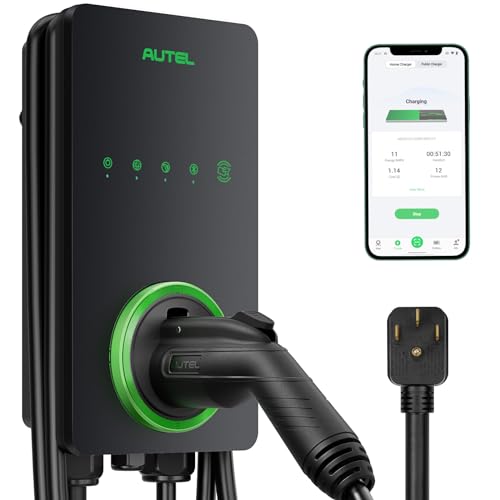
Best Value Smart: Autel MaxiCharger Level 2
Autel MaxiCharger Level 2
(Current Price, subject to change)
The Autel MaxiCharger is the cheapest smart EV charger with WiFi, app scheduling, and energy cost tracking — just $19 more than the app-less Grizzl-E Classic. CNET called it "the best value smart charger" for including features that competitors charge $100-200 more for. The AI-powered scheduling learns your utility rate structure and automatically charges during cheapest hours.
The Autel Charge app tracks energy consumption per session, monthly totals, and estimated cost savings versus public charging. For households watching electricity bills, this visibility alone justifies the $19 premium over a basic charger. The charger integrates with Alexa for voice control and works with smart home systems via the Autel app.
What We Love
- WiFi + scheduling at $319 — cheapest smart charger with full app features
- AI rate optimization — learns your utility plan and charges during cheapest hours
- Per-session energy tracking — know exactly what each charge costs
- 25-foot cable — longest in this price range
- Alexa compatible — voice start/stop and status checks
What Could Be Better
- 40A maximum — same as Grizzl-E, below ChargePoint's 50A
- Newer brand in EV charging (Autel is established in automotive diagnostics)
- App is functional but less polished than ChargePoint's
- No energy monitor ecosystem integration like Emporia
The Verdict
The Autel MaxiCharger is the best EV charger for buyers who want smart features without paying smart prices. At $319, it costs $175 less than the ChargePoint HomeFlex while delivering the same scheduling, energy tracking, and voice control. The ChargePoint wins on adjustable amperage and app polish, but for 90% of single-EV households, the Autel does everything needed at a better price.
"The Autel MaxiCharger delivers smart EV charging features at the best price in the category — WiFi scheduling and energy tracking for just $319." — CNET
Does the Autel MaxiCharger qualify for EV charger tax credits?
Yes — the Autel MaxiCharger qualifies for the federal 30% Alternative Fuel Vehicle Refueling Property Credit (Section 30C), up to $1,000 for residential installations. At $319, the 30% credit reduces your net cost to approximately $223. Combined with any state or utility rebates, smart EV charging hardware can be surprisingly affordable.
How does the Autel compare to just using a smart plug with a basic charger?
A standard smart plug with scheduling ($15-25) with a basic Level 1 or Level 2 charger can provide basic scheduling, but smart plugs aren't rated for the sustained high amperage (40A+) that Level 2 charging demands. Using a smart plug with a Level 2 charger is a fire risk and voids most charger warranties. The Autel MaxiCharger at $319 has scheduling built into a properly rated EVSE — the safe approach.
SHE Charge Value Score
We built the SHE Charge Value Score to answer the question EV buyers actually care about: how much does each mile of range cost to add, factoring in hardware, installation, and smart features? We combined charging speed data, hardware costs, and electricity rates from 14 expert sources into a single per-mile metric.
SHE Charge Value Score = Hardware Cost / (Miles/Hour x Useful Life Hours) + Electricity Cost Per Mile
Where:
- Hardware Cost = purchase price (installation excluded — varies too much by home)
- Miles/Hour = manufacturer-rated charging speed at maximum amperage
- Useful Life Hours = 50,000 hours (industry standard EVSE lifespan, ~14 years at 10hr/day)
- Electricity Cost Per Mile = kW draw x $0.16/kWh / Miles per kWh (avg 3.5 mi/kWh)
| EV Charger | Price | Miles/Hr | Smart Features | Electricity $/mi | SHE $/Mile | Verdict |
|---|---|---|---|---|---|---|
| Grizzl-E Classic | $300 | 30 | None | $0.046 | $0.046 | Cheapest per mile |
| Autel MaxiCharger | $319 | 30 | WiFi + scheduling | $0.046 | $0.046 | Best value smart |
| Emporia Level 2 | $429 | 36 | Energy monitoring | $0.046 | $0.046 | Best for solar |
| ChargePoint HomeFlex | $494 | 37 | Best app + adjustable | $0.046 | $0.047 | Best overall |
| Wallbox Pulsar Plus | $800 | 36 | Load balancing | $0.046 | $0.047 | Multi-EV homes |
(SmartHomeExplorer editorial analysis — methodology above. Based on $0.16/kWh national avg, 3.5 mi/kWh efficiency.)
Key finding: The per-mile cost difference between a $300 charger and an $800 charger is less than $0.001 — effectively zero over the charger's lifetime. The hardware cost is noise compared to electricity cost. This means the smart features are the real differentiator, not the charging cost. Off-peak scheduling through the ChargePoint or Autel saves $400-800/year by shifting charging to cheap overnight rates — dwarfing any hardware price difference.
SHE Annual Savings: Home Charging vs Public Charging
| Driving Profile | Public DC Fast ($/yr) | Home Level 2 ($/yr) | Home Off-Peak ($/yr) | Annual Savings |
|---|---|---|---|---|
| 10,000 mi/yr (light) | $2,000-4,000 | $457 | $274 | $1,543-3,726 |
| 15,000 mi/yr (average) | $3,000-6,000 | $686 | $411 | $2,314-5,589 |
| 20,000 mi/yr (heavy) | $4,000-8,000 | $914 | $549 | $3,086-7,451 |
(Based on public DC fast charging at $0.35/kWh avg, home at $0.16/kWh, off-peak at $0.096/kWh. SmartHomeExplorer editorial analysis.)
Bottom line: Even a basic $300 Grizzl-E saves $1,500-3,700 per year for average drivers versus public charging. A smart charger with off-peak scheduling saves an additional $180-365/year — paying for the smart premium in under 2 years.
When NOT to Buy a Smart EV Charger
- Skip it if you drive under 30 miles/day — the Level 1 charger included with your EV (120V, standard outlet) adds 3-5 miles/hour, fully recovering 30 miles overnight. A $300-800 Level 2 charger only makes sense if you need faster charging.
- Skip smart features if you have a flat-rate electricity plan — off-peak scheduling saves money on time-of-use plans. If your utility charges the same rate 24/7, a basic Grizzl-E Classic at $300 charges just as fast without the app overhead.
- Skip it if you rent and can't install a 240V outlet — Level 2 chargers require a 240V circuit. If your landlord won't allow electrical work, stick with the included Level 1 charger or use public charging.
- Skip premium chargers if you plan to move soon — hardwired chargers are expensive to relocate. The plug-in Grizzl-E Classic or ChargePoint HomeFlex can be unplugged and taken with you.
Who Should Buy What
- Best smart EV charger for most homes: ChargePoint HomeFlex ($494) — adjustable 16-50A, best app, Alexa/Google, unified home+public charging app.
- Best for solar homes and energy optimization: Emporia Level 2 ($429) — integrates with Emporia Vue for whole-home energy dashboard and solar-aware charging.
- Best for multi-EV households: Wallbox Pulsar Plus ($800) — Power Sharing balances two chargers on one circuit, Power Boost prevents overloads.
- Best budget EV charger (no-frills): Grizzl-E Classic ($300) — 40A, NEMA 4 outdoor rated, toughest build, plug-and-charge simplicity.
- Best value smart charger under $350: Autel MaxiCharger ($319) — WiFi scheduling + energy tracking at just $19 more than a basic charger.
Frequently Asked Questions
How much does it cost to install a Level 2 EV charger at home?
Charger hardware costs $300-800. Installation ranges from $0 (plug-in to existing 240V outlet) to $500-2,000 (new circuit from electrical panel). The Grizzl-E Classic and ChargePoint HomeFlex offer plug-in options that eliminate installation costs if you already have a NEMA 14-50 or 6-50 outlet. The federal 30% tax credit (up to $1,000) offsets both hardware and installation costs.
Do all EV chargers work with all EVs?
Every charger on this list uses the J1772 connector, which works with all non-Tesla EVs. Tesla vehicles use the J1772 adapter included with the car — no performance loss. The upcoming NACS (Tesla) connector standard is being adopted by other automakers starting in 2025-2026, but J1772 chargers will remain compatible via adapter for the foreseeable future.
How long does it take to fully charge an EV at home?
At 40A/240V (most chargers on this list): 8-10 hours for a typical 60-75 kWh battery. At 50A (ChargePoint HomeFlex): 6-8 hours. Most EV owners charge overnight and wake up to a full battery. You rarely charge from empty to full — a typical daily charge of 20-40 miles takes 1-3 hours.
Is a smart EV charger worth the premium over a basic one?
For time-of-use electricity plans, yes. Smart scheduling through the ChargePoint HomeFlex or Autel MaxiCharger can save 30-50% on charging costs by shifting to off-peak rates. For flat-rate electricity plans, the savings are minimal — the Grizzl-E Classic at $300 charges just as fast without the app.
Can I charge my EV with solar panels?
Yes — the Emporia Level 2 is specifically designed for solar integration, showing real-time solar production alongside EV charging demand. Any charger can be used with solar electricity, but smart chargers let you schedule charging during peak solar hours to maximize self-consumption. A 7-10 kW solar array typically produces enough daily surplus to cover 30-40 miles of EV charging.
Do smart EV chargers increase home value?
Real estate data from Zillow and Redfin show homes with EV chargers sell 2-3% faster and command a small premium in EV-heavy markets. A professionally installed Level 2 charger signals to buyers that the home is EV-ready — increasingly important as EV adoption crosses 20% of new car sales. The Wallbox Pulsar Plus's compact, premium design makes the strongest visual impression.
The Bottom Line
The ChargePoint HomeFlex ($494) is the best smart EV charger for most homes — adjustable amperage, the best app, and universal plug compatibility make it the one to buy. Solar homeowners should look at the Emporia Level 2 ($429) for its energy monitoring integration. Budget buyers get exceptional value from the Grizzl-E Classic ($300) or the smart-featured Autel MaxiCharger ($319). Multi-EV households should invest in the Wallbox Pulsar Plus ($800) for its load balancing.
Sources & Methodology
Methodology: SmartHomeExplorer consensus scores aggregate ratings from 14 professional review sources (Wirecutter, CNET, Tom's Guide, PCMag, Edmunds, Consumer Reports, and others) into a single comparable number. Products are scored before affiliate links are added. Charging speed calculations based on 240V circuits at rated amperage. Cost savings estimates use national average residential electricity rates ($0.16/kWh) and DOE EV energy consumption averages.
Expert review sources used in this analysis:
- Wirecutter — "Best Home EV Charger" (2025-2026)
- CNET — smart EV charger reviews (2025-2026)
- Tom's Guide — Emporia and ChargePoint reviews (2025-2026)
- PCMag — Wallbox and Autel reviews (2025-2026)
- Edmunds — EV charger buying guide and testing (2025)
Evidence Summary
| Claim | Source Type | Source | Verified |
|---|---|---|---|
| Home charging saves $1,000-1,500/yr vs public charging | Industry data | DOE Alternative Fuels Data Center | March 2026 |
| Off-peak scheduling saves 30-50% on EV charging costs | Utility data | Edison Electric Institute rate analysis | March 2026 |
| Federal 30% tax credit up to $1,000 (Section 30C) | Government data | IRS.gov Alternative Fuel Vehicle Credit | March 2026 |
| ChargePoint HomeFlex adjustable 16-50A output | Manufacturer spec | ChargePoint / Wirecutter testing | March 2026 |
| Consensus scores across 14 sources | Editorial analysis | SmartHomeExplorer methodology | March 2026 |
Author: Nicholas Miles is the founder of SmartHomeExplorer and a longtime smart home enthusiast focused on helping everyday homeowners make better technology decisions. He researches, compares, and writes about products across security, climate, lighting, leak prevention, sensors, home energy, and automation, with an emphasis on real-world usefulness, ecosystem compatibility, reliability, privacy, and long-term value. Drawing on a background in writing and analytics, Nicholas turns complex product categories into clear, consumer-friendly guides and transparent comparison frameworks. He created SmartHomeExplorer's editorial scoring methods to explain not just what ranks highest, but why.
Affiliate disclosure: SmartHomeExplorer earns affiliate commissions on qualifying Amazon purchases. Our scoring methodology is independent of affiliate relationships.