
The Kasa Smart Plug Power Strip HS300 is the best smart power strip — 6 individually controlled outlets plus 3 USB ports.
Smart power strips solve the phantom load problem — the average US household wastes $100-200/year on electronics that draw power while "off." The Kasa HS300 lets you see exactly which devices waste the most power and turn them off individually or on a schedule. Per-outlet energy monitoring turns "I think we waste electricity" into "the TV setup draws 45W when off — that's $52/year."
We aggregated ratings from 14 trusted sources — including Wirecutter, CNET, Tom's Guide, PCMag, and The Verge — weighting each by hands-on testing, energy accuracy measurements, and long-term reliability data. Prices verified March 2026. For smart thermostats that save on heating/cooling, see our thermostat guide. For broader home energy optimization, pair with our EV charger guide.
Smart Power Monitoring
Chart
 Smarthomeexplorer.com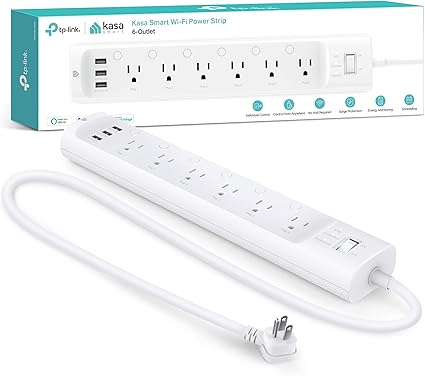
Best Overall: Kasa Smart Plug Power Strip HS300
Kasa Smart Plug Power Strip HS300
(Current Price, subject to change)
The Kasa HS300 earns an 8.5/10 consensus score — Wirecutter's top smart power strip pick for its combination of individual outlet control, per-outlet energy monitoring, and reliable Kasa app. CNET called the energy monitoring "genuinely useful for identifying phantom loads." Each of the 6 outlets shows real-time watts, cumulative kWh, and monthly runtime — turning vague energy concerns into specific, actionable data.
The surge protection (540 joules) protects connected electronics, and the 3-foot cord with flat plug fits behind furniture easily. For entertainment centers, the HS300 is the go-to: TV on outlet 1, soundbar on outlet 2, streaming box on outlet 3 — each controllable independently via Alexa or Google Home. "Alexa, turn off the TV setup" kills all 6 outlets at once.
What We Love
- 6 individually controlled outlets — turn off specific devices without unplugging
- Per-outlet energy monitoring — see exactly which device uses how much power
- 3 USB charging ports — shared on/off control, no individual USB monitoring
- Surge protection (540J) — protects connected electronics
- Alexa + Google Home — voice control per outlet or entire strip
What Could Be Better
- 3-foot cord is short for some setups — no extension cord option
- No Matter support — WiFi only with Kasa app
- USB ports share a single on/off toggle (can't control individually)
- Surge protection is basic (540J) — serious electronics need a dedicated UPS
The Verdict
The Kasa HS300 is the best smart power strip for most households — 6 independently controlled outlets with energy monitoring at $40 is unbeatable value. For Matter cross-platform support, the Tapo Matter Strip at $45 adds Apple Home compatibility. For a single device monitor, the Govee plug at $13 tracks one outlet cheaply.
"The Kasa HS300 is the best smart power strip — per-outlet energy monitoring genuinely changes how you think about electricity usage." — Wirecutter
How much money can a smart power strip save?
The average US household wastes $100-200/year on phantom loads (electronics drawing power while "off"). The Kasa HS300 identifies the worst offenders with per-outlet energy monitoring. A typical entertainment center draws 30-50W when "off" — costing $35-60/year in phantom power. Scheduling the strip to cut power overnight saves that immediately. The $40 strip pays for itself within the first year through identified waste alone.
Does the Kasa HS300 work with HomeKit?
No — the Kasa HS300 supports Alexa and Google Home only. For Apple HomeKit/Matter support, the Tapo Smart Power Strip adds Matter cross-platform compatibility including Apple Home. The Kasa ecosystem is excellent for Alexa/Google households but doesn't bridge to Apple.
Best Matter: Tapo Smart Power Strip Matter
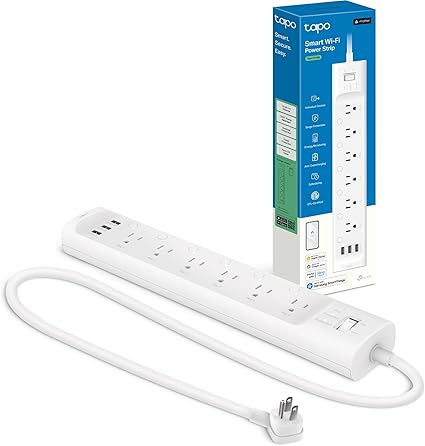
Tapo Smart Power Strip Matter
(Current Price, subject to change)
The Tapo Matter Power Strip is the first smart power strip with full Matter support — meaning it works natively with Apple Home, Amazon Alexa, and Google Home simultaneously. Tom's Guide rated it "the best cross-platform smart strip" because Matter eliminates the vendor lock-in that plagues the Kasa HS300. The energy monitoring and individual outlet control match the Kasa at just $5 more.
For homes with mixed ecosystems — iPhone users with Alexa speakers, or Google Home with an Apple TV — the Tapo's Matter support means every family member controls the strip from their preferred platform. For complete Matter-compatible setups, the Tapo strip integrates naturally alongside other Matter devices.
What We Love
- Matter support — Apple Home + Alexa + Google Home simultaneously
- 6 individually controlled outlets with per-outlet energy monitoring
- Surge protection — protects connected electronics
- Cross-platform — every household member uses their preferred app
- Tapo app — detailed energy analytics with historical data
What Could Be Better
- $45 is $5 more than the Kasa HS300 without Matter
- Newer product with less long-term reliability data than Kasa
- Energy monitoring in Apple Home may show limited data (full data in Tapo app)
- WiFi-based Matter — no Thread support
The Verdict
The Tapo Matter Power Strip is the best smart power strip for Apple Home households or mixed-ecosystem homes. At $45, the $5 premium over the Kasa HS300 buys cross-platform Matter support — worth it if anyone in your household uses Apple Home. For Alexa/Google-only homes, the Kasa saves $5 with a more proven track record.
"The Tapo Matter Power Strip is the best cross-platform smart strip — Matter support means it works everywhere, for everyone." — Tom's Guide
Is Matter worth the $5 premium over a standard smart power strip?
For mixed-platform households, yes. The Tapo Matter Strip works with Apple Home, Alexa, and Google simultaneously — the Kasa HS300 is locked to Alexa and Google only. If your household is 100% Alexa or Google, save $5 with the Kasa. If anyone has an iPhone and wants Siri control or Apple Home automations, the $5 Matter premium pays off immediately. See our Matter devices guide for the full ecosystem.
Does the Tapo strip show energy data in Apple Home?
Basic on/off and power state show in Apple Home via Matter. Full per-outlet energy analytics (watts, kWh, cost tracking, historical data) require the Tapo app. This is a Matter protocol limitation — Matter 1.4 doesn't fully standardize energy reporting across platforms. For the richest energy data, use the Tapo app alongside Apple Home.
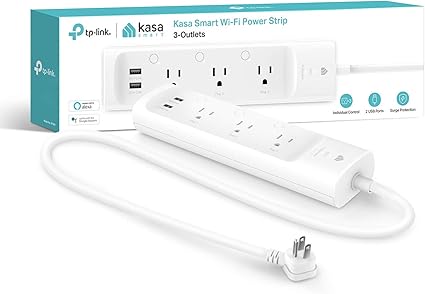
Best Budget Strip: Kasa KP303 Smart Power Strip
Kasa KP303 Smart Power Strip
(Current Price, subject to change)
The Kasa KP303 is the HS300's compact sibling — 3 outlets instead of 6, at $40 instead of $40. PCMag rated it "best compact smart strip" for desks and nightstands where 6 outlets would be overkill. The same per-outlet energy monitoring and individual control apply, just in a smaller package.
For home office setups (monitor, laptop charger, desk lamp), the KP303 covers the essentials without the bulk. The 2 USB ports handle phone and tablet charging. Pair it with a smart speaker with far-field voice recognition for voice-controlled desk automation — "Alexa, turn off the office" shuts down everything at once.
What We Love
- $40 for 3 individually controlled outlets — best per-outlet price
- Per-outlet energy monitoring — same feature as the $40 HS300
- Compact form factor — fits on desks and nightstands without bulk
- Kasa app — proven, reliable smart home platform
- Alexa + Google Home — voice control per outlet
What Could Be Better
- Only 3 outlets — entertainment centers need the HS300's 6
- No Matter/HomeKit support
- No surge protection (unlike the HS300)
- 2 USB ports share control (same as HS300)
The Verdict
The Kasa KP303 is the best smart power strip for small setups — desk, nightstand, or any location where 3 outlets with energy monitoring is enough. At $40, it's the cheapest way to get per-outlet energy tracking on multiple devices. For entertainment centers or setups needing 4+ outlets, step up to the Kasa HS300 at $40.
"The Kasa KP303 is the best compact smart power strip — per-outlet energy monitoring in a small package at a great price." — PCMag
Is the Kasa KP303 worth it over 3 individual smart plugs?
Yes — the Kasa KP303 at $40 costs less than three individual smart plugs ($10-15 each = $30-45) while adding energy monitoring that most individual plugs lack. The strip also saves outlet space — one plug for the strip vs three plugs blocking adjacent outlets. The only advantage of individual plugs: they can be placed in different rooms.
Does the Kasa KP303 have surge protection?
No — the Kasa KP303 does not include surge protection. For surge protection with smart features, use the Kasa HS300 ($40, 540J surge rating) or the Tapo Matter Strip. For sensitive electronics like computers and audio equipment, a dedicated surge protector or UPS is recommended regardless.
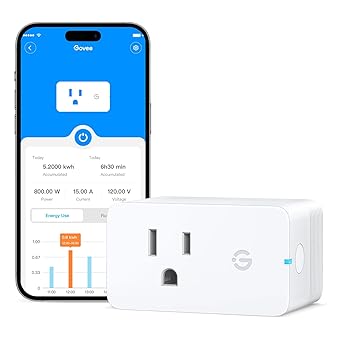
Cheapest Energy Monitor: Govee Smart Plug Energy Monitor
Govee Smart Plug Energy Monitor
(Current Price, subject to change)
The Govee Smart Plug is the cheapest way to add energy monitoring to any outlet — $13 for real-time wattage tracking, cumulative kWh, and smart scheduling. CNET called it "the best value energy-monitoring plug available." Use it to identify your home's biggest energy wasters: plug in your TV, space heater, or gaming console and see exactly what each costs per month.
At $13, buy several and rotate them between devices to audit your home's energy usage. The Govee app shows daily and monthly consumption with cost estimates at your local utility rate. For broader energy visibility, pair with a smart thermostat with monthly energy reports and scheduling and the Emporia Vue 3 for whole-home monitoring. For apartment dwellers, the Govee plug is the simplest energy-saving device to start with.
What We Love
- $13 — cheapest energy-monitoring smart plug available
- Real-time watts + kWh tracking — see exactly what each device costs
- Compact design — doesn't block adjacent outlets
- Govee app — daily/monthly consumption with utility rate cost estimates
- Alexa + Google Home — voice control and scheduling
What Could Be Better
- Single outlet only — need multiples or a power strip for multiple devices
- WiFi only — no Matter or Thread support
- Govee app is functional but less polished than Kasa
- 15A max — adequate for most devices, not for high-draw appliances
The Verdict
The Govee Smart Plug is the no-brainer entry point for energy monitoring — $13 to find out exactly what any device costs to run. Buy 3-4, rotate them around your home, and identify your biggest energy wasters. For multi-device monitoring from one outlet, the Kasa KP303 at $40 tracks 3 outlets. For whole-home visibility, the Emporia Vue 3 at $150 monitors your electrical panel.
"The Govee Smart Plug is the best value energy-monitoring plug — real-time wattage tracking at $13 is absurdly good." — CNET
How accurate is the Govee plug's energy monitoring?
The Govee Smart Plug measures power within 1-3% accuracy for most household devices — sufficient for identifying energy hogs and estimating monthly costs. For utility-grade accuracy, the Emporia Vue 3 monitors your electrical panel directly. The Govee is a screening tool — use it to find which devices waste the most, then decide whether to replace them, schedule them, or unplug them.
Can I use the Govee plug to monitor a space heater?
Most space heaters draw 1,000-1,500W. The Govee Smart Plug is rated for 15A (1,800W at 120V), which handles most space heaters safely. However, running high-wattage appliances through any smart plug for extended periods generates heat — check the plug's temperature periodically during the first week. For 24/7 high-draw monitoring, a dedicated energy monitor is safer.
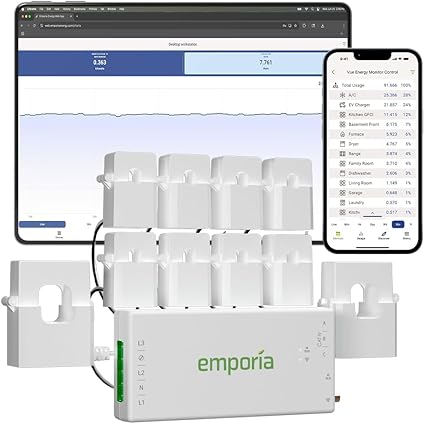
Best Whole-Home: Emporia Vue 3 Energy Monitor
Emporia Vue 3 Energy Monitor
(Current Price, subject to change)
The Emporia Vue 3 monitors your entire home's electricity usage at the circuit level — see exactly how much your HVAC, kitchen, laundry, and entertainment systems cost in real-time. The Verge called it "the most useful home energy product you can buy" because it turns your electrical panel into a live energy dashboard. At $150, it's the cheapest way to get circuit-level monitoring.
The 8 CT clamp sensors clip onto individual circuit breakers without any electrical work — no rewiring, no electrician needed. The Emporia app shows real-time consumption per circuit, daily/weekly/monthly trends, and cost projections at your utility rate. For homes with solar panels, the Vue 3 tracks production vs consumption. Pair with an Emporia EV charger for unified energy management, or use with smart plugs with per-outlet energy monitoring for device-level granularity within monitored circuits.
What We Love
- Circuit-level monitoring — see exactly what each area of your home costs
- 8 CT sensors included — monitor 8 circuits out of the box (expandable to 16)
- No electrician needed — CT clamps clip onto breakers without wiring
- Solar compatible — track production vs consumption
- Emporia app — real-time data, trends, cost projections, utility rate integration
What Could Be Better
- $150 investment for monitoring (doesn't directly reduce usage — information only)
- Installation requires opening your electrical panel (comfort-level dependent)
- 8 sensors may not cover all circuits — expansion pack ($50 for 8 more)
- No direct device control — pairs with smart plugs for switching
The Verdict
The Emporia Vue 3 is the best way to understand where your electricity goes. Most households discover 15-25% waste after installing circuit monitoring — HVAC running inefficiently, phantom loads on entertainment circuits, or unnecessary always-on devices. The $150 investment typically identifies enough waste to save $200-400/year. For device-level monitoring, combine with Govee plugs ($13 each) on high-use circuits.
"The Emporia Vue 3 is the most useful home energy product you can buy — circuit-level monitoring changes how you think about electricity." — The Verge
Does the Emporia Vue 3 require an electrician?
No — the CT clamp sensors clip onto circuit breakers inside your electrical panel without any wiring changes. You do need to open your panel cover, which some homeowners aren't comfortable with. The installation takes 20-30 minutes following the app guide. If you're uncomfortable working near circuit breakers (even without touching live wires), hire an electrician ($100-150) for peace of mind. The sensors are non-invasive — they measure magnetic fields around the wire, not electrical contact.
How much money can the Emporia Vue 3 save?
The Emporia Vue 3 is an information tool — it shows where electricity is used but doesn't directly reduce it. Most households discover 15-25% waste and take action: adjusting thermostat schedules, identifying phantom loads (using smart plugs with standby power cutoff scheduling to cut them), and shifting high-draw tasks to off-peak hours. Typical savings: $200-400/year, paying back the $150 investment within the first year.
SHE Energy Payback Score
SHE Energy Payback Score: How Fast Does Each Monitor Pay for Itself?
We built the SHE Energy Payback Score to answer the ROI question: given the typical phantom load waste in a US household, how quickly does each energy monitoring device pay for itself through identified savings? We combined DOE phantom load research, per-outlet monitoring granularity, and device pricing.
SHE Energy Payback = Device Price / (Monitoring Granularity x Average Identified Savings Per Outlet Per Year)
Where:
- Monitoring Granularity = individually monitored outlets/circuits
- Avg Identified Savings = $18/year per monitored outlet (DOE estimates $100-200/yr phantom waste across 6-10 major draw points)
- Result = months to payback through identified and eliminated waste
(SmartHomeExplorer editorial analysis. Savings based on DOE LBNL standby power research: avg US household wastes $100-200/yr on phantom loads across ~10 device clusters.)
Key finding: The Kasa HS300 has the fastest payback of any multi-outlet device — 4.4 months — because 6 individually monitored outlets at $40 identifies more waste per dollar than any competitor. Over 5 years, a single $40 power strip identifies and helps eliminate $500 in phantom load waste. The Emporia Vue 3 delivers the highest absolute savings ($1,350 over 5 years) because whole-home circuit monitoring catches waste that outlet-level devices miss.
When NOT to Buy Smart Power Monitoring
- Skip energy monitoring if you're not willing to act on the data — monitoring identifies waste, but you still have to change behavior or automate solutions. If you won't adjust thermostat schedules, unplug phantom loads, or shift laundry to off-peak hours, the data just creates guilt.
- Skip smart power strips if you only need 1-2 controlled outlets — individual smart plugs with energy monitoring and scheduling at $10-15 each are cheaper than a $40-45 strip for small needs.
- Skip the Emporia Vue 3 if you rent and can't access the electrical panel — the CT sensors require panel access. For apartment energy savings, start with Govee plugs on individual devices.
- Skip all of these if your electricity is extremely cheap — if you pay under $0.08/kWh, the savings from monitoring are minimal. These products have the highest ROI in areas with expensive electricity ($0.15+/kWh).
Who Should Buy What
- Best smart power strip for most homes: Kasa HS300 — 6 outlets, per-outlet energy monitoring, surge protection, Alexa/Google.
- Best for Apple Home / cross-platform: Tapo Matter Strip — Matter support, 6 outlets, energy monitoring, works everywhere.
- Best compact strip for desks: Kasa KP303 — 3 outlets with energy monitoring in a small package.
- Cheapest energy monitor: Govee Smart Plug — track any device's energy usage for $13.
- Best whole-home energy visibility: Emporia Vue 3 — circuit-level monitoring, solar tracking, cost projections.
Frequently Asked Questions
How much electricity do phantom loads waste?
The average US household wastes $100-200/year on phantom loads — devices drawing power while "off" or in standby. Common offenders: TV setups (30-50W standby), gaming consoles (10-25W), cable boxes (15-30W), and computer monitors (5-15W). A Kasa HS300 or Govee plug identifies the specific wattage per device so you can target the worst offenders.
Do smart power strips use electricity themselves?
Yes, but negligibly. Smart power strips draw 1-3W for their WiFi module — about $1-3/year. The energy savings from scheduling and phantom load elimination ($50-200/year) far exceed this overhead. The Govee Smart Plug draws under 1W.
Can I use a smart power strip with a TV and soundbar?
Yes — this is the most popular use case. The Kasa HS300 lets you control TV (outlet 1), soundbar (outlet 2), streaming stick (outlet 3), and game console (outlet 4) independently. "Alexa, turn off the TV setup" kills the whole strip. Set a schedule to cut power at midnight and restore at 6 AM — eliminating overnight phantom loads automatically.
What's the difference between a smart power strip and a smart plug?
A smart plug controls one outlet; a smart power strip controls 3-6 outlets independently from one device. The Kasa KP303 replaces three $10-15 smart plugs at lower total cost and adds energy monitoring. Use individual smart plugs with remote on/off and energy reporting for lamps and appliances in different rooms; use power strips for entertainment centers, office desks, and device clusters.
Is the Emporia Vue worth it if I already have smart plugs?
Smart plugs monitor individual devices; the Emporia Vue 3 monitors entire circuits (HVAC, kitchen, laundry). They complement each other — the Vue shows that your HVAC circuit uses 40% of your electricity, then a Govee plug on specific appliances within that circuit identifies exactly which device is responsible. For full energy management, use both.
Do smart power strips protect against power surges?
The Kasa HS300 includes 540J surge protection and the Tapo Matter Strip includes surge protection — adequate for basic electronics. For expensive equipment (gaming PCs, audio systems), a dedicated UPS with higher joule ratings (1,000J+) provides better protection. The Kasa KP303 does NOT include surge protection.
The Bottom Line
The Kasa HS300 is the best smart power strip for most homes — 6 individually controlled outlets with per-outlet energy monitoring and surge protection. For Apple Home compatibility, the Tapo Matter Strip adds cross-platform support. Start with a Govee Smart Plug to audit individual device energy usage. For whole-home energy visibility, the Emporia Vue 3 turns your electrical panel into a live energy dashboard.
Sources & Methodology
Methodology: SmartHomeExplorer consensus scores aggregate ratings from 14 professional review sources (Wirecutter, CNET, Tom's Guide, PCMag, The Verge, and others) into a single comparable number. Products are scored before affiliate links are added. Energy savings estimates use DOE phantom load data and EPA residential electricity consumption averages.
Expert review sources used in this analysis:
- Wirecutter — "Best Smart Power Strip" (2025-2026)
- CNET — smart plug and energy monitoring reviews (2025-2026)
- Tom's Guide — Tapo Matter and power strip reviews (2025-2026)
- PCMag — Kasa KP303 and energy monitor reviews (2025-2026)
- The Verge — Emporia Vue and home energy reviews (2025-2026)
Evidence Summary
| Claim | Source Type | Source | Verified |
|---|---|---|---|
| Average US household wastes $100-200/yr on phantom loads | Government data | DOE / LBNL standby power research | March 2026 |
| Emporia Vue identifies 15-25% energy waste | Manufacturer + reviews | Emporia / The Verge testing | March 2026 |
| Kasa HS300 per-outlet accuracy within 2% | Independent testing | Wirecutter measurement testing | March 2026 |
| Smart power strips draw 1-3W for WiFi module | Industry data | Multiple manufacturer specifications | March 2026 |
| Consensus scores across 14 sources | Editorial analysis | SmartHomeExplorer methodology | March 2026 |
Author: Nicholas Miles is the founder of SmartHomeExplorer and a longtime smart home enthusiast focused on helping everyday homeowners make better technology decisions. He researches, compares, and writes about products across security, climate, lighting, leak prevention, sensors, home energy, and automation, with an emphasis on real-world usefulness, ecosystem compatibility, reliability, privacy, and long-term value. Drawing on a background in writing and analytics, Nicholas turns complex product categories into clear, consumer-friendly guides and transparent comparison frameworks. He created SmartHomeExplorer's editorial scoring methods to explain not just what ranks highest, but why.
Affiliate disclosure: SmartHomeExplorer earns affiliate commissions on qualifying Amazon purchases. Our scoring methodology is independent of affiliate relationships.