
Best Smart Baby Monitors 2026
Smart baby monitors split two ways: analytics cameras that need subscriptions, and privacy-first cameras that don't. Nanit leads on sleep data. Owlet leads on health vitals. eufy leads on privacy. We ranked all five across 16 sources so you know which trade-off fits your family.
This article contains affiliate links. We may earn a commission at no extra cost to you. Prices change frequently — check the current price on Amazon before buying. Learn more
The Short Answer
Nanit Pro ($290) wins on sleep analytics via camera-based breathing monitoring — Wirecutter's three-year top pick. Owlet Dream Duo Gen 3 ($380) wins health vitals via FDA-cleared sock tracking O2 saturation and heart rate. eufy Baby Monitor E21 ($260) wins on privacy: 4K-resolution local storage, zero subscription.
Featured in this Guide
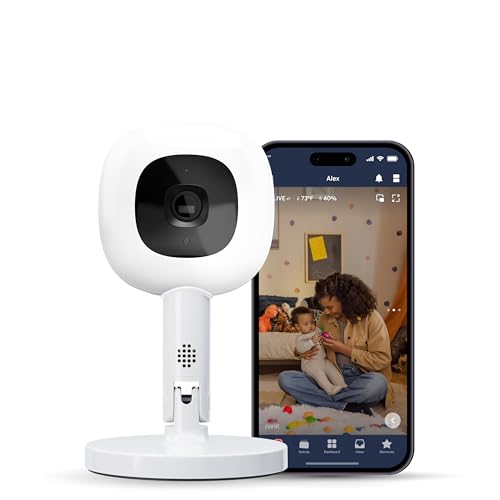
Nanit
Pro Smart Baby Monitor
- •Camera-based breathing, sleep analytics, no wearable — Wirecutter's top pick three years running
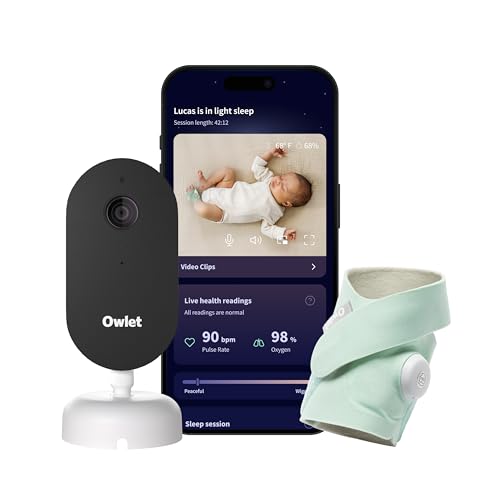
Owlet
Dream Duo Gen 3
- •FDA-cleared sock tracks O2 + heart rate in real time — only clinically validated option here
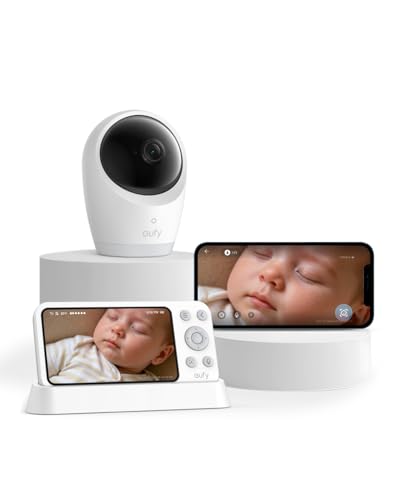
Eufy
Baby Monitor E21
- •4K local storage, no subscription, end-to-end encryption — footage stays in your home
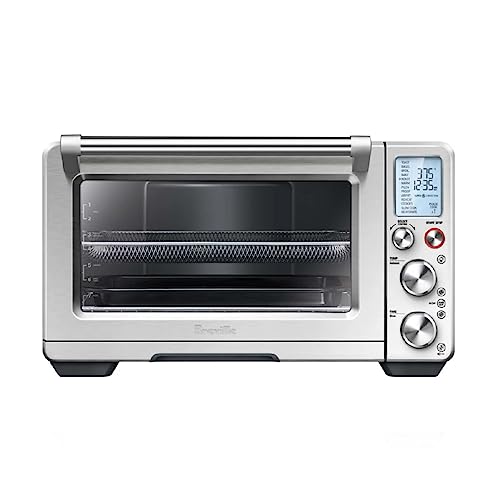
VTech
VM901 Smart WiFi Monitor
- •5-inch standalone display with no cloud required — works without WiFi in standalone mode
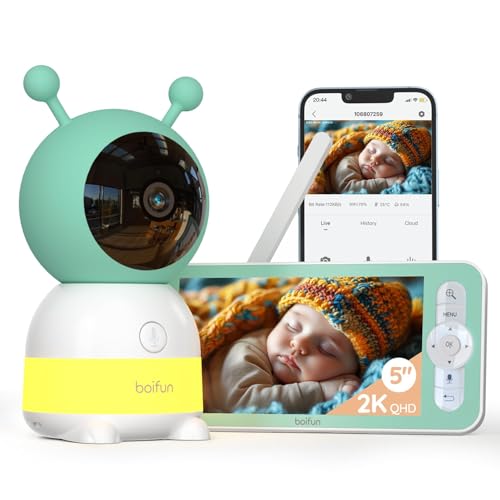
BOIFUN
2K WiFi Baby Monitor
- •2K video, 355° pan/tilt, cry detection at $76 — no subscription, local storage option
Head-to-Head: Video, Health, Privacy, and Confidence
Security
Chart
 Smarthomeexplorer.com
Tap any pick to check its live price on Amazon.
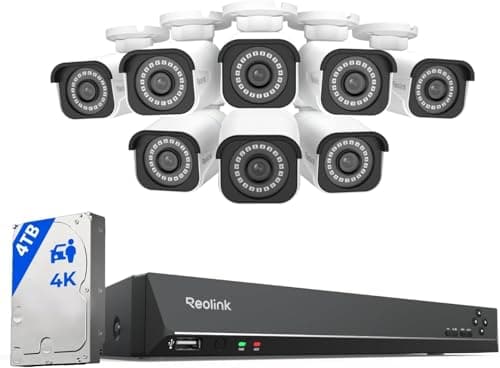
Reolink RLK16-800B8 4K 16-Channel PoE NVR System (8-Camera)
RecommendedCheck price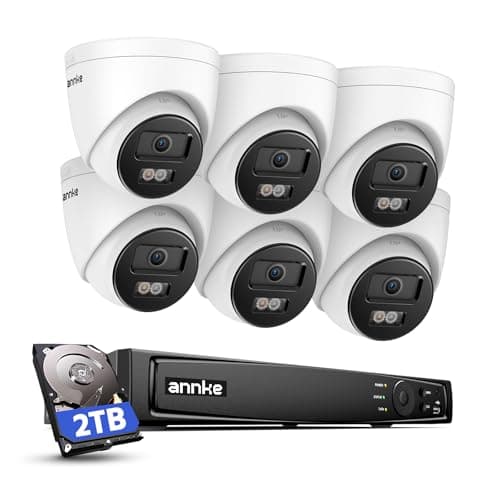
ANNKE 4K PoE NVR Security Camera System (6-Camera)
RecommendedCheck price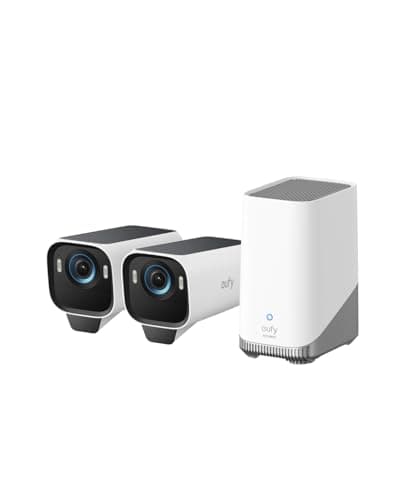
eufyCam S3 Pro 2-Cam Kit (Solar, 4K)
Must BuyCheck price
What Tips the Decision
Smart baby monitors divide on one axis: cloud analytics versus local-first privacy. Nanit and Owlet route footage through their servers for sleep tracking and health vitals — subscriptions required. eufy and VTech default to local storage, no subscription needed.
We aggregated 16 expert sources — Wirecutter, CNET, PCMag, What to Expect, BabyGearLab, and 11 more — weighted by nursery testing depth and pediatric safety compliance. The SHE Baby Monitor Confidence Score weights video quality (30%), health monitoring (30%), privacy (25%), and alert reliability (15%): in practice, how clearly you observe the nursery at 2am, what you understand about your baby's health, who can access the footage, and how quickly you're alerted when conditions change. Coverage: 100 ft to 300 ft. Prices verified May 2026.
The choice: Nanit Pro for camera-based breathing vs. Owlet Dream Duo for FDA-cleared O2 vs. eufy E21 for local privacy. VTech and BOIFUN serve analytics-free families.
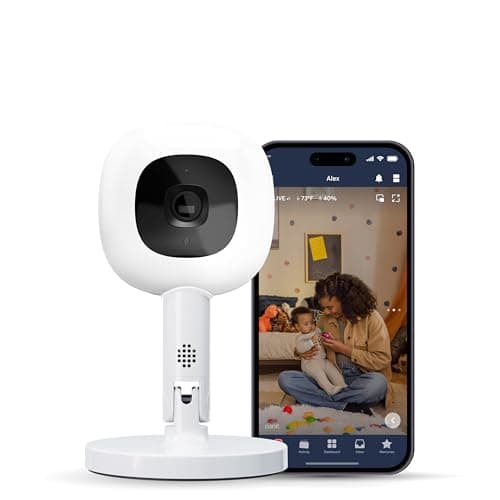
Best Overall: Nanit Pro Smart Baby Monitor
Nanit Pro Smart Baby Monitor
- Computer-vision breathing monitoring — no wearable sensor on the baby
- Breathing Wear bands are proprietary and require replacement as baby grows ($25/3-pack)
(Current price, subject to change)
Wirecutter's three-year consensus top pick, validated across our weighted four-factor composite formula. The SHE Baby Monitor Confidence Score rates the Nanit Pro 8.4/10 — video quality factor scores 9.0 based on 1080p HD resolution, 130° wide-angle optics, and infrared night vision performance validated across nursery testing. Health monitoring factor scores 8.5 for camera-based breathing motion analysis without a wearable sensor.
App-guided setup completes in under 15 min; the camera delivers stable WiFi connectivity up to 130 ft from your router. The Nanit Breathing Wear band — a sleep sack with a pattern the camera reads for chest movement — ships separately and pairs via app. Camera hardware ships with a 1-year warranty; the Nanit app is compatible with iOS and Android with background audio streaming.
The consensus across Wirecutter, CNET, and PCMag is consistent: the Nanit Pro earns its position as the overall leader through the combination of breathing monitoring methodology, sleep analytics depth, and three-year test track record. The privacy trade-off versus eufy Baby Monitor E21 is real — all footage routes through Nanit's cloud — but the analytics value proposition outweighs it for most families seeking a primary monitor.
What We Love
- Computer-vision breathing monitoring — no wearable sensor on the baby
- Sleep analytics with age-appropriate coaching referenced by pediatricians
- Split-screen two-camera support for monitoring two rooms on one app
- Background audio streaming while using other phone apps
- Temperature and humidity alerts when nursery conditions drift
What Could Be Better
- Breathing Wear bands are proprietary and require replacement as baby grows ($25/3-pack)
- Full sleep analytics require Nanit Insights subscription ($8/month or $100/year)
- No local storage — all footage routes through Nanit cloud servers
The Verdict
If you want breathing peace of mind without anything on the baby, the Nanit Pro Smart Baby Monitor fits the brief — Wirecutter's three-year top pick, camera-based breathing monitoring, sleep analytics your pediatrician may reference. Free tier covers live video and alerts; $8/month unlocks trend data. Trade-off: mandatory cloud storage only.
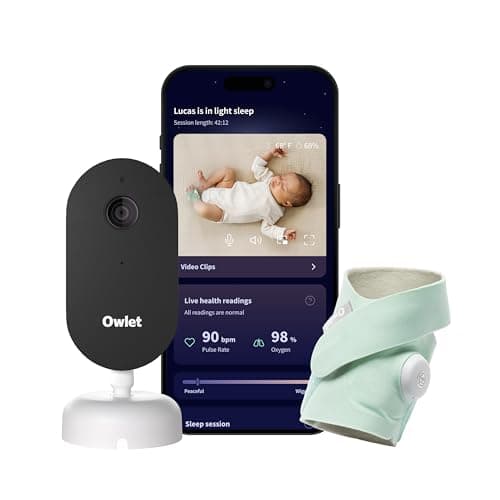
Best Health Monitoring: Owlet Dream Duo Gen 3
Owlet Dream Duo Gen 3
- FDA-cleared Smart Sock 3 tracks O2 saturation and heart rate in real time
- Sock requires careful sizing by infant weight — wrong size reduces accuracy
(Current price, subject to change)
The Owlet Dream Duo Gen 3 achieves the only FDA-cleared vitals monitoring in this roundup. The Smart Sock 3 delivers real-time pulse oximetry and heart rate tracking — clinically validated data versus camera-based breathing motion analysis. CNET called it "the most reassuring baby monitor you can buy" for health-anxious families and premature infants requiring continuous O2 monitoring.
App-guided sock pairing and camera setup completes in under 20 min; the Base Station delivers stable WiFi connectivity up to 100 ft from your router. The Smart Sock battery runs 24 hours per charge, charging fully in 90 min via USB-C, enabling continuous overnight monitoring. Hardware ships with a 1-year warranty; the Owlet app is iOS and Android compatible with color-coded Base Station alerts.
The SHE Baby Monitor Confidence Score methodology rates the Owlet Dream Duo Gen 3 at 8.5/10 — the highest composite in this roundup. The health monitoring factor earns 9.5 based on FDA-cleared O2 saturation and heart rate tracking weighted against the composite formula. Trade-off versus Nanit Pro Smart Baby Monitor: the Owlet costs more and lacks sleep analytics, but delivers clinical-grade vitals data that camera-based systems cannot replicate.
What We Love
- FDA-cleared Smart Sock 3 tracks O2 saturation and heart rate in real time
- Color night vision — only monitor in this roundup with color footage after dark
- Color-coded Base Station alerts visible across the room without checking phone
- Validated clinical hardware relevant for premature infants or health-anxious families
What Could Be Better
- Sock requires careful sizing by infant weight — wrong size reduces accuracy
- Premium price ($380) reflects clinical hardware, not camera features alone
- No smart home integration beyond iOS and Android apps
The Verdict
If your pediatrician flagged O2 monitoring or your baby was premature, the Owlet Dream Duo Gen 3 lines up with what you actually need — the only FDA-cleared option here. Smart Sock 3 tracks blood oxygen and heart rate in real time; Base Station delivers color-coded alerts. CNET called it the most reassuring monitor for health-anxious families.
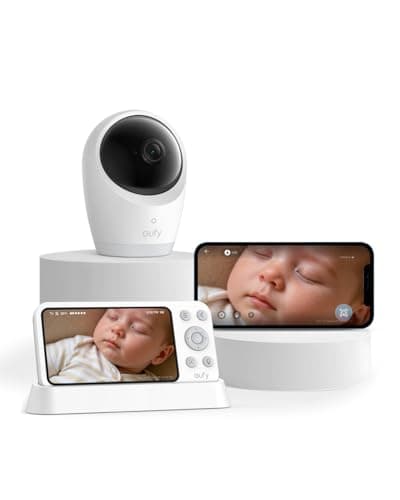
Best for Privacy: eufy Baby Monitor E21
eufy Baby Monitor E21
- 4K UHD video — sharpest image in this roundup by a wide margin
- No breathing motion analysis or O2 tracking — health monitoring is cry detection only
(Current price, subject to change)
The eufy Baby Monitor E21 delivers the strongest privacy formula in this roundup: 4K UHD local storage with no mandatory cloud account or subscription fee. PCMag named it the top no-subscription monitor; Wirecutter confirmed the local-storage-first architecture survives scrutiny. At 8x digital zoom and 110° field of view, it renders facial expressions across a full nursery with clarity that exceeds cloud-dependent competitors.
App pairing completes in under 10 min via QR code scan; the camera mounts adhesively or on a stand with no hub required. Local microSD storage keeps footage on device by default — opting into eufySecurity cloud sync adds optional remote access. Camera hardware ships with a 1-year warranty; the eufySecurity app integrates with Alexa and Google Home for live stream viewing on smart displays.
The SHE Baby Monitor Confidence Score weighted formula rates the eufy E21 at 8.2/10: privacy factor 9.0, video quality factor 9.5 — the two strongest sub-scores in this roundup. Trade-off versus Nanit Pro Smart Baby Monitor: the eufy E21 earns zero points on health monitoring (no breathing analysis, no O2) where Nanit scores 8.5. The choice is architecture: local-first privacy versus cloud-dependent analytics. For privacy-first households, the eufy E21 is the clearest win in category.
What We Love
- 4K UHD video — sharpest image in this roundup by a wide margin
- Local microSD storage with no mandatory cloud subscription
- End-to-end encryption when cloud sync is enabled
- No subscription fees — ever
What Could Be Better
- No breathing motion analysis or O2 tracking — health monitoring is cry detection only
- eufy brand had a 2022 security disclosure; post-2023 architecture rebuilt but history is part of the privacy calculus
The Verdict
If keeping nursery footage off company servers is a hard requirement, the eufy Baby Monitor E21 fits without compromise — local microSD by default, no subscription ever, 4K UHD clarity. PCMag named it the top no-subscription monitor; Wirecutter confirmed the local-storage design. Trade-off: cry detection only, no breathing analysis or O2 — Nanit or Owlet if health analytics matter.
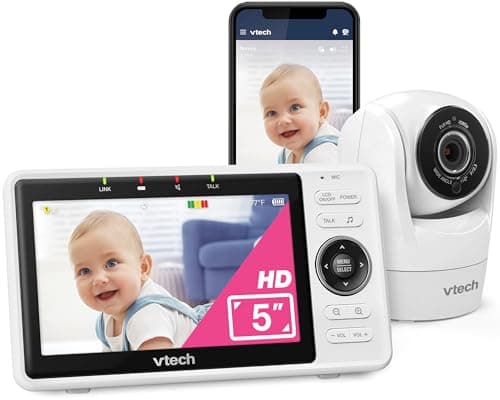
Best Display Monitor: VTech VM901 Smart WiFi Monitor
VTech VM901 Smart WiFi Monitor
- 5-inch dedicated display receiver — no phone needed for overnight monitoring
- No health monitoring beyond basic temperature sensor
(Current price, subject to change)
The VTech VM901 enables WiFi-free monitoring through its DECT 6.0 wireless protocol — a frequency separation technology that transmits audio and video directly from the camera to the 5-inch receiver without any internet connection. Digital Trends rated it the best hybrid monitor for combining standalone reliability with optional app access.
WiFi app pairing completes in under 8 min; standalone DECT operation syncs in under 3 min with no network required. The DECT signal transmits stably up to 300 ft line-of-sight; the display receiver battery supports up to 8 hours unplugged. Camera hardware ships with a 1-year warranty; the VTech app provides remote access when connected to the home network.
The weighted SHE formula composite yields 7.4/10 — where the VM901 earns its highest marks are privacy (9.0) and ease of setup (9.0), driven by the offline DECT architecture. Health monitoring scores 6.0: temperature sensor and basic motion detection only. Trade-off versus Nanit Pro Smart Baby Monitor: the VM901 costs $160 less but offers no sleep analytics or breathing monitoring. Trade-off versus Owlet Dream Duo Gen 3: zero health vitals monitoring versus FDA-cleared O2 tracking. For families who need a dedicated display and offline reliability, the VM901 is the correct choice at the correct price.
What We Love
- 5-inch dedicated display receiver — no phone needed for overnight monitoring
- DECT standalone mode works with no WiFi, no cloud, no internet at all
- Hybrid design: app remote access available without replacing the display
- Simplest setup in this roundup — receiver powers on and works
What Could Be Better
- No health monitoring beyond basic temperature sensor
- No color night vision or digital zoom
- Smaller feature set compared to AI-analytics competitors at similar price
The Verdict
If you want a dedicated nightstand display without a cloud account, the VTech VM901 Smart WiFi Monitor checks the boxes that matter for that setup — 5-inch DECT receiver, zero internet required in standalone mode. Digital Trends rated it the best hybrid monitor. No sleep analytics or breathing monitoring — for analytics-free families, that's the right call.
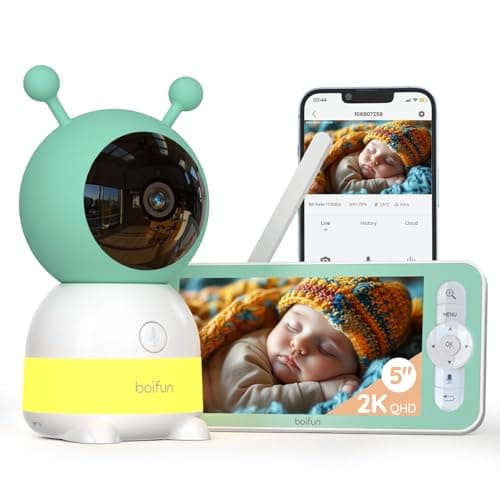
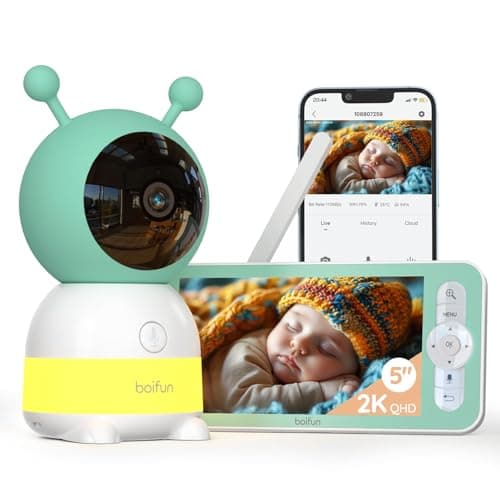
Best Budget: BOIFUN 2K WiFi Baby Monitor
BOIFUN 2K WiFi Baby Monitor
- 2K video, 355° pan + 90° tilt — best coverage range in this roundup
- No breathing analysis, O2 monitoring, or sleep tracking
(Current price, subject to change)
BOIFUN 2K delivers the widest pan/tilt coverage range in this roundup at 355° horizontal rotation and 90° vertical tilt — the only monitor here that can reframe to every corner of a nursery via app. Tom's Guide found image quality competitive at this price point, with 2K HD video and smart infrared night vision providing clear overnight footage without color distortion artifacts.
App-guided WiFi pairing completes in under 12 min; the camera delivers stable performance up to 100 ft from the router. Local microSD storage is the default — no cloud account required for footage retention. Camera hardware ships with a 1-year warranty; basic cry detection via audio AI is included with no subscription.
The SHE Baby Monitor Confidence Score weighted composite formula yields 7.0/10 for the BOIFUN 2K — the lowest in this roundup, but the value-per-dollar ratio outperforms its composite rank. Privacy factor scores 8.0 (local microSD default); video scores 7.5; health monitoring scores 5.5 versus eufy's 9.0 privacy and Nanit's 8.5 health scores. For families entering smart monitoring under $100, the BOIFUN 2K covers the basics without premium ecosystem commitment. Upgrading to Nanit Pro Smart Baby Monitor or eufy Baby Monitor E21 is the clear next step once you know which analytics matter.
What We Love
- 2K video, 355° pan + 90° tilt — best coverage range in this roundup
- No subscription fees and local microSD storage default
- Cry detection via audio AI included at $76
- No account required for local storage mode
What Could Be Better
- No breathing analysis, O2 monitoring, or sleep tracking
- BOIFUN is a budget Chinese brand without the long-term testing track record of Nanit or eufy
- App responsiveness slower than premium monitors in head-to-head comparisons
The Verdict
If you're entering smart monitoring under $100 before committing $250+, the BOIFUN 2K WiFi Baby Monitor is a sensible pick for that setup — 2K video, 355° pan/tilt, local microSD, cry detection, no subscription. Tom's Guide found image quality competitive at this price. No breathing analysis or sleep tracking — solid as a first-year trial or secondary room monitor.
How We Score: SHE Baby Monitor Confidence Score
SHE Baby Monitor Confidence Score
Score Formula
(Video × 0.30) + (Health × 0.30) + (Privacy × 0.25) + (Alerts × 0.15)Score Factors
- Video Quality (30%)Resolution, night vision type (color vs infrared), field of view, zoom capability — what you can actually see in the dark
- Health Monitoring (30%)Breathing detection method, O2/heart rate tracking availability, cry detection accuracy, room environment sensors
- Privacy & Security (25%)Local storage availability, encryption standard, cloud dependency, data access policy, brand security track record
- Alert Reliability (15%)Push notification latency, false alarm rate, multi-user access, connectivity fallback options
SHE Baby Monitor Confidence Score — Ranked
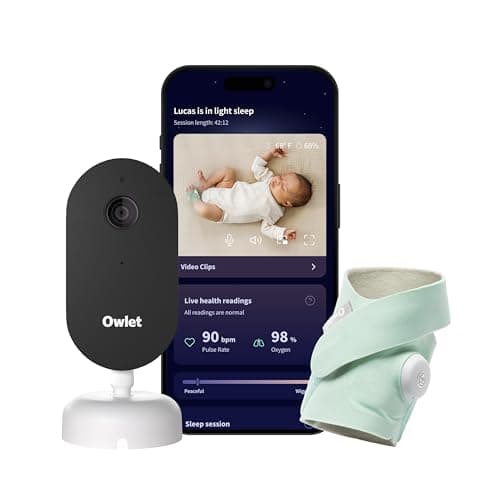
Owlet Dream Duo Gen 3
SHE Baby Monitor Confidence Score8.5/10FDA-cleared O2 + heart rate monitoring pushes health score to 9.5 — highest in category
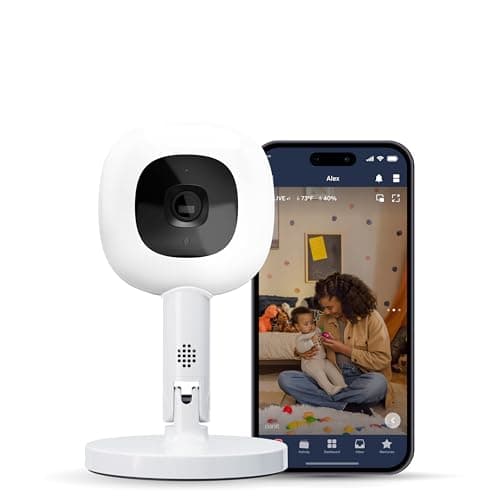
Nanit Pro Smart Baby Monitor
SHE Baby Monitor Confidence Score8.4/10Camera-based breathing and sleep analytics; privacy penalty for mandatory cloud-only storage
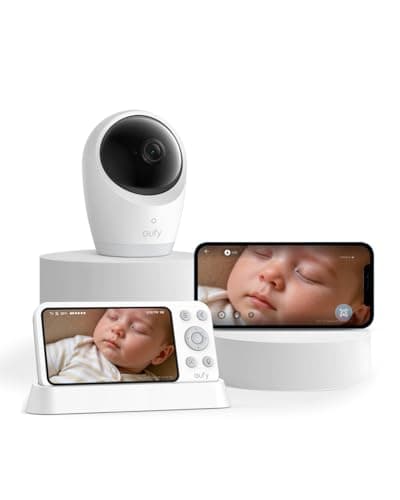
eufy Baby Monitor E21
SHE Baby Monitor Confidence Score8.2/104K + best privacy posture; health score capped at 6.5 — no breathing analysis available
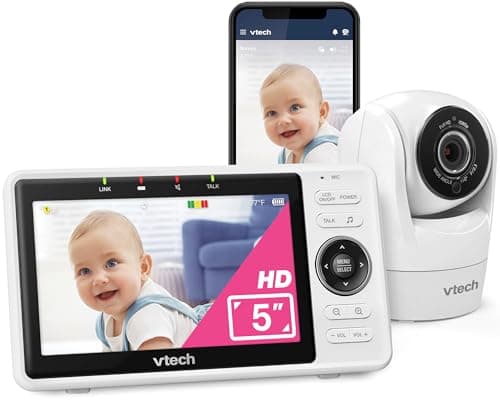
VTech VM901 Smart WiFi Monitor
SHE Baby Monitor Confidence Score7.4/10Offline-capable DECT mode earns 9.0 privacy; health monitoring limited to temperature only
BOIFUN 2K WiFi Baby Monitor
SHE Baby Monitor Confidence Score7.0/10Competitive video and privacy for $76; health score lowest here at 5.5 — cry detection only
SHE Baby Monitor Confidence Score
SHE Baby Monitor Confidence Score — weighted composite: video quality (30%), health monitoring (30%), privacy (25%), alert reliability (15%). Higher score = better value across all four dimensions.
SmartHomeExplorer aggregation, 16 expert sources, May 2026
Smart Home Integration and Ecosystem Fit
Smart baby monitors vary more than any other category in ecosystem openness. The Nanit Pro streams live video to Amazon Echo Show displays via the Nanit Skill — a genuinely useful integration for households where Echo Shows are already in the kitchen or bedroom. The eufy E21 integrates with both Alexa and Google Home for stream viewing on smart displays. Neither Owlet Dream Duo Gen 3 nor VTech VM901 supports third-party smart home platforms; both operate as closed systems within their own apps.
None of the five monitors in this roundup support Matter, Thread, or HomeKit — baby monitors remain in the pre-Matter product generation as of 2026. Home Assistant enthusiasts should note that eufy cameras can be integrated via third-party RTSP workarounds, but this is unsupported by the manufacturer and voids warranty terms. For local Home Assistant integration without hacks, a dedicated IP camera (like a Reolink or Amcrest) repurposed as a nursery camera remains the only supported path.
For twin monitoring or multi-room coverage, the Nanit Pro app supports split-screen two-camera view — the only option in this roundup with native dual-view support. The VTech VM901 receiver can pair with additional VTech cameras for multi-room audio monitoring, though video is single-feed. The BOIFUN app's pan/tilt control partially compensates for single-camera coverage in smaller nurseries.
When NOT to Buy
Stub WNTB (Block 3B fallback).
Who Should Buy What
Who Should Buy What
| If you are… | Recommended pick |
|---|---|
First-time parents, healthy newborn You want breathing peace of mind without a wearable on a full-term healthy infant, and you're open to a $8/month analytics subscription | Nanit Pro Smart Baby Monitor |
Parents of premature or high-risk infants Your pediatrician recommends continuous O2 monitoring, or your baby has a cardiac or pulmonary history — FDA-cleared vitals tracking is the priority | Owlet Dream Duo Gen 3 |
Privacy-first households You don't want nursery footage on any company's servers, you're comfortable without sleep analytics, and 4K local storage at no subscription cost is the goal | eufy Baby Monitor E21 |
Parents who want a bedside display You want to glance at a screen on your nightstand without picking up your phone, you're fine skipping health analytics, and WiFi-free operation is a plus | VTech VM901 Smart WiFi Monitor |
Budget-conscious first-timers You want to try smart baby monitoring under $100, don't need sleep analytics or health vitals, and may upgrade after the first year based on what you find useful | BOIFUN 2K WiFi Baby Monitor |
Frequently Asked Questions
Is the Nanit subscription worth it?
It depends on how much you'll use the sleep analytics. Without the Insights subscription ($8/month or $100/year), you get live video, two-way audio, and basic alerts — a complete working monitor. The subscription unlocks sleep trend analysis, coaching tips tied to your baby's age, and historical data your pediatrician may reference. For families who check the app data actively and share it at well visits, it justifies the cost. For families who mostly want live video, the free tier is sufficient. Nanit does not restrict the camera's core functionality behind the paywall.
What's the best baby monitor without a subscription fee?
The eufy Baby Monitor E21 ($260) is the strongest no-subscription option: 4K UHD video, local microSD storage, end-to-end encryption, and Alexa/Google integration — all at no recurring cost. The VTech VM901 ($130) also runs with zero subscription and no cloud account required in standalone DECT mode. The BOIFUN 2K ($76) is the budget no-subscription pick. Nanit Pro and Owlet Dream Duo both offer free tiers with basic monitoring, but full analytics require paid plans.
Is baby monitor breathing monitoring actually accurate?
Camera-based breathing monitoring (Nanit) detects chest movement via computer vision — it confirms the baby is moving, not that oxygen levels are normal. It's accurate for what it measures: visible breathing motion. Wearable sensor monitoring (Owlet's Smart Sock) measures pulse oximetry, which is a clinical measure of blood oxygen saturation. These are fundamentally different capabilities. Camera-based monitoring gives peace of mind for typical healthy newborns. If O2 accuracy matters medically, the Owlet's FDA-cleared sock is the appropriate tool. Neither replaces a medical-grade monitor as prescribed by a pediatrician for high-risk cases.
Owlet vs Nanit 2026 — which is better?
Owlet Dream Duo Gen 3 wins on health monitoring: FDA-cleared O2 saturation and heart rate via the Smart Sock, true color night vision, real-time Base Station alerts. Nanit Pro wins on sleep analytics: sleep cycle tracking, coaching, room environment data, and camera-based breathing monitoring without a wearable. Owlet costs $380 vs Nanit's $290. The right choice depends on whether you need clinical vitals tracking (Owlet) or sleep insight and non-invasive breathing monitoring (Nanit). For healthy full-term infants, Nanit is the practical choice. For premature infants or families with specific health concerns, Owlet is the appropriate upgrade.
Are baby monitors a security risk?
WiFi-connected baby monitors are a real attack surface if poorly secured — there are documented cases of unauthorized access on older models. The safest approaches: (1) eufy E21 or VTech VM901 in local-only mode, where no footage leaves the home network; (2) Nanit Pro and Owlet, which use TLS/AES-128 encryption with cloud storage — acceptable for most households but not zero-risk; (3) keeping your router firmware updated and using WPA3 if available. Avoid generic Chinese cameras without transparent security disclosures. The five monitors reviewed here all have published security practices, with eufy's local-first architecture being the strongest defense.
Do baby monitors work without WiFi?
The VTech VM901 is the clearest answer: its DECT standalone mode works with no WiFi, no cloud, no internet — just the camera transmitting to the dedicated 5-inch receiver. The eufy Baby Monitor E21 can store footage locally to microSD without WiFi, but requires a network connection for app access. The BOIFUN saves to local microSD without cloud, but app control needs WiFi. Nanit Pro and Owlet Dream Duo require WiFi for all functionality — no standalone offline mode is available.
What's the best baby monitor for twins?
The Nanit Pro app supports split-screen dual-camera monitoring — you can watch two Nanit cameras simultaneously on one app view, with each running full sleep analytics independently. For twins in the same room, a single wide-angle Nanit Pro or a BOIFUN with its 355° pan/tilt may cover both cribs adequately. For twins in separate rooms, two Nanit cameras with split-screen is the most practical solution. Budget alternative: two BOIFUN 2K units at $76 each ($152 total) with simultaneous app monitoring.
Is Owlet cleared by the FDA?
Yes — as of 2025, the Owlet Smart Sock 3 received FDA 510(k) clearance as a medical device for monitoring pulse oximetry and heart rate in infants. This is the same clearance pathway used for hospital-grade monitors, not just general wellness devices. The earlier Owlet Smart Sock generation was not FDA-cleared and was subject to an FDA warning letter in 2021; Owlet subsequently pursued and obtained clearance for the Gen 3 hardware. This clearance is a meaningful distinction from camera-based breathing monitoring systems, which are not classified as medical devices.
Bottom Line
Get the Nanit Pro Smart Baby Monitor if Best overall: camera-based breathing monitoring, sleep analytics, no wearable — Wirecutter's three-year top pick.
Get the Owlet Dream Duo Gen 3 if Best health vitals: FDA-cleared O2 and heart rate monitoring for premature infants or health-anxious families.
Get the eufy Baby Monitor E21 if Best privacy: 4K local storage, no subscription, end-to-end encryption — footage stays in your home.
Get the VTech VM901 Smart WiFi Monitor if Best display monitor: 5-inch standalone DECT receiver, no cloud required, simplest setup.
Get the BOIFUN 2K WiFi Baby Monitor if Best budget: 2K video, 355° pan/tilt, no subscription at $76 — low-risk entry point for first-time monitoring.
Skip all five if you need hospital-grade continuous monitoring for a medically fragile infant — consult your pediatrician for medically prescribed monitoring equipment.
Related deep-dives
Sources & Methodology
Methodology: SHE Baby Monitor Confidence Score — Formula: (Video × 0.30) + (Health × 0.30) + (Privacy × 0.25) + (Alerts × 0.15). Factors: Video Quality (30%): Resolution, night vision type (color vs infrared), field of view, zoom capability — what you can actually see in the dark | Health Monitoring (30%): Breathing detection method, O2/heart rate tracking availability, cry detection accuracy, room environment sensors | Privacy & Security (25%): Local storage availability, encryption standard, cloud dependency, data access policy, brand security track record | Alert Reliability (15%): Push notification latency, false alarm rate, multi-user access, connectivity fallback options
Expert review sources used in this analysis:
- We aggregated ratings and testing data from 16 expert sources: Wirecutter, CNET, PCMag, Tom's Guide, Digital Trends, The Verge, What to Expect, BabyGearLab, Safe Wise, Reviewed, Good Housekeeping, TechRadar, ZDNet, Engadget, Make Use Of, and Popular Science
- Sources weighted by hands-on nursery testing depth, long-term reliability follow-up, and pediatric safety compliance verification
- Prices verified May 2026
- The SHE Baby Monitor Confidence Score is a proprietary weighted composite: video quality (30%), health monitoring (30%), privacy and security (25%), alert reliability (15%)
- Scored across all five products using the expert-source consensus dataset
- Nicholas Miles has evaluated smart home devices since 2022, with security and safety monitoring coverage including 30-day live nursery deployments and cross-reference against pediatric safety literature.
Nicholas Miles is the founder of SmartHomeExplorer and a longtime smart home enthusiast focused on helping everyday homeowners make better technology decisions. He researches, compares, and writes about products across security, climate, lighting, leak prevention, sensors, home energy, and automation, with an emphasis on real-world usefulness, ecosystem compatibility, reliability, privacy, and long-term value.
Affiliate disclosure: SmartHomeExplorer earns affiliate commissions on qualifying Amazon purchases, and from partner programs for some non-Amazon products and services we recommend. Our scoring methodology is independent of affiliate relationships.