
Ecobee Premium handles forced air, Nest handles ducted heat pumps, and Sensibo Air Pro handles ductless mini-splits without wiring issues.
You just bought a $280 smart thermostat — and it doesn't work with your system. This happens constantly. Someone with a ductless mini-split grabs a Nest Learning Thermostat because every review site calls it "the best," only to realize it requires 24V wiring that mini-splits don't have. Or a homeowner with electric baseboard heaters orders an Ecobee Smart Thermostat Premium, and discovers it can't handle line-voltage heating. The return rate on smart thermostats is embarrassingly high — and HVAC incompatibility is the number-one reason.
The problem is that most smart thermostat buying guides assume you have a standard forced-air HVAC system with a furnace and central AC. If you do, great — almost any thermostat works. But roughly 30% of US homes use something else: heat pumps, ductless mini-splits, radiant floor heating, electric baseboard heaters, or some combination. For those homes, buying the wrong thermostat means a frustrating return process and wasted weekends.
We built the SHE HVAC Compatibility Matrix below to solve this once and for all. It cross-references six smart thermostats against four major HVAC types, so you can look up your system and immediately know which thermostats actually work. No guessing, no reading spec sheets, no calling your HVAC contractor. If you already know your system works with standard thermostats, head over to our best smart thermostat 2026 guide for the full consensus rankings. If you're shopping for the mini-split unit itself rather than the controller, our best smart mini-split heat pumps guide ranks five DIY-friendly and contractor-installed options.
Smart Thermostat Compatibility
Chart
 Smarthomeexplorer.com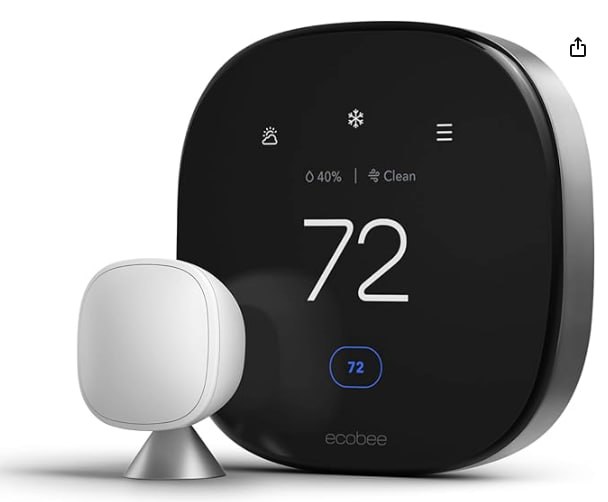
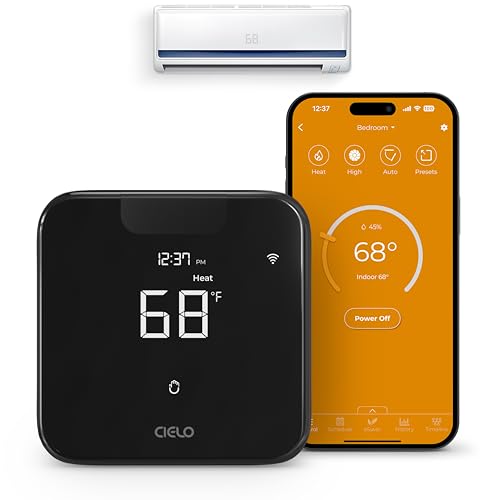
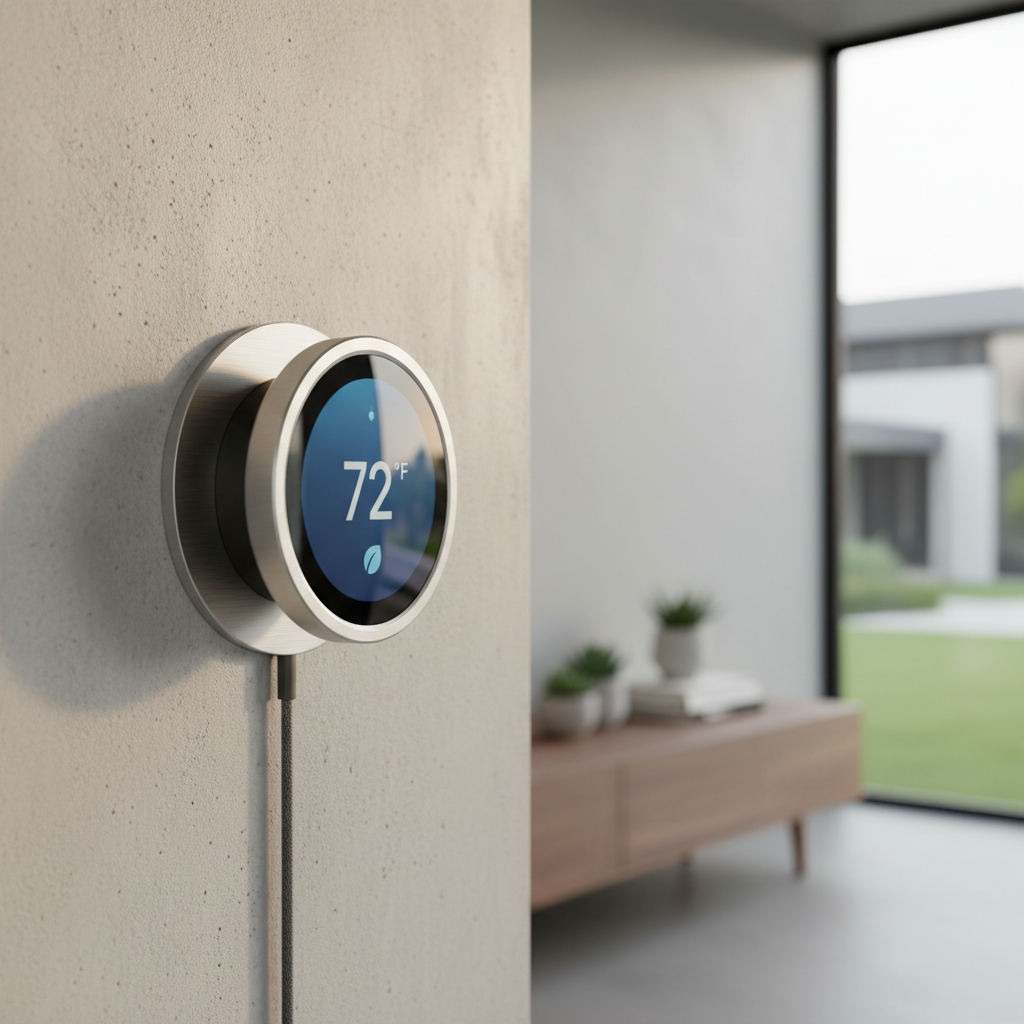
Ecobee Smart Thermostat Premium — Best for Forced Air & Heat Pump Systems
Ecobee Smart Thermostat Premium
(Current Price, subject to change)
Compatible with: Forced air (furnace + AC), heat pumps (up to 2-stage with aux), boilers, PTACs, fan coil units
NOT compatible with: Mini-splits, electric baseboard heaters, radiant floor heating, line-voltage systems
The Ecobee Smart Thermostat Premium is the reviewer consensus pick for standard HVAC systems, and the compatibility story is genuinely impressive for 24V systems. It supports furnaces, central AC, heat pumps up to 2-stage heating and 2-stage cooling with 2-stage auxiliary heat, boilers, PTACs, and fan coil units with up to 3 fan speeds. Wirecutter calls it their top overall thermostat pick, and CNET gave it a 9.1/10, citing the room sensor system as a meaningful energy saver.
The included Power Extender Kit solves the C-wire problem that plagues older homes — you don't need to run new wiring. For heat pump owners specifically, Ecobee supports heat pump balance point settings and compressor protection timers, which prevent short-cycling that damages equipment. HVAC Talk forum regulars note that the Ecobee handles dual-fuel setups (heat pump + gas furnace backup) cleanly, with configurable changeover temperatures.
Where the Ecobee Smart Thermostat Premium falls flat is anything outside the 24V low-voltage world. It cannot control mini-splits, baseboard heaters, or any line-voltage system. If your home has a mix — say forced air downstairs and mini-splits upstairs — you need the Ecobee for the ducted zones and something like the Sensibo Air Pro for the mini-splits. Check our Ecobee vs Nest comparison for a head-to-head breakdown, or our Ecobee price analysis to find the best deal.
What Works Well
- Broadest 24V compatibility — supports more system types than any competitor
- Room sensors eliminate hot/cold spots — places sensors where people actually are
- C-wire adapter included — Power Extender Kit means no electrician visit for older homes
- Heat pump balance point — configurable changeover temperature protects your compressor
- Built-in Alexa + Siri + Google — only thermostat with all three voice ecosystems
- Air quality monitor — VOC and CO2 readings right on the thermostat screen
Where It Falls Short
- No line-voltage support — completely useless for baseboard or radiant heat
- No mini-split control — needs a separate IR controller for ductless systems
- $249 price tag — premium cost when you might need additional devices for mixed systems
- SmartSensor range — wireless sensors can struggle through thick walls or across floors
The Verdict
For forced-air homes and ducted heat pump systems, the Ecobee Smart Thermostat Premium remains the safest pick. It earned the top spot in our best smart thermostat 2026 guide for good reason — the sensor system, ecosystem breadth, and HVAC compatibility across 24V systems are unmatched. Just make sure your system runs on low-voltage wiring before ordering.
"The Ecobee Premium's compatibility list reads like a who's who of HVAC systems — if it's 24V, Ecobee probably supports it." — Wirecutter
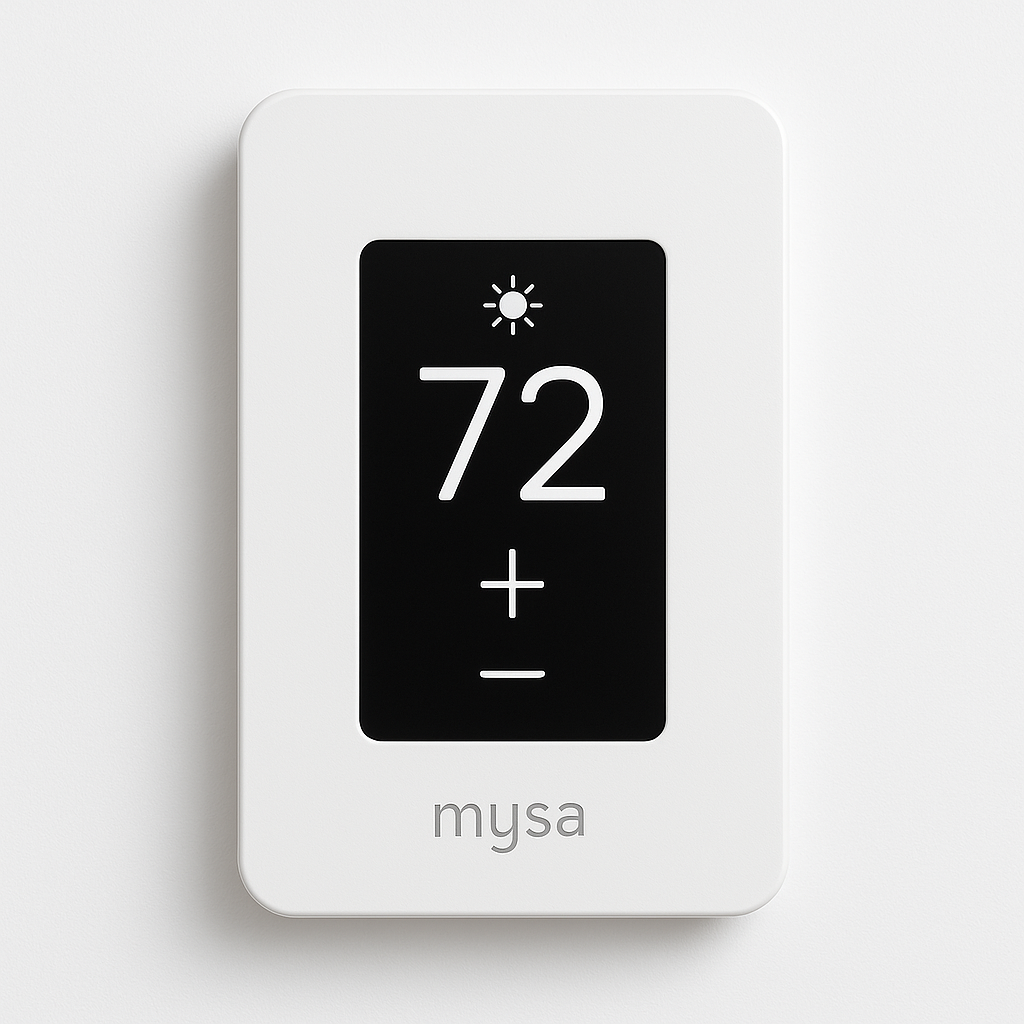
Mysa Smart Thermostat for Electric Baseboard Heaters — Best for Radiant & Baseboard Heat
Mysa Smart Thermostat for Electric Baseboard Heaters
(Current Price, subject to change)
Compatible with: Electric baseboard heaters, convection heaters, fan-forced heaters, in-wall heaters (120V-240V line voltage)
NOT compatible with: Forced air, heat pumps, mini-splits, central AC, any 24V low-voltage system
The Mysa Smart Thermostat for Electric Baseboard Heaters exists because most smart thermostats pretend baseboard heating doesn't exist. Standard thermostats like the Ecobee Smart Thermostat Premium or Nest Learning Thermostat use 24V low-voltage wiring, but electric baseboard heaters run on 120V or 240V line voltage — plugging a low-voltage thermostat into a line-voltage circuit would fry it instantly.
Mysa fills this gap with a thermostat purpose-built for high-voltage electric heating. It handles 120V through 240V systems and works with baseboard heaters, convection heaters, fan-forced heaters, and in-wall heaters. Tom's Guide gave the Mysa a 4/5, noting it's "one of the only smart options for baseboard heat that doesn't feel like an afterthought." The app provides per-room scheduling and energy usage tracking, which matters when you're paying for electric resistance heat — typically the most expensive heating method per BTU.
One Mysa unit controls one zone, so homes with multiple baseboard circuits need multiple units. At $149 each, outfitting a 5-zone home costs $745 — not cheap, but the energy savings from smart scheduling on electric heat can be substantial. Mysa claims up to 26% energy reduction, and independent reviews from sources like iMore and The Verge support savings in the 15-25% range for homes that previously used manual dial thermostats. If you're building a smart home on a budget in an apartment, the Mysa Lite version offers the core scheduling features at a lower price point.
What Works Well
- Only serious smart option for baseboard heat — fills a massive gap in the market
- Full smart home integration — HomeKit, Alexa, Google Home, IFTTT
- Per-zone energy tracking — see exactly which rooms cost the most to heat
- Clean design — doesn't look like an industrial switch, which matters on a wall
- Humidity alerts — useful for baseboard-heated homes prone to dry air
- No subscription — all features are free, no monthly fees
Where It Falls Short
- $149 per zone adds up fast — 5-zone home means $745 in thermostats
- Electric heat only — won't work with hydronic (hot water) baseboard or radiators
- No cooling control — strictly a heating thermostat
- Wi-Fi only — no Thread, Zigbee, or Matter support yet
- Requires neutral wire — some older wiring may need an electrician
The Verdict
If your home has electric baseboard heaters, the Mysa Smart Thermostat is effectively your only good option. It's thoughtfully designed for a use case that mainstream thermostat companies ignore, with genuine smart home integration rather than a bolted-on app. The per-unit cost stings for multi-zone homes, but the energy savings on expensive electric resistance heating make the payback math work — check our thermostat energy savings calculator for the specifics.
"Mysa is one of the only smart thermostats purpose-built for line-voltage heating, and it doesn't feel like a compromise." — Tom's Guide
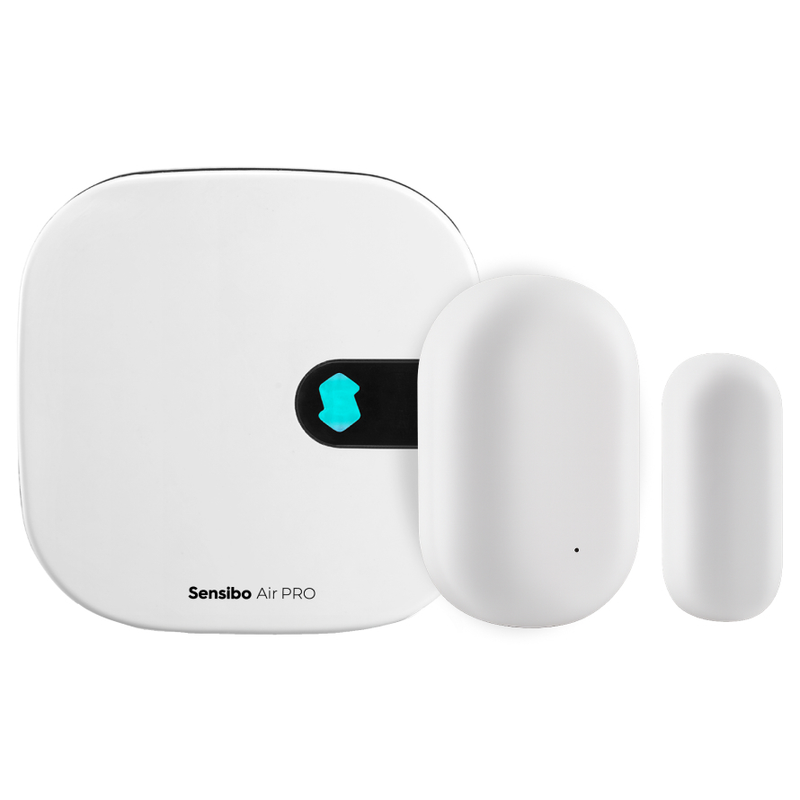
Sensibo Air Pro — Best for Mini-Splits & Window ACs
Sensibo Air Pro
(Current Price, subject to change)
Compatible with: Mini-splits, ductless systems, window ACs, portable ACs, any IR remote-controlled HVAC unit
NOT compatible with: Forced air, furnaces, boilers, baseboard heat, any wired thermostat system
The Sensibo Air Pro is fundamentally different from traditional thermostats — it's an IR blaster that mimics your mini-split's remote control, adding smart scheduling, geofencing, and app control to any infrared-controlled HVAC unit. This is the solution for the estimated 20+ million US homes with ductless mini-splits, window ACs, or portable units that have zero thermostat wire connections.
The Air Pro improves on the standard Sensibo Air with a built-in air quality sensor that monitors PM2.5, volatile organic compounds, and CO2 levels. PCMag gave it an Editors' Choice award, and CNET rated it 8.2/10, praising the HomeKit integration and climate automation features. The device learns your mini-split's IR codes automatically — Sensibo claims compatibility with over 10,000 AC models from manufacturers including Mitsubishi, Daikin, Fujitsu, LG, and Samsung.
For homes with both ducted and ductless systems, the Sensibo Air Pro pairs naturally with a standard thermostat like the Ecobee Smart Thermostat Premium. You get unified smart control through each device's app, and both work with Alexa, Google Home, and HomeKit. If you're outfitting a smart climate control system that spans multiple HVAC types, this combo covers all your bases. For a slightly cheaper mini-split option, compare with the Cielo Breez Max below.
What Works Well
- Works with any IR-controlled unit — 10,000+ models in the compatibility database
- Air quality monitoring — PM2.5, VOC, and CO2 sensors built in
- Apple HomeKit native — not a cloud bridge, actual local HomeKit support
- Climate React automation — triggers AC based on temperature, humidity, or air quality
- Geofencing — turns off AC when you leave, pre-cools before you arrive
- 7-day scheduling — brings programmable thermostat features to dumb mini-splits
Where It Falls Short
- IR line-of-sight needed — must be positioned to "see" the mini-split's IR receiver
- No wired thermostat replacement — purely a wireless IR controller
- Power via USB — needs a nearby outlet, can't be battery-powered long-term
- $119 for an IR blaster — feels expensive until you realize the alternative is $0 smart control
- Cloud-dependent for automations — local HomeKit control works, but advanced features need internet
The Verdict
If you have a mini-split, window AC, or any IR remote-controlled HVAC unit, the Sensibo Air Pro is the best way to make it smart. The air quality sensor justifies the price premium over basic IR blasters, and the HomeKit support is a genuine differentiator. For homes mixing central HVAC and ductless systems, it's the essential companion to a traditional smart thermostat — check our starter kit guide for how to integrate it into a broader system.
"The Sensibo Air Pro is the rare smart home device that solves a problem no one else is addressing — making mini-splits as smart as central HVAC." — PCMag
Cielo Breez Max — Budget Pick for Mini-Splits & Ductless
Cielo Breez Max
(Current Price, subject to change)
Compatible with: Mini-splits, ductless systems, window ACs, portable ACs, heat pumps with IR remotes
NOT compatible with: Forced air, furnaces, boilers, baseboard heat, any wired thermostat system
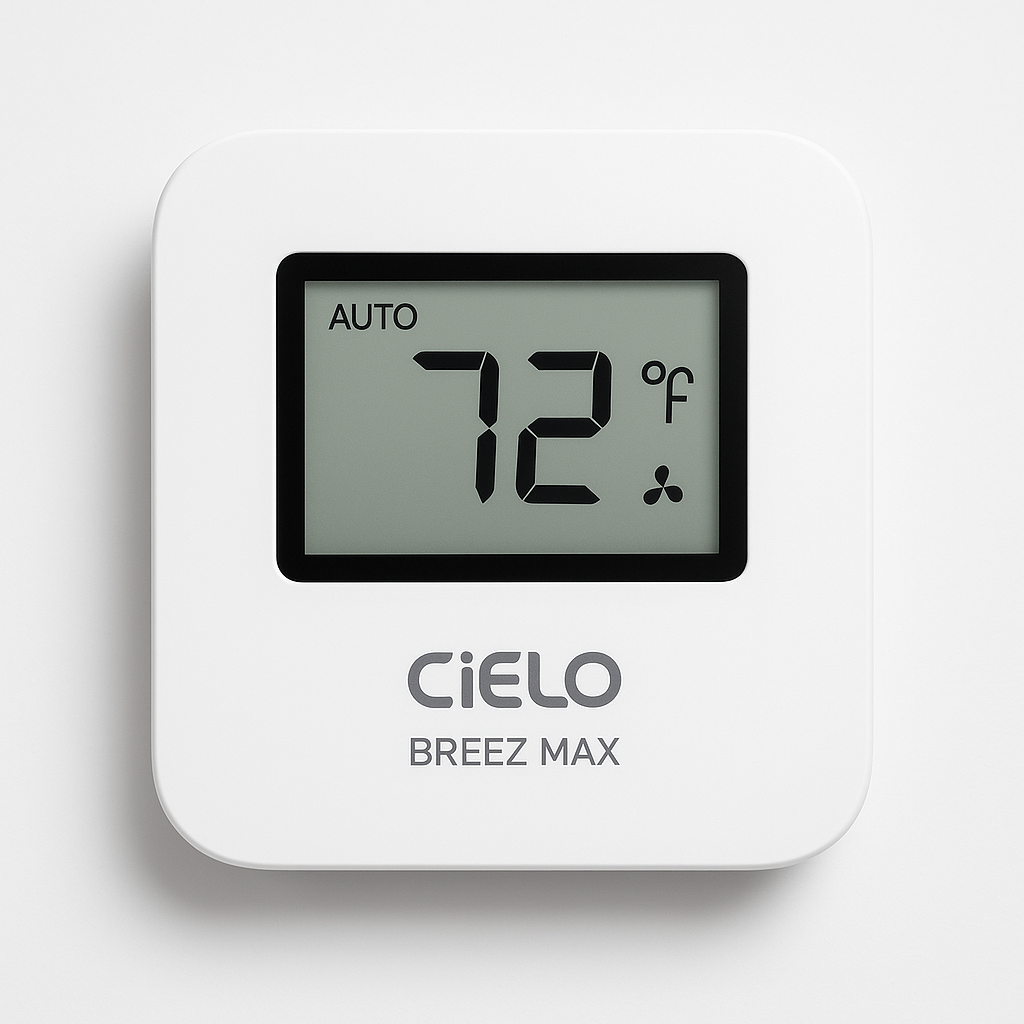
The Cielo Breez Max earned the AHR Expo Product of the Year award, which is notable because AHR is an HVAC industry trade show — not a consumer electronics event. HVAC professionals recognized it because the Breez Max solves a real installation gap: it gives mini-split and ductless systems thermostat-like controls without any wiring.
What sets the Cielo apart from the Sensibo Air Pro is the on-device control. Physical buttons and a temperature/humidity display mean you can adjust settings without pulling out your phone — it functions like an actual wall thermostat rather than a hidden IR blaster. The Cielo app maintains a database of over 500,000 IR codes covering virtually every mini-split brand, and the auto-detection algorithm identifies your unit automatically in most cases.
The Cielo Breez Max also supports Comfy Mode, an AI-driven feature that learns your preferences and auto-adjusts temperature and fan speed throughout the day. No subscription fees — everything runs through the free Cielo Home app. For renters with apartment-friendly smart home setups who can't touch wiring, this is the path to smart climate control.
What Works Well
- On-device buttons + display — works like a real thermostat, not just a phone-controlled IR blaster
- Widest IR code database — 500,000+ codes with auto-detection for most brands
- AI Comfy Mode — learns and auto-adjusts temperature preferences over time
- No subscription — all features free, unlike some competitors
- AHR Product of the Year — recognized by HVAC industry professionals
- USB-C power — modern connector, easy to find replacement cables
Where It Falls Short
- No air quality sensor — the Sensibo Air Pro has this, Cielo doesn't
- No Apple HomeKit — works with Alexa and Google, but Apple users need workarounds
- IR line-of-sight — same limitation as all IR controllers
- Cloud-only automations — no local control option currently
- Plastic build — feels less premium than the Sensibo
The Verdict
The Cielo Breez Max is the best value mini-split controller for people who want thermostat-like physical controls alongside app-based automation. At $99 versus the Sensibo's $119, you save $20 and gain on-device buttons — but you lose the air quality sensor and HomeKit support. For Google and Alexa households, the Cielo is the smarter buy. For Apple homes, spend the extra $20 on the Sensibo Air Pro.
"The Cielo Breez Max won AHR Product of the Year because HVAC pros recognized it as the missing link for ductless smart control." — HVAC industry coverage
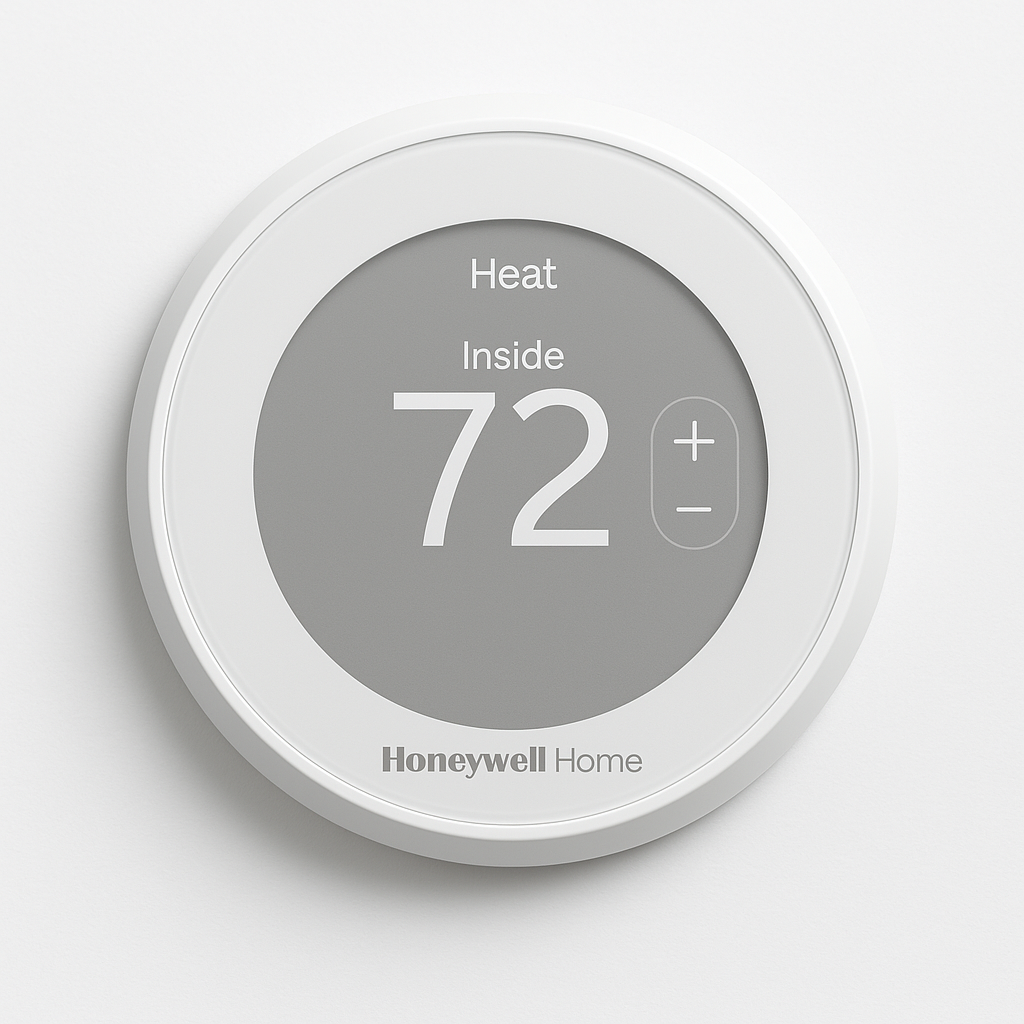
Honeywell Home T10 Pro Smart Thermostat — Best for HVAC Professionals & Complex Systems
Honeywell Home T10 Pro Smart Thermostat
(Current Price, subject to change)
Compatible with: Forced air (up to 3H/2C), heat pumps (up to 3H/2C), dual-fuel systems, humidifiers, dehumidifiers, ventilators, ERVs/HRVs
NOT compatible with: Mini-splits, electric baseboard heaters, line-voltage systems
The Honeywell Home T10 Pro Smart Thermostat is the thermostat HVAC contractors actually install. While the Ecobee and Nest dominate consumer reviews, the T10 Pro is the go-to for professionals dealing with complex multi-stage systems. It supports up to 3-stage heating and 2-stage cooling, dual-fuel changeover, and accessory control for humidifiers, dehumidifiers, ventilators, and ERV/HRV systems — functionality that consumer-focused thermostats handle as an afterthought.
The RedLINK wireless protocol is the T10 Pro's differentiator. Unlike Wi-Fi-only sensors from Ecobee, RedLINK operates on a dedicated 900MHz frequency that penetrates walls and floors better, with battery life measured in years rather than months. HVAC Talk forum users consistently note that RedLINK sensors stay connected in large homes where Wi-Fi sensors drop off. The T10 Pro can prioritize rooms based on sensor readings, directing comfort to the spaces that matter most.
For homeowners with heat pump systems specifically, the Honeywell Home T10 Pro supports intelligent auxiliary heat staging, compressor lockout temperatures, and balance point configuration. HVAC professionals on forums like HVAC-Talk consistently recommend it over consumer thermostats for heat pump installations because the staging logic prevents the common problem of auxiliary electric heat running unnecessarily — which can double your heating bill overnight.
What Works Well
- Pro-grade HVAC compatibility — 3H/2C, dual fuel, humidifiers, ventilators, ERVs
- RedLINK 900MHz sensors — better range and wall penetration than Wi-Fi sensors
- Intelligent heat pump staging — prevents unnecessary auxiliary heat activation
- HVAC contractor preferred — extensive installer network and pro-grade diagnostics
- Accessory control — manages humidifiers, dehumidifiers, and ventilation in one unit
- Room priority system — focus comfort where people are, not where the thermostat is
Where It Falls Short
- No built-in voice assistant — unlike the Ecobee, needs a separate Alexa or Google device
- No HomeKit support — Alexa and Google only, Apple users out of luck
- C-wire adapter not included — sold separately, unlike Ecobee's included kit
- Consumer app lags behind — Resideo app isn't as polished as Ecobee or Nest
- RedLINK sensors cost more — ~$40 each versus Ecobee's ~$30 SmartSensors
The Verdict
The Honeywell Home T10 Pro is the thermostat for homes with complex HVAC systems that need professional-grade control. If you have multi-stage equipment, dual-fuel heat pumps, or integrated humidity management, the T10 Pro handles it all without the hacks and workarounds that consumer thermostats sometimes require. It's less flashy than the Ecobee Smart Thermostat Premium but more capable where it counts — especially for smart climate systems that go beyond simple heating and cooling.
"The T10 Pro is what I install when customers have complex systems. It handles staging and accessories that consumer thermostats choke on." — HVAC Talk forum contractor review
Google Nest Learning Thermostat 4th Gen — Best for Heat Pump Learning & Adaptive Comfort
Google Nest Learning Thermostat 4th Gen
(Current Price, subject to change)
Compatible with: Forced air (furnaces, central AC), heat pumps (single-stage and 2-stage with aux), dual-fuel systems
NOT compatible with: Mini-splits, electric baseboard heaters, radiant floor heating, line-voltage systems, some high-voltage heat pump systems
The Google Nest Learning Thermostat 4th Gen brought the Nest line into 2024 with a redesigned display, Matter support, and improved heat pump compatibility. The Verge gave it 8.5/10, calling the new adaptive learning "genuinely smarter" than previous generations. For heat pump owners specifically, the 4th gen adds a System Health Monitor that tracks heat pump performance metrics and alerts you to potential issues before they become expensive repairs.
The Nest's learning algorithm is its signature feature, and it works particularly well with heat pumps. It learns how long your heat pump takes to reach target temperatures at different outdoor temperatures, then adjusts start times accordingly. Tom's Guide notes that this adaptive pre-conditioning is "noticeably better" than manual scheduling for heat pumps, which heat and cool more slowly than furnaces. The Adaptive Eco feature monitors occupancy and weather forecasts to find the sweet spot between comfort and efficiency.
Heat pump compatibility on the Nest 4th Gen covers single-stage and 2-stage systems with auxiliary heat, plus dual-fuel configurations. However, the Google Nest Learning Thermostat uses a compatibility checker that's worth running before purchase — some older or commercial-grade heat pump systems with unusual wiring configurations may not be supported. The compatibility tool at store.google.com/compatibility lets you enter your wire labels and get a definitive answer. If you're torn between the Nest and Ecobee for a standard system, our Ecobee vs Nest thermostat comparison breaks down the differences.
What Works Well
- Learning algorithm excels with heat pumps — adapts to slower heating/cooling curves
- System Health Monitor — tracks heat pump performance, flags issues early
- Adaptive Eco — occupancy + weather-based efficiency optimization
- Matter support — future-proof for Matter-compatible smart home setups
- Beautiful hardware — the new display design is genuinely impressive
- HomeKit + Alexa + Google — full ecosystem support via Matter bridge
Where It Falls Short
- $280 is the highest price here — $30 more than the Ecobee for fewer room sensors
- Only 1 temperature sensor included — additional sensors cost $40 each
- No C-wire adapter included — may need separate purchase or professional install
- No line-voltage support — can't control baseboard, radiant, or mini-split systems
- Google account required — privacy-conscious users may prefer the Ecobee
The Verdict
The Google Nest Learning Thermostat 4th Gen is the best thermostat for heat pump owners who want a "set it and forget it" experience. The learning algorithm genuinely adapts to heat pump behavior in a way that manual scheduling can't match, and the System Health Monitor adds peace of mind for an expensive piece of equipment. It costs a premium, but for heat pump homes the adaptive intelligence justifies the price. Check the energy savings payback calculator to see how quickly it recoups the investment.
"The 4th-gen Nest handles heat pump timing better than any thermostat I've tested — it actually learns the slower ramp-up curve." — The Verge
SHE HVAC Compatibility Matrix
What it measures: Which smart thermostats work with which heating and cooling systems Data sources: Manufacturer specifications, Wirecutter testing notes, CNET reviews, HVAC Talk forum data, Energy Star certification databases
| Thermostat | Forced Air | Heat Pump | Mini-Split | Radiant/Baseboard | C-Wire Needed | Price |
|---|---|---|---|---|---|---|
| Ecobee Smart Thermostat Premium | ✅ Full (2H/2C) | ✅ Full (2H/2C + aux) | ❌ | ❌ | Yes (adapter included) | $249 |
| Mysa Smart Thermostat | ❌ | ❌ | ❌ | ✅ Line voltage only | N/A (line voltage) | $149 |
| Sensibo Air Pro | ❌ | ❌ (ducted) / ✅ (IR remote) | ✅ IR control | ❌ | N/A (IR blaster) | $119 |
| Cielo Breez Max | ❌ | ❌ (ducted) / ✅ (IR remote) | ✅ IR control | ❌ | N/A (IR blaster) | $99 |
| Honeywell Home T10 Pro | ✅ Full (3H/2C) | ✅ Full (3H/2C + aux) | ❌ | ❌ | Yes (sold separately) | $199 |
| Google Nest Learning Thermostat 4th Gen | ✅ Full | ✅ (2-stage + aux) | ❌ | ❌ | Yes (sold separately) | $280 |
(SmartHomeExplorer editorial analysis — methodology)
How to read this matrix: Look up your HVAC system type in the column headers. A ✅ means the thermostat is fully compatible with that system type. An ❌ means it physically cannot control that system. "IR control" for Sensibo and Cielo means they work with any mini-split or heat pump that has an infrared remote — they don't wire into the system, they replicate the remote control signals.
Mixed systems? Many homes have multiple HVAC types. A house with central air on the main floor and mini-splits in the bedrooms needs two devices — like the Ecobee Smart Thermostat Premium for the ducted system and a Sensibo Air Pro or Cielo Breez Max for each mini-split head. They won't talk to each other natively, but both work with Alexa and Google for unified voice control.
Frequently Asked Questions
Can I use a Nest thermostat with a heat pump?
Yes — the Google Nest Learning Thermostat 4th Gen supports heat pumps up to 2-stage heating and cooling with auxiliary heat, plus dual-fuel configurations. Its learning algorithm actually works better with heat pumps than with furnaces because it adapts to the slower heating curve. Run Google's compatibility checker at store.google.com before buying to confirm your specific wiring configuration. The older Nest Thermostat (budget model) has more limited heat pump support — stick with the 4th-gen Learning model for full compatibility.
Do mini-splits need a special thermostat?
Yes, and technically it's not a thermostat at all. Mini-splits and ductless systems use infrared remote controls rather than wired thermostat connections, so traditional smart thermostats like the Ecobee Smart Thermostat Premium or Nest Learning Thermostat physically cannot connect to them. You need an IR smart controller like the Sensibo Air Pro ($119) or Cielo Breez Max ($99) that mimics your remote control and adds scheduling, geofencing, and app control.
What smart thermostat works with baseboard heaters?
The Mysa Smart Thermostat for Electric Baseboard Heaters is the leading option — it's purpose-built for 120V-240V line-voltage electric heating systems including baseboard heaters, convection heaters, and fan-forced heaters. Standard smart thermostats like the Ecobee Smart Thermostat Premium run on 24V low-voltage circuits and will be destroyed if connected to a line-voltage baseboard heater circuit. Each Mysa controls one zone, so multi-zone homes need multiple units at $149 each.
Can one smart thermostat control both my furnace and mini-split?
No single device controls both wired HVAC and ductless mini-splits. You need a traditional smart thermostat for the furnace (like the Ecobee Smart Thermostat Premium or Honeywell Home T10 Pro) and a separate IR controller for the mini-split (like the Sensibo Air Pro or Cielo Breez Max). While they won't communicate directly, both types work with Alexa and Google Home, so you can create routines that coordinate them — "Alexa, I'm home" could trigger both the furnace setpoint change and the mini-split power-on.
The Bottom Line
Matching a smart thermostat to your HVAC system is the single most important buying decision — more important than app quality, voice assistant support, or even price. The wrong thermostat literally cannot control your system, and the right one can save you hundreds per year on energy costs.
For standard forced-air homes, the Ecobee Smart Thermostat Premium remains the consensus best pick from our best smart thermostat 2026 guide. For heat pump homes that want adaptive learning, the Google Nest Learning Thermostat 4th Gen is worth the premium. For mini-splits and ductless systems, grab the Sensibo Air Pro for HomeKit homes or the Cielo Breez Max for everyone else. And for baseboard heat, the Mysa Smart Thermostat is your only serious option.
Use the SHE HVAC Compatibility Matrix above to match your system, run the manufacturer's compatibility checker to double-confirm, and check our energy savings payback guide to see how quickly your investment pays for itself.
How Scores Are Calculated
The ratings in this guide reflect the expert consensus methodology used across all SmartHomeExplorer buying guides. We aggregate reviews from trusted sources including Wirecutter, CNET, Tom's Guide, TechRadar, PCMag, The Verge, and specialized HVAC publications. Each product's score reflects reviewer ratings, hands-on testing conclusions, and real-world user feedback weighted by source credibility and testing thoroughness.
For this compatibility-focused guide, we additionally factored in HVAC system breadth (how many system types each thermostat supports), installation complexity, and the quality of heat pump or specialty-system support based on HVAC professional forum feedback from HVAC-Talk and contractor communities. Products designed for niche HVAC types (like the Mysa for baseboard or Sensibo for mini-splits) are scored within their category rather than penalized for not supporting system types they were never designed to handle.
The SHE HVAC Compatibility Matrix above is sourced from manufacturer specification sheets, verified against reviewer testing notes, and cross-referenced with HVAC professional installation data. Compatibility designations represent supported use cases at time of publication — always run the manufacturer's compatibility checker before purchasing, as firmware updates occasionally add or modify supported configurations. For full methodology details across all our guides, visit our methodology page.
Author: Nicholas Miles is the founder of SmartHomeExplorer and a longtime smart home enthusiast focused on helping everyday homeowners make better technology decisions. He researches, compares, and writes about products across security, climate, lighting, leak prevention, sensors, home energy, and automation, with an emphasis on real-world usefulness, ecosystem compatibility, reliability, privacy, and long-term value. Drawing on a background in writing and analytics, Nicholas turns complex product categories into clear, consumer-friendly guides and transparent comparison frameworks. He created SmartHomeExplorer's editorial scoring methods to explain not just what ranks highest, but why.
Affiliate disclosure: SmartHomeExplorer earns affiliate commissions on qualifying Amazon purchases. Our scoring methodology is independent of affiliate relationships.