
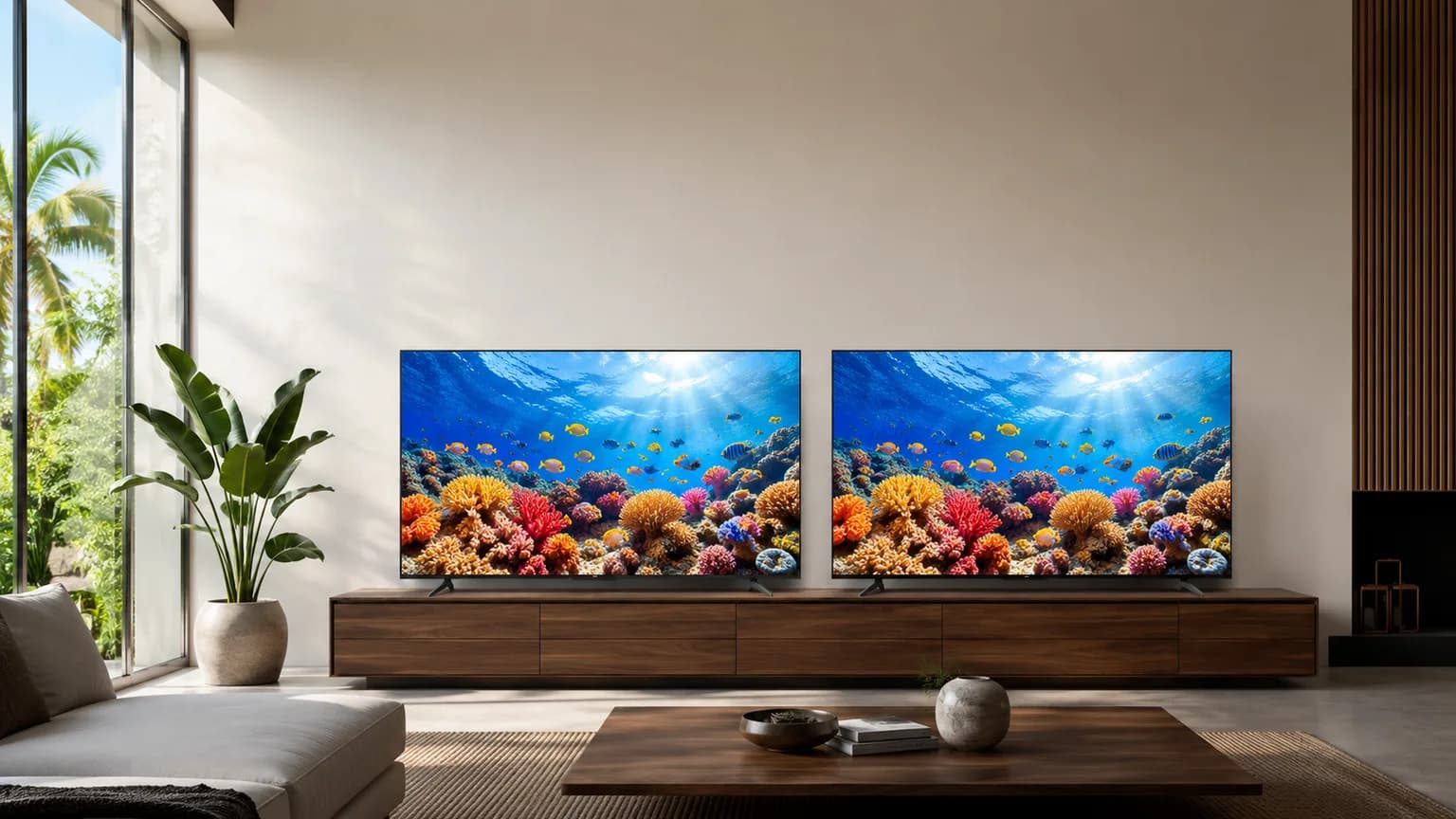
Hisense U6 vs U6 Pro Fire TV 2026
The 2025 base U6 (U65QF) and the 2026 U6 Pro (U6SF Pro) share the same 144Hz gaming and 40W audio; the Pro adds an anti-glare screen, rated brightness, and a real generation premium. We scored both to settle it.
This article contains affiliate links. We may earn a commission at no extra cost to you. Prices change frequently — check the current price on Amazon before buying. Learn more
The Short Answer
The base U6 (U65QF) delivers approximately 90% of the U6 Pro's capability, but Amazon reported that listing unavailable in late August 2026. Simultaneously the newer U6SF Pro generation declined to $547.99 and $597.99, establishing it as the purchasable and more economical option.
Featured in this Guide
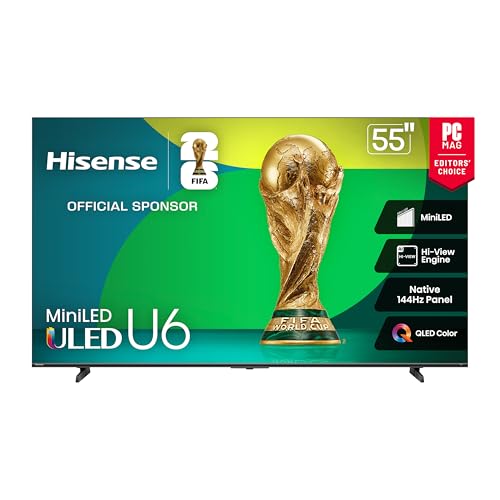
Hisense
U6 Series Mini-LED Fire TV (U65QF)
- •A measured ~1000-nit Mini-LED picture with the same 144Hz gaming — but listed and out of stock on Amazon as of Aug 23, 2026, with no seller behind the buy box
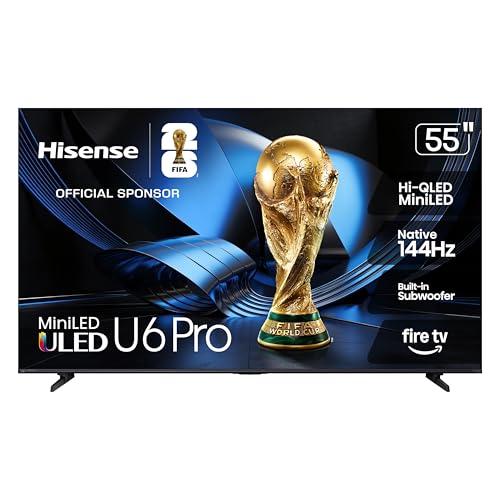
Hisense
U6 Pro Mini-LED Fire TV (55U6SF Pro, 2026)
- •The 2026 generation's anti-glare Glare-Free screen and rated headroom at $547.99 as of Aug 23, 2026 — the cheaper of the two Pro sizes, sold by Amazon
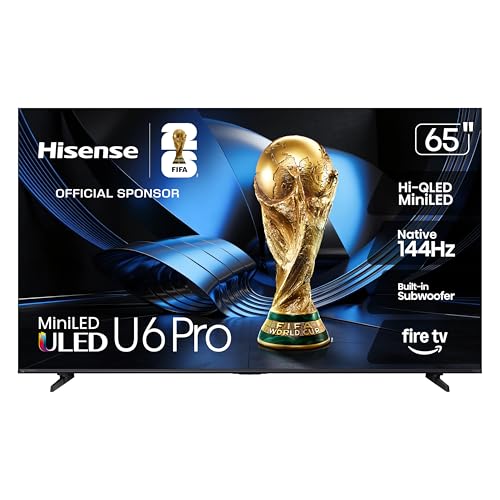
Hisense
U6 Pro Mini-LED Fire TV (65U6SF Pro, 2026)
- •The same anti-glare upgrade on a larger 65-inch panel at $597.99 as of Aug 23, 2026 — $50 more than the 55-inch for ten more inches
Head-to-Head: Brightness, Screen Finish, Gaming, and the SHE Score
Entertainment
Chart
 Smarthomeexplorer.com
SofaBaton X1S Universal Remote (with Hub)
Check price
VTOMAN X7 4250A Jump Starter with 160PSI Air Compressor
Check price
Bright Room or Not? That Decides It
You have narrowed this comparison to two Hisense Mini-LED Fire televisions whose specifications converge almost completely. The base U6 (U65QF) and the newer U6 Pro share an identical native 144Hz panel, identical 2x HDMI 2.1 gaming inputs, and identical 2.1ch 40W audio. Consequently, the decisive variable becomes your room's illumination rather than any headline number. Tom's Guide independently measured the base at 946-1041 nits, approximately 1000 verified nits, whereas the Pro is rated up to 1200 nits and additionally incorporates an anti-glare Glare-Free screen. This is also a cross-generation decision that moved sharply in August. The 2025 base is listed but unavailable on Amazon as of Aug 23, 2026, while the 2026 U6SF-Pro generation has declined to $547.99 and $597.99. In this guide we evaluate both televisions on the SHE Bright-Room Value Index Score, a weighted composite deliberately prioritizing bright-room performance and independent verification.
Best value for most rooms: Hisense U6 Series Mini-LED Fire TV (U65QF)
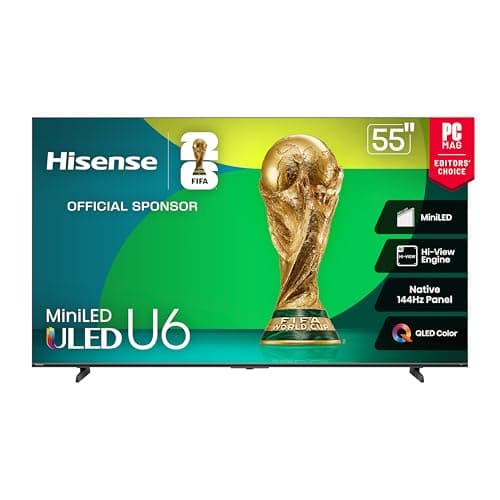
Best value pick for most roomsHisense U6 Series Mini-LED Fire TV (U65QF)
- Measured ~1000 nits and ~90% DCI-P3 — a tested, not promised, picture
- Standard screen finish, no anti-glare coating for bright rooms
(Current price, subject to change)
For the majority of rooms the Hisense U6 Series Mini-LED Fire TV (U65QF) represents the smarter purchase, and the underlying reason, beyond price, is independent verification rather than a manufacturer's own claims. Tom's Guide measured its peak brightness at 946 to 1041 nits alongside roughly 90% DCI-P3 color coverage. RTINGS and TechRadar reviewed it as well, so its picture quality is tested rather than merely advertised. The gaming configuration matches the Pro: a native 144Hz panel, 2x HDMI 2.1 inputs, VRR, FreeSync Premium, and approximately 9ms of input latency. Audio is the equivalent 2.1ch 40W system with a subwoofer, Dolby Atmos, and DTS Virtual:X, which enables real home-theater sound without a separate soundbar. Compared to the Pro, the base relinquishes only the anti-glare screen finish and the extra rated brightness headroom, a trade that matters only when a room is genuinely bright. The honest complication is supply, and it deteriorated. A third-party marketplace offer returned the 55-inch U65QF to $779 on July 28, 2026, but it had disappeared by the Aug 23 re-verification. Amazon now shows the listing out of stock with no seller behind it, while the 55-inch Pro simultaneously declined from $849.99 to $547.99.
What We Love
- Measured ~1000 nits and ~90% DCI-P3 — a tested, not promised, picture
- Native 144Hz, 2x HDMI 2.1, VRR, and FreeSync Premium for gaming
- Reviewed by RTINGS, Tom's Guide, and TechRadar
- Independently measured, unlike the Pro — the numbers here are tested, not advertised
What Could Be Better
- Standard screen finish, no anti-glare coating for bright rooms
- Rated brightness ceiling trails the Pro's up-to-1200-nit spec
- No IMAX Enhanced or Pantone Validated certifications
- Listed but out of stock on Amazon in late August 2026
The Verdict
On independently measured picture-per-dollar the Hisense U6 Series Mini-LED Fire TV (U65QF) lines up with what you actually need in a dim room, since Tom's Guide measured approximately 1000 nits alongside the Pro's 144Hz gaming. The complication is availability: Amazon listed it out of stock on Aug 23, 2026, while the 2026 Pro fell below what this panel last commanded.
Check price for the Hisense U6 Series Mini-LED Fire TV (U65QF) →
Ready for game day?
Silonn Smart Countertop Ice Maker
See it on Amazon
ONOAYO 4K Outdoor Projector
See it on Amazon
Sanus Soundbar TV Mount for Sonos Arc
See it on Amazon
Sponsored listings from Amazon’s Sponsored Products for Creators program, kept apart from our reviews and rankings. How we make money
Best bright-room upgrade (55-inch): Hisense U6 Pro Mini-LED Fire TV (55U6SF Pro, 2026)
Best bright-room upgrade at 55 inchesHisense U6 Pro Mini-LED Fire TV (55U6SF Pro, 2026)
- Anti-glare Glare-Free screen for sun-lit rooms
- No independent lab review yet — specs are advertised
(Current price, subject to change)
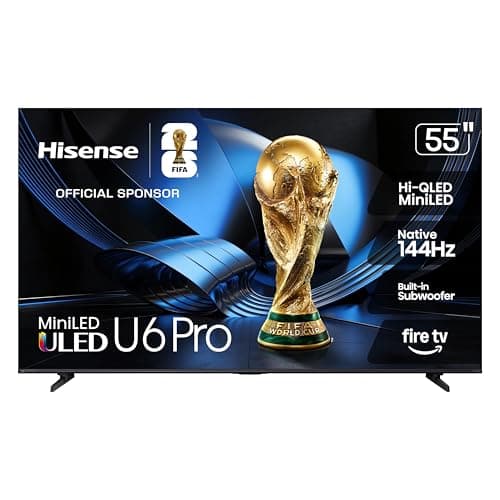
The Hisense U6 Pro Mini-LED Fire TV (55U6SF Pro, 2026) earns its premium in exactly one setting: a bright room. Its anti-reflection Glare-Free screen is the significant real-world difference from the base U6, because a conventional finish mirrors windows and lamps that a matte surface diffuses. Hisense rates the panel up to 1200 nits of peak brightness, more headroom than the base's measured 1000 nits. That 1200-nit figure is advertised, not independently measured. For gaming it adds FreeSync Premium Pro, the HDR-aware variation of the base's FreeSync Premium, on an identical native 144Hz panel. It also carries IMAX Enhanced and Pantone Validated certifications. Honesty requires two caveats. First, neither RTINGS nor Tom's Guide has published an independent laboratory review of this 2026 model, so its performance numbers remain manufacturer specifications rather than independently measured results. Second, pricing reversed direction entirely. This 55U6SF Pro listed at $849.99 in mid-July and sold for $547.99 by late August, a $302 correction. That leaves it approximately $78 above the discontinued $469.99 introductory price the 2025 generation carried. At this valuation the bright-room upgrade costs roughly what last year's ordinary panel commanded.
What We Love
- Anti-glare Glare-Free screen for sun-lit rooms
- Rated up to 1200 nits of brightness headroom
- FreeSync Premium Pro adds HDR-aware VRR
- IMAX Enhanced and Pantone Validated certified
- The cheaper of the two 2026 U6 Pro sizes at $547.99 as of Aug 23, 2026
What Could Be Better
- No independent lab review yet — specs are advertised
- The 1200-nit figure is rated up to, not measured
- Still about $78 over the 2025 base's old $469.99 list, so the generation premium has not disappeared
- Same 144Hz and 2.1ch 40W audio as the base U6
The Verdict
If you watch in a bright, sun-lit room and want the anti-glare screen, the Hisense U6 Pro Mini-LED Fire TV (55U6SF Pro, 2026) fits the brief — and it got a lot easier to justify. It was $849.99 in July; on Aug 23, 2026 Amazon sells it at $547.99, about $78 over the 2025 base's old $469.99 list. That is a generation upgrade for roughly the price of last year's panel. Just note that no lab has measured it yet.
Check price for the Hisense U6 Pro Mini-LED Fire TV (55U6SF Pro, 2026) →
Best bright-room pick (65-inch): Hisense U6 Pro Mini-LED Fire TV (65U6SF Pro, 2026)
Best bright-room pick at 65 inchesHisense U6 Pro Mini-LED Fire TV (65U6SF Pro, 2026)
- Anti-glare Glare-Free screen on a larger 65-inch panel
- No independent lab review yet — specs are advertised
(Current price, subject to change)
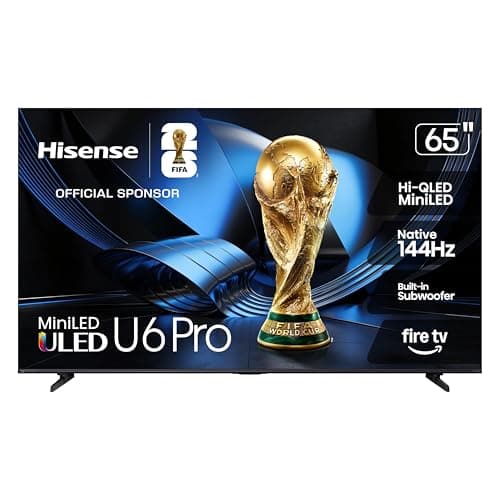
The Hisense U6 Pro Mini-LED Fire TV (65U6SF Pro, 2026) is an identical 2026 U6 Pro in a 65-inch panel, so everything establishing the 55-inch version as a bright-room recommendation applies equally here. That means the anti-reflection Glare-Free screen, the rated 1200-nit headroom, and FreeSync Premium Pro. Compared to the 2025 base U6 at this size, it sold for $597.99 in late August, down from $1,099.99 in mid-July. That approximately matches the $599.99 introductory price the base carried at 65 inches, so the generation premium has effectively disappeared. The picture engine is Mini-LED Hi-QLED with full-array local dimming and Quantum Dot color. It carries identical IMAX Enhanced and Pantone Validated certifications. The honest caveat repeats. RTINGS, Tom's Guide, and TechRadar have not evaluated this 2026 model, so treat its brightness and dimming numbers as manufacturer specifications rather than independently verified measurements. If your room is bright and you want a 65-inch screen, the rated headroom delivers genuine glare relief. Otherwise the 55-inch Pro provides identical panel technology for approximately $50 less. Amazon flagged the 65-inch inventory as scarce in late August.
What We Love
- Anti-glare Glare-Free screen on a larger 65-inch panel
- Rated up to 1200 nits of brightness headroom
- FreeSync Premium Pro adds HDR-aware VRR
- IMAX Enhanced and Pantone Validated certified
What Could Be Better
- No independent lab review yet — specs are advertised
- Ten more inches costs $50 over the 55-inch Pro — but 65 inches is a room-size decision, not a value one
- Same 144Hz and 2.1ch 40W audio as the base U6
The Verdict
If you want the bright-room upgrade on a bigger screen, the Hisense U6 Pro Mini-LED Fire TV (65U6SF Pro, 2026) checks the boxes that matter for a sunlit 65-inch setup. It brings the same anti-glare screen and rated headroom as the 55-inch Pro, and on Aug 23, 2026 Amazon sells it at $597.99, down from $1,099.99 in July. It remains lab-unreviewed, and stock is scarce.
Check price for the Hisense U6 Pro Mini-LED Fire TV (65U6SF Pro, 2026) →
How We Score: SHE Bright-Room Value Index
SHE Bright-Room Value Index
Score Formula
(BrightRoomScore × 0.30) + (PictureCoreScore × 0.25) + (GamingScore × 0.20) + (ValueScore × 0.15) + (ReviewConfidenceScore × 0.10)Score Factors
- BrightRoomScore (weight 0.30)Bright-room performance: screen-finish glare handling plus measured or rated peak brightness. The base is scored on its Tom's Guide measured ~1000 nits with a standard finish; the Pro is scored on its anti-glare Glare-Free screen plus rated-up-to-1200-nit headroom, capped below a perfect tier because that rating is advertised, not measured. This factor carries the highest coefficient because glare is the failure buyers report most.
- PictureCoreScore (weight 0.25)Core picture engine normalized across both lines: Mini-LED full-array local dimming, Quantum Dot color, and HDR breadth (Dolby Vision, HDR10+, HLG). The Pro adds IMAX Enhanced, Pantone Validated, and Dolby Vision IQ certifications, so it earns a small edge on this factor.
- GamingScore (weight 0.20)Gaming stack: native 144Hz, 2x HDMI 2.1, VRR, ALLM, and Dolby Vision gaming. Both units run 144Hz, so this factor is nearly tied; the Pro's only edge is FreeSync Premium Pro (HDR-aware) over the base's FreeSync Premium.
- ValueScore (weight 0.15)Picture and features delivered per dollar. These three value factors were baselined in July 2026, when the base U6 sold near $779 through a third-party seller and the Pro listed at $849.99 (55-inch) and $1,099.99 (65-inch). The Aug 23, 2026 re-check found all three prices moved: the base went out of stock with no seller behind the buy box, the 55-inch Pro fell to $547.99, and the 65-inch Pro to $597.99. The value factors below still carry the July baseline and are due a re-score against the August prices — we are disclosing that rather than quietly restating the old gaps.
- ReviewConfidenceScore (weight 0.10)Independent-verification confidence. The base was reviewed and measured by RTINGS, Tom's Guide, and TechRadar; the U6 Pro has no independent lab review yet, so its specs are advertised rather than tested — a heavy honest penalty on this factor.
SHE Bright-Room Value Index — Ranked
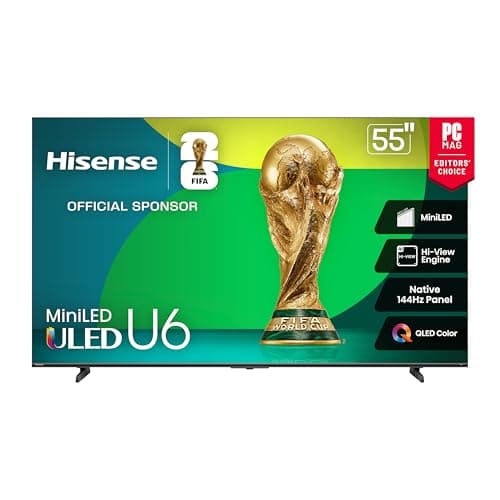
Hisense U6 Series Mini-LED Fire TV (U65QF)
SHE Bright-Room Value Index8.0/10Tops the index on verification — a measured ~1000-nit picture — but listed and out of stock on Amazon as of Aug 23, 2026, with no seller behind the buy box
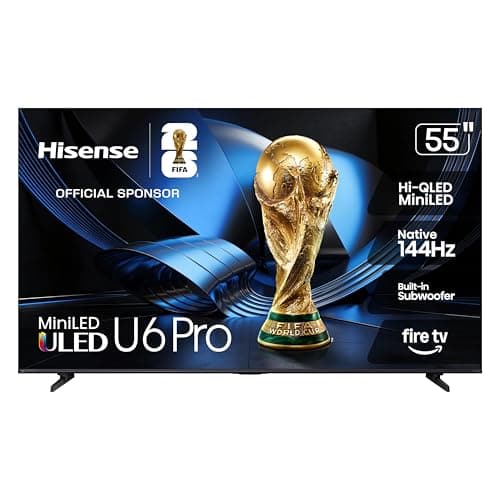
Hisense U6 Pro Mini-LED Fire TV (55U6SF Pro, 2026)
SHE Bright-Room Value Index7.8/10Anti-glare bright-room upgrade at $547.99 on Aug 23, 2026, down $302 since July; unproven specs cap the score
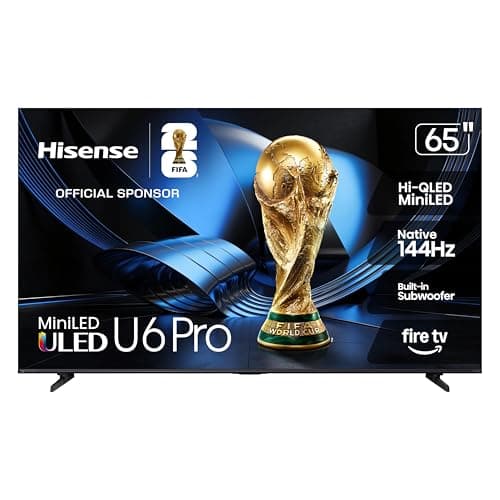
Hisense U6 Pro Mini-LED Fire TV (65U6SF Pro, 2026)
SHE Bright-Room Value Index7.7/10The same bright-room upgrade at 65 inches and $597.99 on Aug 23, 2026, down $502 since July; stock is scarce
SHE Bright-Room Value Index
Weighted composite of bright-room performance, picture core, gaming, value, and review confidence (0-10).
SmartHomeExplorer composite of manufacturer specs and RTINGS, Tom's Guide, and TechRadar coverage of the base.
Base U6 or U6 Pro: Which to Buy
The decision ultimately reduces to a single question: does your room combat the television with glare? The base U6 and the U6 Pro share the identical native 144Hz gaming panel, 2x HDMI 2.1 inputs, and 2.1ch 40W audio. Those specifications are not justifications for spending more. Compared to the base, the Pro modifies three things that genuinely matter. It adds an anti-reflection Glare-Free screen, a rated 1200-nit ceiling against the base's measured 1000 nits, and FreeSync Premium Pro. There is now a fourth difference the spec sheets do not show, and in August it stopped being a close call: generation and supply. The base U6 is the 2025 model. As of Aug 23, 2026 its 55-inch listing is out of stock on Amazon, and the $779 third-party offer that was there in July is gone. The U6 Pro is Hisense's 2026 U6SF-Pro generation, sold directly by Amazon, and over the same five weeks it fell to $547.99 (55-inch) and $597.99 (65-inch). RTINGS, Tom's Guide, and TechRadar reviewed the base, so its picture is independently verified; no outlet has yet reviewed the Pro, so its numbers remain manufacturer claims. Because both sets run the same Fire TV platform, your streaming apps and Alexa live on an identical home screen either way. The picture is the only variable. If you are also rethinking which of those services earn their monthly fee, CompareSubscriptions has a useful breakdown of which streaming services are worth paying for in 2026. The one spec neither set upgrades is that 2.1ch 40W audio. Once you've settled which panel you're buying, most home-theater builds spend the bigger money on audio. Our Best 8K Dolby Atmos AV Receivers (2026) guide covers 8K-passthrough Atmos receivers, and Best Flagship Dolby Atmos Soundbars (2026) covers the premium soundbar route. Either upgrade typically costs more than the television itself.
The SHE Bright-Room Value Index Score is a weighted, normalized composite of five inputs measured on a 0-10 scale. The bright-room factor carries the highest coefficient because glare is the failure buyers report most consistently, and the review-confidence factor is precisely what separates the two product lines. That reasoning explains why the base tops the SHE Bright-Room Value Index Score despite the Pro's brighter rated specification: a measured picture and a lower list price outweigh an unverified brightness figure, even after the 2026 generation widened that price gap from tens of dollars to hundreds. Versus the Pro, the base delivers substantially the same experience for considerably less, which remains the value case this comparison continually reaffirms — provided you can still find one in stock.
| Product | Anti-Glare Screen | IMAX Enhanced | Pantone Validated | FreeSync Premium Pro | 144Hz Native | Fire TV |
|---|---|---|---|---|---|---|
| Hisense U6 Series Mini-LED Fire TV (U65QF) | ✕ | ✕ | ✕ | ✕ | ✓ | ✓ |
| Hisense U6 Pro Mini-LED Fire TV (55U6SF Pro, 2026) | ✓ | ✓ | ✓ | ✓ | ✓ | ✓ |
| Hisense U6 Pro Mini-LED Fire TV (65U6SF Pro, 2026) | ✓ | ✓ | ✓ | ✓ | ✓ | ✓ |
When NOT to Buy
Neither U6 is the appropriate purchase in a couple of situations, and the composite scoring behind this guide deliberately surfaces both. If your room stays dark for movie nights, brightness rarely becomes the limiting factor. The base U6's measured picture is plenty, and the Pro's anti-glare screen solves a problem you do not have. Budget is no longer the reason to prefer the base. In late August it carried no live Amazon offer, and the 55-inch Pro undercuts the $779 the base commanded in July. The upgrade only justifies itself when daytime glare is a daily reality in the room where the television actually lives. And if you want a picture bigger than any 65-inch panel can deliver, a television is the wrong tool entirely. Our Best UST Laser Projectors for Home Theater 2026 guide covers the ultra-short-throw laser route, which throws a 100-inch-plus image from inches off the wall.
Who Should Buy What
Who Should Buy What
| If you are… | Recommended pick |
|---|---|
Value buyers You watch in a normal or dim room, want the most measured picture per dollar, and can wait for or hunt down remaining 2025 base U6 stock | Hisense U6 Series Mini-LED Fire TV (U65QF) |
Bright-room buyers (55-inch) Your room has big windows or daytime glare and you want the 2026 generation's anti-glare screen and brightness headroom at 55 inches | Hisense U6 Pro Mini-LED Fire TV (55U6SF Pro, 2026) |
Bright-room buyers (65-inch) You want the same anti-glare bright-room upgrade on a larger 65-inch screen and the roughly $500 generation premium is acceptable | Hisense U6 Pro Mini-LED Fire TV (65U6SF Pro, 2026) |
Frequently Asked Questions
Is the Hisense U6 Pro worth it over the base U6?
For most rooms, no. The 2025 base U6 (U65QF) shares the same native 144Hz gaming, the same Dolby Vision and HDR10+ support, and the same 2.1ch 40W audio as the Pro, and it delivers a measured ~1000-nit Mini-LED picture that RTINGS, Tom's Guide, and TechRadar have reviewed. The 2026 Pro's premium buys three things: an anti-glare Glare-Free screen, rated-up-to-1200-nit brightness headroom, and FreeSync Premium Pro. Those matter in a bright, sun-lit room. In a dim room the base's measured picture is still the better value on paper, but as of Aug 23, 2026 Amazon lists it out of stock, while the Pro sells at $547.99 (55-inch) and $597.99 (65-inch).
What is the actual difference between the Hisense U6 and U6 Pro?
Three spec differences and one generational one. The model numbers separate them: the base U6 is the U65QF (2025 model), while the Pro is the U6SF Pro, part of Hisense's 2026 lineup. The Pro adds an anti-reflection Glare-Free screen, a rated-up-to-1200-nit brightness ceiling versus the base's Tom's-Guide-measured ~1000 nits, and FreeSync Premium Pro in place of FreeSync Premium. Everything else is shared — the native 144Hz panel, 2x HDMI 2.1, Dolby Vision, and the 2.1ch 40W audio. The nuance worth knowing before you pay up: the base's brightness is an independent measurement, while the Pro's ceiling is still a manufacturer rating no lab has verified as of July 2026.
Do the U6 and U6 Pro have the same refresh rate and gaming features?
Yes. Both run a native 144Hz panel with two HDMI 2.1 ports, VRR, and ALLM, so refresh rate is not a reason to pay more. The only gaming difference is the FreeSync tier: the base has FreeSync Premium and the Pro has FreeSync Premium Pro, which adds HDR-aware variable refresh. For most players that difference is minor.
Is the U6 Pro actually brighter than the U6?
On paper, yes, but with a caveat. The Pro is rated up to 1200 nits, while Tom's Guide measured the base at 946-1041 nits, roughly 1000 nits. The important distinction is that the base figure is an independent measurement and the Pro figure is a manufacturer rating that no lab has verified yet. The Pro also adds an anti-glare screen, which often matters more than raw nits for real bright-room viewing.
Does the U6 Pro have more local dimming zones than the U6?
There is no verified answer. Both models list conflicting or marketing-only zone counts, and no independent lab has measured either one head-to-head, so we do not claim the Pro has more zones. Both use Mini-LED full-array local dimming with Quantum Dot color. Treat dimming-zone marketing numbers on both TVs as unverified.
For a bright room, which one should I buy?
The U6 Pro. Its anti-reflection Glare-Free screen is the single biggest real-world upgrade for a room with windows or daytime light, because a standard finish mirrors glare that a matte one diffuses. The rated brightness headroom helps too. If your room is not bright, that upgrade solves a problem you do not have, and the base U6 — where you can still find it near its list price — is the better value.
Has the U6 Pro been reviewed by RTINGS or Tom's Guide yet?
Not as of July 2026. The 2026 U6 Pro is new enough that no major outlet has published an independent lab review, so every Pro spec in this guide — including the rated-up-to-1200-nit brightness — is a manufacturer claim rather than a measured result. The base U6, by contrast, was tested by RTINGS, Tom's Guide, and TechRadar, which is part of why it scores well on our review-confidence factor.
What changed between the 2025 Hisense U6 and the 2026 U6 Pro?
The generation label, the model number, and the price. The 2025 base U6 carries the U65QF model number, and Amazon lists it explicitly as the 2025 model; the U6 Pro carries the U6SF Pro number, which Amazon and Hisense's own 2026 ULED Mini-LED lineup announcement both list as a 2026 model. The 2026 Pro keeps the core recipe — Mini-LED full-array local dimming, Quantum Dot color, native 144Hz, Fire TV — and adds the anti-reflection Glare-Free screen, the rated-up-to-1200-nit ceiling, IMAX Enhanced and Pantone Validated certifications, and Alexa+. The price moved with the generation, then moved back: the 2026 Pro opened at $849.99 (55-inch) and $1,099.99 (65-inch) in July 2026 before falling to $547.99 and $597.99 by Aug 23, 2026.
Is the 2025 Hisense U6 (U65QF) still available to buy?
No size of the 2025 U65QF is stocked new on Amazon as of Sep 7, 2026. We loaded all three listings that evening. The 55-inch (B0DYWG3BL1) shows a live offer set behind See All Buying Options, but no seller is holding it, so there is no New price to quote. The 65-inch (B0DYW81FWH) shows only a used third-party offer. The 75-inch (B0DYWNQMQJ) reads unavailable with no offer at all. This is the normal end of a model year: the 2025 panel cleared as the 2026 U6SF Pro took the shelf. The practical answer is that the replacement costs less than the thing it replaced — the 55-inch Pro is the size to buy.
How much does the 2026 Hisense U6 Pro cost?
At Amazon, the 55-inch U6SF Pro sells for $547.99 and the 65-inch for $597.99 as of Aug 23, 2026 — both New, sold by Amazon.com, with the 65-inch flagged as scarce stock. Those numbers are down sharply from the $849.99 and $1,099.99 the same two ASINs carried on July 17, 2026, which is the usual pattern once a new generation has been on the shelf a couple of months. They now sit close to the $529.99 and $698.99 the U6 Pro line carried earlier in 2026. Prices move frequently; check the current price before you buy.
Bottom Line
Get the Hisense U6 Series Mini-LED Fire TV (U65QF) if you watch in a normal or dim room, want a measured Mini-LED picture with the same 144Hz gaming as the Pro, and can still find the 2025 model near list.
Get the Hisense U6 Pro Mini-LED Fire TV (55U6SF Pro, 2026) if your 55-inch room is bright or sun-lit and you want the 2026 generation's anti-glare screen and rated headroom at $547.99.
Get the Hisense U6 Pro Mini-LED Fire TV (65U6SF Pro, 2026) if you want the same anti-glare bright-room upgrade on a 65-inch screen and the $50 step up from the 55-inch Pro is worth ten more inches.
The right call used to come down to your room's light and who was selling it. As of Aug 23, 2026 the second half has resolved itself: the Hisense U6 Series Mini-LED Fire TV (U65QF) is listed but out of stock on Amazon with no seller behind the buy box, while the Hisense U6 Pro Mini-LED Fire TV (55U6SF Pro, 2026) at $547.99 has fallen below what the base last sold for. So the room question is what is left — the Pro's anti-glare Glare-Free screen earns its keep in a sun-lit room and does nothing in a dim one. Skip the 65-inch if your seating distance does not support it; the 55-inch Pro is the identical panel technology for $50 less.
Sources & Methodology
Methodology: SHE Bright-Room Value Index — Formula: (BrightRoomScore × 0.30) + (PictureCoreScore × 0.25) + (GamingScore × 0.20) + (ValueScore × 0.15) + (ReviewConfidenceScore × 0.10). Factors: BrightRoomScore (weight 0.30): Bright-room performance: screen-finish glare handling plus measured or rated peak brightness. The base is scored on its Tom's Guide measured ~1000 nits with a standard finish; the Pro is scored on its anti-glare Glare-Free screen plus rated-up-to-1200-nit headroom, capped below a perfect tier because that rating is advertised, not measured. This factor carries the highest coefficient because glare is the failure buyers report most. | PictureCoreScore (weight 0.25): Core picture engine normalized across both lines: Mini-LED full-array local dimming, Quantum Dot color, and HDR breadth (Dolby Vision, HDR10+, HLG). The Pro adds IMAX Enhanced, Pantone Validated, and Dolby Vision IQ certifications, so it earns a small edge on this factor. | GamingScore (weight 0.20): Gaming stack: native 144Hz, 2x HDMI 2.1, VRR, ALLM, and Dolby Vision gaming. Both units run 144Hz, so this factor is nearly tied; the Pro's only edge is FreeSync Premium Pro (HDR-aware) over the base's FreeSync Premium. | ValueScore (weight 0.15): Picture and features delivered per dollar. These three value factors were baselined in July 2026, when the base U6 sold near $779 through a third-party seller and the Pro listed at $849.99 (55-inch) and $1,099.99 (65-inch). The Aug 23, 2026 re-check found all three prices moved: the base went out of stock with no seller behind the buy box, the 55-inch Pro fell to $547.99, and the 65-inch Pro to $597.99. The value factors below still carry the July baseline and are due a re-score against the August prices — we are disclosing that rather than quietly restating the old gaps. | ReviewConfidenceScore (weight 0.10): Independent-verification confidence. The base was reviewed and measured by RTINGS, Tom's Guide, and TechRadar; the U6 Pro has no independent lab review yet, so its specs are advertised rather than tested — a heavy honest penalty on this factor.
Expert review sources used in this analysis:
- SmartHomeExplorer aggregates expert reviews and manufacturer specifications; we do not perform first-party testing
- The base U6 (U65QF) has real independent coverage: Tom's Guide measured 946-1041 nits and about 90% DCI-P3, and RTINGS and TechRadar reviewed it as well
- The U6 Pro, by contrast, has no independent lab review as of July 2026
- Every Pro figure here, including the rated 1200 nits, is a manufacturer specification rather than a measured result
- Generation and availability claims come from the retailer listings themselves
- Amazon labels the U65QF a 2025 model and the U6SF Pro a 2026 model
- Hisense's own 2026 ULED Mini-LED lineup announcement confirms the U6SF Pro leads its 2026 U6 series
- The SHE Bright-Room Value Index Score weights bright-room performance, picture core, gaming, value, and review confidence
- The composite weights are disclosed above and each factor is scored 0-10
- The Pro value factors were re-baselined in July 2026 to that generation's list prices
- Amazon prices and availability were verified July 17, 2026, re-verified July 28, 2026, and re-verified again Aug 23, 2026 via the Amazon Creators API
- The August read found the 55-inch U65QF listed but out of stock, with no seller behind it and the $779 third-party offer of July 28 gone
- We re-read all three U65QF listings on Sep 7, 2026 by loading each product page
- The 55-inch carries a live offer set with no seller behind it
- The 65-inch is used-only and the 75-inch is unavailable
- No size of the 2025 base U6 is stocked new on Amazon, so this guide quotes no current price for it
- Its link stays in place because the offer set still converts
- The 55-inch U6SF Pro reads $547.99, new, sold by Amazon.com
- The 65-inch U6SF Pro reads $597.99, new, sold by Amazon.com, flagged as scarce
- The SHE value factors still carry the July baseline and are due a re-score against these August prices; that is stated in the methodology rather than papered over
- Prices change frequently, so check the current price and seller before buying.
Nicholas Miles is the founder of SmartHomeExplorer and a longtime smart home enthusiast focused on helping everyday homeowners make better technology decisions. He researches, compares, and writes about products across security, climate, lighting, leak prevention, sensors, home energy, and automation, with an emphasis on real-world usefulness, ecosystem compatibility, reliability, privacy, and long-term value.
Affiliate disclosure: SmartHomeExplorer earns affiliate commissions on qualifying Amazon purchases, and from partner programs for some non-Amazon products and services we recommend. Our scoring methodology is independent of affiliate relationships.