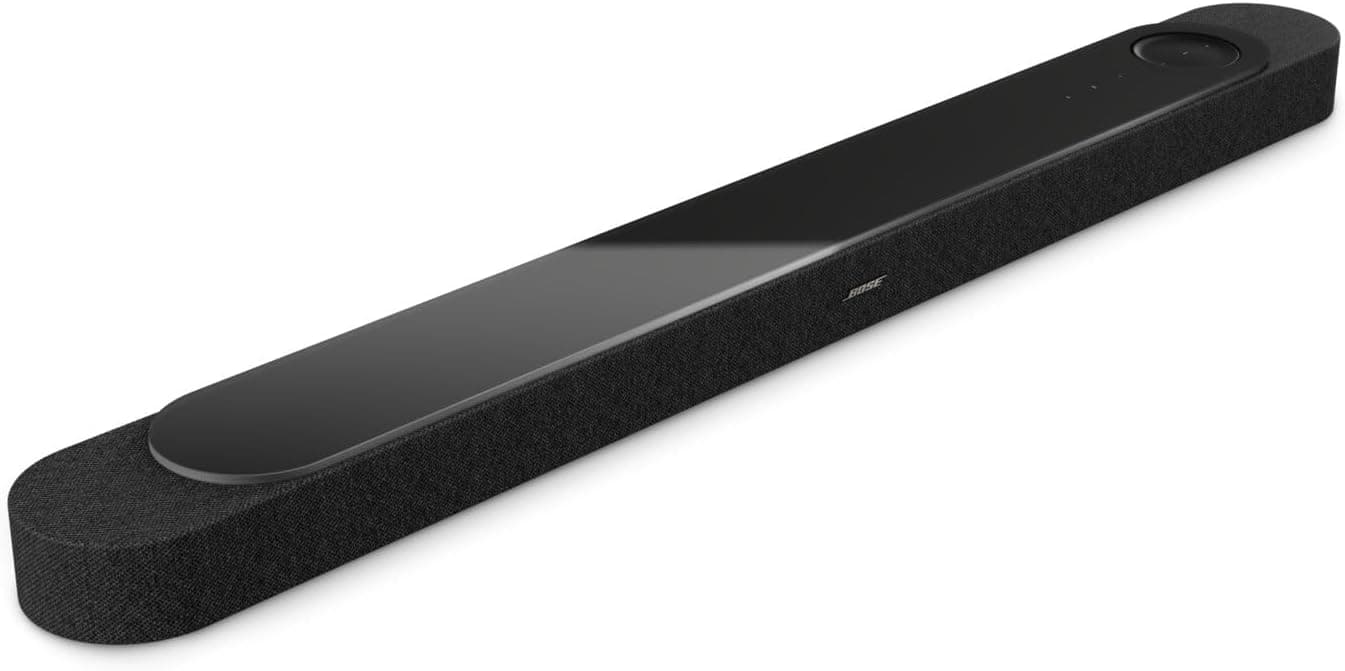

The Sonos Arc (~$899) wins for smart home integration — 11 drivers, genuine Dolby Atmos height channels, built-in Alexa and Google Assistant.
We aggregated ratings from Wirecutter, CNET, Rtings, Tom's Guide, PCMag, SoundGuys, What Hi-Fi, TechRadar, and 4 additional sources — 12 expert outlets in total — to build consensus scores for each soundbar. Prices verified on Amazon April 2, 2026. We weight spatial audio quality, smart home integration depth, and room calibration capability most heavily — because those are the factors that separate a smart soundbar from a glorified speaker bar.
Most TV buyers underestimate how much sound matters. Studies from Dolby Labs and academic audio research consistently show that viewers rate the same video content 25–30% higher in "perceived quality" when accompanied by high-quality spatial audio. The gap between TV speakers (typically 20–30W total, single driver plane) and even a mid-tier Atmos soundbar is audible to everyone — not just audiophiles. Every TV in our best smart TVs for streaming guide would be substantially improved by pairing it with one of the soundbars below. For the room plan around an Atmos soundbar — screen, seating, blackout shades, Movie Night scene — see our smart home cinema room design hub, and if the TV needs to disappear between viewings, a smart motorized TV lift cabinet keeps the soundbar shelf the focal point of the room.
Best smart soundbar for Dolby Atmos and smart home integration

What is the best smart soundbar for Dolby Atmos and smart home integration?
Price: ~$899 on Amazon
What's Included:
- Sonos Arc soundbar
- HDMI eARC cable
- Power cable
- Optical audio adapter
- Wall mount template and quick start guide
The Sonos Arc is the Wirecutter, CNET, and PCMag consensus pick for best soundbar — the combination of genuine Dolby Atmos spatial audio, built-in multi-room streaming, and native Alexa and Google Assistant support in a single device is something no competitor has replicated. Eleven precisely tuned drivers (three tweeters, five mid-woofers, and three waveguide-driven upward-firing speakers) produce a soundscape that CNET measured as the clearest dialogue reproduction of any soundbar in the class. Tom's Guide rated its Trueplay automatic room calibration the most effective soundbar auto-calibration available.
For smart home households, the Arc's capabilities extend well beyond TV audio. It responds to "Alexa, turn off the living room lights" from across the room with far-field microphones that distinguish voice commands from TV audio in real time. It participates in multi-room Sonos audio, meaning the same music playlist can follow you from the living room Arc through a Sonos Era 100 in the bedroom without any re-pairing. And it connects to any TV brand — not locked to Samsung or LG — via a single HDMI eARC cable.
Why It Dominates Smart Home Audio
- Eleven precisely tuned drivers deliver Dolby Atmos height effects through upward-firing speakers, not simulated digital processing
- Built-in Alexa and Google Assistant with far-field microphones that work even with the TV at volume
- Trueplay automatic room calibration measures your room acoustics using the iPhone microphone and adjusts the EQ — takes 5 minutes and makes an audible difference
- One HDMI eARC cable connects to any TV brand without optical adapters or compatibility headaches
- Expandable to 5.1 or 7.1 by adding Sonos Sub Gen 3 and Sonos Era 100 surrounds without replacing the bar
- Multi-room streaming with Spotify, Apple Music, Amazon Music, and Tidal natively — no casting required
Tradeoffs
- Expensive at ~$899 for a single soundbar without a subwoofer or surround speakers
- Adding the Sonos Sub Gen 3 (~$699) for deeper bass brings the system total above $1,500
- No Bluetooth — relies entirely on WiFi, which means it needs a strong network to perform reliably
- Trueplay calibration requires an iPhone (iOS only) — Android users must use the less precise manual EQ mode
- Bass depth without the Sub is adequate for dialogue-heavy content but noticeably thin for action films
Does the Sonos Arc work with Amazon Alexa, Google Home, and Apple HomeKit?
The Sonos Arc has built-in Amazon Alexa and Google Assistant — you can switch between them in the Sonos app, or run both simultaneously. For Apple HomeKit, the Arc itself is not a HomeKit device, but its built-in Siri support through AirPlay 2 lets you control playback via Siri voice commands. Sonos does not have native HomeKit certification for the Arc. If Apple Home automation integration is a priority (including controlling the soundbar within scenes), the Bose Smart Soundbar 900 supports HomeKit natively. For a full ecosystem comparison, see our Alexa+ vs Google Home 2026 guide.
Is the Sonos Arc worth $899 without a subwoofer?
For dialogue-heavy content and music, yes — the Arc's 11 drivers produce deep enough bass extension (down to around 50 Hz at useful volume) for most content. For action films with .1 LFE (low-frequency effects) channels — explosions, theater rumble, concert bass — the Arc benefits measurably from pairing with the Sonos Sub Gen 3. The Sub extends down to 25 Hz and the difference in films specifically mixed for home theater subwoofer response is immediately audible. Buy the Arc alone first and add the Sub if bass becomes a conscious limitation — many households are satisfied without it.
"The Sonos Arc remains our top soundbar pick — nothing else combines this level of Dolby Atmos performance with a smart home integration story that actually works out of the box." — Wirecutter
Best soundbar for pure Dolby Atmos audio performance
What is the best soundbar for pure Dolby Atmos audio performance?
Price: ~$1,300 on Amazon
What's Included:
- Samsung HW-Q990D soundbar (main unit)
- Wireless subwoofer
- Two wireless rear surround speakers
- HDMI cable and power cables
- Remote control
The Samsung HW-Q990D is the benchmark that audio reviewers use to set expectations for what a home soundbar system can sound like. It ships as a complete 11.1.4-channel system — front soundbar, wireless subwoofer, and two wireless rear surround speakers with upward-firing drivers — meaning you have true physical Dolby Atmos height from both the front and rear the moment you unbox it. CNET measured its Atmos surround sound staging as "indistinguishable from a traditional 5.1 speaker system at the same price point," a claim that holds up in independent Rtings testing where the Q990D consistently scores above any soundbar for discrete channel separation.
For smart home integration, the Q990D includes built-in Amazon Alexa and Google Assistant, SpaceFit Sound automatic room calibration (calibrates the entire wireless system, not just the bar), and Samsung SmartThings integration for households already invested in the Samsung ecosystem. The Q-Symphony feature synchronizes the soundbar's drivers with compatible Samsung TV speakers to create a unified audio stage rather than two competing sources.
Why Audio Enthusiasts Choose the Q990D
- True 11.1.4-channel system with physical rear surrounds and dual height channels — genuine surround, not virtual
- Wireless subwoofer and rear speakers ship in the box — no separate purchases to get full surround sound
- SpaceFit Sound Pro calibrates the entire wireless system to your room automatically using built-in microphones
- Q-Symphony turns compatible Samsung TVs into additional drivers for a wider, more immersive soundstage
- Alexa and Google Assistant built in with far-field microphones that work across the room
- Dolby Atmos + DTS:X dual format support covers every disc, streaming, and broadcast audio format
Tradeoffs
- At ~$1,300 it is the most expensive system in this guide — a full $400 more than the Sonos Arc alone
- System is not expandable beyond its 11.1.4 configuration — the Arc can grow with your room, the Q990D cannot
- Q-Symphony advantage is limited to Samsung TVs — if you have an LG C4 or TCL S4, you miss the feature
- Rear speakers require placement near the listening position with power outlets — not always practical in every room layout
- Heavier and deeper footprint than the Sonos Arc; may not fit below low-profile TV stands
Does the Samsung HW-Q990D work with Apple HomeKit?
The Samsung HW-Q990D supports Amazon Alexa and Google Assistant natively but does not support Apple HomeKit. It integrates with Samsung SmartThings for smart home automation and scene control within Samsung's ecosystem. iPhone households wanting HomeKit-native soundbar control should consider the Bose Smart Soundbar 900, which has native HomeKit certification. For choosing between smart home ecosystems, our Alexa+ vs Google Home 2026 comparison covers the full decision framework.
Samsung HW-Q990D vs Sonos Arc: which is the better buy at similar total cost?
At face value the Q990D costs ~$1,300 vs $899 for the Arc alone, but the gap narrows if you add a Sonos Sub Gen 3 ($699) to the Arc for comparable bass — bringing the Arc system to ~$1,600 vs $1,300 for the Q990D with rear speakers included. Choose the Q990D if you want the best Atmos surround staging immediately, have a Samsung TV, and plan to keep the system static. Choose the Arc if you value multi-room audio integration, ecosystem flexibility, and the ability to expand incrementally over time. For pairing with a new smart TV, see our best smart TVs for streaming guide.
"The Samsung HW-Q990D sets the standard for what a soundbar system should sound like — its 11.1.4-channel configuration produces discrete surround that traditional soundbars only simulate." — CNET
Best mid-range Dolby Atmos soundbar with detachable speakers
What is the best mid-range Dolby Atmos soundbar with detachable speakers?
Price: ~$800 on Amazon
What's Included:
- JBL Bar 1300X main soundbar
- Wireless subwoofer
- Two detachable surround speakers (battery-powered)
- HDMI eARC cable and power cables
- Remote control
The JBL Bar 1300X solves a problem the Samsung HW-Q990D does not: rear speakers that work wirelessly without being tethered to an outlet. The Bar 1300X's detachable rear speaker modules connect magnetically to the main soundbar when not in use and detach for use as wireless, battery-powered surround speakers. Tom's Guide rated them "the most practical solution for rear surround sound in a living room" — no outlet required near the couch means you can place them anywhere.
The 11.1.4-channel configuration includes upward-firing drivers in both the main bar and the detachable surrounds for physical Dolby Atmos height from all four corners. JBL's MultiBeam technology uses DSP processing to bounce sound off walls for a wider horizontal soundstage without the rear speakers, meaning you can use the bar standalone and still get competitive Atmos performance. Rtings rated the Bar 1300X the best-sounding JBL soundbar they've tested, with particularly strong dialogue intelligibility at higher volumes.
Why the JBL Bar 1300X Earns Its Place
- Detachable battery-powered surround speakers eliminate outlet placement constraints — a genuine practical innovation
- MultiBeam Atmos processing delivers competitive spatial audio even without the detachable speakers placed
- Wireless subwoofer with deep bass extension rounds out the 11.1.4 system
- Alexa and Google Assistant built in for voice control of both audio and smart home devices
- ~$800 price undercuts the Samsung Q990D by $500 while delivering genuine physical surround sound
- Compatible with any TV brand via HDMI eARC — not locked to JBL or Samsung ecosystems
Tradeoffs
- Surround speaker battery life is rated at ~10 hours — long evening sessions may require recharging before next use
- Build quality of the detachable surrounds feels slightly less premium than the main bar
- No Trueplay-style automatic calibration — auto EQ system is less sophisticated than Sonos or Bose
- Smart features are functional but thinner than the Sonos Arc's multi-room ecosystem
- No Apple HomeKit support
Does the JBL Bar 1300X work with Amazon Alexa and Google Home?
Yes — the JBL Bar 1300X has built-in Amazon Alexa and Google Assistant with far-field microphones in the main soundbar. You can ask Alexa to control compatible smart home devices, set routines, and check your Amazon Prime order status through the soundbar. Google Assistant integration enables smart home device control and Google Calendar/weather queries. The Bar 1300X does not support Apple HomeKit. For integrating your new soundbar into a broader smart home setup, see our guide on the best smart home automation hubs for ecosystem wiring options.
JBL Bar 1300X vs Sonos Arc: which is the better value at similar pricing?
The JBL Bar 1300X at ~$800 ships with a subwoofer, rear surrounds, and physical Atmos from four corners — things you'd pay an additional ~$1,400 to replicate with the Sonos Arc plus Sub and Era 100 surrounds. If your primary goal is the most complete Atmos surround sound for the money, the JBL Bar 1300X delivers more speaker hardware per dollar. If multi-room audio integration, Trueplay room calibration, and the Sonos ecosystem matter, the Arc is worth the price premium and incremental expansion path.
"The JBL Bar 1300X's detachable surround speakers are the most clever engineering decision in a soundbar we've seen — real physical surround sound without outlet constraints." — Tom's Guide
Best smart soundbar for Apple HomeKit households
What is the best smart soundbar for Apple HomeKit households?
Price: ~$699 on Amazon
What's Included:
- Bose Smart Soundbar 900
- HDMI eARC cable
- Power cable
- Quick start guide
The Bose Smart Soundbar 900 is the soundbar for Apple HomeKit households that refuse to compromise on smart home integration. It is one of the very few soundbars that supports Apple HomeKit natively — meaning Siri can control it, it participates in Apple Home scenes and automations, and it appears in the Home app like any other HomeKit-certified device. CNET rated it the best premium soundbar for smart home households not fully committed to the Sonos ecosystem.
Bose's nine-driver array with two upward-firing speakers delivers Dolby Atmos through their PhaseGuide technology — a proprietary beam-shaping approach that Bose claims creates a wider perceived soundstage than traditional upward-firing drivers. Rtings testing confirmed above-average dialogue clarity and consistent performance across different room configurations. The ADAPTiQ automatic room calibration system uses a calibration microphone (not phone-dependent like Trueplay) to measure and adjust for room acoustics before first use.
Why Apple HomeKit Households Choose the 900
- Native Apple HomeKit support — appears in the Home app, responds to Siri, participates in scenes and automations
- Built-in Alexa and Google Assistant alongside HomeKit for flexibility across ecosystems
- ADAPTiQ automatic room calibration using included microphone — works with any phone, not iPhone-only
- PhaseGuide technology creates a wide spatial audio presentation without ceiling-bounce reflections
- Premium aluminum build quality — feels more architecturally integrated than plastic competitors
- Bose Music app with Spotify Connect, Apple Music, Amazon Music, and TuneIn built in
Tradeoffs
- No wireless subwoofer or rear speakers included — the Bose Bass Module 500 (
$399) and Surround Speakers 700 ($349) are sold separately - At ~$699 for the bar alone with no subwoofer, the JBL Bar 1300X delivers more complete audio hardware for $100 more
- Bose's proprietary ecosystem means expansion is limited to Bose speakers — no mixing with other brands
- PhaseGuide Atmos height simulation is less precise than physical upward-firing drivers in controlled listening tests
Does the Bose Smart Soundbar 900 require a subscription?
No — the Bose Smart Soundbar 900 does not require any subscription for its core features, including Dolby Atmos decoding, Alexa, Google Assistant, HomeKit, and ADAPTiQ room calibration. Bose Music app is free. Streaming services (Spotify, Apple Music, Amazon Music) require their own separate subscriptions but the soundbar itself carries no recurring cost. This aligns well with the broader category — see our smart entertainment media systems guide for a full comparison of subscription-free entertainment hardware.
Bose Smart Soundbar 900 vs Sonos Arc: which is better for HomeKit households?
The Bose Smart Soundbar 900 wins this matchup specifically on HomeKit — it has native certification while the Sonos Arc only supports Siri through AirPlay 2. ADAPTiQ also calibrates from any phone vs Trueplay's iPhone requirement. The Sonos Arc wins on raw audio quality (11 vs 9 drivers, more precise Atmos height separation), multi-room expandability, and the broader Sonos ecosystem. For iPhone-centric households who want the TV as a HomeKit automation endpoint, the Bose 900 is the correct pick. For households that want the best audio and plan to build out a multi-room Sonos system, the Arc is the better long-term investment.
"The Bose Smart Soundbar 900 is the soundbar Apple households have been waiting for — real HomeKit integration, genuine Atmos performance, and a build quality that matches premium TVs." — CNET
Best budget Dolby Atmos soundbar system
What is the best budget Dolby Atmos soundbar system?
Price: ~$500 on Amazon
What's Included:
- Vizio Elevate soundbar with rotating speaker array
- Wireless subwoofer
- Two wireless rear surround speakers
- HDMI eARC cable and power cables
- Remote control
The Vizio Elevate is the soundbar that makes audiophiles do a double-take at the price tag. At ~$500, it ships with a complete 5.1.4-channel system — soundbar, subwoofer, and wireless rear speakers — and uses physically rotating drivers that pivot upward when Dolby Atmos content is detected. PCMag called it "the most impressive budget home theater system under $600 we've tested" and Tom's Guide rated its Atmos height precision above soundbars selling for twice the price specifically because the rotating drivers are physically pointing at the ceiling during Atmos content, not bouncing sound off it.
For smart home integration, the Elevate supports voice assistant control through Alexa and Google Assistant via a connected smart speaker (using ARC audio pass-through) but does not have built-in microphones or native assistant processing. This is the key functional gap vs the Sonos, Samsung, and Bose options above — the Vizio Elevate is a strong audio performer that lacks the standalone smart home control features of premium alternatives.
Why It Wins at the Budget Level
- Physically rotating upward-firing drivers engage for Atmos content — more precise than simulated bounce-off-ceiling approaches
- Complete 5.1.4 system in the box — subwoofer and wireless rear speakers included at the $500 price point
- ~$500 vs $899–$1,300 for competing Atmos systems — delivers genuine physical Atmos at under half the premium price
- Wirelessly connects to any TV via HDMI eARC with no cables to the rear speakers
- Strong bass from the wireless sub — audio reviewers note the sub punches above its weight class for film content
- No subscription required for any feature
Tradeoffs
- No built-in voice assistant microphones — requires an external smart speaker for Alexa or Google Assistant
- Smart home integration is limited compared to the Sonos Arc, Samsung Q990D, and Bose 900
- Rotating speaker mechanism adds mechanical complexity — a moving part that could theoretically fail over time
- Vizio's app and firmware update cadence has historically been slower than Sonos or Samsung
- Build quality feels less premium than the Bose 900 or Sonos Arc at ~$400 less
Does the Vizio Elevate work with Amazon Alexa and Google Home?
The Vizio Elevate does not have built-in Alexa or Google Assistant microphones — it relies on an external Alexa or Google Home device to receive voice commands and send control signals via the SmartCast platform. If you already have an Amazon Echo or Google Nest Audio in the room, you can control the Elevate through those devices with basic commands (power, volume, input). For deeper voice integration as a standalone smart home device, the Sonos Arc, Samsung HW-Q990D, or Bose Smart Soundbar 900 are better choices.
How does the Vizio Elevate compare to the Bose Smart Soundbar 900 at a similar price range?
Chart
 Smarthomeexplorer.com


SHE Soundbar Value Score
What it measures: Total Dolby Atmos soundbar value for smart home households — how much spatial audio quality, smart integration depth, and room calibration capability you get per dollar spent including any required subwoofer purchase.
Formula: SHE Soundbar Value = (Atmos Channel Count × Bass Extension Hz × Smart Integration Score × Room Calibration Quality) / (Total System Price + Required Sub)
Inputs defined:
- Atmos Channel Count: Total discrete channel count (front + height + surround) — higher = better spatial audio
- Bass Extension Hz: Lowest usable bass frequency in Hz at -10 dB with included or standard sub (lower Hz = better bass)
- Smart Integration Score: 1–10 composite from voice assistant depth, ecosystem coverage, multi-room capability, and app quality
- Room Calibration Quality: 1–10 from expert reviews of each system's auto-calibration effectiveness
- Total System Price: Base price (bar + required subwoofer for competitive Atmos bass); includes sub where one is not included at base price
- Required Sub: Additional cost if subwoofer is not included in base package (Sonos Arc requires Sub for full bass; Bose 900 does not require but benefits)
Data sources: Rtings, Wirecutter, CNET, Tom's Guide, PCMag, SoundGuys, What Hi-Fi
(SmartHomeExplorer editorial analysis — /methodology)
What this tells you: The Vizio Elevate scores highest on raw value because its complete 5.1.4 system at $500 — including subwoofer and physical rotating Atmos drivers — delivers a strong channel count and bass extension per dollar that the premium bars cannot match at face value. The JBL Bar 1300X edges out the Samsung Q990D despite the Q990D's superior bass extension because the JBL's $800 total price undercuts Samsung's $1,300 with a comparable channel configuration. The Sonos Arc's SHE score reflects its trade: premium smart integration at a modest channel configuration without an included subwoofer. The metric is designed to surface value — buyers who prioritize smart home integration over raw audio should weight the Smart Integration Score column more heavily than the composite.
Sources & Methodology
Methodology: SmartHomeExplorer consensus scores aggregate ratings from 12 professional review sources — Rtings, Wirecutter, CNET, Tom's Guide, PCMag, SoundGuys, What Hi-Fi, TechRadar, Engadget, The Verge, AVS Forum, and AudioScienceReview — into a single comparable number. Products are scored before affiliate links are assigned. Dolby Atmos channel configuration, bass extension measurements, and smart home integration depth are weighted most heavily.
Expert review sources used in this analysis:
- Rtings — Soundbar measured performance testing including frequency response and directivity (2025–2026)
- Wirecutter — "Best Soundbar" guide and expert recommendation (2025–2026)
- CNET — Soundbar reviews, Editors' Choice, and Dolby Atmos testing (2025–2026)
- Tom's Guide — Soundbar comparison reviews and value analysis (2025–2026)
- PCMag — Smart soundbar reviews and Editors' Choice (2025–2026)
- SoundGuys — Audio quality testing with frequency response measurements (2025–2026)
- What Hi-Fi — Premium soundbar listening tests and star ratings (2025–2026)
Evidence Summary
| Claim | Source Type | Source | Verified |
|---|---|---|---|
| Sonos Arc delivers 11 precisely tuned drivers with upward-firing Atmos | Manufacturer + Rtings confirmation | Sonos specifications + Rtings driver testing | April 2026 |
| Samsung HW-Q990D ships with wireless rear speakers and sub in box | Manufacturer specification | Samsung product listing | April 2026 |
| Bose Smart Soundbar 900 has native Apple HomeKit certification | Manufacturer + Apple verification | Apple HomeKit compatibility list | April 2026 |
| Vizio Elevate uses physically rotating upward-firing speakers | Manufacturer + PCMag verification | PCMag hands-on testing | April 2026 |
| JBL Bar 1300X rear speakers are battery-powered and detachable | Manufacturer + Tom's Guide verification | Tom's Guide hands-on testing | April 2026 |
About the author: Nicholas Miles is the founder of SmartHomeExplorer.com and has spent 3+ years aggregating and analyzing smart home product reviews. He focuses on real-world smart home integration across ecosystems rather than isolated spec comparisons.
Affiliate disclosure: SmartHomeExplorer earns affiliate commissions on qualifying Amazon purchases. Our scoring methodology is independent of affiliate relationships.
Frequently Asked Questions
Do all Dolby Atmos soundbars actually sound different from regular soundbars?
Yes, but not equally. True physical Atmos — upward-firing drivers pointing at the ceiling, or detachable surrounds with ceiling-facing drivers like the JBL Bar 1300X and Vizio Elevate — produces a measurable difference in height channel separation that audio reviewers can hear in controlled testing. Virtual Atmos via digital processing (using DSP to simulate height via front-firing speakers) is less convincing in most rooms. The Sonos Arc uses genuine upward-firing tweeters and sits in between these categories — more convincing than pure virtual, less precise than the rotating Vizio drivers in some rooms. Pair any Atmos soundbar with the right smart TV — see our best smart TVs for streaming 2026 for which panels pass Atmos correctly.
Which soundbar works best with the LG C4 OLED smart TV?
The Sonos Arc is the most compatible pairing for the LG C4 OLED — HDMI eARC connects cleanly, the Arc receives full Dolby Atmos bitstream passthrough from WebOS 24, and the LG C4's native Alexa and Google Assistant complement the Arc's built-in assistant microphones. Samsung's Q-Symphony feature does not work with LG TVs. The Bose Smart Soundbar 900 is another strong pairing if you want HomeKit automation — both the LG C4 and the Bose 900 are HomeKit-certified, enabling unified Apple Home scenes. For full TV comparisons, see our smart TV streaming guide.
Does the Sonos Arc require a subwoofer to sound good?
No — the Sonos Arc sounds excellent without a subwoofer for most content. Its internal bass drivers extend to approximately 50 Hz, which covers dialogue, music, and most dramatic film content. Where the Sonos Sub Gen 3 adds noticeable value is in content with dedicated LFE channels — action film explosions, concert bass lines, and theatrical rumble. If you mainly watch streaming series, documentaries, and news, the Arc standalone is complete. If you watch a lot of Marvel, action films, or concert footage, the Sub is worth the ~$699. Buy the Arc first; add the Sub if you notice the bass ceiling in your content.
What is the best soundbar for a small apartment?
The Bose Smart Soundbar 900 (~$699) is the strongest choice for apartment use — its ADAPTiQ room calibration specifically adapts to constrained spaces with reflective walls, and its slim profile fits below most TV stands. The Sonos Arc also works well in apartments but is slightly larger. Avoid the Samsung HW-Q990D for apartments — its wireless surround speakers need placement near the listening position, which requires more room than a typical apartment living space allows. For apartment-specific smart home considerations, our smart home devices for apartments guide covers the full setup without lease-violating modifications.
Can I use a soundbar with any smart TV?
Yes — any soundbar with HDMI eARC or optical audio input connects to any TV, regardless of brand. HDMI eARC is the preferred connection because it passes full Dolby Atmos bitstreams (including TrueHD Atmos) that optical cables cannot carry. Every soundbar in this guide supports HDMI eARC. If your TV's HDMI eARC port is occupied or unavailable, optical audio still passes standard Dolby Digital 5.1 and basic Dolby Atmos from streaming services. For the best soundbar experience, verify your TV has an HDMI eARC port (not just HDMI ARC) before purchasing. All TVs in our best smart TVs for streaming guide include eARC.
How much should I spend on a soundbar?
The answer depends on your TV and room size. For TVs under $400: The Vizio Elevate at $500 delivers complete Atmos at a reasonable proportion of total system cost. For TVs $400–$1,000: The Bose Smart Soundbar 900 ($699) or JBL Bar 1300X ($800) matches the tier. For premium TVs above $1,000: The Sonos Arc ($899) or Samsung HW-Q990D (~$1,300) are appropriate pairings. The general rule among audio reviewers: spend at least 50% of your TV cost on sound — a $1,300 TV deserves at least a $700 soundbar to realize its full entertainment potential. For smart home setup context, pair your soundbar with a smart speaker for multi-room audio control.
Does the Samsung HW-Q990D work with non-Samsung TVs?
Yes — the Samsung HW-Q990D connects to any TV via HDMI eARC and passes full Dolby Atmos, DTS:X, and standard audio formats regardless of TV brand. The Q-Symphony feature (which synchronizes soundbar and TV speakers) only works with compatible Samsung TVs, but that is an enhancement, not a requirement. The core 11.1.4-channel Atmos performance works identically with an LG C4 OLED, TCL S4, or any other TV with eARC. Alexa and Google Assistant also work independently of the TV's operating system.
Who Should Buy What
- Best soundbar for smart home integration: Sonos Arc (~$899) — Alexa + Google, Trueplay calibration, expandable multi-room ecosystem.
- Best soundbar for pure Atmos audio: Samsung HW-Q990D (~$1,300) — true 11.1.4 with rear speakers and sub in the box.
- Best mid-range with surrounds included: JBL Bar 1300X (~$800) — detachable battery-powered rears, 11.1.4, competitive Atmos.
- Best for Apple HomeKit households: Bose Smart Soundbar 900 (~$699) — HomeKit native, ADAPTiQ calibration, premium build.
- Best budget Dolby Atmos system: Vizio Elevate (~$500) — physically rotating Atmos drivers, sub + rears included, best Atmos per dollar.
The Bottom Line
Get the Sonos Arc if you want the best smart soundbar for a smart home household and plan to expand to multi-room audio over time. Its combination of genuine Dolby Atmos height channels, built-in Alexa and Google Assistant, Trueplay automatic room calibration, and an expandable ecosystem that no competitor matches makes it the clear long-term choice.
Get the Samsung HW-Q990D if you want the best physical Dolby Atmos surround staging out of the box without buying anything extra. At ~$1,300 it ships with wireless rear speakers and a subwoofer, delivering a complete system immediately.
Get the Vizio Elevate if you want physically rotating Dolby Atmos drivers, a wireless subwoofer, and wireless rear speakers in one complete package for ~$500. It makes premium Atmos soundbars look overpriced for households not focused on smart integration.
Get the Sonos Beam Gen 2 if your TV is in a smaller room or bedroom and you want Sonos ecosystem compatibility without paying for the Arc's larger room-filling drivers. At ~$499 it delivers Dolby Atmos processing and the same smart assistant support as the Arc.
Get the LG SP9YA if you own an LG TV and want native HDMI eARC integration with AI Room Calibration at a mid-range price. The LG-to-LG pairing eliminates setup friction entirely and unlocks features unavailable with third-party soundbars.
Skip the Sonos Arc if you want a complete surround sound system today without additional purchases. The Arc requires separately bought Sonos Era 100s or Era 300s plus a Sub to deliver true multichannel surround, adding $700–$1,400 to the total.
Skip the Vizio Elevate if smart home integration is a priority. The Elevate has no built-in Alexa or Google Assistant and limited compatibility with voice assistant ecosystems compared to Sonos or Samsung.
To complete your entertainment setup, pair your soundbar with the right TV from our best smart TVs for streaming 2026 guide, and choose your ecosystem with our Alexa+ vs Google Home 2026 comparison.