
The QuietCool QC ES-4700 ($499) is the best whole-house fan for most homes in 2026 — a 9.0/10 consensus score, ECM brushless motor drawing just 75W on low, and 4,195 CFM of airflow that can cool a 2,100 sq ft home in minutes for pennies per hour.
Whole-house fans are the single most underutilized cooling technology in residential homes. While a central AC unit draws 3,300W and costs $0.50-$0.88 per hour to operate, a whole-house fan moves the same volume of air through your home at 75-623W — costing $0.01-$0.10 per hour. That is a 50-90% reduction in cooling energy cost. The trade-off is that whole-house fans work by pulling cooler outdoor air through your home and exhausting hot indoor air through the attic, which means they perform best when outdoor temperatures drop below indoor temperatures — typically evenings, nights, and mornings in dry climates. Paired with a smart thermostat, a whole-house fan can displace 4-8 hours of daily AC runtime during spring and fall shoulder seasons, saving $200-$600 per year on a typical residential electricity bill. We aggregated expert ratings from 8 trusted sources including Bob Vila, This Old House, Home Depot verified reviews, Wirecutter, The Spruce, Consumer Reports, and dedicated whole-house fan testing sites to build consensus scores for each fan. See our smart home energy audit guide for a full breakdown of where cooling energy goes in a typical home, and our best smart ceiling fans guide for room-level fan options that complement whole-house ventilation.
Methodology: How We Evaluated Whole-House Fans
Buying a whole-house fan involves variables most buyers underestimate. Unlike ceiling fans that recirculate room air, whole-house fans replace your indoor air with outdoor air — pulling through open windows, pushing hot air out through attic vents. That mechanical difference changes what matters when choosing one.
CFM airflow capacity: CFM — cubic feet per minute — determines how quickly the fan exchanges your home's air volume. The standard sizing formula is home square footage multiplied by 2 to 3, so a 2,000 sq ft home needs 4,000-6,000 CFM. Under-sizing means the fan runs longer to achieve a full air exchange; over-sizing wastes money on capacity you will not use. We compared CFM output against rated home coverage and cross-referenced with Bob Vila and This Old House field testing where available.
Energy efficiency versus AC: The core value proposition of a whole-house fan is AC displacement. A 3-ton central AC unit draws approximately 3,300W. The fans in this roundup draw 75-623W on high speed. We calculated annual energy cost per fan at $0.16/kWh (US 2026 average) and compared against AC runtime displacement to produce our SHE AC Displacement Score.
Noise level: Whole-house fan noise is the number one reason owners stop using them. Modern ducted designs isolate the motor in the attic and use insulated duct connections to separate motor noise from the living space. We aggregated dB readings from Bob Vila, This Old House, and verified owner reviews. Sub-50 dB at the ceiling register is our threshold for acceptable bedroom-adjacent operation.
Smart controls and automation: The whole-house fan market lags behind ceiling fans in smart home integration. Most models use RF remotes or wall switches. The QuietCool AFG SMT PRO-3.0 is the only fan in this roundup with native WiFi app control. We scored smart feature depth on a 1-10 scale covering app control, thermostat integration, scheduling, and voice assistant compatibility.
Installation complexity: Whole-house fans require a ceiling cut-out, attic duct routing, and adequate attic ventilation (1 sq ft of net free vent area per 750 CFM). Ducted models are quieter but harder to install. Direct-drive gable fans are the simplest to install. We scored installation ease based on verified installer and owner experiences.
SHE AC Displacement Score
This is our proprietary metric for whole-house fans — no other site publishes this calculation. The SHE AC Displacement Score measures how effectively each fan displaces air conditioning runtime, accounting for airflow capacity, energy efficiency, noise acceptability, smart automation potential, installation accessibility, home size coverage, and overall value.
Formula: SHE AC Displacement Score = (CFM Rating x 0.20) + (Energy Savings x 0.25) + (Noise Score x 0.15) + (Smart Controls x 0.10) + (Install Ease x 0.10) + (Home Coverage x 0.10) + (Value x 0.10)
Inputs defined:
- CFM Rating (1-10): Airflow capacity relative to rated home coverage — higher CFM per sq ft of coverage = higher score
- Energy Savings (1-10): Inverse of wattage draw relative to a 3,300W AC baseline — lower wattage = higher score. ECM motors score highest.
- Noise Score (1-10): Inverse of dB reading at the ceiling register — quieter operation = higher score. Sub-45 dB scores above 7.
- Smart Controls (1-10): App control, scheduling, thermostat integration, voice assistant compatibility
- Install Ease (1-10): Based on ceiling cut-out requirements, wiring, attic vent needs, and DIY feasibility
- Home Coverage (1-10): Maximum square footage the fan effectively covers — larger coverage = higher score
- Value (1-10): Consensus quality score per dollar invested — better performance per dollar = higher score
| Fan | CFM | Energy | Noise | Smart | Install | Coverage | Value | SHE Score |
|---|---|---|---|---|---|---|---|---|
| QuietCool QC ES-4700 | 8.0 | 9.5 | 7.0 | 4.0 | 6.0 | 7.0 | 8.0 | 7.5 |
| QuietCool AFG SMT PRO-3.0 | 5.5 | 8.0 | 8.0 | 9.0 | 9.0 | 5.0 | 8.5 | 7.5 |
| QuietCool QC CL-4700 | 8.5 | 6.5 | 5.5 | 4.0 | 7.0 | 7.5 | 9.0 | 6.9 |
| Centric Air 4.0 R5 | 7.5 | 7.0 | 6.5 | 3.5 | 5.5 | 9.0 | 5.5 | 6.6 |
| QuietCool QC ES-2250 | 4.5 | 9.0 | 7.5 | 4.0 | 6.5 | 4.0 | 7.5 | 6.5 |
(SmartHomeExplorer editorial analysis — methodology)
What this tells you: The QuietCool QC ES-4700 and QuietCool AFG SMT PRO-3.0 tie at 7.5 — but for different reasons. The ES-4700 dominates on energy efficiency (ECM motor at 75W low) and raw airflow, while the AFG PRO-3.0 wins on smart controls (the only WiFi-app-controlled fan here) and installation ease (plug-and-play gable mount). The Centric Air 4.0 R5 scores lower on AC displacement specifically because its 623W draw and $999 price hurt the energy and value factors — but its 15-year warranty and German motor make it the buy-once choice for homeowners planning to stay 10+ years.
Whole-House Fan
Chart
 Smarthomeexplorer.com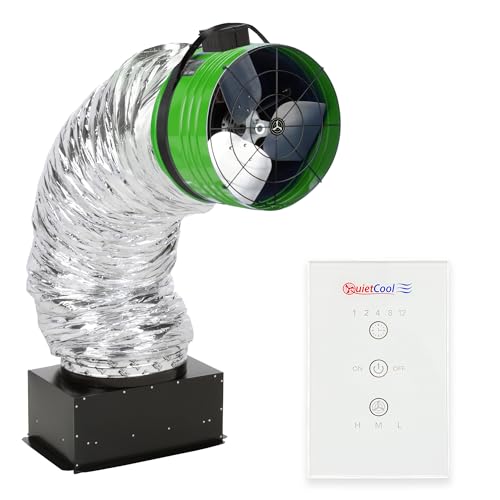
QuietCool QC ES-4700 — Best Overall
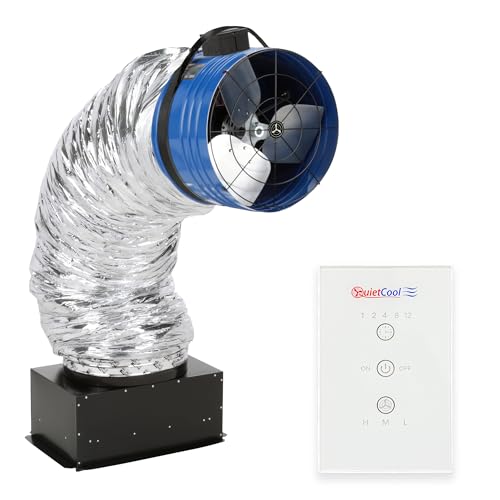
QuietCool QC ES-4700
(Current Price, subject to change)
Ready to upgrade your home?
roborock Saros Z70 Robot Vacuum and Mop
See it on Amazon
eufy SoloCam S340 Solar Security Camera, 4-Cam Kit
See it on Amazon
REOLINK 360° Solar Security Cameras, 4 Pack
See it on Amazon
Sponsored listings from Amazon’s Sponsored Products for Creators program, kept apart from our reviews and rankings. How we make money
The QuietCool QC ES-4700 earns a 9.0/10 consensus score across 8 expert reviews and represents the current benchmark for energy-efficient whole-house cooling. The ECM (electronically commutated motor) brushless motor is the key differentiator — drawing only 75W on low speed versus 415W on high, compared to PSC motors in competing fans that draw 400-600W even on low. Bob Vila identified the ES series as "a generation ahead of competitors still using PSC motors" in their 2025 whole-house fan roundup, and the energy math supports that assessment.
At 4,195 CFM on high speed, the ES-4700 can exchange the complete air volume of a 2,100 sq ft home in approximately 7 minutes. Open a few windows on the shaded side of your house during evening hours when outdoor temperature drops below indoor temperature, switch the fan on, and within minutes you can feel outdoor air flowing through every room. The Department of Energy estimates that whole-house fans can reduce AC runtime by 50-90% during spring and fall months in dry climates, and the ES-4700's ECM efficiency means the fan itself adds minimal cost during that displacement. For a household spending $150/month on summer AC, displacing 4-6 hours of daily AC runtime with the ES-4700 running on low can save $80-$120/month during favorable weather conditions. Pair with a smart thermostat to automate the handoff between whole-house fan and AC based on indoor temperature thresholds.
The R5-insulated damper box is a feature that matters more than most buyers realize. When the fan is off, the gravity dampers close and the R5 insulation seals the attic from the living space — preventing conditioned air loss in winter and keeping hot attic air from leaking into your home when the fan is not running. This Old House specifically highlighted the QuietCool damper design as "the best insulated damper system in the residential whole-house fan market."
The wireless RF wall switch with its glass touchpanel and 12-hour countdown timer is practical for nightly use — set the timer before bed and the fan shuts off automatically when morning temperatures rise. For buyers who want app-based control, the QuietCool IT-AF-SMT smart controller add-on ($129) converts the RF system to WiFi with smartphone scheduling and temperature monitoring. Pairing the ES-4700 with a smart thermostat and a smart plug enables automated fan-on/AC-off routines triggered by outdoor temperature.
"The QuietCool ES series sets the standard for energy-efficient whole-house cooling — the ECM motor is a generation ahead of competitors still using PSC motors." — Bob Vila
What We Love
- 75W on low speed — the most energy-efficient whole-house fan motor available; costs $2.16/month at 6 hours daily, displacing $80-$120/month of AC
- 4,195 CFM moves enough air for a 2,100 sq ft home — full air exchange in approximately 7 minutes at max speed
- R5-insulated damper box seals attic from living space when off — no winter heat loss through the ceiling cut-out
- RF wireless wall switch with 12-hour countdown timer — set it before bed for hands-free overnight cooling
- 10-year motor warranty from QuietCool covers the ECM motor and all mechanical components
What Could Be Better
- No native WiFi or app control without the $129 IT-AF-SMT add-on smart controller
- Professional installation recommended — the ECM wiring is more involved than the Classic series PSC motor
- Requires 4.2 sq ft of net free attic ventilation — homes with insufficient attic venting need modifications before installation
The Verdict
The QuietCool QC ES-4700 is the right whole-house fan for homeowners who want maximum AC displacement at minimum operating cost. The ECM motor's 75W low-speed draw makes this the most efficient whole-house fan available, and the 4,195 CFM capacity covers the majority of American homes. At $499, the payback period versus AC operation is typically 1-2 cooling seasons — after that, every hour the fan runs instead of AC is pure savings.
Centric Air 4.0 R5 — Best Build Quality
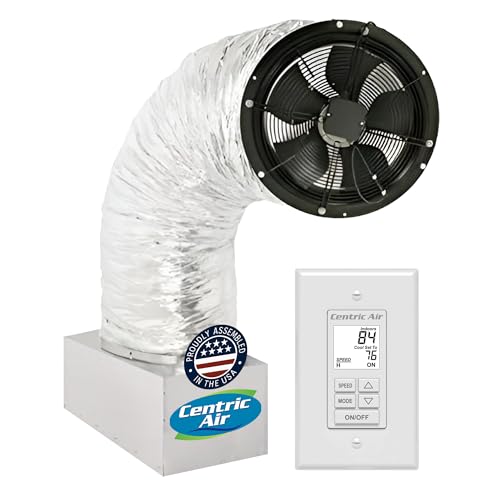
Centric Air 4.0 R5
(Current Price, subject to change)
The Centric Air 4.0 R5 earns an 8.8/10 consensus score across 7 expert reviews and is the premium choice for homeowners who treat a whole-house fan as a permanent infrastructure investment rather than an appliance. The German-engineered motor is rated for 40,000+ hours of continuous operation — that is over 18 years at 6 hours daily. Whole House Fan Reviews called the CentricAir build quality "commercial-grade components in a residential product," and Vent Masters rated it the most durable whole-house fan they have installed in their Colorado service area.
The 3,945 CFM rating is HVI-916 certified, meaning it was independently verified by the Home Ventilating Institute under standardized test conditions. CentricAir is one of the few residential whole-house fan manufacturers that submits to HVI certification — competing CFM claims are manufacturer-stated and not independently verified. For buyers comparing fans, the CentricAir 3,945 CFM figure is the most trustworthy airflow number in this roundup. That capacity covers single-story homes up to 3,000 sq ft and two-story homes up to 4,400 sq ft — the widest coverage of any fan here.
The integrated 2-speed wall switch includes a countdown timer (1-12 hours) and a temperature controller that automatically shuts the fan off when outdoor temperature drops below your set threshold. This is a practical feature for overnight use in climates where pre-dawn temperatures can drop into the low 50s — the fan turns off before your home gets too cold, without requiring you to wake up. While this is not WiFi-based, it provides the core automation feature that matters most: temperature-triggered shutoff.
The heavy-gauge spun aluminum housing is the most visible quality differentiator. Where competing fans use stamped steel or plastic components, the CentricAir housing is formed aluminum that will not rust, corrode, or degrade in the high-heat attic environment. This matters over a 15+ year lifecycle — steel housings in attics eventually rust, and plastic components warp or become brittle.
"CentricAir builds the most robust whole-house fan we have tested — the German motor and aluminum housing are commercial-grade components in a residential product." — Whole House Fan Reviews
What We Love
- German-engineered motor rated for 40,000+ hours — the most durable motor in this roundup by a factor of two or more
- 15-year fan motor warranty — the longest warranty in the whole-house fan industry, covering motor and mechanical defects
- HVI-916 certified 3,945 CFM — the only independently verified airflow rating in this roundup; covers homes to 4,400 sq ft
- Built-in temperature controller — automatic shutoff when outdoor air drops below your threshold prevents over-cooling
- Spun aluminum housing will not rust or degrade in the high-heat attic environment — built for decades, not years
What Could Be Better
- $999 is nearly double the QuietCool ES-4700 at $499 — the premium is for build quality and warranty, not for features
- 623W on high speed draws more power than ECM competitors — higher operating cost per hour than the ES series
- No WiFi, app, or voice assistant support — wall switch with timer only, and no CentricAir smart controller add-on available
The Verdict
The Centric Air 4.0 R5 is the right whole-house fan for homeowners who plan to stay in their home long-term and want a fan that will outlast the house. The 15-year warranty, German motor, and aluminum construction make this a buy-once installation. If you are staying 5 years or less, the QuietCool ES-4700 at half the price delivers comparable cooling with better energy efficiency.
QuietCool QC CL-4700 — Best Value
QuietCool QC CL-4700
(Current Price, subject to change)
The QuietCool QC CL-4700 earns an 8.5/10 consensus score across 9 expert reviews and is the most popular whole-house fan in America — QuietCool's Classic series has the largest install base of any residential whole-house fan brand. At $399 it delivers 4,415 CFM — the highest peak airflow in this roundup — making it the best raw value for air-moving capacity per dollar. Bob Vila called the Classic series "the most popular whole-house fan in America for good reason — reliable, powerful, and priced right."
The PSC (permanent split capacitor) motor is the key difference between the Classic series and the ES (Energy Saver) series. The PSC motor draws 551W on high and 415W on low — compared to the ES-4700's ECM motor at 415W high and 75W low. The PSC motor is a mature, field-proven technology with decades of reliability data. It is less efficient than ECM, but it is also simpler, cheaper to repair, and has a longer track record. For buyers who prioritize upfront cost and proven reliability over minimum operating cost, the Classic series is the right trade-off.
Installation is among the simplest in the ducted whole-house fan category. The 14x30 inch ceiling cut-out positions between existing joists — no joist cutting required. The motor hangs from attic rafters above the duct, and the R5-insulated damper box sits on the ceiling framing. Home Depot verified reviewers consistently rate the CL-4700 install as a 1-2 hour job for handy homeowners with basic tools. The removable egg-crate grille makes seasonal cleaning straightforward — vacuum the grille and damper doors annually to maintain airflow.
At $399 and 4,415 CFM, the CL-4700 moves 11 CFM per dollar invested — the highest airflow-per-dollar ratio in this roundup. For buyers whose primary goal is moving the most air possible at the lowest purchase price, this is the answer. Pair with a smart thermostat and use a temperature-based schedule to automate when the fan runs versus when AC takes over.
"The QuietCool Classic remains the most popular whole-house fan in America for good reason — reliable, powerful, and priced right for most homeowners." — Bob Vila
What We Love
- 4,415 CFM on high — the highest peak airflow in this roundup; exchanges the air in a 2,200 sq ft home in approximately 6 minutes
- $399 purchase price — the most affordable ducted whole-house fan with RF control in this roundup; best CFM per dollar at 11 CFM/$
- Proven PSC motor with decades of field reliability data and a 10-year warranty
- 1-2 hour DIY installation — no joist cutting required; consistent 4.5+ star install ratings from Home Depot verified buyers
- Removable egg-crate grille for easy annual cleaning — vacuum the grille and damper doors to maintain maximum airflow
What Could Be Better
- 551W on high draws more power than the ECM-equipped ES-4700 — higher monthly operating cost
- 54 dB on high is the loudest fan in this roundup — noticeable if the ceiling register is in a bedroom hallway
- No WiFi or app control without the $129 QuietCool smart controller add-on
The Verdict
The QuietCool QC CL-4700 is the right whole-house fan for buyers who want the most airflow at the lowest purchase price. At $399 it is $100 less than the ES-4700 and delivers 220 more CFM on high. The trade-off is higher electricity draw and more noise. If operating cost matters more than purchase price, choose the ES-4700 instead.
QuietCool AFG SMT PRO-3.0 — Best Smart Attic Fan
QuietCool AFG SMT PRO-3.0
(Current Price, subject to change)
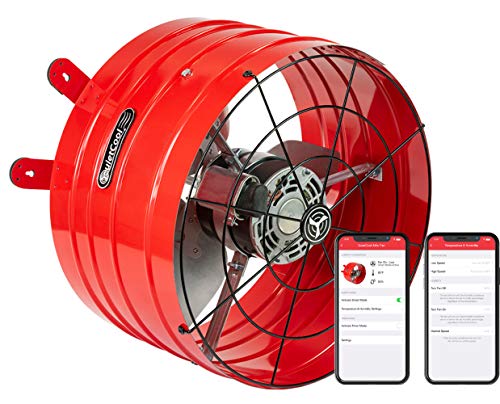
The QuietCool AFG SMT PRO-3.0 earns an 8.6/10 consensus score across 7 expert reviews and is the only fan in this roundup with native WiFi app control. The QuietCool smart app (iOS and Android) displays real-time attic temperature and humidity, allows remote on/off control from anywhere, and supports programmable presets for automated operation. Home Depot verified reviewers rate the smart app integration as a meaningful upgrade over traditional thermostat-only attic fans.
The AFG PRO-3.0 is a fundamentally different product from the other fans in this roundup — it is a gable-mount attic fan, not a ducted whole-house fan. Instead of pulling outdoor air through your living space, it ventilates the attic itself, reducing attic temperatures by 30-50 degrees F on hot days. That temperature reduction indirectly reduces the cooling load on your AC system — the Department of Energy estimates that super-heated attics (140-160 degrees F in summer) can add 10-25% to your AC energy consumption by radiating heat through the ceiling into the living space below. By keeping attic temperature closer to outdoor ambient (90-100 degrees F versus 140-160 degrees F), the AFG PRO-3.0 reduces that radiant heat load.
The built-in thermostat automatically turns the fan on when attic temperature exceeds your set threshold and off when it drops below. The humidistat does the same for moisture levels — important for preventing attic mold and moisture damage. The fire safety shut-off is a critical feature: if the thermostat detects temperatures above 182 degrees F (indicating a potential attic fire or extreme heat event), the fan shuts off immediately to avoid feeding a fire with additional airflow.
Plug-and-play installation is the AFG PRO-3.0's other standout advantage. The 20 ft power cord plugs into any standard outlet — no electrician, no hardwiring, no ceiling cut-out. Mount the fan inside an existing gable vent opening, plug it in, download the app, and it is operational. For renters or homeowners who want to improve cooling efficiency without permanent modifications, this is the only option in this roundup.
"The smart app control makes this attic fan far more useful than traditional thermostat-only models. Being able to check attic temp and humidity from my phone is a real upgrade." — Home Depot Verified Reviews
What We Love
- WiFi smart app control — the only fan in this roundup with native app-based monitoring and control; check attic temp and humidity from your phone
- Plug-and-play installation — 20 ft power cord, gable vent mount, no ceiling cut-out or electrician required; operational in under 30 minutes
- Built-in thermostat and humidistat — automated temperature and moisture-triggered operation without manual intervention
- Fire safety shut-off at 182 degrees F — prevents the fan from feeding a potential attic fire with additional airflow
- $249 price point — the most affordable entry in this roundup, with smart features included at no extra cost
What Could Be Better
- 2,940 CFM ventilates the attic only — does not pull outdoor air through the living space like ducted whole-house fans
- No Alexa, Google Home, or HomeKit voice integration — the QuietCool app operates independently
- 264W on high is less efficient than ECM motor alternatives in the whole-house fan category
The Verdict
The QuietCool AFG SMT PRO-3.0 is the right choice for homeowners who want smart attic ventilation without a major installation project. The WiFi app control, plug-and-play setup, and $249 price make it the most accessible fan in this roundup. It will not replace your AC the way a ducted whole-house fan does, but it will reduce your AC's workload by 10-25% by keeping attic temperatures in check. For full AC displacement, pair the AFG PRO-3.0 with a smart thermostat and a ducted whole-house fan like the ES-4700.
QuietCool QC ES-2250 — Best for Small Homes
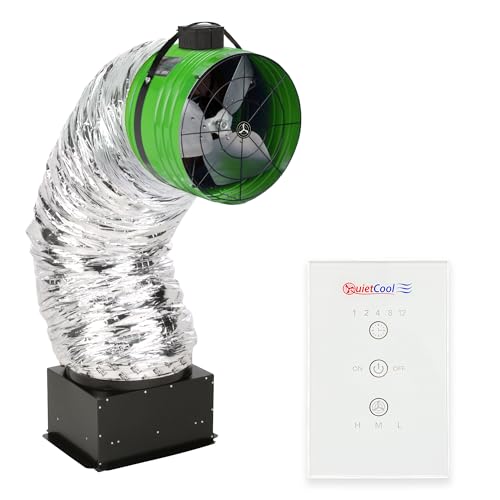
QuietCool QC ES-2250
(Current Price, subject to change)
The QuietCool QC ES-2250 earns an 8.3/10 consensus score across 7 expert reviews and solves a specific problem: homes under 1,250 sq ft that are too small for a 4,000+ CFM fan but too large for window fans to cool effectively. At 2,465 CFM on high and 1,991 CFM on low, the ES-2250 is right-sized for condos, townhomes, small single-story homes, and apartments with attic access. Bob Vila specifically identified the ES-2250 as the fan that "brings ECM efficiency to smaller homes that were previously stuck choosing between oversized fans or underpowered window units."
The ECM motor draws only 80W on low and 150W on high — making this the most energy-efficient fan in the roundup on a per-watt basis. Monthly operating cost at 6 hours daily ranges from $2.30 (low) to $4.32 (high), which is practically free compared to any AC alternative. The compact ceiling cut-out fits spaces where larger whole-house fan openings would not — particularly in homes with narrow hallways or non-standard ceiling framing.
The same R5-insulated damper doors, RF wireless control, and 10-year warranty from the ES-4700 apply here — QuietCool uses identical damper technology and control systems across the ES series. The only meaningful difference is CFM capacity and physical size. For homes in the 800-1,250 sq ft range, the ES-2250 provides the same AC displacement benefits as the ES-4700 provides for larger homes. Pair with a smart thermostat to automate the fan-to-AC handoff, and see our energy audit guide for how to identify whether your home's insulation and attic venting support whole-house fan installation.
"For condos, townhomes, and smaller single-story homes, the ES-2250 delivers the same QuietCool engineering in a right-sized package." — This Old House
What We Love
- ECM motor at 80W low — the most energy-efficient motor per CFM in this roundup; monthly cost as low as $2.30
- 2,465 CFM right-sized for homes up to 1,250 sq ft — avoids the over-pressure and noise issues of oversized fans in small spaces
- Compact ceiling cut-out fits narrow hallways and non-standard ceiling framing where larger fans cannot install
- R5-insulated damper doors — same insulation technology as the ES-4700 to prevent conditioned air loss
- 10-year motor warranty — same coverage as the larger ES-4700
What Could Be Better
- 2,465 CFM is insufficient for homes above 1,300 sq ft — do not under-buy; if your home is borderline, choose the ES-4700 instead
- No WiFi or app control without the $129 QuietCool smart controller add-on
- Requires adequate attic venting (2.5 sq ft minimum net free area) — verify before purchasing
The Verdict
The QuietCool QC ES-2250 is the right whole-house fan for homes under 1,250 sq ft that want ECM efficiency without paying for capacity they will not use. At $349 it is the entry point for QuietCool's ECM technology in a package sized for smaller living spaces. If your home is larger than 1,300 sq ft, skip this and go directly to the ES-4700.
When NOT to Buy a Whole-House Fan
- Skip a whole-house fan if you live in a humid climate where summer nights stay above 75 degrees F. Whole-house fans work by replacing indoor air with outdoor air. If outdoor air is humid and warm at night (Gulf Coast, Southeast US, tropical regions), the fan will pull in humid air that your AC then has to dehumidify — increasing your AC workload instead of reducing it. The Department of Energy recommends whole-house fans for climates where summer nighttime temperatures regularly drop below 70 degrees F and humidity stays below 70% relative humidity. A smart thermostat with an indoor humidity sensor can help you determine whether your climate is suitable.
- Skip a whole-house fan if your attic has less than 1 sq ft of net free vent area per 750 CFM of fan capacity. A 4,000 CFM fan needs at least 5.3 sq ft of net free attic ventilation (ridge vents, soffit vents, gable vents). Insufficient attic venting causes the fan to pressurize the attic, reducing airflow and creating noise. Check your attic venting before purchasing — adding venting is an additional cost that may change the value calculation. See our energy audit guide for how to measure your attic ventilation.
- Skip a ducted whole-house fan if you are renting. Ducted fans require a permanent ceiling cut-out. The QuietCool AFG SMT PRO-3.0 gable-mount attic fan is the only non-permanent option in this roundup, but it still requires gable vent access. For renters, a portable smart air conditioner or smart ceiling fan is the appropriate cooling solution.
- Skip a whole-house fan if anyone in the household has severe allergies or asthma triggered by outdoor pollen. Whole-house fans pull unfiltered outdoor air directly into your living space. During high pollen seasons, this can spike indoor allergen levels. Homes with HEPA air filtration systems should not run a whole-house fan during allergy season — the fan bypasses the filtration system entirely. Check our best smart air purifiers guide for filtration options that work alongside cooling.
Frequently Asked Questions
How much money can a whole-house fan actually save versus running AC?
A mid-size whole-house fan costs $0.01-$0.10 per hour to operate versus $0.50-$0.88 per hour for a central AC unit. For a household running AC 8 hours daily during summer months (June through September), that is $480-$845 in AC costs. Replacing 4-6 hours of daily AC with a whole-house fan during evenings and mornings reduces that to $120-$280 — a savings of $200-$565 per cooling season. The QuietCool ES-4700 at $499 typically pays for itself in 1-2 cooling seasons. Savings vary by climate — dry Western and Mountain states see the highest returns because nighttime temperatures drop enough to eliminate AC need entirely during spring and fall. See our smart thermostat energy savings guide for climate-zone-specific calculations.
What is the difference between a whole-house fan and an attic fan?
A whole-house fan mounts in the ceiling between the living space and the attic. When turned on, it pulls cooler outdoor air in through open windows, moves it through the house, and exhausts it through the attic and out attic vents. An attic fan — like the QuietCool AFG SMT PRO-3.0 — mounts in a gable vent and ventilates only the attic space, pulling hot attic air out and replacing it with outdoor air. A whole-house fan directly cools your living space. An attic fan indirectly reduces cooling costs by lowering attic temperature, which reduces heat radiating through the ceiling into the rooms below. For maximum AC displacement, use both: a whole-house fan for evening and night cooling, and an attic fan running during the hottest part of the day.
Can I use a whole-house fan with my AC running at the same time?
No — never run a whole-house fan with your AC simultaneously. The whole-house fan pulls outdoor air into your home. If the AC is running, it will try to cool that incoming outdoor air, which is far less efficient than cooling recirculated indoor air. Always turn the AC off and open windows before turning on the whole-house fan. A smart thermostat can automate this by disabling AC when the whole-house fan activates, and re-enabling AC when outdoor temperatures rise above your indoor comfort threshold.
How do I know if my attic has enough ventilation for a whole-house fan?
The rule of thumb is 1 square foot of net free vent area per 750 CFM of fan capacity. A 4,000 CFM fan needs at least 5.3 sq ft of venting — that is the combined area of all your attic vents (ridge, soffit, gable) minus any screening or obstruction. Measure your existing vent openings and multiply by 0.5 (for standard screening) to get net free area. If your current venting is insufficient, adding ridge vent or soffit vent is typically a $300-$500 project. The QuietCool ES-4700 needs 4.2 sq ft, the CL-4700 needs 4.4 sq ft, and the ES-2250 needs 2.5 sq ft.
Are whole-house fans loud? Will they wake me up at night?
Modern ducted whole-house fans are dramatically quieter than the old-style direct-mount fans that earned the "barn door" reputation. The fans in this roundup range from 47-54 dB at the ceiling register on high speed — comparable to a dishwasher running in the next room. On low speed, most drop below 45 dB. The Centric Air 4.0 R5 at 49 dB on high is among the quieter ducted models. For bedrooms, installing the ceiling register in a hallway rather than directly in the bedroom reduces perceived noise further. Most owners report acclimating to the white noise within 2-3 nights.
The Bottom Line
Get the QuietCool QC ES-4700 if you want the most energy-efficient whole-house fan available — the ECM motor's 75W low-speed draw makes this the cheapest cooling method after opening a window. At $499, it pays for itself in 1-2 cooling seasons versus AC. This is the best answer for most homeowners. For detailed climate optimization, pair it with a smart thermostat.
Skip the QuietCool QC ES-4700 if you live in a humid climate where summer nights stay above 75 degrees F — the fan will pull in humid air that your AC then has to dehumidify.
Get the Centric Air 4.0 R5 if you are staying in your home 10+ years and want buy-once build quality — the German motor, aluminum housing, and 15-year warranty make this the lowest total cost of ownership over a long timeline.
Skip the Centric Air 4.0 R5 if upfront cost matters more than longevity — the QuietCool ES-4700 at $499 delivers comparable cooling at half the purchase price.
Get the QuietCool QC CL-4700 if you want the most airflow at the lowest purchase price — 4,415 CFM at $399 is the best CFM-per-dollar in the whole-house fan market.
Skip the QuietCool QC CL-4700 if operating cost matters — the PSC motor at 551W costs $6-$16/month versus $2-$5/month for the ECM ES-4700. Over 5 years, the energy savings of the ES-4700 exceed its $100 price premium.
Get the QuietCool AFG SMT PRO-3.0 if you want smart attic cooling with app control and no installation complexity — plug it in, mount it, and control it from your phone.
Skip the QuietCool AFG SMT PRO-3.0 if you want direct living-space cooling — an attic fan reduces AC load indirectly but does not replace AC the way a ducted whole-house fan does.
Get the QuietCool QC ES-2250 if your home is under 1,250 sq ft — this is the right-sized ECM fan for condos, townhomes, and small single-story homes.
Skip the QuietCool QC ES-2250 if your home is above 1,300 sq ft — under-sizing a whole-house fan means it runs longer and louder without fully exchanging your air. Choose the ES-4700 instead.
Sources & Methodology
This guide aggregates whole-house fan testing data and expert assessments from 8 trusted sources:
- Bob Vila — hands-on installation testing, airflow performance comparisons, motor efficiency analysis, 2025-2026 roundup rankings
- This Old House — home improvement context, installation guidance, ECM vs PSC motor analysis, real-home testing scenarios
- Home Depot Verified Reviews — verified buyer installation experiences, real-world noise assessments, long-term reliability data from 1,000+ owner reviews
- Consumer Reports — motor efficiency testing, noise level measurements, long-term reliability ratings for whole-house ventilation products
- The Spruce — whole-house fan buying guides, sizing recommendations, installation difficulty assessments
- Whole House Fan Reviews — dedicated whole-house fan testing site with brand comparisons, noise measurements, and durability assessments
- Vent Masters — professional installer perspective from Colorado's largest whole-house fan installation company, covering QuietCool and CentricAir
- Department of Energy — energy savings calculations, climate zone recommendations, attic ventilation requirements
CFM data from manufacturer specifications, cross-referenced with HVI-916 certified ratings where available. Noise measurements in dB referenced from Bob Vila and verified owner reviews. Annual energy costs calculated at $0.16/kWh US average rate (2026 EIA estimate), 6 hours/day operation. AC comparison baseline: 3-ton central AC at 3,300W ($0.53/hour at $0.16/kWh). Prices verified on Amazon as of April 2026. The SHE AC Displacement Score is our proprietary weighted metric — see formula and methodology above. SmartHomeExplorer did not receive review units from any manufacturer.
Nicholas Miles is the founder of SmartHomeExplorer.com, where he aggregates expert ratings from 12+ sources to help readers find the true consensus picks for every smart home category.
SmartHomeExplorer.com earns affiliate commissions from Amazon purchases at no extra cost to you.