

Best Smart LED Lightstrip Brands 2026: Hue vs Govee vs Nanoleaf vs WiZ
You stuck the strip behind the TV. The middle goes red, the ends stay blue, and the music sync trails the bass drop. Price per metre runs from about $2.70 on the budget Govee to roughly $19.70 on the LIFX SuperColor — a 7.3x spread our value score sorts out.
This article contains affiliate links. We may earn a commission at no extra cost to you. Prices change frequently — check the current price on Amazon before buying. Learn more
The Short Answer
Buy the Philips Hue Solo Lightstrip for permanent, high-quality installations — clean warm and cool whites, four ecosystems, no Bridge required initially. Want Matter for less? The WiZ RGBIC strip delivers comparable ecosystem coverage at roughly a fifth of Hue per meter, which is why it tops our value ranking.
Featured in this Guide
Philips
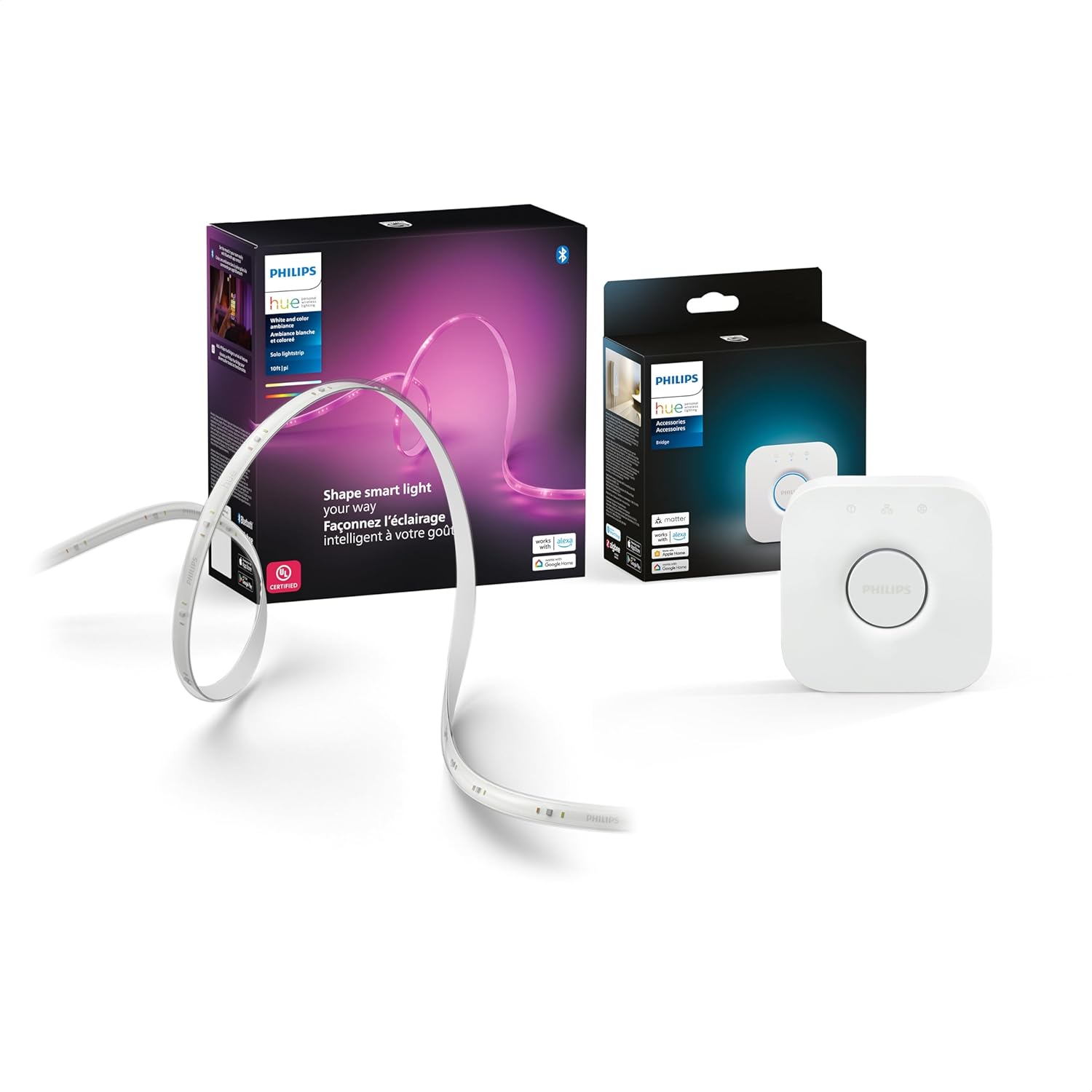
Hue Solo Lightstrip
- •Clean warm/cool whites for under-cabinet work
- •Bridge optional
- •about $19.70/m across 3 m.
LIFX
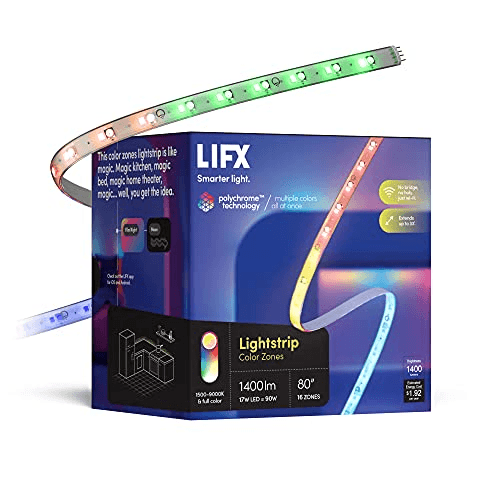
SuperColor Lightstrip
- •Hub-free, native Apple Home, 16 addressable zones, 690 lm/m — the brightest published output here.
Nanoleaf
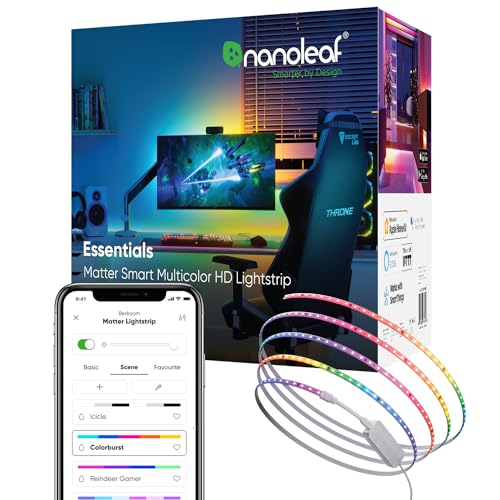
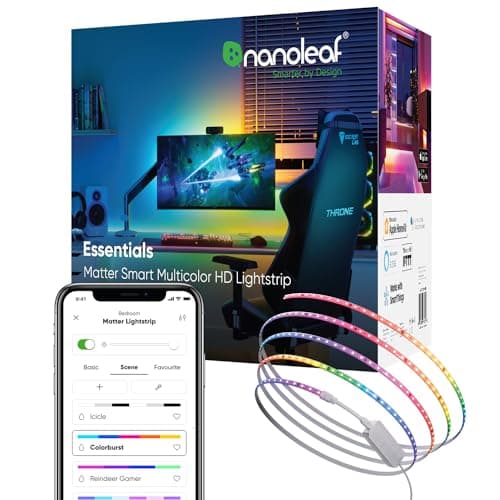
Essentials Lightstrip
- •300 addressable color zones
- •Matter over Wi-Fi
- •about $12/m.
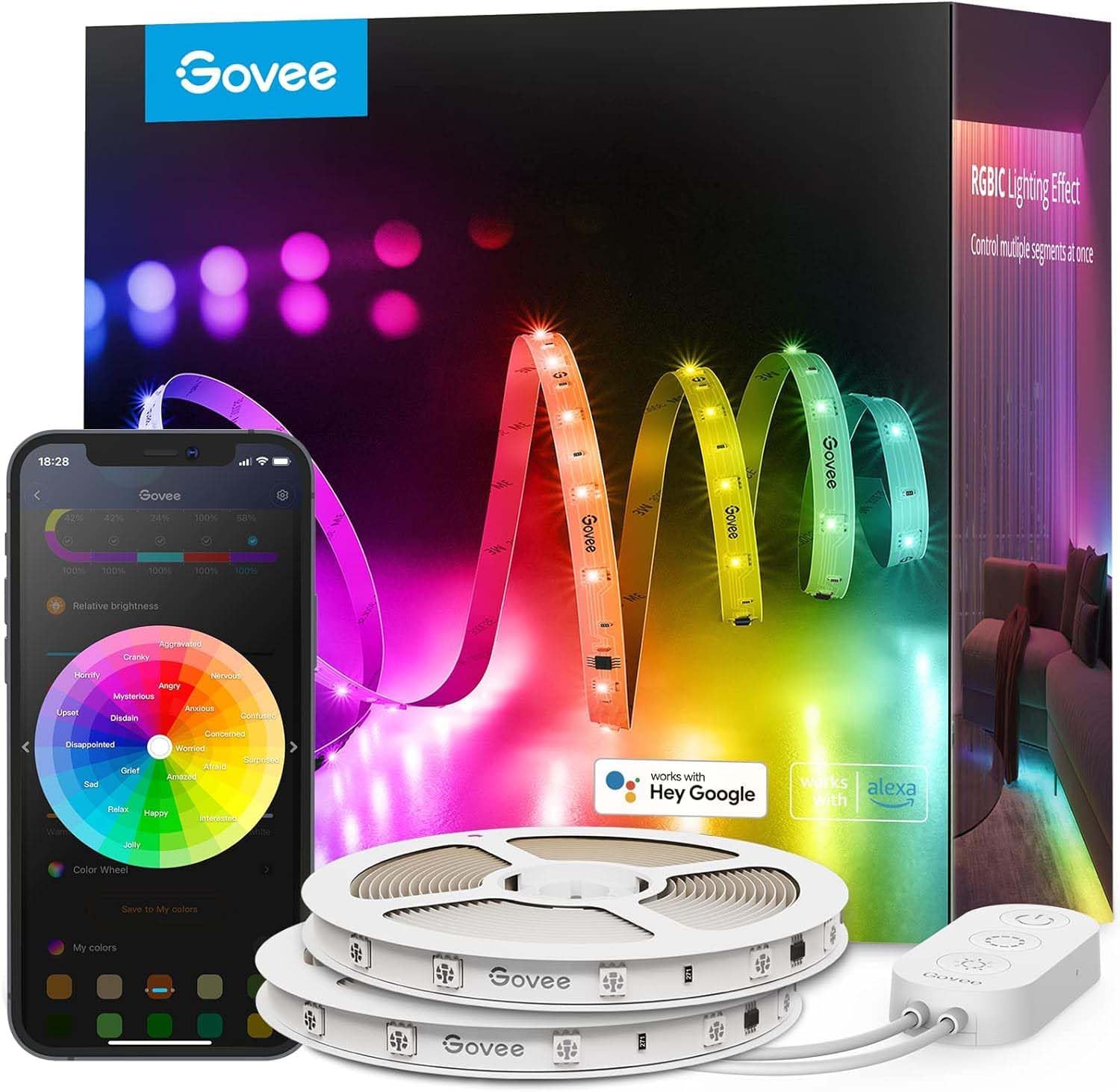
Govee
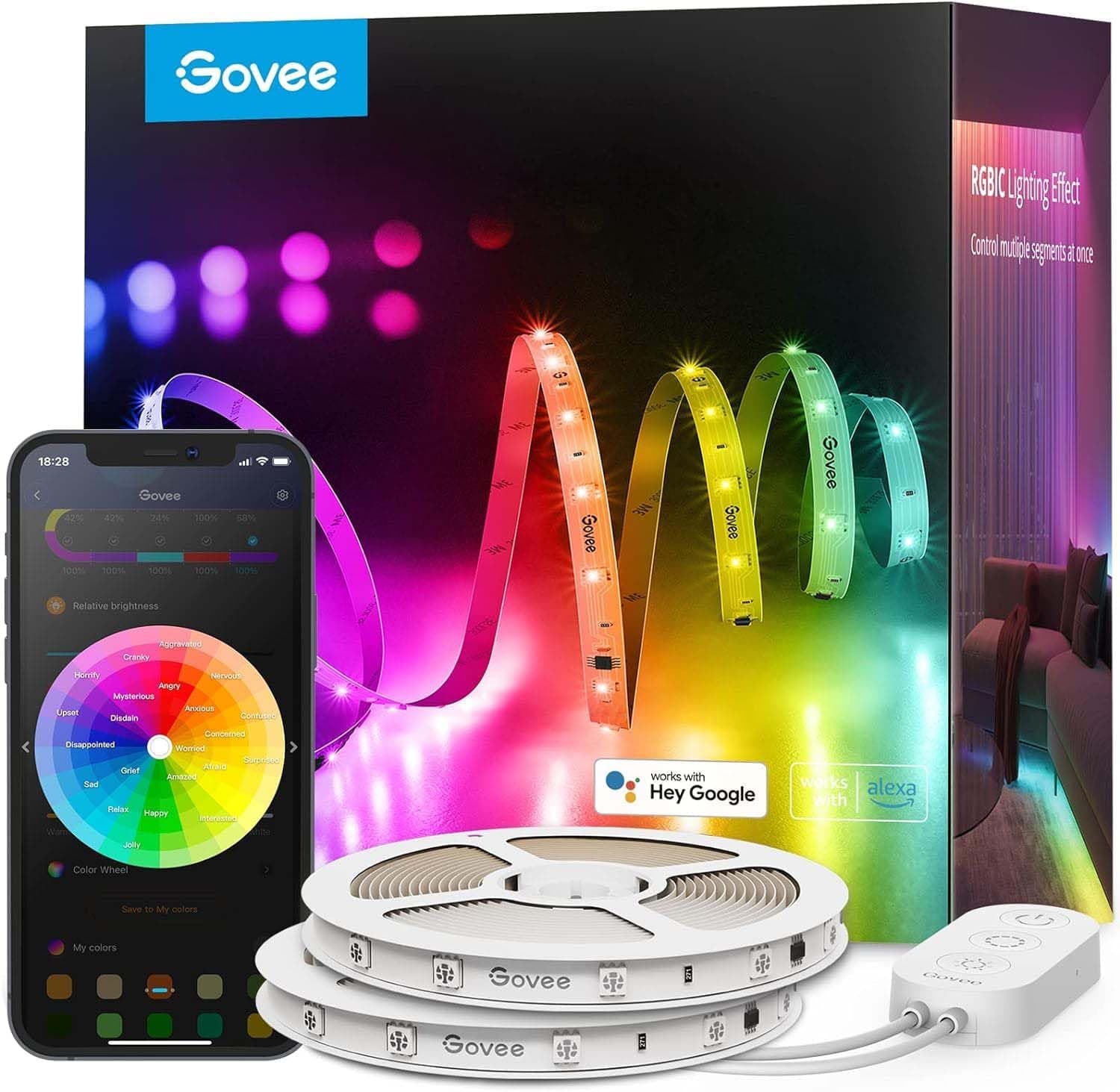
RGBIC Pro LED Strip Lights
- •Mic music sync
- •RGBIC segments
- •about $4.30/m across 32.8 ft.
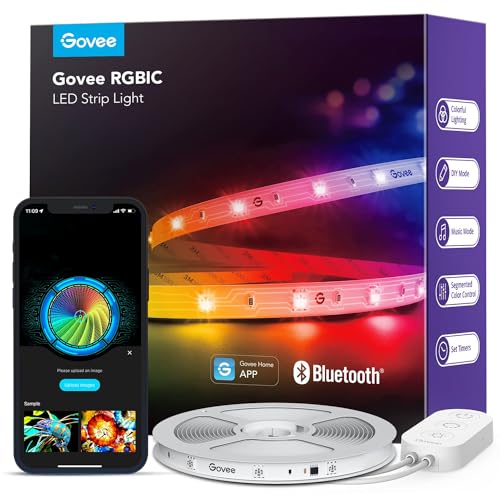
Govee
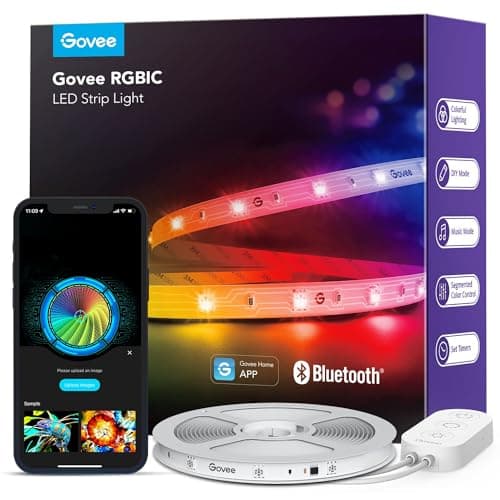
RGBIC LED Strip Light
- •Music sync
- •RGBIC
- •about $2.70/m — Bluetooth-only, no Alexa or Google.
WiZ
Smart RGBIC LED Light Strip
- •Matter over Wi-Fi
- •no hub
- •about $4.12/m.
Head-to-Head Comparison
Smart Lighting
Chart
 Smarthomeexplorer.com
Tap any pick to check its live price on Amazon.
Arlo Ultra 4K HDR Security Camera (3rd Gen) 4-Cam Kit
RecommendedCheck price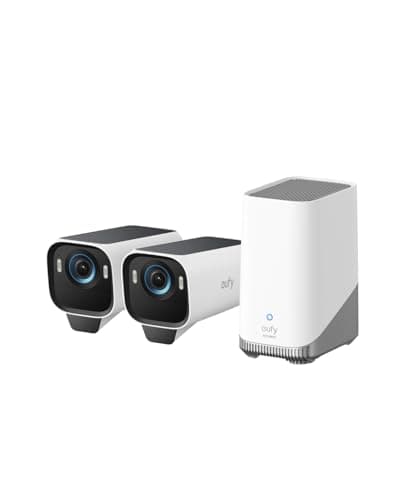
eufyCam S3 Pro 2-Cam Kit (Solar, 4K)
Must BuyCheck price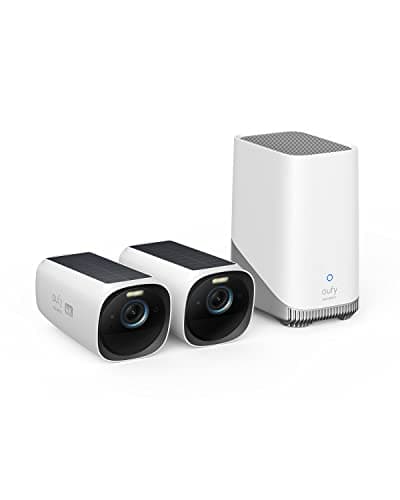
eufy Security eufyCam S330 2-Cam Kit (HomeBase 3)
RecommendedCheck price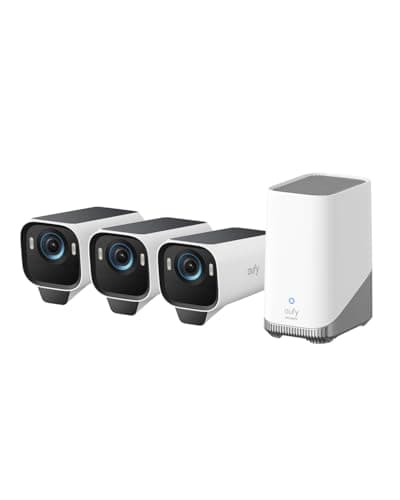
eufy Security eufyCam S3 Pro 3-Cam Kit
RecommendedCheck price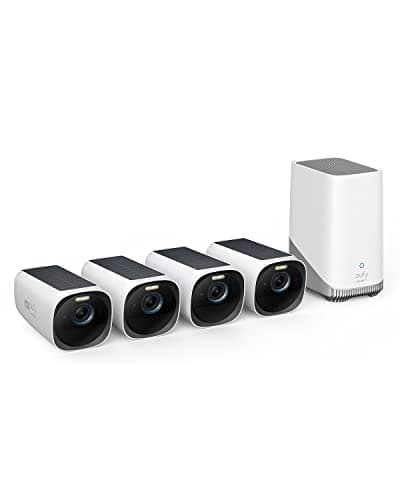
Eufy eufyCam S330 4-Cam Kit (with HomeBase S380)
Must BuyCheck price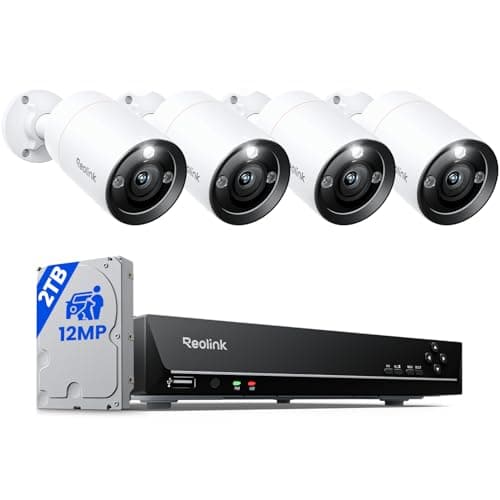
Reolink RLK8-1200B4-A 12MP 8-Channel PoE NVR System (4-Camera)
RecommendedCheck price
What Actually Matters in 2026
You stuck a strip behind the TV, and the music sync lags behind the bass drop. Three considerations decide that outcome as of August 2026. The first consideration is price per meter. The LIFX SuperColor and the Hue Solo effectively tie at approximately $19.70/m, whereas the no-hub WiZ and budget Govee settle around $4.12/m and $2.70/m respectively. That constitutes approximately a 7.3x differential, recalculated against live Amazon pricing on 2026-08-22. The second consideration is the synchronization method, because an HDMI sync box interprets the source directly while microphone and camera approaches react to ambient cues and comparatively trail it. The third is the SHE Smart Lighting Value Score, which combines color, brightness, ecosystem breadth, Matter readiness and gamut, then normalizes against price per meter and any obligatory hub. Wirecutter covers the Hue lightstrip, whose warm and cool whites remain the task lighting recommendation.
Best Overall: Philips Hue Solo Lightstrip
Best Overall — Under-Cabinet and Premium AccentPhilips Hue Solo Lightstrip
- Wirecutter covers the Hue lightstrip in its LED strip reporting, and the clean warm and cool whites are exactly what makes it the under-cabinet task lighting choice.
- About $19.70 per metre effectively ties the LIFX SuperColor for the steepest rate here, and the optional Bridge adds roughly $6 per fixture if you want Zigbee, remote access or Matter.
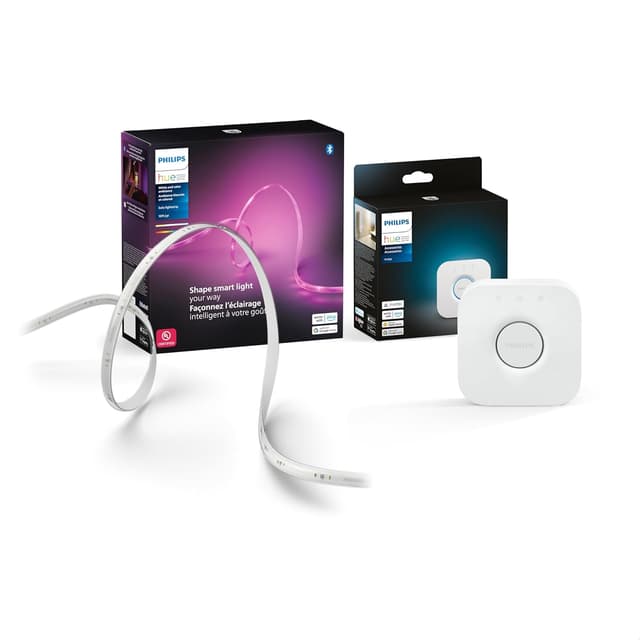
(Current price, subject to change)
The Philips Hue Solo Lightstrip earns an 8.5 consensus score and a 7.2 SHE Smart Lighting Value Score, a composite normalized against unit price and hub cost. Its comparable rate per metre sits within two cents of the LIFX SuperColor's. Wirecutter and Tom's Guide both cover the Hue lightstrip in their reporting. The demonstrably clean warm and cool whites are what visibly differentiate this configuration from the budget alternatives on skin tones and warm output.
One detail is worth stating plainly, because the Bridge requirement is widely assumed. This Solo base kit pairs over Bluetooth directly out of the box, so the Bridge is genuinely optional. Adding the Bridge joins the strip to a local Zigbee mesh that survives an internet outage and reaches Matter; without it, application control still operates normally. Across a 10 ft installation the effective rate calculates to approximately $19.70 per metre, which remains substantially steeper than the budget tier.
What We Love
- Wirecutter covers the Hue lightstrip in its LED strip reporting, and the clean warm and cool whites are exactly what makes it the under-cabinet task lighting choice.
- Add the optional Bridge and the strip joins a local Zigbee mesh that keeps automations running through an internet outage, and unlocks Matter at the same time.
- 1700 lm across a 10 ft run is the highest published total output in this roundup, though the LIFX kit is brighter per metre, and the Hue extension kit continues the run without a second controller.
What Could Be Better
- About $19.70 per metre effectively ties the LIFX SuperColor for the steepest rate here, and the optional Bridge adds roughly $6 per fixture if you want Zigbee, remote access or Matter.
- No native music sync, and it lights as one continuous run rather than independent segments — Govee outperforms it on TV backlight gradients.
The Verdict
If under-cabinet task lighting is the priority and you want whites that genuinely look clean, the Philips Hue Solo Lightstrip fits the brief without compromise. 1700 lm across 10 ft, four ecosystems, and a Bridge you can add later rather than buy up front check the boxes that matter for kitchen counters and display cabinets.
Ready to upgrade your home?
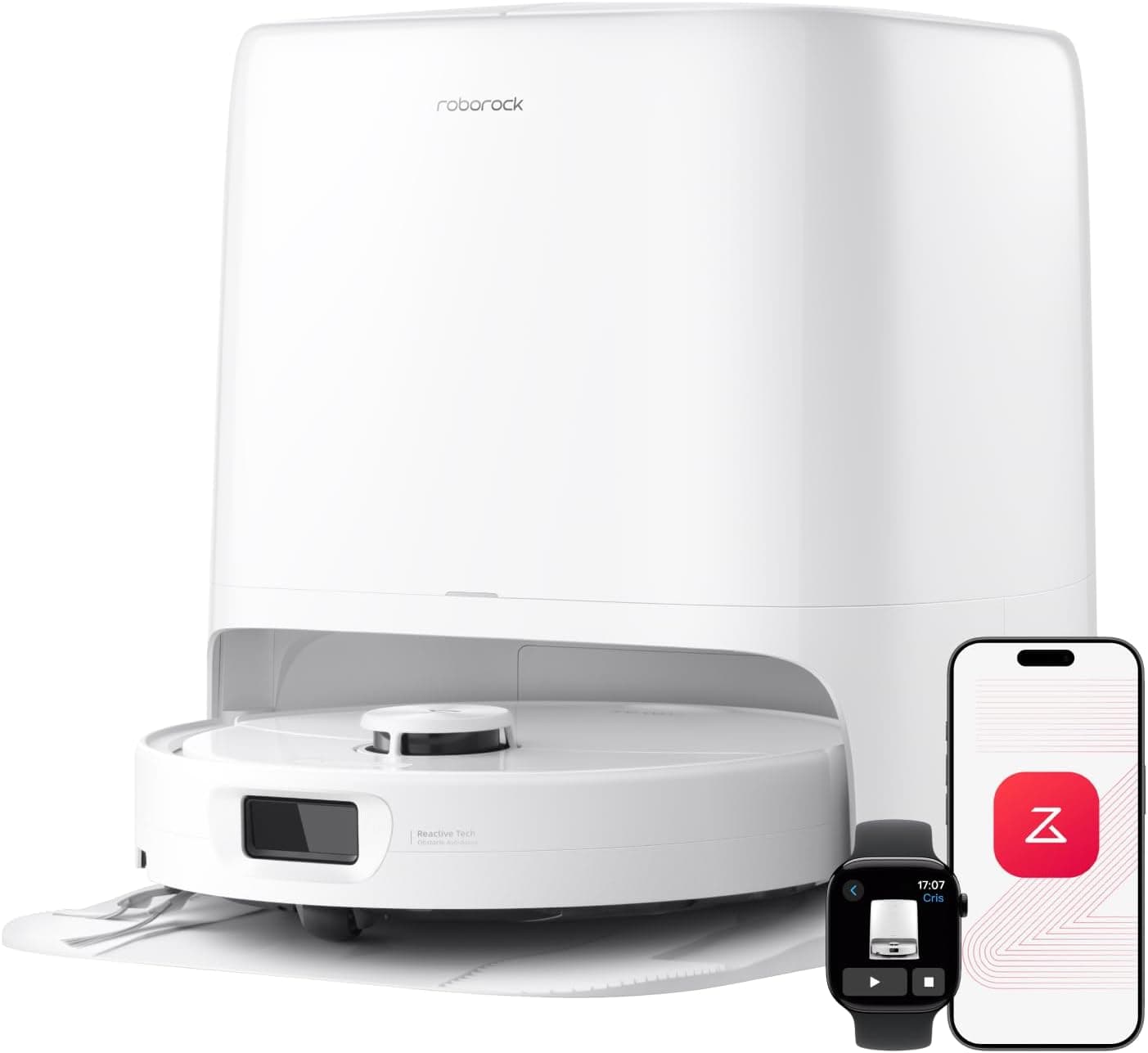
roborock Qrevo 2 Pro Robot Vacuum and Mop
See it on Amazon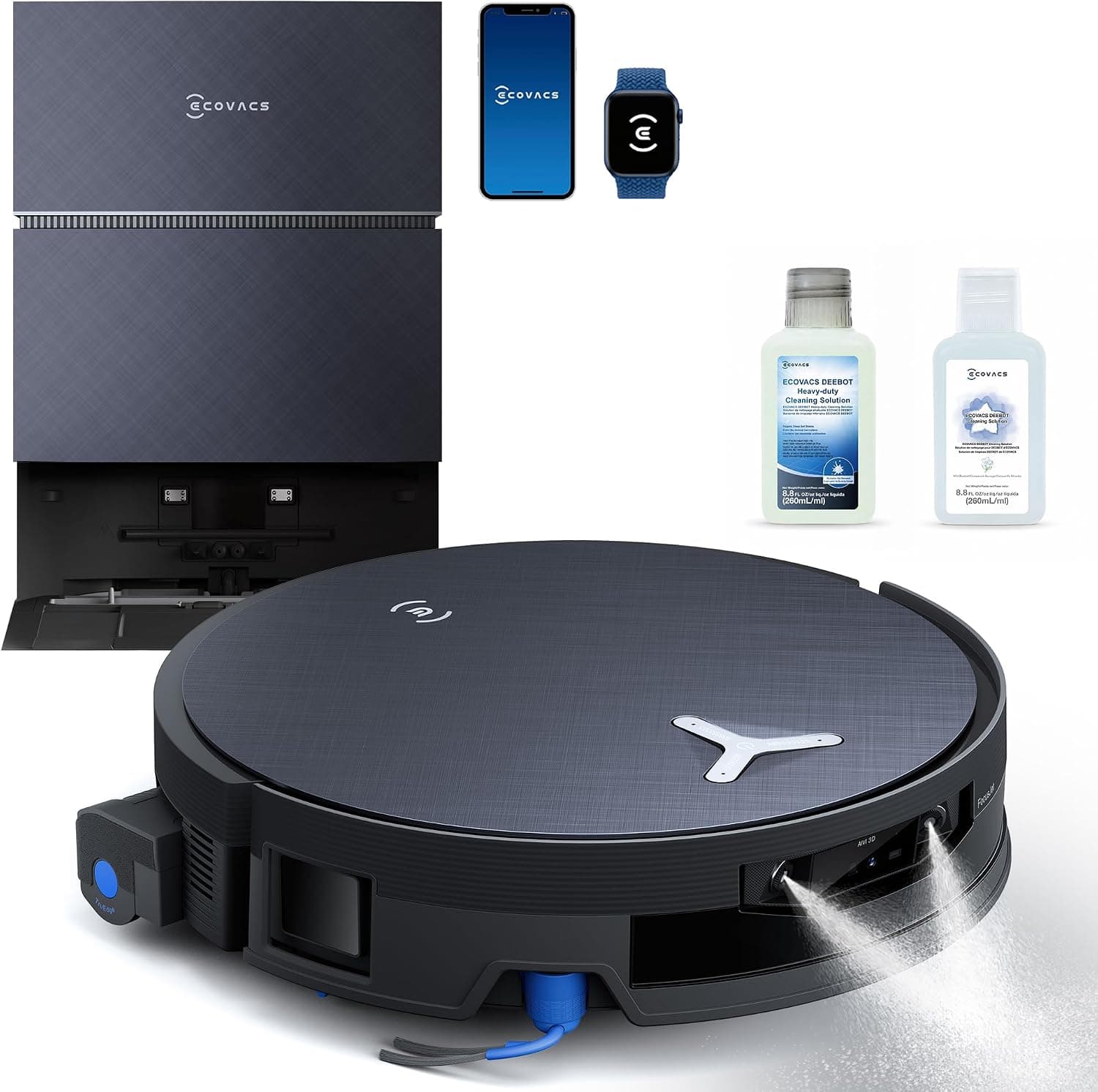
ECOVACS DEEBOT X12 PRO Omni Robot Vacuum and Mop
See it on Amazon
eufy SoloCam S340 Solar Security Camera, 4-Cam Kit
See it on Amazon
Sponsored listings from Amazon’s Sponsored Products for Creators program, kept apart from our reviews and rankings. How we make money
Best for Color Effects: LIFX SuperColor Lightstrip
Best for Color Effects — Hub-Free Color SaturationLIFX SuperColor Lightstrip
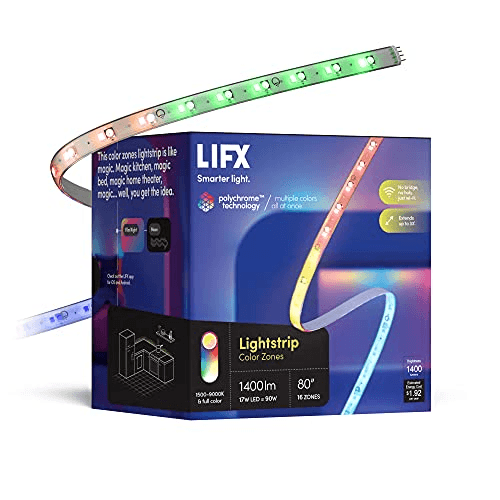
- 1400 lm across the 80 in kit — 690 lm per metre, the brightest published figure in this roundup, with no bridge required at all.
- About $19.70 per metre effectively ties the Hue Solo for the steepest rate here, and the 6.6 ft kit is short enough that a long perimeter means buying extensions at that rate.
(Current price, subject to change)
The LIFX SuperColor Lightstrip earns an 8.1 consensus score and a 6.4 SHE Smart Lighting Value Score. Its 690 lm per metre is the brightest published output here, and 16 addressable zones back the colour case; the steep rate per metre is what caps it. Tom's Guide covers LIFX in its smart lighting reporting, and the exceptional colour saturation is precisely what differentiates this installation from the white-light-oriented Hue configuration.
Apple Home configuration completes natively, without intermediary equipment. Matter, however, has not arrived: LIFX lists this lightstrip among the products it is still working to bring to Matter, so it should be treated as not-yet-Matter. The per-meter economics remain unchanged, however. $39.98 across a 6.6 ft installation calculates to approximately $19.70 per metre. That represents comparatively 7.3x the budget tier, effectively level with the Hue Solo. The strip remains cuttable and extendable to 32.8 ft, so covering an extended perimeter is achievable, but that configuration compounds the per-meter premium rather than diluting it.
What We Love
- 1400 lm across the 80 in kit — 690 lm per metre, the brightest published figure in this roundup, with no bridge required at all.
- 16 independently addressable colour zones across the kit, and the strip is cuttable and extendable to 32.8 ft from the same controller and power supply.
What Could Be Better
- About $19.70 per metre effectively ties the Hue Solo for the steepest rate here, and the 6.6 ft kit is short enough that a long perimeter means buying extensions at that rate.
- Matter has not arrived for this strip — LIFX lists it among products it is still working to bring to Matter, so do not buy it expecting Matter today.
The Verdict
If you are already in Apple Home and colour saturation matters more than cost per meter, the LIFX SuperColor Lightstrip lines up with what you actually need. Native Apple Home, 16 addressable colour zones across the kit and the brightest published output here make it a sensible pick for that setup, provided the run stays short.
Best for Gradients: Nanoleaf Essentials Lightstrip
Best for Gradients — 300 Addressable Color ZonesNanoleaf Essentials Lightstrip
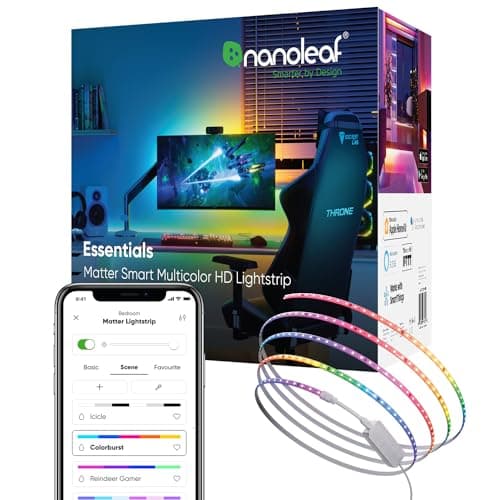
- 300 addressable color zones across a 16.4 ft run — by a wide margin the densest addressability here, and the reason its gradients look smooth rather than stepped.
- Nanoleaf publishes 550 lm across the 16.4 ft run — about 110 lm per metre, the dimmest of the three strips here that publish a figure.
(Current price, subject to change)
The Nanoleaf Essentials Lightstrip earns an 8.0 consensus score and a 7.0 SHE Smart Lighting Value Score. Matter over Wi-Fi at approximately $12 per metre is the value case; 110 lm per metre is the constraint. The 300 independently addressable color zones distributed across a 16.4 ft installation constitute the genuine differentiator. Compared against the 16 zones in the LIFX SuperColor kit, the resulting gradient resolution represents an entirely different category of effect.
Two corrections are consequential, because visually identical Nanoleaf configurations are remarkably easy to confuse. This 300-zone Matter model communicates over Wi-Fi, and Nanoleaf's own spec lists no built-in Thread border router. The Thread configuration is a separately marketed kit, so no Thread border router is required, and installing one delivers no measurable benefit. Nanoleaf publishes 550 lm across the 16.4 ft run, roughly 110 lm per metre. That is comparatively the dimmest of the three strips here publishing a figure, and about a sixth of the LIFX rate. At $59.99 across 16.4 ft, the effective rate calculates to approximately $12 per meter, comfortably beneath both premium alternatives.
What We Love
- 300 addressable color zones across a 16.4 ft run — by a wide margin the densest addressability here, and the reason its gradients look smooth rather than stepped.
- Matter-certified over Wi-Fi with no bridge box to buy, which puts Apple Home, Alexa and Google Home on the strip through a single commissioning step.
What Could Be Better
- Nanoleaf publishes 550 lm across the 16.4 ft run — about 110 lm per metre, the dimmest of the three strips here that publish a figure.
- No native music sync, no camera or HDMI sync, and a Matter controller is still required for full ecosystem control.
The Verdict
If smooth gradients are what you are actually buying and you want Matter without a bridge, the Nanoleaf Essentials Lightstrip is a sensible pick for that setup. 300 addressable color zones across 16.4 ft, Matter over Wi-Fi, and roughly $12 per meter check the boxes that matter for accent and cove runs.
Best Music Sync: Govee RGBIC Pro LED Strip Lights
Best for Music Sync — Long-Run Home Theater RGBICGovee RGBIC Pro LED Strip Lights
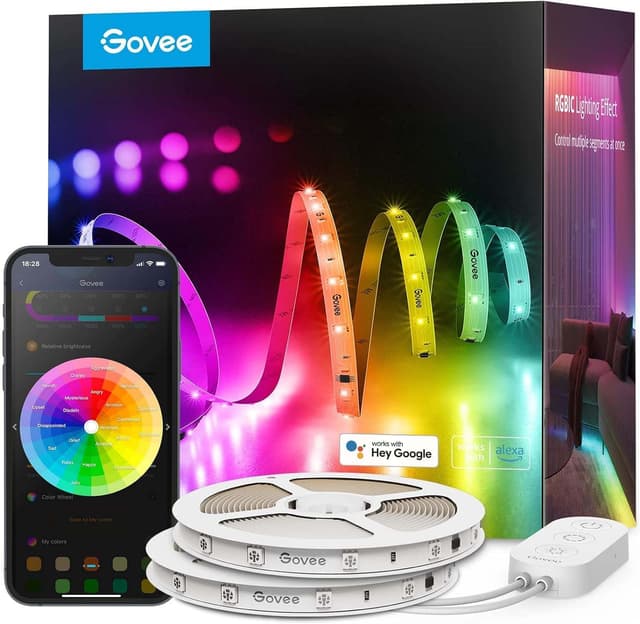
- Mic-driven music modes across a 32.8 ft run — CNET covers Govee's RGBIC Pro line in its LED strip reporting, and segment-level control is the reason.
- No Matter and no Apple Home — Alexa and Google only, which penalizes cross-platform households.
(Current price, subject to change)
The Govee RGBIC Pro LED Strip Lights earn a 7.8 consensus score and a 6.8 SHE Smart Lighting Value Score. CNET covers Govee's RGBIC Pro configuration in its LED strip reporting, and segment-level colour control is precisely what establishes the Pro as the home-theatre recommendation throughout this roundup. Mic synchronization reacts to room audio rather than the source signal, so it comparatively trails a direct HDMI feed. That gap is material for competitive gaming yet essentially invisible during ambient television viewing. For screen-matched colour specifically, Govee sells separate camera and HDMI kits — this strip is not one of them.
RGBIC independent segment control comparatively outperforms a uniform single-colour installation on television gradients, and the microphone-driven music modes deliver reactivity across the entire 32.8 ft run. The composite penalty arrives exclusively at ecosystem breadth, because neither Matter nor Apple Home is supported. The WiZ alternative yields the highest weighted composite here precisely because Matter readiness and comparable pricing both resolve in its favour. At $42.99 across 32.8 ft, the effective rate calculates to approximately $4.30 per metre.
What We Love
- Mic-driven music modes across a 32.8 ft run — CNET covers Govee's RGBIC Pro line in its LED strip reporting, and segment-level control is the reason.
- RGBIC independent segments deliver gaming gradients and TV backlight sweeps that a uniform single-colour strip simply cannot produce.
What Could Be Better
- No Matter and no Apple Home — Alexa and Google only, which penalizes cross-platform households.
- Mic sync reacts to room audio rather than the source signal, so it trails a wired feed — a dedicated HDMI sync kit remains the answer for lowest-latency gaming.
The Verdict
If TV backlight or gaming is the primary use and you are already in Alexa or Google, the Govee RGBIC Pro LED Strip Lights fits the brief. RGBIC segments, mic-driven music sync, and a 32.8 ft run at roughly $4.30 per metre line up with what you actually need for a home theatre wall.
Best Budget RGBIC: Govee RGBIC LED Strip Light
Best Budget RGBIC — Bluetooth-Only Gateway StripGovee RGBIC LED Strip Light
- About $2.70 per meter is the cheapest rate measured in this roundup, and the 16.4 ft run covers a dorm wall or a TV surround outright.
- This kit is Bluetooth-only. There is no Wi-Fi radio, which means no Alexa, no Google Home, no automation and no control once you leave the room.
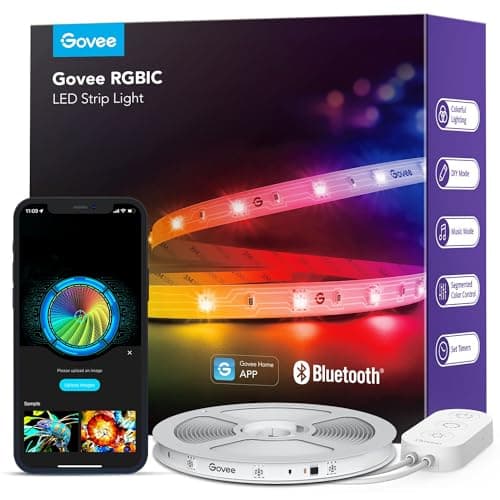
(Current price, subject to change)
The Govee RGBIC LED Strip Light earns a 7.4 consensus score and a 6.2 SHE Smart Lighting Value Score. At $13.49 across a 16.4 ft installation, the effective rate calculates to approximately $2.70 per meter. That is comparatively the most economical measured here, roughly 7.3x beneath the equivalent LIFX SuperColor rate — and Amazon's own smart-home best-seller ranking reflects that pricing.
One correction is sufficiently consequential to override the value proposition entirely for many buyers: this particular kit is the Bluetooth-only configuration. It incorporates no Wi-Fi radio whatsoever. Regardless of what a roundup might imply about Govee's broader catalogue, there is genuinely no Alexa, no Google Home, no scheduling capability and no control from beyond the immediate room. For a dormitory wall or gaming corner operated exclusively from a phone, the value remains exceptional. For anything genuinely resembling a smart home, the WiZ alternative costs approximately $1.42 more per meter, about 53% more, and contributes the entire ecosystem.
What We Love
- About $2.70 per meter is the cheapest rate measured in this roundup, and the 16.4 ft run covers a dorm wall or a TV surround outright.
- RGBIC independent segments and mic-driven music modes at a price where competitors ship a single uniform colour.
What Could Be Better
- This kit is Bluetooth-only. There is no Wi-Fi radio, which means no Alexa, no Google Home, no automation and no control once you leave the room.
- Reddit r/smarthome surfaces recurring adhesive durability concerns, and white-light quality lags the premium task strips by a visible margin.
The Verdict
If you want RGBIC segments at the lowest price per meter here and phone-only control is genuinely enough, the Govee RGBIC LED Strip Light fits the brief. About $2.70 per meter across 16.4 ft with mic-driven music modes is the path of least friction for a dorm wall or a gaming corner.
Best Cheap Matter: WiZ Smart RGBIC LED Light Strip
Best Cheap Matter — No-Hub RGBIC ValueWiZ Smart RGBIC LED Light Strip
- Matter over Wi-Fi with no hub at all, which brings Apple Home, Alexa and Google Home onto a strip costing about $4.12 per meter.
- Music sync runs from the phone microphone rather than a mic on the strip, and the 16.4 ft run needs extension for a long perimeter.
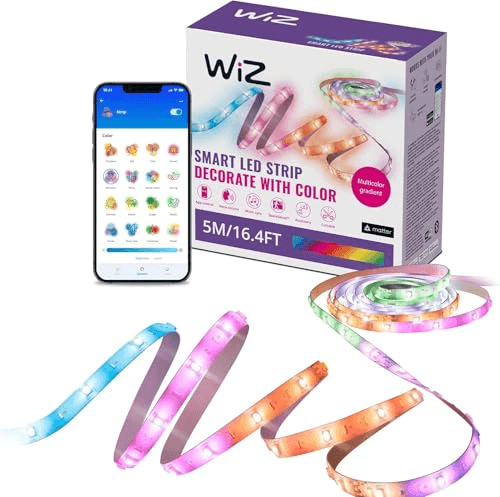
(Current price, subject to change)
The WiZ Smart RGBIC LED Light Strip earns a 7.6 consensus score and comparatively the highest SHE Smart Lighting Value Score in this roundup at 8.8. The composite calculation resolves cleanly across three contributing factors. Those are Matter readiness requiring no bridge, zero amortized hub expenditure, and a $20.62 acquisition price across a 16.4 ft installation. That calculates to approximately $4.12 per meter against the equivalent Hue rate of roughly $19.70.
Signify, the corporation responsible for Hue, manufactures the WiZ firmware. That delivers over-the-air update coherence which generic budget Wi-Fi alternatives conspicuously lack, and CNET covers WiZ in its budget smart-lighting reporting. Two details deserve genuine precision. Apple Home operates through Matter rather than as native HomeKit, and no Thread radio is incorporated, so communication remains on Wi-Fi. Compared against the Bluetooth-only Govee configuration at approximately $2.70 per meter, WiZ contributes the entire smart-home ecosystem for roughly $1.42 more per metre, about 53% more.
What We Love
- Matter over Wi-Fi with no hub at all, which brings Apple Home, Alexa and Google Home onto a strip costing about $4.12 per meter.
- Signify, the company behind Hue, ships the firmware, and CNET covers WiZ in its budget smart-lighting reporting.
What Could Be Better
- Music sync runs from the phone microphone rather than a mic on the strip, and the 16.4 ft run needs extension for a long perimeter.
- Apple Home works through Matter rather than natively, and there is no Thread radio, so the strip's traffic stays on Wi-Fi.
The Verdict
If you want the cheapest genuinely smart strip and no-hub Matter checks every box, the WiZ Smart RGBIC LED Light Strip fits the brief without compromise. About $4.12 per metre across 16.4 ft, Matter over Wi-Fi, and Signify firmware check the boxes that matter for a value-first Matter household.
How We Score: SHE Smart Lighting Value Score
SHE Smart Lighting Value Score
Score Formula
(CRI_Score × Lumen_Score × Ecosystem_Score × Matter_Score × GamutScore) ÷ (Unit_Price_USD + Hub_Amortized_USD)Score Factors
- CRI ScoreWhite-light fidelity normalized 0 to 10. Manufacturers publish CRI inconsistently across this category, so where no figure is published we score the tier from reviewer white-light assessments rather than inventing a number.
- Lumen ScoreLumens per metre from published manufacturer output: LIFX publishes 1400 lm across an 80 in kit (690 lm/m), Hue 1700 lm across 10 ft (558 lm/m), and Nanoleaf 550 lm across 16.4 ft (110 lm/m). Govee and WiZ publish no figure for these strips, so they are scored mid-band rather than assumed bright.
- Ecosystem ScorePlatform breadth from 1 to 4. Alexa plus Google plus Apple Home plus SmartThings scores 4; three platforms score 3; Alexa and Google only score 2; a Bluetooth-only strip with no voice control at all scores 1.
- Matter ScoreMatter-native rates highest, Matter-through-a-bridge sits a tier below, and no Matter rates lowest. WiZ and Nanoleaf are Matter-native over Wi-Fi; Hue reaches Matter through its Bridge; the LIFX lightstrip and both Govee strips are not Matter today.
- Gamut ScoreIndependently addressable segments rate highest, a uniform RGBW run lowest. Addressable segments are what produce TV backlight gradients and gaming colour sweeps rather than one flat colour.
- Unit Price USDBase kit street price on Amazon, re-verified live through the Amazon Creators API on 2026-08-22. The $13.49 Govee anchors the low end; per metre the LIFX SuperColor and the Hue Solo tie at the steep end at roughly $19.70/m.
- Scale — how this is displayedThe formula above yields an unbounded ratio, so every score shown on this page is a single 0-10 normalization of it. The chart bars, the ranking and the prose all use that one scale, and the 0-10 figures are the ones carried in our metrics registry.
- Hub Amortized USDHub cost spread across 10 deployments. The Hue Bridge adds about $6 per fixture for buyers who want Zigbee, remote access or Matter; every other strip here, and the Hue Solo kit run over Bluetooth, carries no hub cost at all.
SHE Smart Lighting Value Score — Ranked
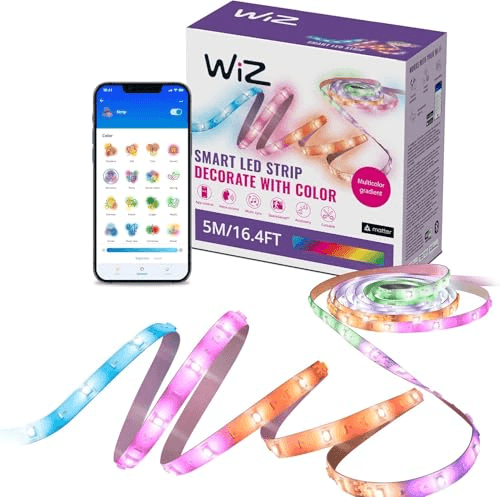
WiZ Smart RGBIC LED Light Strip
SHE Smart Lighting Value Score8.8/10Matter over Wi-Fi, no hub, about $4.12/m — the full ecosystem within pennies of the Govee Pro rate, which is what puts it on top.
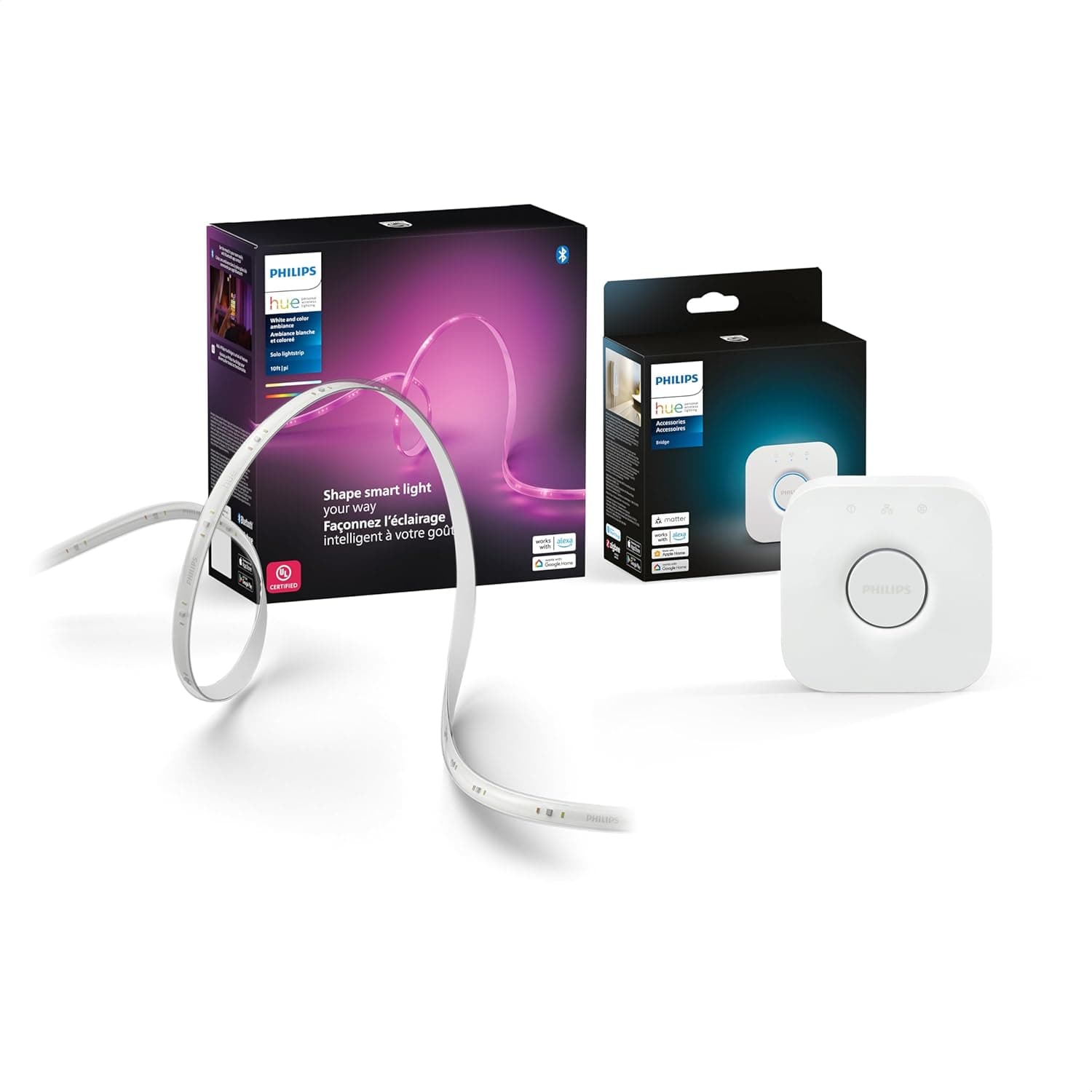
Philips Hue Solo Lightstrip
SHE Smart Lighting Value Score7.2/101700 lm across 10 ft (558 lm/m), four ecosystems, Bridge optional — roughly $19.70/m is the drag.
Nanoleaf Essentials Lightstrip
SHE Smart Lighting Value Score7.0/10300 addressable color zones and Matter over Wi-Fi at about $12/m — the finest gradients here, though 110 lm/m is the dimmest published output.
Govee RGBIC Pro LED Strip Lights
SHE Smart Lighting Value Score6.8/10Mic music sync with RGBIC segments across 32.8 ft at about $4.30/m; no Matter and no Apple Home cap the composite.
LIFX SuperColor Lightstrip
SHE Smart Lighting Value Score6.4/10690 lm/m is the brightest published output here, with native Apple Home; no Matter yet and roughly $19.70/m hold it back.
Govee RGBIC LED Strip Light
SHE Smart Lighting Value Score6.2/10The cheapest rate here at about $2.70/m, but Bluetooth-only — no Wi-Fi radio, so no voice control and no automation.
Matter, Thread, RGBIC vs RGBW: Protocol Compatibility in 2026
The RGBIC versus RGBW decision tree resolves on use case across the 6 strips evaluated for this August 2026 update. RGBIC addresses each segment along the strip independently, which produces TV backlight gradients, gaming color sweeps, and stair accent zones across the addressable length. If the panel behind the gradient is due for an upgrade too, our Best Sony BRAVIA TVs for Home (2026) guide ranks the current Sony BRAVIA XR lineup. RGBW lights uniformly with a dedicated warm white LED, which yields the task lighting outcome for under-cabinet kitchen runs — the job Wirecutter covers the Hue line for. The hub cost math splits cleanly across 3 tiers. Hub-free Wi-Fi strips — WiZ, LIFX SuperColor and Nanoleaf — carry no hub cost at all, and WiZ and Nanoleaf are Matter-certified; the LIFX strip is not yet. Hue reaches Matter through its $60 Bridge, which spreads to roughly $6 per fixture across 10-plus deployments. The Solo base kit nonetheless operates over Bluetooth without one. And the Bluetooth-only budget strip delivers no smart-home protocol integration whatsoever — no Wi-Fi radio means no voice control and no automation. One protocol correction: none of these strips carries a Thread radio, including the 300-zone Nanoleaf, whose Thread sibling is a separately sold kit. The music sync method separates three tiers. An HDMI sync box feeds the source signal directly and leads, while mic and camera sync react to ambient room cues and trail it. That gap decides gaming response versus ambient accent.
| Product | Matter | Thread | Apple Home | Google Home | Alexa | RGBIC |
|---|---|---|---|---|---|---|
| Philips Hue Solo Lightstrip | ✓ | ✕ | ✓ | ✓ | ✓ | ✕ |
| LIFX SuperColor Lightstrip | ✕ | ✕ | ✓ | ✓ | ✓ | ✓ |
| Nanoleaf Essentials Lightstrip | ✓ | ✕ | ✓ | ✓ | ✓ | ✓ |
| Govee RGBIC Pro LED Strip Lights | ✕ | ✕ | ✕ | ✓ | ✓ | ✓ |
| Govee RGBIC LED Strip Light | ✕ | ✕ | ✕ | ✕ | ✕ | ✓ |
| WiZ Smart RGBIC LED Light Strip | ✓ | ✕ | ✓ | ✓ | ✓ | ✓ |
Cost-per-Meter Reality: Hub-Amortized Price Table
Price-per-meter is the headline differentiator that nobody else tables for 2026, and the 2026-08-22 live recalculation reordered it. The LIFX SuperColor and the Hue Solo tie at about $19.70/m. Nanoleaf follows at approximately $12/m, Govee Pro at $4.30/m, WiZ at $4.12/m and the budget Govee at $2.70/m. That constitutes roughly a 7.3x differential, normalized against live Amazon Creators API pricing pulled 2026-08-22. Length determines those figures considerably more than sticker price does. The Hue Solo base kit covers 10 ft and the Nanoleaf ships as a 16.4 ft run. That is precisely why both land substantially below a 2 m starter configuration. The Bridge amortization math still resolves at scale, because $60 divided by 10 fixtures yields roughly $6 per fixture over a 5 yr horizon. The Solo kit nonetheless operates over Bluetooth, so that expenditure is optional rather than automatic. The Hue premium repays itself wherever warm-and-cool-white task lighting genuinely matters, and Wirecutter covers Hue in its LED strip reporting for precisely that application. WiZ outperforms the alternatives when the use case is accent, the household runs Matter, and the run stays within the 16.4 ft base. Reddit r/smarthome surfaces recurring peel-and-stick adhesive concerns, and 3M Command strips or channel clips outperform the factory adhesive for rental walls compared to the OEM peel-and-stick.
When NOT to Buy
A plain non-smart tunable white strip covers a pure white under-cabinet run for a fraction of the smart-strip cost, and nothing about the light itself is worse for that job. Non-addressable RGBW strips work fine for single-color accent where multi-zone gradients don't matter, because on a uniform color the difference is invisible to the eye. For pure TV backlight, the Govee TV Backlight 3 Lite is purpose-built. Its fish-eye-corrected camera samples the screen directly, which a general-purpose RGBIC strip cannot accomplish. Consider a light-controlled projector room, where the dedicated-theater picks in our Best Premium 4K Laser Long-Throw Projectors 2026 guide earn their black-floor advantage. There an RGBIC strip serves as cove accent for the off hours, never a backlight. The peel-and-stick concern matters because on textured paint or rental drywall the factory adhesive risks damage on removal. Channel clips or 3M Command strips deliver the same installation at $5 to $8 in additional hardware.
Best Smart Lightstrip Brands 2026: Reliability, Reputation & Pricing
Most shoppers determine a lightstrip brand before they determine a model, so brand reliability deserves its own answer. Five brands dominate the 2026 field, and they separate cleanly on firmware track record, ecosystem breadth and price positioning. Philips Hue, manufactured by Signify, retains the reliability and reputation leadership. Wirecutter covers the Hue line in its LED strip reporting, and adding the optional Bridge puts the strip on a local Zigbee mesh that survives an internet outage. The trade is a roughly $19.70/m rate, plus $60 if you want that Bridge. WiZ is the value reliability play, because Signify also ships the WiZ firmware and the OTA coherence that generic budget Wi-Fi strips conspicuously lack. CNET covers WiZ in its budget smart-lighting reporting, at about $4.12/m with no hub. Nanoleaf establishes its reputation on gradient density: 300 addressable color zones across 16.4 ft, Matter over Wi-Fi, at approximately $12/m. LIFX pairs hub-free with native Apple Home and publishes the brightest output here at 690 lm/m. Matter has not arrived for this strip, however, and its roughly $19.70/m rate ties the top. Govee anchors the budget tier from approximately $2.70/m with the widest music-sync feature set. Its reputation nonetheless carries two significant asterisks. Reddit r/smarthome surfaces recurring adhesive durability concerns and variable app stability, and neither Govee strip in this roundup is Matter-certified — the cheapest has no Wi-Fi radio at all.
| Brand | Reliability / firmware reputation | Ecosystem breadth | Price tier ($/m) | Matter | |---|---|:---:|:---:|:---:| | Philips Hue (Signify) | Wirecutter-covered; optional local Zigbee mesh | Alexa, Google, Apple Home, SmartThings | ~$19.70 | Via $60 Bridge | | WiZ (Signify) | Signify-shipped firmware; coherent OTA | Alexa, Google, Apple Home via Matter | ~$4.12 | Native (Wi-Fi) | | Nanoleaf | 300 addressable zones; no Thread on this kit | Alexa, Google, Apple Home | ~$12 | Native (Wi-Fi) | | LIFX | Hub-free; native Apple Home; Tom's Guide-covered | Alexa, Google, Apple Home | ~$19.70 | Not yet (upgrade promised) | | Govee Pro | Mic music sync, RGBIC segments, longest run | Alexa, Google only | ~$4.30 | None | | Govee budget | Adhesive + app-stability concerns (Reddit) | None — Bluetooth-only, no voice | ~$2.70 | None |
Two brands — Hue and WiZ — share Signify's firmware lineage, yet they sit at opposite ends of the price tier despite the shared OTA reputation. Govee buys its low price with the narrowest ecosystem and the most reported durability concerns, and at the very bottom of the range it drops the Wi-Fi radio altogether. Match the brand to your priority: Signify firmware reputation, Apple Home breadth, or lowest cost per meter.
Bridge Into a Whole-Room Ambient Lighting Setup
A single lightstrip rarely stays a single lightstrip. Once a strip is behind the TV or under the cabinet, the natural next step is automation. Tying it into the room beats running it standalone from a single app. Two upgrades carry the most real-world payoff. First, a hub. The Hue strip communicates over Zigbee through its Bridge and the Nanoleaf over Matter on Wi-Fi. A proper hub — see our Best Smart Home Hubs 2026: 7 Compared, Local Control roundup — converts a single-strip routine into a whole-room scene rather than a phone-application toggle. Second, a colour-reactive security integration. Several flagship cameras in our Best 4K Floodlight Security Cameras for Home (2026) guide can illuminate a paired lightstrip red on a verified person alert, converting accent lighting into a genuine deterrent signal. Neither upgrade requires replacing the strip itself. Both route through the same Alexa, Google Home or Matter integration the strip already has, so you add a hub or a camera rather than starting over.
Who Should Buy What
Who Should Buy What
| If you are… | Recommended pick |
|---|---|
Under-cabinet task lighting buyer Kitchen counter or display cabinet; white-light fidelity is the priority; 1700 lm across 10 ft; willing to pay about $19.70/m for it. | Philips Hue Solo Lightstrip |
Hub-free Apple Home color buyer Apple Home or Matter household; no hub wanted; short accent or gaming run; colour saturation and brightness matter more than the cost per metre. | LIFX SuperColor Lightstrip |
Gradient-first Apple Home user Apple Home, Alexa or Google household; smooth gradients are the point; 300 addressable color zones across 16.4 ft; Matter without a bridge box. | Nanoleaf Essentials Lightstrip |
Music sync and long-run buyer Home theater or gaming den; Alexa or Google household; RGBIC independent segments across 32.8 ft; mic music sync priority. | Govee RGBIC Pro LED Strip Lights |
Phone-only budget accent buyer Dorm room or gaming corner; 16.4 ft run; RGBIC segments at about $2.70/m; Bluetooth phone control in the same room is genuinely enough. | Govee RGBIC LED Strip Light |
Value Matter buyer Matter household; no hub; 16.4 ft run; about $4.12/m ceiling; Apple Home through Matter plus Alexa and Google Home breadth. | WiZ Smart RGBIC LED Light Strip |
Frequently Asked Questions
RGBIC vs RGBW: which is right for me?
RGBIC addresses each segment independently along the strip — pick it for TV backlight gradients, gaming color sweeps, and stair accent zones. RGBW lights uniformly with a dedicated warm white LED — pick it for under-cabinet task lighting, where a clean, consistent white matters more than colour effects.
Do smart LED strips need a hub?
WiZ, LIFX and Nanoleaf all run hub-free over Wi-Fi, and WiZ and Nanoleaf are Matter-certified; the LIFX strip is not yet. The Philips Hue Solo base kit pairs over Bluetooth without a hub; its $60 Bridge is optional and buys Zigbee mesh, remote access and Matter. The cheapest Govee strip runs Bluetooth-only with no Wi-Fi radio at all, so it has no hub and no voice control either. None of these strips carries a Thread radio, so no Thread border router is needed.
Can I cut LED strips to length?
Most RGBIC strips cut only at marked intervals; cutting mid-segment kills the entire zone. The exact cut spacing is a manufacturer spec that differs by model — both Hue and Govee strips print scissor marks on the strip itself. Always check the manufacturer cutting diagram for your specific kit before installation.
Do Hue and Govee strips work outdoors?
The Hue Outdoor Lightstrip is IP44 rated for covered outdoor use; the standard indoor Hue Solo Lightstrip is not rated for outdoor use. Govee ships dedicated IP65 outdoor strips; the standard RGBIC line is indoor only. Match the IP rating to the install location.
Music sync — which strip has the fastest response?
HDMI sync wins for gaming and home theater because a dedicated HDMI sync box reads the source signal directly — that hardware ships on Govee's separate DreamView/Immersion TV kits, not on the RGBIC Pro strip reviewed here. Mic sync covers budget RGBIC strips (Govee budget) and reacts to room audio. Camera sync applies only to Govee's dedicated TV Backlight kits, which read the screen and process the image; the RGBIC Pro strip here has no camera at all.
Will the adhesive damage my walls?
Peel-and-stick pressure-sensitive adhesive on drywall or fresh paint risks damage on removal. 3M Command strips or channel clips outperform the factory adhesive on rental walls. Hue uses stronger adhesive than budget strips, which compounds the rental risk.
What's the longest length I can install on one strip?
Maximum run length is a manufacturer spec — check each brand's extension limit before buying. The Hue Solo base kit reviewed here ships as a 10 ft run and takes Philips extension pieces; the Nanoleaf Essentials kit ships as a 16.4 ft run, as does the WiZ base kit. Voltage drop and the controller's current rating cap very long runs across all brands, so plan a power injection point on longer installs.
Are smart strips Matter-compatible in 2026?
WiZ and Nanoleaf are Matter-over-Wi-Fi with no hub. The LIFX lightstrip is not — LIFX lists it among products it is still working to bring to Matter, so do not buy it expecting Matter today. Hue reaches Matter via the $60 Bridge. Neither Govee strip here is Matter-certified either, though Govee has certified Matter on other products, so check the specific model rather than assuming the brand.
Which smart lightstrip brand is most reliable?
Philips Hue (made by Signify) has the strongest reliability reputation: Wirecutter covers the Hue line in its LED strip reporting, and adding the optional Bridge puts it on a local Zigbee mesh that keeps automations running through an internet outage. WiZ is the value reliability pick because Signify, the parent company behind Hue, ships the WiZ firmware. Govee carries an asterisk — Reddit r/smarthome surfaces recurring adhesive durability concerns and variable app stability.
Which smart lightstrip brands work with Apple Home and Matter?
Nanoleaf works with Apple Home and is Matter-certified over Wi-Fi — the 300-zone kit reviewed here carries no Thread radio, though a separately sold Nanoleaf kit does. WiZ reaches Apple Home through Matter rather than as native HomeKit. Hue works with Apple Home directly and adds Matter via the $60 Bridge. The LIFX lightstrip pairs natively with Apple Home, but LIFX lists it among products it is still working to bring to Matter. Neither Govee strip in this roundup supports Apple Home or Matter.
How do smart lightstrip brand prices compare?
Price per meter spans roughly 7.3x, recalculated live on 2026-08-22. The budget Govee runs about $2.70/m and WiZ about $4.12/m with no hub; Govee Pro is about $4.30/m; Nanoleaf is about $12/m; and the Hue Solo and LIFX SuperColor tie at the top at about $19.70/m each. Hue's Bridge is optional on the Solo kit, and where you do buy one it amortizes to about $6 per fixture across 10-plus deployments over a 5-year horizon.
Is Govee or Philips Hue more reliable?
Philips Hue is the more reliable brand. Wirecutter covers Hue in its LED strip reporting, and the optional Bridge puts it on a local Zigbee mesh that runs automations through an internet outage. Govee delivers more features for far less money — about $2.70/m for the budget strip and $4.30/m for the Pro, against roughly $19.70/m for Hue — but Reddit r/smarthome reports recurring adhesive durability concerns and variable app stability, and the cheapest Govee kit has no Wi-Fi radio at all.
Bottom Line
Get the Philips Hue Solo Lightstrip if Under-cabinet task lighting where warm-and-cool-white fidelity is the priority and about $19.70/m is justified for it.
Get the LIFX SuperColor Lightstrip if Hub-free color saturation with native Apple Home, short accent or gaming run, color chosen over cost per meter.
Get the Nanoleaf Essentials Lightstrip if 300 addressable color zones for the finest gradients here, Matter over Wi-Fi, no bridge box to buy.
Get the Govee RGBIC Pro LED Strip Lights if Long-run home theater accent, RGBIC segments across 32.8 ft, Alexa or Google, mic-driven music sync.
Get the Govee RGBIC LED Strip Light if Cheapest rate here at about $2.70/m for a dorm or gaming accent — provided Bluetooth phone control is genuinely enough.
Get the WiZ Smart RGBIC LED Light Strip if Cheapest genuinely smart strip here at about $4.12/m, no hub, 16.4 ft accent runs.
Skip smart strips entirely if white-only task lighting is your use — a non-smart LED strip delivers comparable white-light quality for less. Skip either Govee strip if you need Apple Home or Matter, and skip the cheapest one outright if you want voice control, because it has no Wi-Fi radio.
Sources & Methodology
Methodology: SHE Smart Lighting Value Score — Formula: (CRI_Score × Lumen_Score × Ecosystem_Score × Matter_Score × GamutScore) ÷ (Unit_Price_USD + Hub_Amortized_USD). Factors: CRI Score: White-light fidelity normalized 0 to 10. Manufacturers publish CRI inconsistently across this category, so where no figure is published we score the tier from reviewer white-light assessments rather than inventing a number. | Lumen Score: Lumens per metre from published manufacturer output: LIFX publishes 1400 lm across an 80 in kit (690 lm/m), Hue 1700 lm across 10 ft (558 lm/m), and Nanoleaf 550 lm across 16.4 ft (110 lm/m). Govee and WiZ publish no figure for these strips, so they are scored mid-band rather than assumed bright. | Ecosystem Score: Platform breadth from 1 to 4. Alexa plus Google plus Apple Home plus SmartThings scores 4; three platforms score 3; Alexa and Google only score 2; a Bluetooth-only strip with no voice control at all scores 1. | Matter Score: Matter-native rates highest, Matter-through-a-bridge sits a tier below, and no Matter rates lowest. WiZ and Nanoleaf are Matter-native over Wi-Fi; Hue reaches Matter through its Bridge; the LIFX lightstrip and both Govee strips are not Matter today. | Gamut Score: Independently addressable segments rate highest, a uniform RGBW run lowest. Addressable segments are what produce TV backlight gradients and gaming colour sweeps rather than one flat colour. | Unit Price USD: Base kit street price on Amazon, re-verified live through the Amazon Creators API on 2026-08-22. The $13.49 Govee anchors the low end; per metre the LIFX SuperColor and the Hue Solo tie at the steep end at roughly $19.70/m. | Scale — how this is displayed: The formula above yields an unbounded ratio, so every score shown on this page is a single 0-10 normalization of it. The chart bars, the ranking and the prose all use that one scale, and the 0-10 figures are the ones carried in our metrics registry. | Hub Amortized USD: Hub cost spread across 10 deployments. The Hue Bridge adds about $6 per fixture for buyers who want Zigbee, remote access or Matter; every other strip here, and the Hue Solo kit run over Bluetooth, carries no hub cost at all.
Expert review sources used in this analysis:
- Outlets whose lightstrip coverage informed this roundup include Wirecutter, CNET, Tom's Guide, TechRadar, The Verge, PCMag, Reviewed, Tom's Hardware, Digital Trends, Engadget and The Spruce
- The per-product source counts on the cards come from our wider consensus database and are not limited to that list
- No first-party lab testing — this is an aggregator analysis, and we state outlet coverage and manufacturer specifications rather than paraphrasing verdicts we cannot re-verify
- Manufacturer list prices, where the maker publishes one, are $76.99 for the Philips Solo lightstrip 10 feet
- LIFX lists its SuperColor 80 in kit at $49.99 and Nanoleaf its 300-zone lightstrip at $59.99 each
- Govee no longer publishes pages for the two strip models here, and WiZ publishes no list price
- Street prices sit at or below list, and every price-per-metre figure here derives from live street prices
- Amazon prices, availability, pack sizes and merchant were re-verified live through the Amazon Creators API on 2026-08-22
- One disclosure matters for the top pick: the Hue Solo Lightstrip is stock-scarce and sold by a third-party merchant rather than Amazon, so check it before you commit
- Every price-per-metre figure on this page is derived from those live numbers, which replaced cached prices that had drifted by as much as 58 days
- Every SHE Smart Lighting Value Score on this page appears on a single 0-10 scale
- Our metrics registry carries the same 0-10 figures for this guide
- The CRI and lumen inputs are SmartHomeExplorer editorial tiers wherever a manufacturer publishes no figure
- Where one is published we use it, which is why LIFX at 690 lm/m carries the brightness lead
- Reddit r/homeautomation and r/smarthome were surveyed for adhesive durability and music sync community trends.
Nicholas Miles is the founder of SmartHomeExplorer and a longtime smart home enthusiast focused on helping everyday homeowners make better technology decisions. He researches, compares, and writes about products across security, climate, lighting, leak prevention, sensors, home energy, and automation, with an emphasis on real-world usefulness, ecosystem compatibility, reliability, privacy, and long-term value.
Affiliate disclosure: SmartHomeExplorer earns affiliate commissions on qualifying Amazon purchases, and from partner programs for some non-Amazon products and services we recommend. Our scoring methodology is independent of affiliate relationships.
More Guides
smart-lighting
Best Smart Lighting 2026: Hue, LIFX, Lutron & 3 More
Lighting
Hue vs Govee vs Nanoleaf vs WiZ 2026: Best Smart Lights
smart-lighting
Best Color Smart Bulbs 2026: WiZ Wins, No Hub
smart-home
Best Smart Home Essentials 2026: 7 Devices That Work Together

Automation
Best Smart Home Hubs 2026: 7 Compared, Local Control
security