

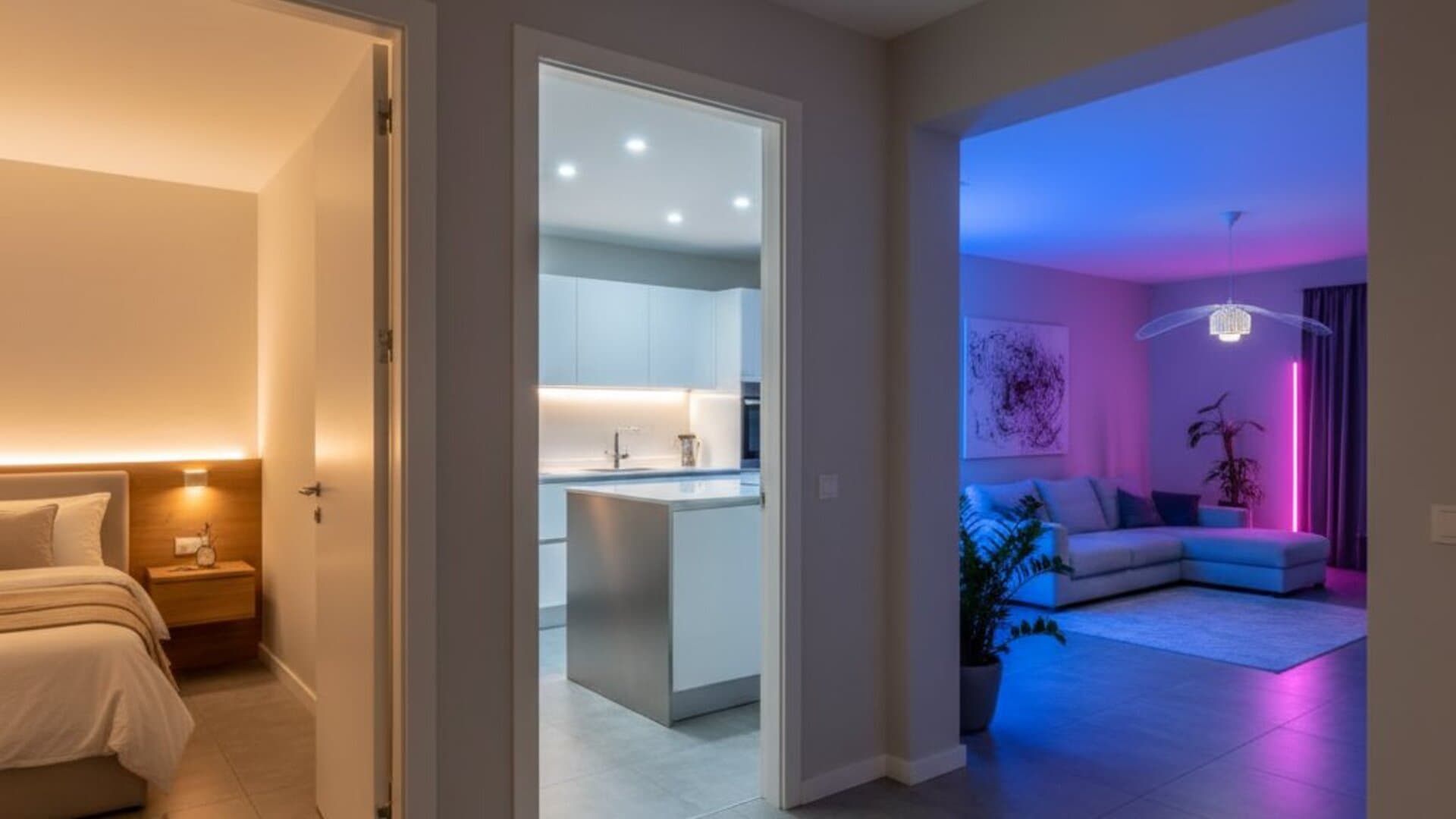
Best Smart Lighting 2026: Hue, LIFX, Lutron & 3 More
You bought one smart bulb 3 yr ago. Now you have 11 bulbs, 3 apps, and the kitchen Hue still won't sync with the Govee scene. The Hue kit wins whole-home, the LIFX 2-pack wins no-hub colour at about 44% of Hue's per-bulb price, and Lutron wins the wall switch.
This article contains affiliate links. We may earn a commission at no extra cost to you. Prices change frequently — check the current price on Amazon before buying. Learn more
The Short Answer
Buy the Philips Hue starter kit for whole-house installations: the Bridge arrives included, its Zigbee mesh keeps every bulb off your Wi-Fi, and all four ecosystems communicate with it natively. For one or two rooms without a hub, the Matter-compatible LIFX 2-pack costs about 44% as much per bulb.
Featured in this Guide
Philips
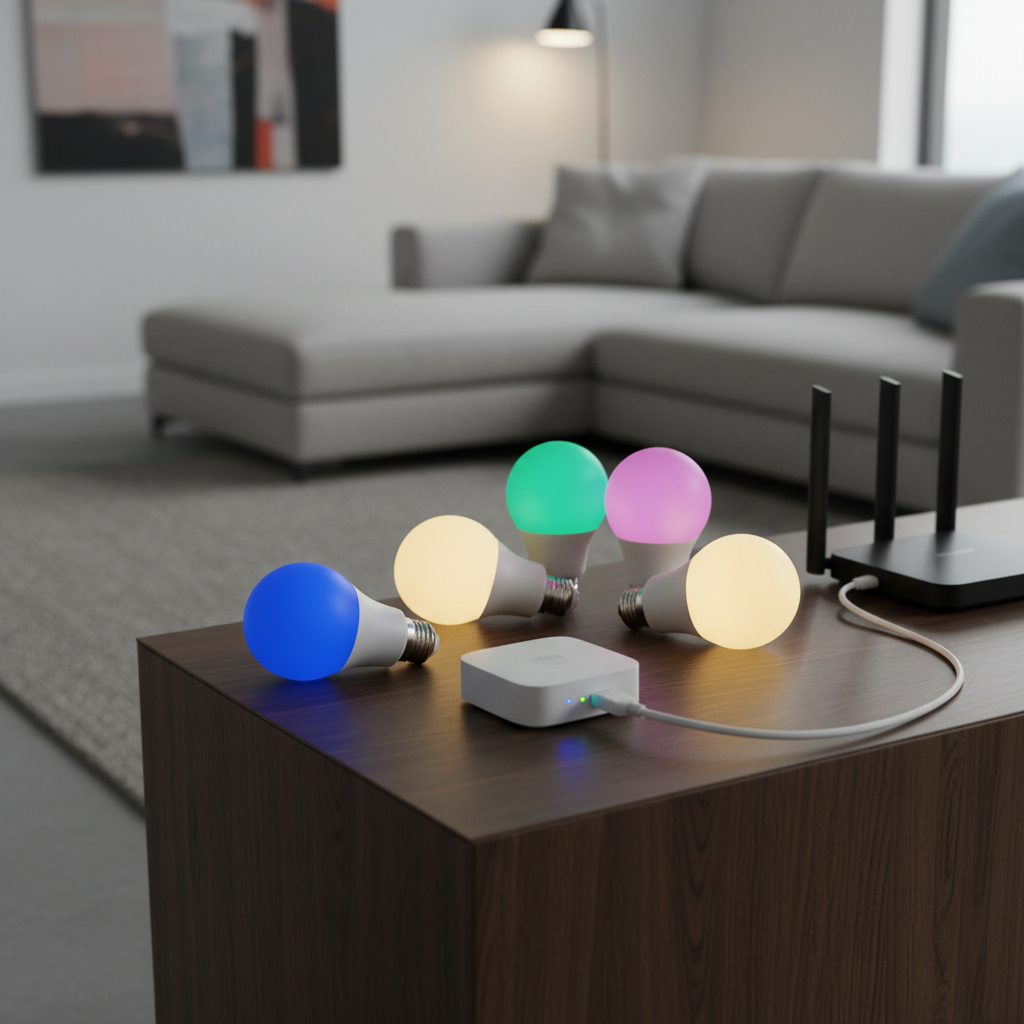
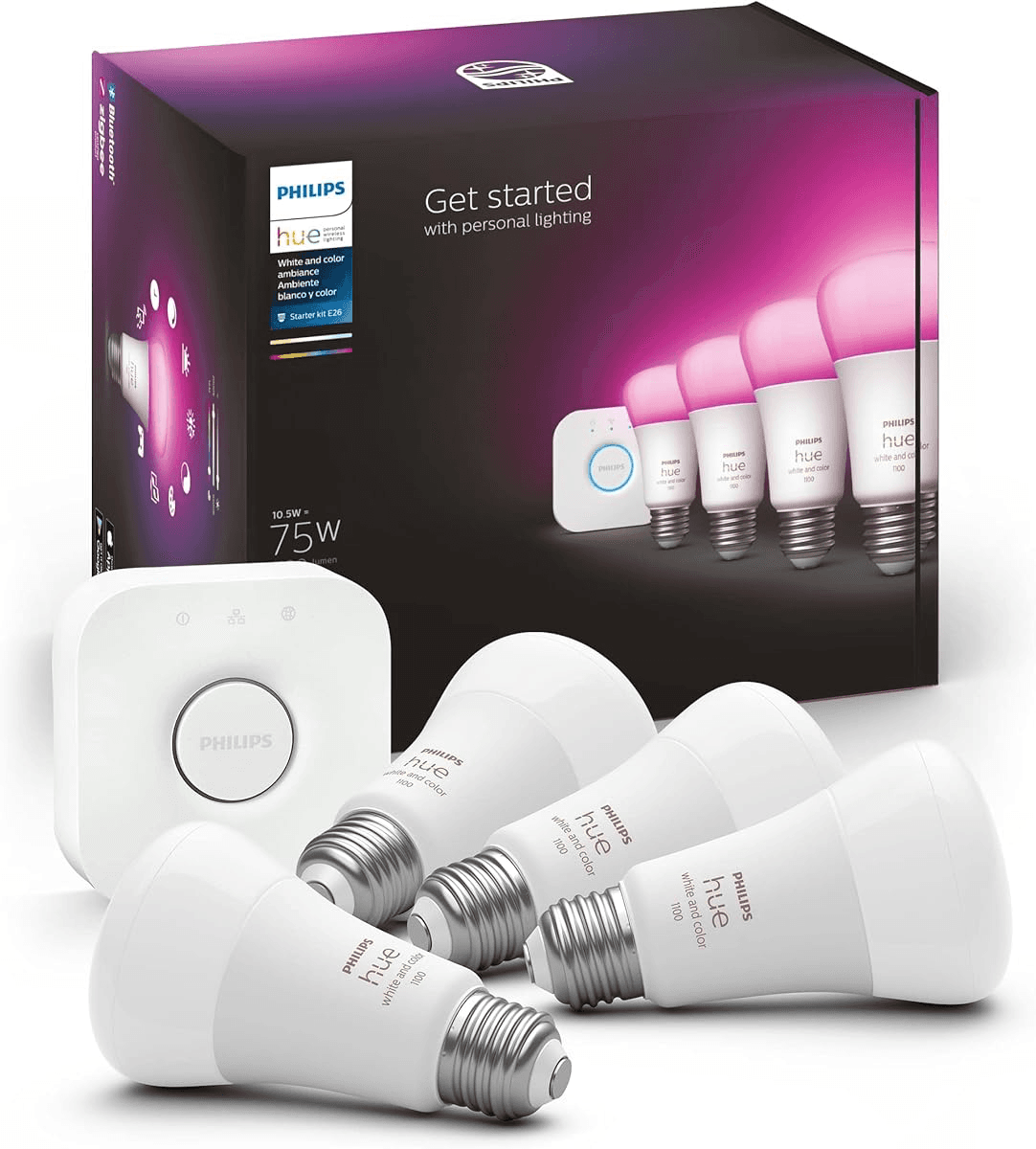
Hue White and Color Starter Kit
- •Zigbee mesh, all 4 ecosystems, a huge product ecosystem — covered in Tom's Guide's smart-lighting reporting
Lutron
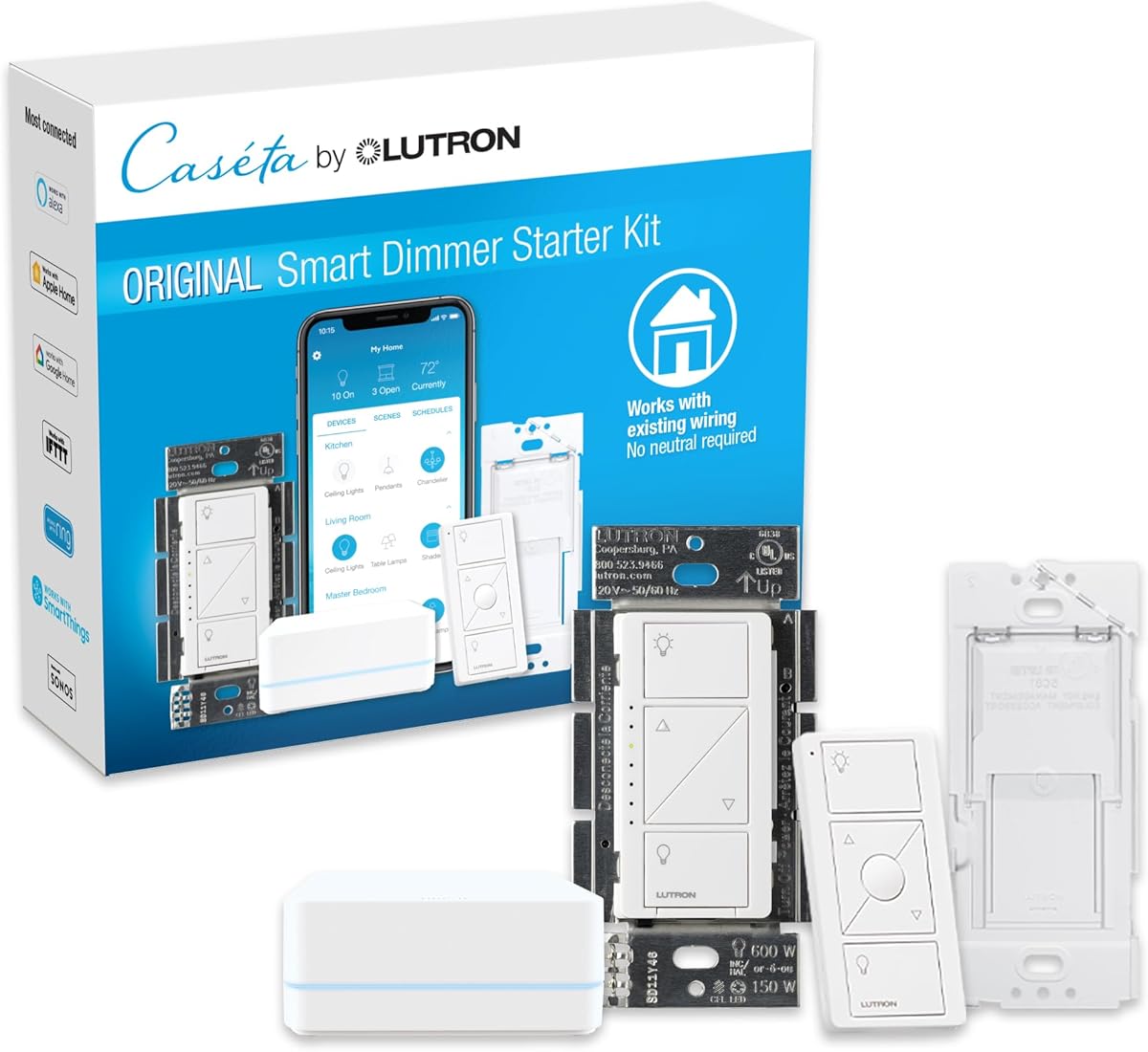
Caseta Dimmer Starter Kit
- •No neutral wire required
- •Clear Connect RF on its own radio band, works with any bulb
LIFX
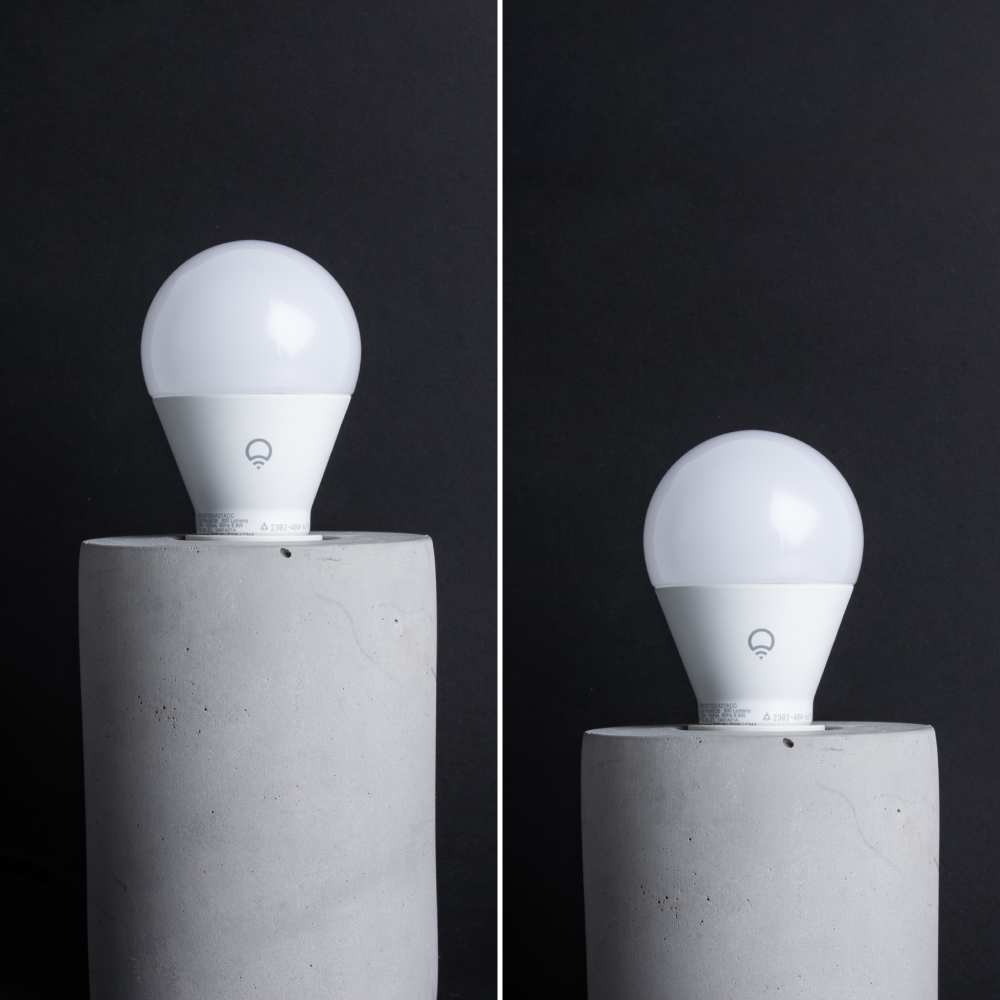
Color A19
- •The best hub-free colour here on our own scoring
- •800 lm, Matter compatible, native Apple Home, no bridge required
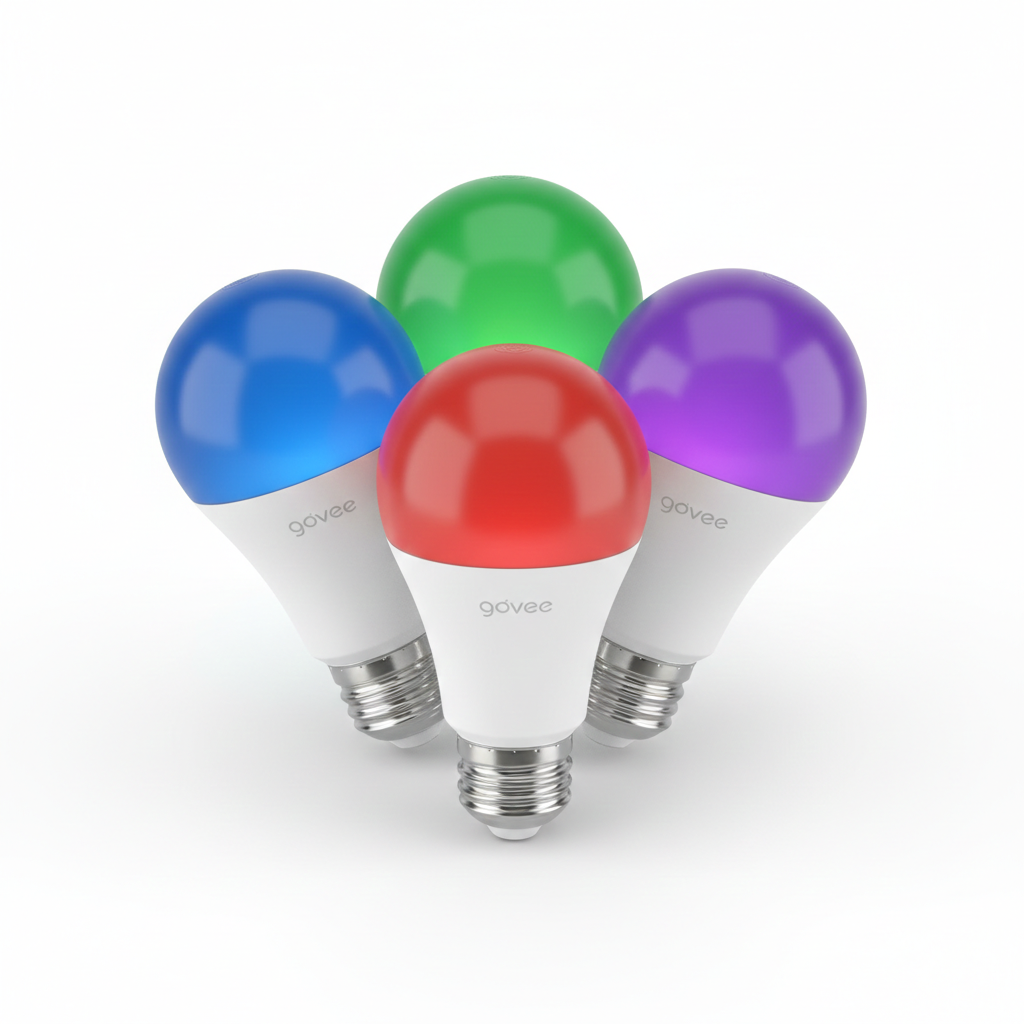
Govee
Smart Light Bulbs
- •16M colors plus music sync in a 4-pack that works out to about $8.25 a bulb — best entry-level color value
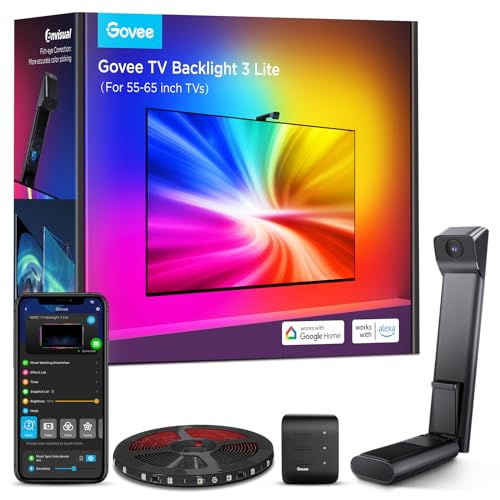
Govee
TV Backlight 3 Lite (Camera Sync)
- •Built-in camera samples your screen and mirrors color to the strip — any TV brand, no HDMI box needed
WiZ
Connected Smart Bulbs
- •SpaceSense motion sensing and sunset-to-sunrise scheduling run on the bulb firmware
- •Matter, no hub, ~$8.33/bulb
Head-to-Head: Ecosystem, Setup, Brightness, and SHE Value
Smart Lighting
Chart
 Smarthomeexplorer.com
Tap any pick to check its live price on Amazon.
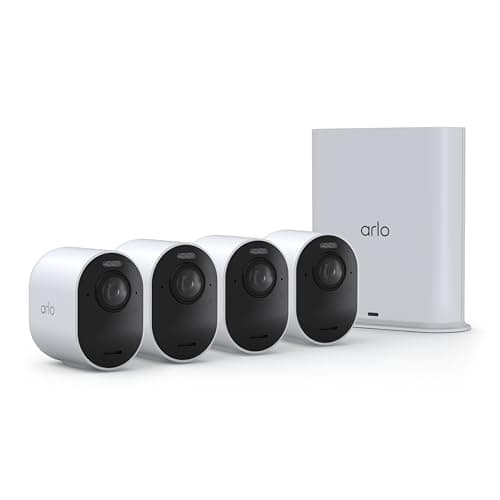
Arlo Ultra 4K HDR Security Camera (3rd Gen) 4-Cam Kit
RecommendedCheck price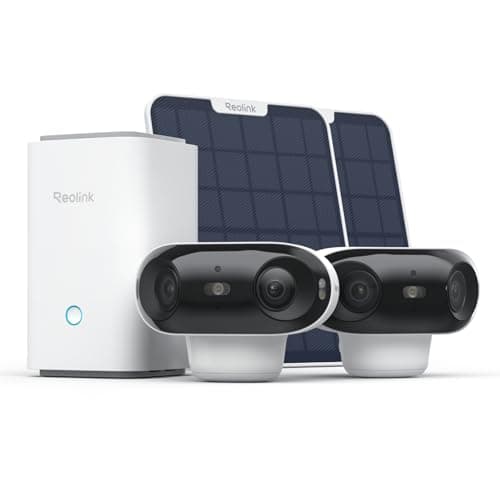
Reolink Home Hub with 2x Argus 4 Pro
RecommendedCheck price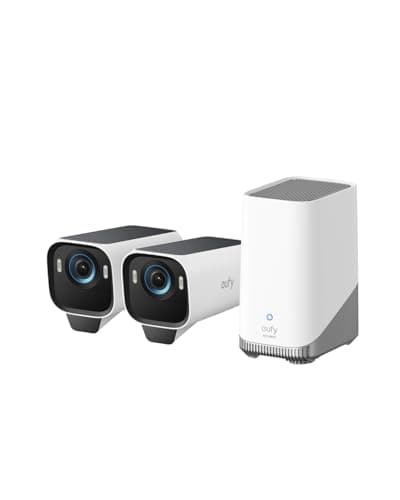
eufyCam S3 Pro 2-Cam Kit (Solar, 4K)
Must BuyCheck price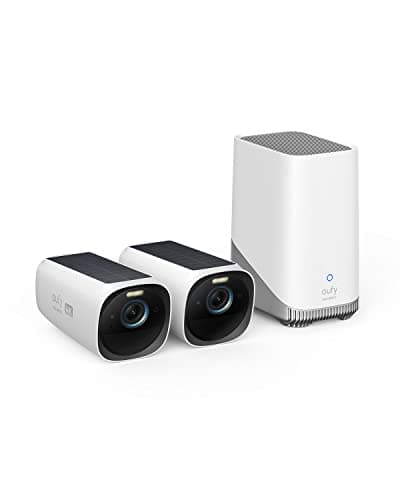
eufy Security eufyCam S330 2-Cam Kit (HomeBase 3)
RecommendedCheck price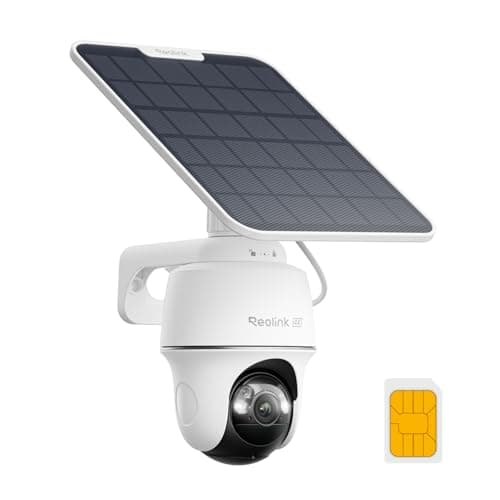
Reolink Go PT Ultra + SP2 Solar Panel
Must BuyCheck price
What Tips the Decision
The smart-lighting decision is rarely about brightness alone; it determines which protocol your household can accommodate, and that is precisely what the weighted SHE Smart Lighting Systems Value Score quantifies. It synthesizes color quality, brightness, ecosystem breadth, Matter readiness, and value-for-money against a published, recomputable ten-point rubric, with price as a single, constrained 20% factor rather than a hidden denominator.
For whole-home installations the Philips Hue kit appears in both Tom's Guide and TechRadar reporting. It includes the Bridge, costs roughly 2.3x the LIFX rate per bulb, and its Zigbee mesh justifies that Bridge across a 10 yr horizon. Without a hub, the LIFX 2-pack pairs natively with Apple Home. The Lutron Caseta Deluxe kit eliminates the neutral-wire requirement. And the budget tier pits Govee's four-pack at about $8.25 a bulb against the WiZ three-pack at about $8.33.
Best Overall: Philips Hue White and Color Starter Kit
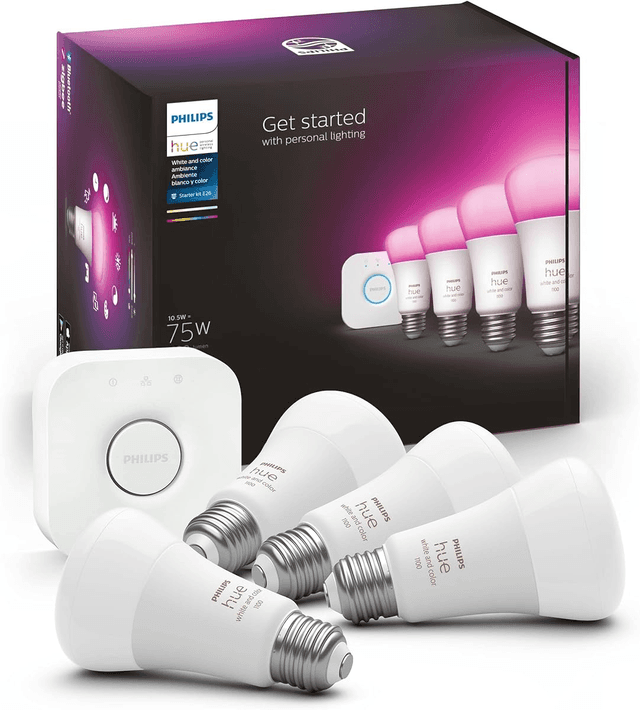
Philips Hue White and Color Starter Kit
- Tom's Guide and TechRadar both cover Hue in their smart-lighting reporting, and the Zigbee mesh is why the system keeps its reputation for reliability
- Premium pricing — about $34.50 per bulb in the 4-bulb kit (Bridge included), roughly 4x the per-bulb price of Govee or WiZ
(Current price, subject to change)
The Philips Hue White and Color Starter Kit earns a 7.0 SHE Smart Lighting Systems Value Score — last here, on the value-for-money factor that drives it, though hardly because the product underperforms. Philips publishes 1,100 lm at 4000K for these 75W-equivalent bulbs, approximately 1.4x the 800 lm comparable bulbs deliver. That brightness (8.5) and the broadest ecosystem compatibility (9.5) carry the weighted composite. Colour scores 7.0, because the only Color Rendering Index Philips publishes for this bulb is greater-than-80, which our rubric bands alongside the budget alternatives. Value-for-money (3.5) restrains the composite: at approximately $34.50 per bulb, Bridge included, no comparable bulb here approaches that expenditure. Matter-via-bridge (6.0) constitutes a secondary drag. Tom's Guide and TechRadar both cover Hue in their smart-lighting reporting despite the premium price.
The breadth of the Hue catalog — bulbs, strips, floods, sensors, buttons — produces an ecosystem moat no competing system here approaches across a 10+ yr horizon. The Zigbee mesh additionally keeps the bulbs entirely off your Wi-Fi, contributing no router load at the 10+ device scale where Wi-Fi-only bulbs compound strain. Against the LIFX A19, Hue's 1,100 lm bulbs comparatively outperform the 800 lm LIFX by approximately 1.4x, while additionally delivering full Matter bridging through the Bridge.
What We Love
- Tom's Guide and TechRadar both cover Hue in their smart-lighting reporting, and the Zigbee mesh is why the system keeps its reputation for reliability
- Zigbee mesh keeps the bulbs off your Wi-Fi network entirely, so it adds no router strain compared to Wi-Fi-only bulbs
- A huge Hue product ecosystem — bulbs, strips, floods, sensors, and buttons — means the system grows for 10+ yr without protocol changes
- Works natively with all 4 major ecosystems plus a Matter bridge — no platform lock-in
What Could Be Better
- Premium pricing — about $34.50 per bulb in the 4-bulb kit (Bridge included), roughly 4x the per-bulb price of Govee or WiZ
- The required Bridge adds friction and up-front cost for buyers who only want 1-3 bulbs
- App can feel cluttered next to Govee Home for accent-only buyers
The Verdict
If you've already shortlisted Hue and you've got 5+ rooms to light, the Philips Hue White and Color Starter Kit fits the brief without compromise. Tom's Guide and TechRadar coverage, a local Zigbee mesh that stays off your Wi-Fi, and a huge product ecosystem mean you stop shopping bulbs after this kit.
Check price for the Philips Hue White and Color Starter Kit →
Ready to upgrade your home?
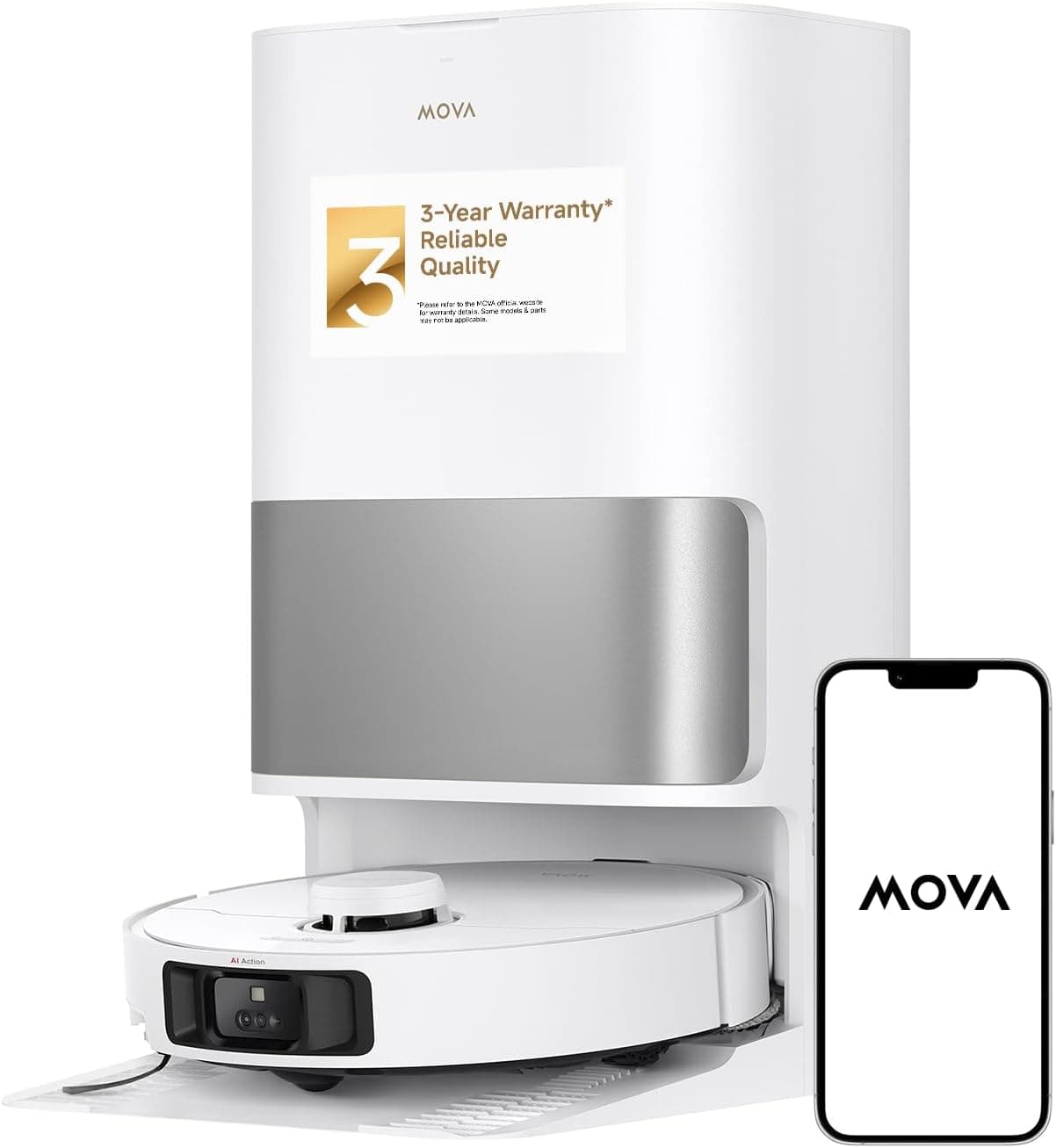
MOVA P10 Pro Ultra Robot Vacuum and Mop
See it on Amazon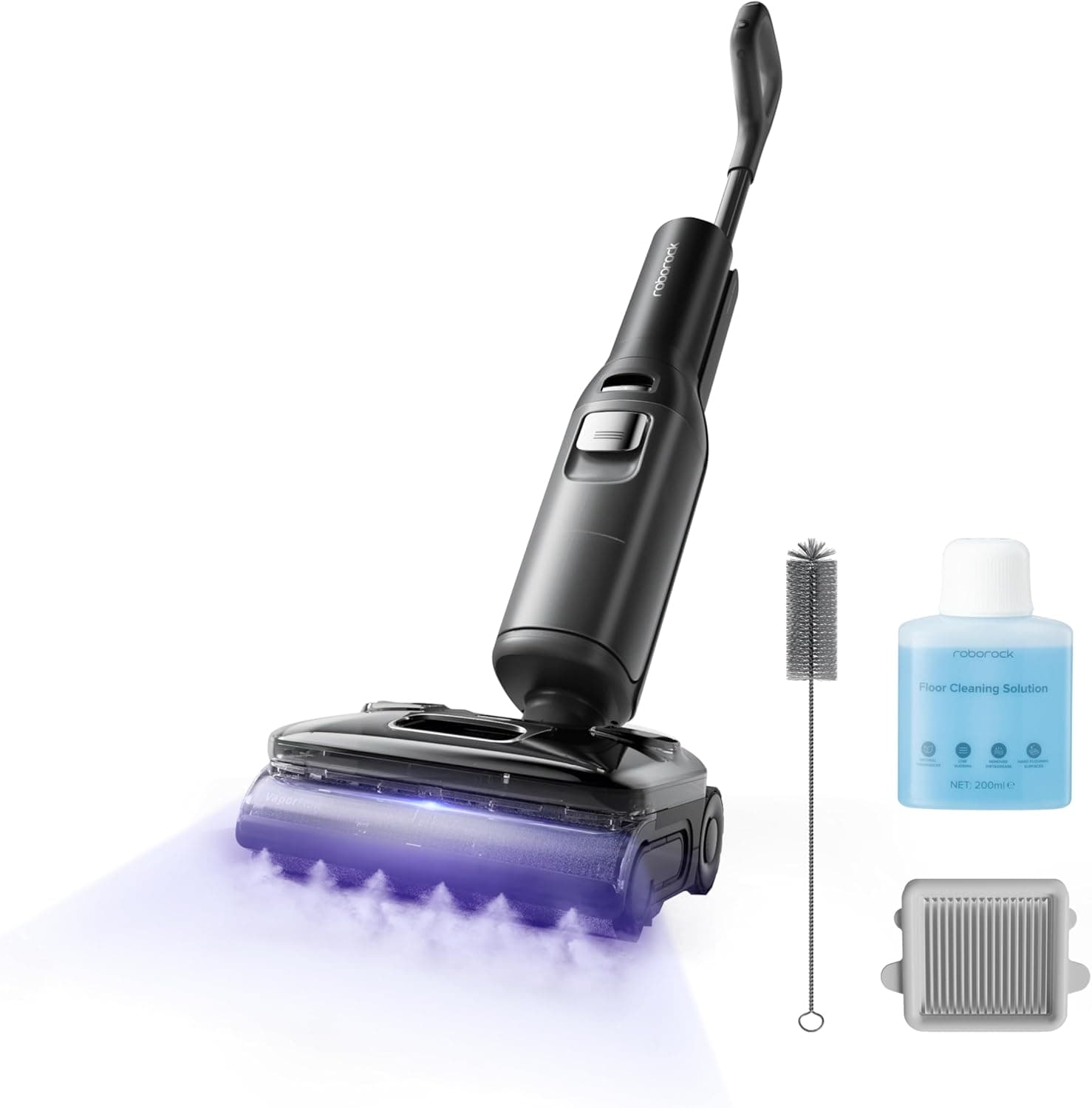
roborock F25 Ultra Steam Wet Dry Vacuum Mop
See it on Amazon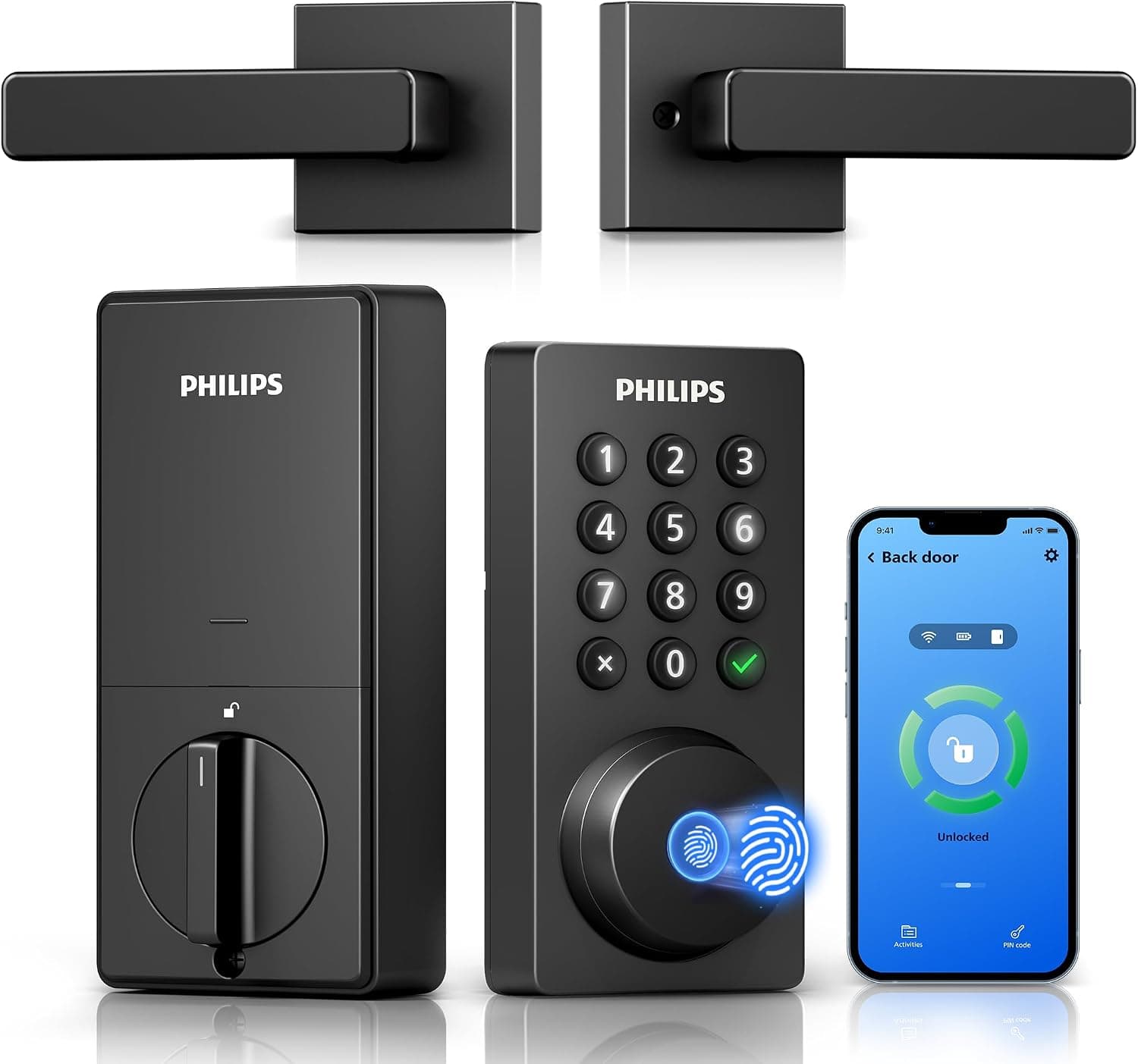
Philips Wi-Fi Keypad Deadbolt with Handle
See it on Amazon
Sponsored listings from Amazon’s Sponsored Products for Creators program, kept apart from our reviews and rankings. How we make money
Best Switches: Lutron Caseta Dimmer Starter Kit
Lutron Caseta Dimmer Starter Kit
- Wirecutter covers Caseta in its smart-switch reporting, and it is one of the few systems that installs at all without a neutral wire
- The Deluxe kit is the priciest entry in this roundup — you pay for 2 dimmers, 2 Pico remotes, and the Smart Bridge up front
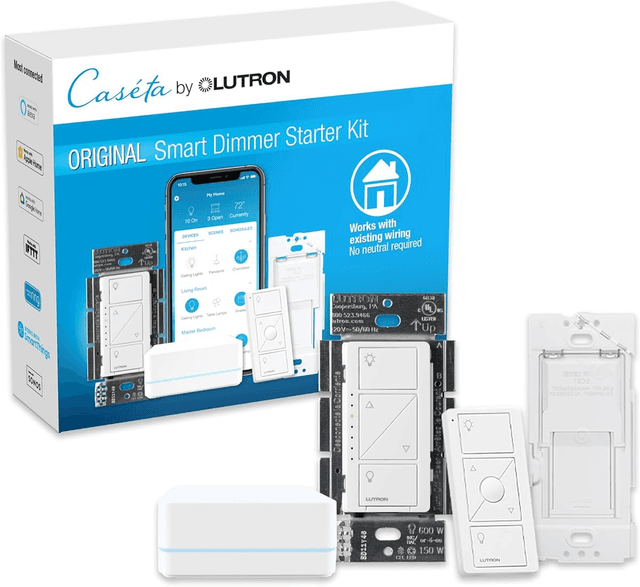
(Current price, subject to change)
The Lutron Caseta Dimmer Starter Kit is not scored on the SHE Smart Lighting Systems Value Score. That metric evaluates color bulbs on color, brightness and gamut — none of which apply to a dimmer switch controlling the bulbs already in your fixtures. Caseta wins its own category here on its install envelope. Wirecutter covers it in its smart-switch reporting, and it is one of a small group of systems that works without a neutral wire at all.
Clear Connect RF is the protocol-side moat, because it runs on its own radio band rather than sharing your Wi-Fi. Lutron publishes no latency figure, and we have measured none. The no-neutral-wire design enables installation in the older wiring common to many US homes, where Wi-Fi switches simply will not work. The Deluxe kit's two Pico remotes add wireless 3-way switches at any location with no rewiring.
Against the Hue Smart Button or a generic Z-Wave dimmer, Caseta yields an install-and-forget profile, and its Clear Connect network survives router resets and cloud outages. Caseta has no native Matter support, so it stays inside the Lutron app plus its bridged Alexa, Apple Home, Google Home and SmartThings integrations.
What We Love
- Wirecutter covers Caseta in its smart-switch reporting, and it is one of the few systems that installs at all without a neutral wire
- No neutral wire required, which makes it one of very few switches that will work at all in the older wiring common to a large share of US homes
- Clear Connect RF is a dedicated radio band rather than Wi-Fi, so the switch is not competing with the rest of your network
- The Deluxe kit includes 2 dimmers and 2 Pico remotes — enough to wire two rooms plus stick-on 3-way control out of the box
What Could Be Better
- The Deluxe kit is the priciest entry in this roundup — you pay for 2 dimmers, 2 Pico remotes, and the Smart Bridge up front
- No color control — dimmer only; pair with a separate bulb system for color
- No native Matter — Lutron's works-with list does not include it
The Verdict
If you live in an older home without neutral wires and you've already narrowed to switch-based smart lighting, the Lutron Caseta Dimmer Starter Kit checks the boxes that matter for that wiring setup. Clear Connect RF on its own radio band, no neutral wire needed — a Wirecutter-covered system with very little competition in the category.
Best No-Hub Bulbs: LIFX Color A19
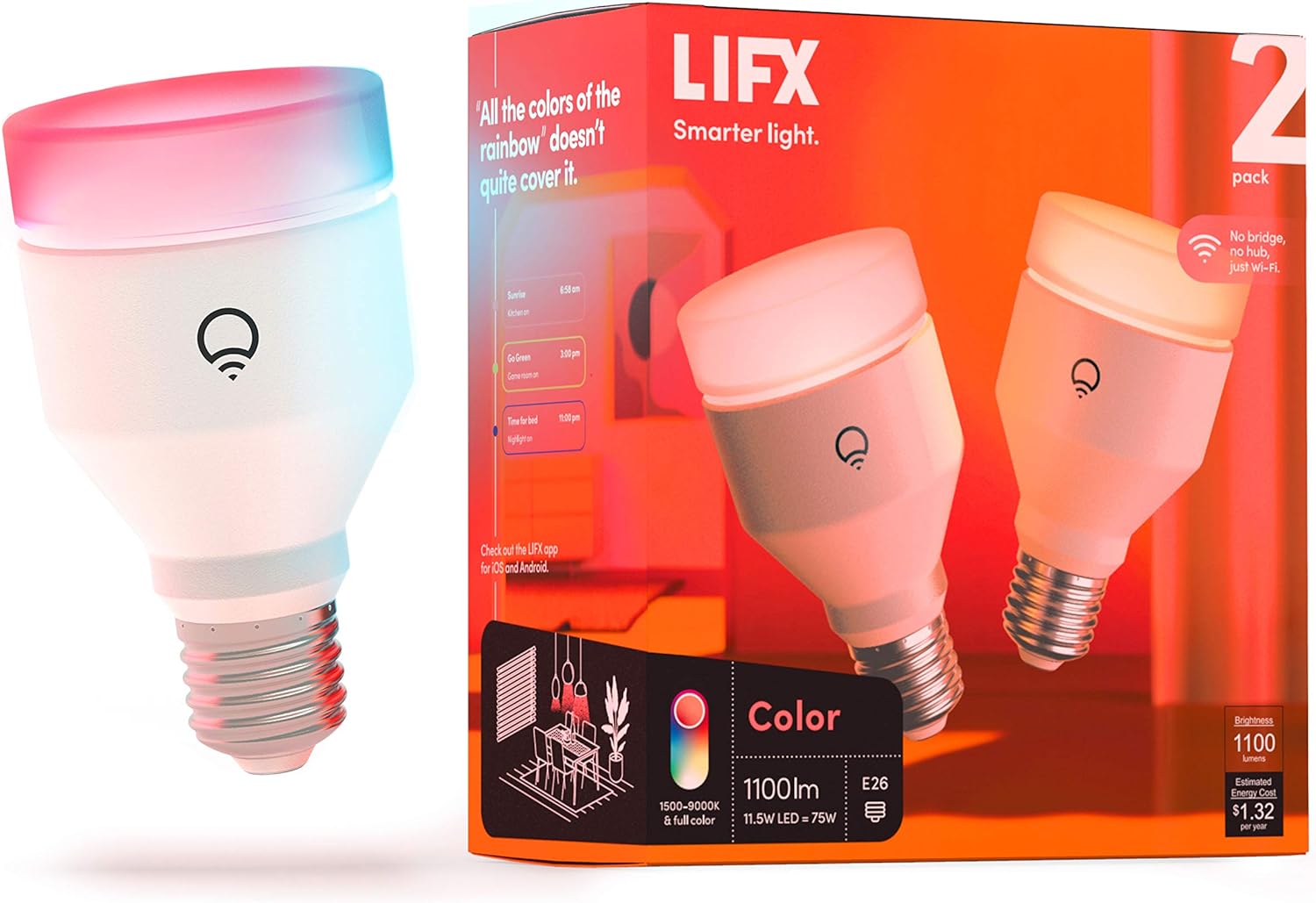
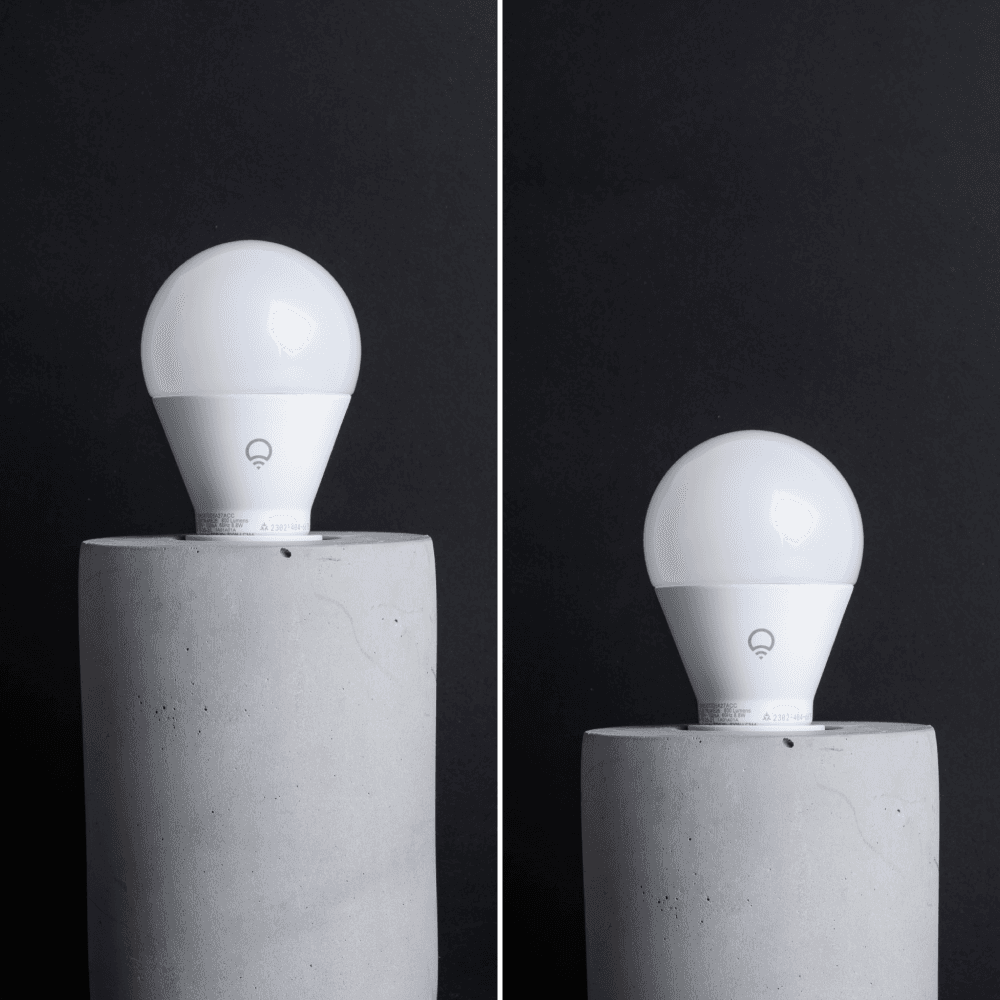
LIFX Color A19
- LIFX's spec table publishes CRI 82 for this bulb, the only no-hub bulb here to put a CRI figure in a spec table rather than in marketing copy, and it leads the no-hub trio on our own colour scoring
- Sold as a 2-pack that works out to about $14.99 per bulb — still the priciest of the three no-hub bulbs here
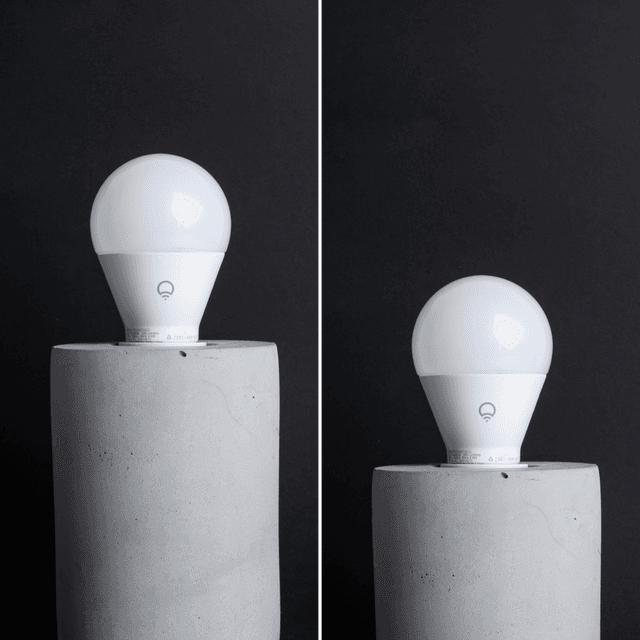
(Current price, subject to change)
The LIFX Color A19 earns a 7.8 SHE Smart Lighting Systems Value Score, the highest among the color bulbs here. The strongest hub-free color fidelity (8.5) and native Matter readiness (8.0) propel that position, rather than affordability or luminous output. At 800 lumens (60W-equivalent) it demonstrates no luminous advantage over WiZ or Govee. At approximately $14.99 per bulb, roughly 1.8x the WiZ equivalent, it is the most expensive hub-free option in this roundup. The exceptional color quality is precisely why it nonetheless retains the leading position.
Wi-Fi maintains the Matter round trip locally, so responsiveness holds up in daily operation, although it cannot match the off-network reliability of Hue's Zigbee mesh. No major outlet has published a model-level CRI laboratory comparison. LIFX's stated CRI 82 therefore remains a manufacturer specification rather than a verified result. One purchasing nuance matters considerably. LIFX ships Matter pre-installed on the current LCM4 Edition rather than delivering it by update, and older v3 units of this identical bulb cannot be upgraded. LIFX's own guidance is that Matter-capable models carry a firmware version starting with v4. Either way, LIFX costs far less to start than Hue: about $60 buys four bulbs, roughly 43% of the Hue kit price.
What We Love
- LIFX's spec table publishes CRI 82 for this bulb, the only no-hub bulb here to put a CRI figure in a spec table rather than in marketing copy, and it leads the no-hub trio on our own colour scoring
- LIFX ships Matter pre-installed on the current LCM4 Edition — no firmware update required, and cross-platform local control without a Wi-Fi-to-cloud round trip
- No hub means no bridge cost — you pay only for the bulbs, about $14.99 each
- Full RGB color plus tunable white in a no-hub bulb that pairs directly with an Apple Home household
What Could Be Better
- Sold as a 2-pack that works out to about $14.99 per bulb — still the priciest of the three no-hub bulbs here
- Wi-Fi-only protocol strains routers at 10+ bulbs, where Hue's Zigbee mesh sidesteps that strain
- Older v3 units of this bulb cannot be upgraded to Matter — LIFX says every Matter-capable model carries a firmware version starting with v4
The Verdict
If you're running 1-5 bulbs in an Apple-Home or Matter household and you've already decided you don't want a hub, the LIFX Color A19 lines up with what you actually need. The best hub-free colour here, 800 lm, a spec-table CRI 82 and Matter — you can stop the search here.
Best Color Under $10: Govee Smart Light Bulbs
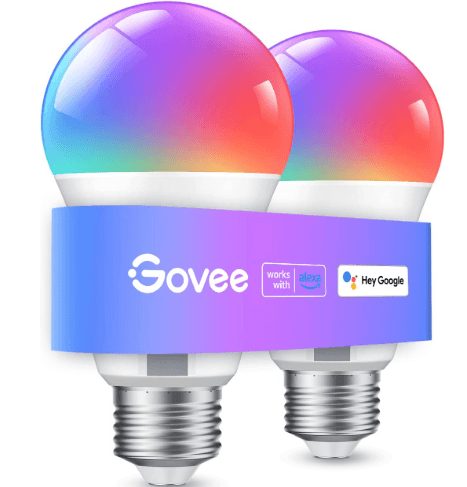
Govee Smart Light Bulbs
- CNET covers Govee's colour bulbs in its budget smart-lighting coverage, and the 4-pack runs about $8.25 a bulb — far below Hue per bulb
- Matter arrived as a hardware revision and Amazon retitled the listing in place, so pre-April-2025 stock of this same ASIN is not Matter — check the box before you rely on it
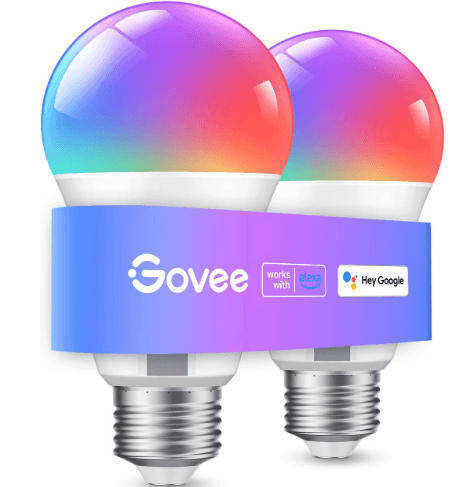
(Current price, subject to change)
The Govee Smart Light Bulbs earns a 7.4 SHE Smart Lighting Systems Value Score, third among the color bulbs. Joint-best value-for-money (8.0, approximately $8.25 per bulb) and Matter certification (8.0) carry it. The remaining restraint is a colour score of 6.5, which reflects an unpublished CRI specification rather than a measured shortfall. CNET reports on Govee's colour bulbs in its budget smart-lighting coverage. The 4-pack calculates to about $8.25 per bulb, roughly a quarter of the Hue kit per-bulb cost. Certification is recorded against the H6008 family at the Connectivity Standards Alliance under certificate CSA251E5MAT45367-24, and Govee's own product page labels the purchase option Matter Compatible for model H6008. The caveat is timing: it dates to April 2025, and Amazon retitled this listing in place, so older stock predates Matter.
Music synchronization is the standout differentiator at this tier, and the DIY scene library ships free in the Govee Home app. Compared against the LIFX A19, Govee surrenders colour fidelity and native Apple Home for a considerably lower per-bulb ratio, though both now reach Matter. Because both bulbs measure 800 lumens, LIFX's genuine advantage is colour, never illumination. Our Govee vs LIFX head-to-head breaks that color-versus-price trade-off down bulb by bulb.
What We Love
- CNET covers Govee's colour bulbs in its budget smart-lighting coverage, and the 4-pack runs about $8.25 a bulb — far below Hue per bulb
- Music sync and the 16M-color DIY scene library are free in the Govee Home app with no in-app purchase to unlock them
- 800 lm output is solid for a budget bulb, at a fraction of Hue's per-bulb price
- Govee Home ships scenes, music sync, and a 16M-color DIY library free in-app — no subscription required to unlock the advanced effects
What Could Be Better
- Matter arrived as a hardware revision and Amazon retitled the listing in place, so pre-April-2025 stock of this same ASIN is not Matter — check the box before you rely on it
- Less expensive driver components than Hue or LIFX, which typically means a shorter usable LED lifespan
- Cloud-dependency for advanced scenes — Wi-Fi outage drops the music-sync and DIY-scene features
The Verdict
If you want Matter-certified colour bulbs at about $8.25 each, the Govee Smart Light Bulbs fits the brief without compromise. 800 lm, music sync free, and a 4-pack at about $8.25 a bulb — no need to overthink it.
Best Entertainment: Govee TV Backlight 3 Lite (Camera Sync)
Govee TV Backlight 3 Lite (Camera Sync)
- A built-in camera samples your screen and mirrors its color to the strip — works with any TV brand, no HDMI box required
- Camera placement is finicky — expect some trial and error before the sync calibrates correctly
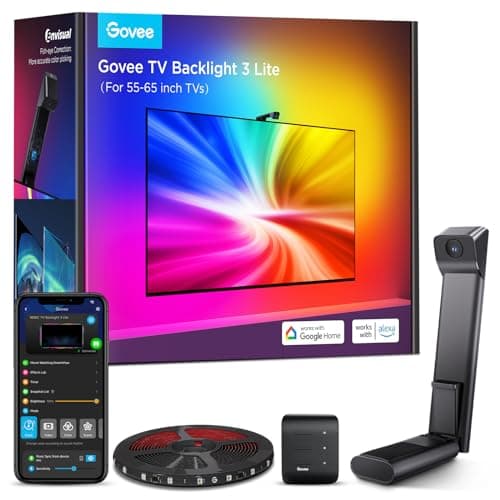
(Current price, subject to change)
The Govee TV Backlight 3 Lite (Camera Sync) is not scored on the SHE Smart Lighting Systems Value Score — that metric rates primary color bulbs, and this is an entertainment bias-light kit. It wins the entertainment category on its own merits: a fish-eye-corrected camera samples what's on screen and mirrors it to the RGBIC strip in real time. TechRadar covers Govee's camera backlights in its bias-lighting reporting. The closest Hue equivalent bundles a separate HDMI Sync Box atop its Play bars, several times Govee's entry price.
The built-in scene library plus a free DIY mode ship in the Govee Home app with no subscription and no in-app purchase to unlock them. The camera samples the screen itself rather than relying on the app to guess, and no outlet in our source set has published a frame-level latency benchmark for it. The RGBIC per-segment color produces gradient effects no single-zone competitor delivers within the same price tier.
Compared to Philips Hue Play strips paired with the Sync Box, Govee delivers comparable screen-driven ambiance for a small fraction of the cost. The trade is keeping its scene library inside the Govee Home app.
What We Love
- A built-in camera samples your screen and mirrors its color to the strip — works with any TV brand, no HDMI box required
- Fish-eye correction keeps the screen sampling accurate across the 55–65 in range
- RGBIC per-segment color delivers gradient effects a single-zone strip cannot produce
- TechRadar covers Govee's camera-sync backlights in its bias-lighting reporting, and the camera samples the screen itself rather than relying on the app
What Could Be Better
- Camera placement is finicky — expect some trial and error before the sync calibrates correctly
- Accent lighting only — not a primary light source for a room, so plan for overhead bulbs separately
- Alexa and Google Home are the voice options, and the scene library lives in the Govee Home app rather than in Apple Home
The Verdict
If you've already shortlisted gaming-room or home-theater lighting and Apple Home isn't required, the Govee TV Backlight 3 Lite (Camera Sync) is a sensible pick for that setup. Camera-based screen sync, a free built-in scene library, and a price well under Hue's Sync Box route — that's the path of least friction.
Check price for the Govee TV Backlight 3 Lite (Camera Sync) →
Best Budget Automation: WiZ Connected Smart Bulbs
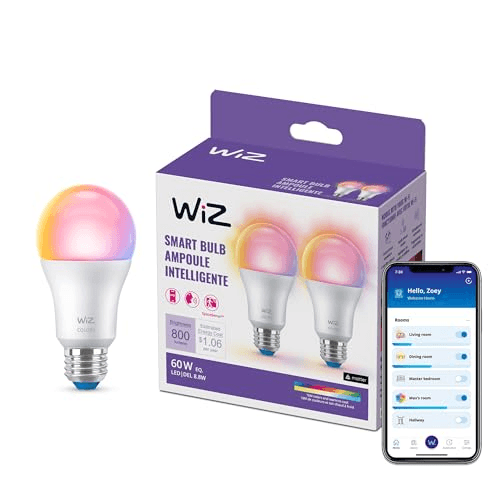
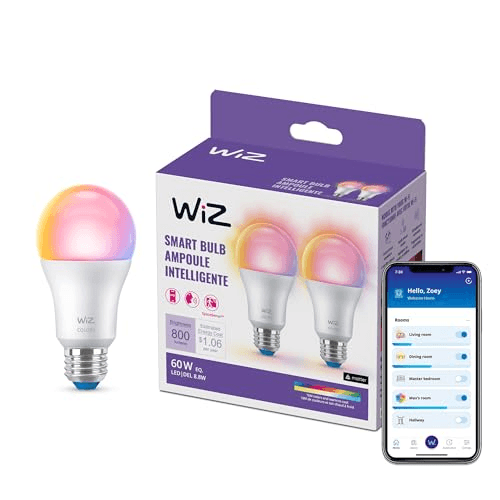
WiZ Connected Smart Bulbs
- Wirecutter and CNET both cover WiZ in their budget smart-bulb reporting, and no hub is needed — $24.99 per 3-pack is about $8.33 per bulb
- WiZ markets a CRI 90-plus figure that no independent measurement we can cite supports, so we score its colour on the unverified band rather than at face value
(Current price, subject to change)
The WiZ Connected Smart Bulbs earns a 7.5 SHE Smart Lighting Systems Value Score, second among the color bulbs and unmistakably the value pick. It combines native Matter readiness (8.0) with joint-best value-for-money (8.0, level with Govee) at approximately $8.33 per bulb. Wirecutter and CNET both cover WiZ in their budget smart-bulb reporting, and no hub is necessary. The $24.99 3-pack calculates to roughly $8.33 per bulb, comfortably beneath the Hue tier.
Sunset-to-sunrise scheduling runs on the bulb's firmware. WiZ's SpaceSense additionally detects motion through Wi-Fi sensing between two or more bulbs without a separate sensor, provided the local Wi-Fi stays up. Matter compatibility lets a HomePod mini or Apple TV bridge WiZ into Apple Home, though these bulbs incorporate no Thread radio and communicate over Wi-Fi instead. Its lone genuine weakness is colour fidelity. WiZ markets a CRI 90-plus specification for this bulb, but no independent laboratory measurement we can responsibly cite corroborates it. Our rubric therefore evaluates an unverified manufacturer CRI on the 6-6.5 band rather than accepting it at face value. That is precisely why it scores 6.5 rather than comparatively higher.
What We Love
- Wirecutter and CNET both cover WiZ in their budget smart-bulb reporting, and no hub is needed — $24.99 per 3-pack is about $8.33 per bulb
- Matter-compatible — a HomePod mini or Apple TV acts as the Matter controller that bridges these Wi-Fi bulbs into Apple Home
- Sunset-to-sunrise and motion-detect automation are built into the bulb firmware, no cloud required
- Full RGB plus warm-to-white tunable color at roughly 0.24x the per-bulb cost of a Hue kit ($8.33 versus about $34.50)
What Could Be Better
- WiZ markets a CRI 90-plus figure that no independent measurement we can cite supports, so we score its colour on the unverified band rather than at face value
- The WiZ Home app carries fewer scene-building features than Govee Home
- Wi-Fi-only protocol strains routers at 10+ bulbs, similar trade-off to LIFX without the CRI advantage
The Verdict
If you've decided to test smart lighting before committing to a Hue kit at roughly 4x the per-bulb price, the WiZ Connected Smart Bulbs is the path of least friction. $24.99 per 3-pack, Matter-compatible, no hub — you'll be well-served here.
How We Score: SHE Smart Lighting Systems Value Score
SHE Smart Lighting Systems Value Score
Score Formula
Score = 0.25 × Color_Quality + 0.20 × Brightness + 0.20 × Ecosystem_Breadth + 0.15 × Matter_Readiness + 0.20 × Value_for_MoneyScore Factors
- Color Quality (weight 0.25)Color fidelity on a 0-10 scale: CRI 90+ with strong independent color praise scores 9-10; CRI 82-89 with solid reviewer color scores 8-8.5; CRI ~80 budget bulbs score 7; bulbs whose manufacturer CRI is unverified and whose reviewer color reads as less refined score 6-6.5. Every CRI figure here is manufacturer-stated — none is lab-tested.
- Brightness (weight 0.20)Peak output per bulb, from the manufacturer's stated wattage equivalence and lumen rating where one is published: 75W-equivalent scores 8.5-9; 800-1,000 lm 60W-equivalent scores 8; 600-800 lm scores 6.5-7.5. Where no lumen figure is published we score the wattage class rather than invent a number. Switches and accent strips have no primary-light rating and are not bulb-scored.
- Ecosystem Breadth (weight 0.20)Platform integrations among Alexa, Google Home, Apple HomeKit, SmartThings, and Matter, weighting native first-class support above platforms reached only through a Matter controller: four native integrations plus Matter scores 9-9.5; three native plus Matter scores 8-8.5; two native plus Matter (which bridges the rest) scores 7-7.5; two native with no Matter scores 4.
- Matter Readiness (weight 0.15)2026 protocol future-proofing: Matter-native with a Thread radio scores 10; Matter-native over Wi-Fi (no Thread) scores 8; Matter only via a bridge scores 6; no Matter scores 1.
- Value for Money (weight 0.20)Effective price per bulb (kit price divided by bulbs in the pack), mapped to a published bounded curve: at or below $6 scores 9; $6-9 scores 8; $9-12 scores 7; $12-16 scores 6; $16-22 scores 5; $22-28 scores 4; above $28 scores 3.5. Price enters the composite ONLY here, as one bounded 20% factor — never as a hidden denominator.
- Scope — what is and isn't scoredThe composite rates directly-comparable color bulbs. The Lutron Caseta dimmer (a switch with no light source of its own) and the Govee camera backlight (an entertainment accent strip) win their own categories and are deliberately not scored on the bulb rubric — only their SHE Smart Lighting Value cells read n/a; their colour and brightness cells are scored but are not what those products are for.
SHE Smart Lighting Systems Value Score — Ranked
LIFX Color A19
SHE Smart Lighting Systems Value Score7.8/102-pack at $14.99 a bulb, 800 lm, native Matter — best hub-free colour (8.5) carries it to the top despite the priciest no-hub bulb cost
WiZ Connected Smart Bulbs
SHE Smart Lighting Systems Value Score7.5/10$24.99 3-pack (~$8.33/bulb), 800 lm, native Matter — joint-best value-for-money at 8.0, with only unverified colour fidelity holding it back
Govee Smart Light Bulbs
SHE Smart Lighting Systems Value Score7.4/104-pack at about $8.25 a bulb, 800 lm, Matter-certified on current stock — joint-best value-for-money; only an unpublished CRI holds it back
Philips Hue White and Color Starter Kit
SHE Smart Lighting Systems Value Score7.0/10$138.00 kit (Bridge + 4 bulbs) at its last in-stock read, 1,100 lm at 4000K, all 4 ecosystems plus Matter — best brightness and broadest reach; per-bulb price and a CRI of only 80-plus are the drags
Ecosystem Compatibility: Zigbee, Wi-Fi, Matter, and Thread
The compatibility decision in 2026 is about which protocol matches your existing smart-home infrastructure, and between them ecosystem breadth and Matter readiness carry 0.35 of the composite above. Philips Hue runs on Zigbee mesh through the Hue Bridge, operating off your Wi-Fi entirely, so router load stays down as the device count climbs. A Matter bridge option handles cross-platform routing. LIFX, Govee, and WiZ run on direct Wi-Fi with no bridge. The Wi-Fi protocol works for 1-5 bulbs but compounds router strain at 10+ devices, where mesh-protocol systems (Zigbee, Thread) maintain consistent response. Lutron Caseta uses Clear Connect RF — a proprietary radio band that works in older wiring without a neutral wire.
Matter and Thread support is the protocol shift that defines the 2026 buying decision. Matter is the cross-platform standard that connects Alexa, Google, Apple HomeKit, and SmartThings to a single bulb without per-platform configuration. Thread is the IP-mesh transport layer that yields local-network routing without Wi-Fi strain. LIFX and WiZ both ship Matter-compatible firmware on current hardware in 2026, but over Wi-Fi — neither carries a Thread radio. Hue routes Matter via the Bridge, and Govee's A19 bulbs are Matter-certified on current stock. The prevailing 2026 recommendation is to choose Matter-native bulbs for new installations, especially in households running an Apple TV or HomePod mini that can act as a Matter controller.
Value-for-money math is the overlooked factor in compatibility decisions. A no-hub Wi-Fi bulb (LIFX, Govee, WiZ) skips the Bridge cost entirely. That is precisely why LIFX and WiZ edge out Hue on the SHE Value Score for 1-5 bulb installations. At 10+ bulbs the calculus flips: Hue's Zigbee mesh reliability clearly outperforms a congested Wi-Fi network, and the per-bulb Bridge cost shrinks as you add bulbs. For a deeper whole-home matchup, our Hue vs Govee vs Nanoleaf vs WiZ comparison pits the four systems head to head. Our Best Smart LED Lightstrip Brands 2026: Hue vs Govee vs Nanoleaf vs WiZ guide covers the accent-strip half of the same decision. The Lutron Smart Bridge folds into its kit price the same way; for the switch-side use case there's no alternative.
Renter compatibility is the final practical consideration. Smart bulbs (Hue, LIFX, Govee, WiZ) screw in to existing fixtures with no wiring changes — every system reviewed here works in any rental. Smart switches (Lutron Caseta) require landlord approval for wall-switch swap, with one exception: the Lutron Caseta plug-in dimmer adds smart dimming to a lamp without modifying wall wiring, and the Pico remote stick-on bracket adds wall-switch-feel control without permanent installation. For renters in older buildings, the plug-in Caseta plus stick-on Pico produces switch-like control with zero landlord approval needed.
| Product | Matter | Thread | HomeKit | Google Home | Alexa | SmartThings |
|---|---|---|---|---|---|---|
| Philips Hue White and Color Starter Kit | ✓ | ✕ | ✓ | ✓ | ✓ | ✓ |
| Lutron Caseta Dimmer Starter Kit | ✕ | ✕ | ✓ | ✓ | ✓ | ✓ |
| LIFX Color A19 | ✓ | ✕ | ✓ | ✓ | ✓ | ✓ |
| Govee Smart Light Bulbs | ✓ | ✕ | ✓ | ✓ | ✓ | ✓ |
| Govee TV Backlight 3 Lite (Camera Sync) | ✕ | ✕ | ✕ | ✓ | ✓ | ✕ |
| WiZ Connected Smart Bulbs | ✓ | ✕ | ✓ | ✓ | ✓ | ✓ |
10-Year Cost of Ownership Math
The 7.8 SHE Smart Lighting Systems Value Score on the LIFX A19 translates concretely. You get 800 lm with the best color of any hub-free bulb here (8.5 on our scale), and your existing Apple Home installation recognizes them without a bridge. Native Matter yields cross-platform local control without the Wi-Fi-to-cloud round trip, and you paid only for the bulbs. The 7.0 score on Hue reflects its premium per-bulb price, with Matter-via-bridge and an unspecific published CRI the secondary drags. Its brightness and ecosystem nonetheless lead the field, which is why it remains the whole-home recommendation.
Every figure below uses the live Amazon price for that product, verified August 2026 through the Creators API. One exception matters before you read the Hue math. The Hue starter kit remains listed on Amazon, but was out of stock there on our 2026-08-23 verification. Its $138.00 figure is therefore the last price we confirmed while it was in stock, on 2026-08-22, rather than a price you can pay today. Smart lighting cost-of-ownership economics across a 10 yr horizon is dominated by three principal factors: starter-kit acquisition cost, any required hub cost, and bulb-replacement frequency calibrated against rated-lifetime specifications. A 4-bulb Philips Hue installation ran approximately $138.00 with the Bridge included at that last in-stock read, plus near-zero replacement cost across a 10 yr horizon. Philips rates the bulbs in hours rather than years, and at typical household usage most homeowners will not replace a Hue bulb within the ownership window. The aggregated 10 yr cost lands at approximately $138 in total expenditure, producing approximately $1.15 per-month economics across the 4-bulb starter kit.
A comparable 4-bulb LIFX installation requires approximately $60 (two 2-packs, about $14.99 per bulb) with no hub expenditure. That yields roughly $60 aggregate cost across 10 yr at a comparable rated lifespan. That economic profile delivers roughly 43% of the Hue total cost at 4-bulb deployment scale, where Wi-Fi protocol strain remains manageable below the 8-device threshold. A 4-bulb Govee installation requires approximately $33 (one 4-pack), plus whatever replacements its cheaper drivers may necessitate. That lands among the most economical 10 yr profiles in this roundup. WiZ economics calibrate similarly. A $24.99 3-pack (about $8.33 per bulb) covers three sockets, and a second 3-pack supplies a fourth socket plus two spares at comparable manufacturer-rated longevity.
For switch-based households, the Lutron Caseta Deluxe kit requires approximately $190 with the Smart Bridge, two dimmers and two Pico remotes included. Whatever existing or replacement bulbs the homeowner selects are additional. The switches themselves are engineered for a long operational service life. The 10 yr cost therefore lands at about $190 plus bulb expenses, yielding efficient cost-per-room economics across 5+ bulbs. The Deluxe kit bundles two Pico remotes and wall plates. Those contribute wireless 3-way switching at two room locations without invasive rewiring.
Camera-based entertainment lighting (the Govee TV Backlight 3 Lite) requires approximately $75 with no hub expenditure. Its 10 yr economics remain approximately $75, driven entirely by the strip's negligible wear profile under typical accent use. Its built-in scene library and DIY mode add no subscription cost across that 10 yr horizon. Hue's screen-sync configuration requires a separate HDMI Sync Box atop its Play light bars. Govee delivers comparable camera-based synchronization for a small fraction of that aggregated cost.
When NOT to Buy
A 1-2 bulb upgrade is better served by a basic smart plug and a standard LED: at that scale the app overhead outweighs the convenience. The Bridge economics that justify Hue at 5+ bulbs add nothing at 1-3.
Renters under no-modification clauses should reach for the Lutron plug-in dimmer for table lamps, paired with the Pico remote stick-on bracket for wall-switch feel. For routers already carrying 15+ Wi-Fi devices, a Zigbee mesh configuration comparatively outperforms accumulating additional Wi-Fi bulbs on a congested network. Hue relocates its bulbs off Wi-Fi onto the Bridge entirely. Every no-hub Wi-Fi bulb reviewed here, WiZ included, adds to that router load rather than relieving it.
Buyers prioritizing Matter and Thread readiness within a constrained budget should evaluate two options. WiZ Connected Smart Bulbs run $24.99 per 3-pack (about $8.33 per bulb), and the Nanoleaf Essentials A19 is the alternative. Both deliver Matter operation, though WiZ runs Matter over Wi-Fi; check the specific Nanoleaf model for Thread, since Nanoleaf sells both Wi-Fi and Thread variants. A Thread variant additionally requires a Thread border router, meaning a HomePod mini or Apple TV 4K. The Wi-Fi WiZ bulbs instead need only a Matter controller, which those same devices also provide.
Who Should Buy What
Who Should Buy What
| If you are… | Recommended pick |
|---|---|
Whole-home reliability buyer You have 5+ rooms to light, run a multi-ecosystem household, and value off-network Zigbee mesh reliability over per-bulb price savings | Philips Hue White and Color Starter Kit |
Older-wiring household You live in older wiring without neutral wires, want any-bulb compatibility, and prefer a switch-based smart home over per-bulb control | Lutron Caseta Dimmer Starter Kit |
Apple Home no-hub adopter You run an Apple HomeKit or Matter household, light 1-5 rooms, and refuse to buy a bridge — color fidelity and Matter are non-negotiable | LIFX Color A19 |
Cheapest Matter colour bulbs You want Matter-certified colour bulbs with music sync at about $8.25 a bulb, and you are buying current stock rather than older inventory of the same listing | Govee Smart Light Bulbs |
Gaming and home theater immersion You want camera-based screen sync for a TV or gaming setup, you accept Alexa or Google as the only voice options, and you are willing to fine-tune the camera position | Govee TV Backlight 3 Lite (Camera Sync) |
Automation-first budget buyer You want under-$10-per-bulb Matter bulbs that also run motion sensing and sunset-to-sunrise scheduling on the bulb itself, and you accept an unverified CRI for the price | WiZ Connected Smart Bulbs |
Frequently Asked Questions
Do smart bulbs need a hub?
It depends on the protocol. Zigbee bulbs (Philips Hue) require a hub, which keeps the bulbs off your Wi-Fi network entirely so they add no router strain. Wi-Fi bulbs (LIFX, Govee, WiZ) work without a hub but strain routers at 10+ devices. Matter-compatible Wi-Fi bulbs (LIFX, WiZ) can pair to Apple Home through a Matter controller (HomePod mini, Apple TV) — but they carry no Thread radio, so they still run their traffic over Wi-Fi rather than joining a low-strain Thread mesh. The hub pays off at 5+ bulbs; below that, hubless Wi-Fi bulbs deliver better dollar efficiency.
Can renters install smart lighting without modifying wiring?
Yes — smart bulbs (Hue, LIFX, Govee, WiZ) screw in to existing fixtures with no wiring changes and work in any rental. Smart switches require landlord approval for wall-switch swap, except for the Lutron Caseta plug-in dimmer which adds smart dimming to lamps without modifying wall wiring. The Lutron Pico remote stick-on bracket adds wall-switch-feel control without permanent installation, which makes it the renter's best switch-equivalent.
Philips Hue vs Govee vs LIFX: which is better?
Hue wins whole-home reliability — Zigbee mesh, all 4 ecosystems, a huge product catalog, and coverage in both Tom's Guide and TechRadar. LIFX wins no-hub colour — a spec-table CRI 82, 800 lm, Matter compatible, no bridge required. Govee wins budget and entertainment — a 4-pack about $8.25 a bulb, 16M colors plus music sync, camera-based TV sync at a fraction of the cost of Hue Sync. Match the system to bulb count, ecosystem, and budget rather than buying everyone's favorite.
Do smart bulbs work without Wi-Fi?
Partially. Hue and Govee both offer Bluetooth fallback control when Wi-Fi drops, which yields local-only operation without scenes or automation. Zigbee bulbs (Hue) maintain mesh operation if the hub loses internet but the local router stays up. Matter-paired Wi-Fi bulbs (WiZ, LIFX) controlled through a HomePod mini or Apple TV keep local Apple Home control during an internet outage as long as the local Wi-Fi stays up, since the controller routes commands on-network. Wi-Fi-only bulbs in standard mode lose all smart features when the network drops.
How long do LED smart bulbs actually last?
In hours, not years. Philips rates second- and third-generation Hue bulbs at 25,000 hours, and works that out itself as roughly 8.6 years at 8 hours a day, or 17+ years at 4 hours a day — which is why any lasts-two-decades claim depends entirely on the usage assumption behind it. Thermal cycling and driver stress shorten any rated figure, and enclosed fixtures shorten it further. Cheaper driver components are the usual reason a budget bulb fails before a premium one; Govee publishes no comparable hour rating for the bulbs here. Check the box for the hour rating on the model you actually buy.
What is Matter and Thread support and which bulbs have it?
Matter is the cross-platform standard that connects a single bulb to Alexa, Google Home, Apple HomeKit, and SmartThings without per-platform setup. Thread is the IP-mesh transport that yields local-network routing without Wi-Fi strain. LIFX and WiZ both ship Matter-compatible firmware on current hardware in 2026 but run it over Wi-Fi — neither has a Thread radio. Philips Hue routes Matter via the Bridge, and Govee's A19 bulbs are Matter-certified on current stock. A Matter controller like a HomePod mini or Apple TV 4K lets these bulbs route locally instead of bouncing every command through the cloud.
Can I dim smart bulbs from a wall switch?
Yes, but only with a smart switch — never a standard wall switch. Cutting power to a smart bulb at the wall wipes routines, drops it from the network, and can damage the driver over time. Lutron Caseta is the standard fix: Clear Connect RF dimming runs on its own radio band, works with any bulb in the fixture, and the Pico remote stick-on adds wall-switch-feel control without rewiring. Hue Smart Button and Aqara H1 are the bulb-system alternatives.
Are smart bulbs a fire hazard?
UL-listed smart bulbs from major brands (Hue, LIFX, Govee, WiZ) are not a fire hazard in standard fixtures. The two real risk factors are enclosed fixtures without rated ventilation and exceeding the socket wattage rating. Smart LED bulbs run substantially cooler than incandescents at equivalent lumen output, which is why an enclosed-fixture rating matters less for LEDs than it did for the legacy bulbs they replace. They still generate real heat, so an enclosed fixture is not a free pass. Always confirm UL listing on the box and check the fixture's enclosed-fitting rating before installing in recessed cans.
Do smart light strips work with Matter?
Most Govee light strips, including the Govee TV Backlight camera kits, run on Wi-Fi plus Bluetooth without Matter compatibility in 2026. Nanoleaf Essentials lightstrips ship Matter-native firmware. For Matter-compatible accent lighting, Nanoleaf Essentials and the Philips Hue Solo Lightstrip (via the Bridge) are the current options.
Should I buy smart switches or smart bulbs?
It comes down to color versus coverage. Smart bulbs — Hue, LIFX, Govee, WiZ — give color, tunable white, and per-bulb scenes, but they stop responding the moment power is cut at the wall. A switch automates the whole fixture and works with whatever ordinary bulbs are already in it, making it the cheaper way to handle a hallway or kitchen running four or six cans on one circuit; what it cannot do is change color. Our switch pick, the Lutron Caseta dimmer starter kit, scores 8.0/10 on ecosystem fit. It carries no SHE Smart Lighting Systems Value Score, and its color and brightness dimensions read low, for one reason: that composite scores color bulbs, and Caseta is a switch. For most houses, both — switches on the high-count fixtures and circulation spaces, bulbs where color earns its price.
Lutron Caseta vs Philips Hue: which should I pick?
They solve different problems, so this is the switch-versus-bulb question wearing two brand names. Philips Hue leads on ecosystem fit (9.5/10) and brightness, and posts a 7.0/10 SHE Smart Lighting Systems Value Score, its Zigbee mesh keeping bulbs off your Wi-Fi. Lutron Caseta scores 8.0/10 on ecosystem fit and is our Best Switches pick because it needs no neutral wire, the wiring reality in many older US homes. Choose Hue for color, scenes, and a catalog you can grow into. Choose Caseta for dependable dimming of the fixtures you already have, particularly in a no-neutral house. They coexist without conflict; they are not competing for the same job.
Bottom Line
Get the Philips Hue White and Color Starter Kit if you have 5+ bulbs to install, run a multi-ecosystem household, and want Zigbee mesh reliability over the 10 yr horizon.
Get the Lutron Caseta Dimmer Starter Kit if you want a switch-based smart home in older wiring without neutral wires and accept the Deluxe kit's up-front cost for two rooms of control.
Get the LIFX Color A19 if you have 1-5 bulbs to install in an Apple HomeKit or Matter household, want the best color, and refuse to buy a hub.
Get the Govee Smart Light Bulbs if you want the cheapest Matter-certified colour bulbs here, with music sync, at about $8.25 a bulb.
Get the Govee TV Backlight 3 Lite (Camera Sync) if you want camera-based screen sync for a gaming or home theater setup at a small fraction of the cost of Hue's Sync Box plus Play bars.
Get the WiZ Connected Smart Bulbs if you want under-$10-per-bulb Matter-compatible smart bulbs and already run a Matter controller such as a HomePod mini or Apple TV 4K.
The right call for whole-home buyers is the Philips Hue White and Color Starter Kit — Zigbee mesh and the broad Hue device ecosystem outweigh the premium per-bulb price at 5+ bulbs. For 1-5 bulb no-hub setups, the LIFX Color A19 yields the highest SHE Value Score among the color bulbs here, with WiZ a close second on value. Skip smart lighting entirely if you only have 1-2 bulbs to upgrade — a basic smart plug at $10 plus a standard LED is the more efficient buy at that scale.
Sources & Methodology
Methodology: SHE Smart Lighting Systems Value Score — Formula: Score = 0.25 × Color_Quality + 0.20 × Brightness + 0.20 × Ecosystem_Breadth + 0.15 × Matter_Readiness + 0.20 × Value_for_Money. Factors: Color Quality (weight 0.25): Color fidelity on a 0-10 scale: CRI 90+ with strong independent color praise scores 9-10; CRI 82-89 with solid reviewer color scores 8-8.5; CRI ~80 budget bulbs score 7; bulbs whose manufacturer CRI is unverified and whose reviewer color reads as less refined score 6-6.5. Every CRI figure here is manufacturer-stated — none is lab-tested. | Brightness (weight 0.20): Peak output per bulb, from the manufacturer's stated wattage equivalence and lumen rating where one is published: 75W-equivalent scores 8.5-9; 800-1,000 lm 60W-equivalent scores 8; 600-800 lm scores 6.5-7.5. Where no lumen figure is published we score the wattage class rather than invent a number. Switches and accent strips have no primary-light rating and are not bulb-scored. | Ecosystem Breadth (weight 0.20): Platform integrations among Alexa, Google Home, Apple HomeKit, SmartThings, and Matter, weighting native first-class support above platforms reached only through a Matter controller: four native integrations plus Matter scores 9-9.5; three native plus Matter scores 8-8.5; two native plus Matter (which bridges the rest) scores 7-7.5; two native with no Matter scores 4. | Matter Readiness (weight 0.15): 2026 protocol future-proofing: Matter-native with a Thread radio scores 10; Matter-native over Wi-Fi (no Thread) scores 8; Matter only via a bridge scores 6; no Matter scores 1. | Value for Money (weight 0.20): Effective price per bulb (kit price divided by bulbs in the pack), mapped to a published bounded curve: at or below $6 scores 9; $6-9 scores 8; $9-12 scores 7; $12-16 scores 6; $16-22 scores 5; $22-28 scores 4; above $28 scores 3.5. Price enters the composite ONLY here, as one bounded 20% factor — never as a hidden denominator. | Scope — what is and isn't scored: The composite rates directly-comparable color bulbs. The Lutron Caseta dimmer (a switch with no light source of its own) and the Govee camera backlight (an entertainment accent strip) win their own categories and are deliberately not scored on the bulb rubric — only their SHE Smart Lighting Value cells read n/a; their colour and brightness cells are scored but are not what those products are for.
Expert review sources used in this analysis:
- SmartHomeExplorer aggregates expert review data and community sentiment to produce consensus-based buying guidance
- We do not perform first-party product testing
- Outlets whose smart-lighting coverage informed this roundup: Wirecutter, CNET, Tom's Guide, TechRadar, The Verge, Reviewed, Forbes
- Also House Beautiful, PCMag, Tom's Hardware, Digital Trends, The Spruce, Consumer Reports, Engadget and SafeWise
- The per-product source counts shown on the cards are drawn from our wider consensus database and are not limited to that list
- Community reliability and installation reports sourced from r/smarthome, r/Hue, r/LIFX, and r/Govee on Reddit
- Manufacturer list prices, where the maker still publishes one, run to $310.00 for the Lutron Caseta Deluxe kit (P-BDG-PKG2W) in Lutron's own price list
- LIFX lists its Color A19 2-pack at $34.99, and Govee lists the A19 4-pack at $39.99
- Govee lists the TV Backlight 3 Lite (55-65 in) at $89.99 as well
- We could not find a current list price for the Bridge-plus-four-bulb starter kit on philips-hue.com, and WiZ publishes no list price
- Street prices run below those figures, and the per-bulb and 10 yr figures here derive from live street prices
- Amazon prices, availability and merchant were re-verified live through the Amazon Creators API on 2026-08-23
- One disclosure
- The Hue starter kit remains a listed Amazon product, but that listing carried no purchasable offer on 2026-08-23
- It was out of stock, with no third-party merchant covering it
- We therefore quote its 2026-08-22 in-stock price rather than a current one, and withhold the purchase link until stock returns
- Ecosystem and protocol support is taken from each manufacturer's own published specification
- The SHE Smart Lighting Systems Value Score factors derive from manufacturer specifications and aggregated reviewer assessments
- No first-party lab testing was conducted, and every CRI and lumen figure is manufacturer-stated
- Price enters the score only through the bounded Value-for-Money factor; the full rubric is published in the methodology above so the composite is recomputable.
Nicholas Miles is the founder of SmartHomeExplorer and a longtime smart home enthusiast focused on helping everyday homeowners make better technology decisions. He researches, compares, and writes about products across security, climate, lighting, leak prevention, sensors, home energy, and automation, with an emphasis on real-world usefulness, ecosystem compatibility, reliability, privacy, and long-term value.
Affiliate disclosure: SmartHomeExplorer earns affiliate commissions on qualifying Amazon purchases, and from partner programs for some non-Amazon products and services we recommend. Our scoring methodology is independent of affiliate relationships.
More Guides
smart-lighting
Best Smart LED Lightstrip Brands 2026: Hue vs Govee vs Nanoleaf vs WiZ
Lighting
Hue vs Govee vs Nanoleaf vs WiZ 2026: Best Smart Lights
smart-home
Best Smart Home Essentials 2026: 7 Devices That Work Together
smart-lighting
Best Smart Decorative Wall Light Panels 2026
smart-climate