
Best 4K Floodlight Security Cameras for Home (2026)
Half the floodlight cams stamped '4K' are 2K sensors with an upscaler. These six output a real 3840x2160 — the Reolink TrackFlex leads on no-fee coverage value.
This article contains affiliate links. We may earn a commission at no extra cost to you. Prices change frequently — check the current price on Amazon before buying. Learn more
The Short Answer
The Reolink TrackFlex Floodlight WiFi prevails because it consolidates exceptional detection range, motorized subject tracking, and subscription-free economics, dominating our coverage-value calculation despite an unavoidable mechanical wear point that fixed-coverage buyers avoid by selecting the Reolink Elite instead.
Featured in this Guide
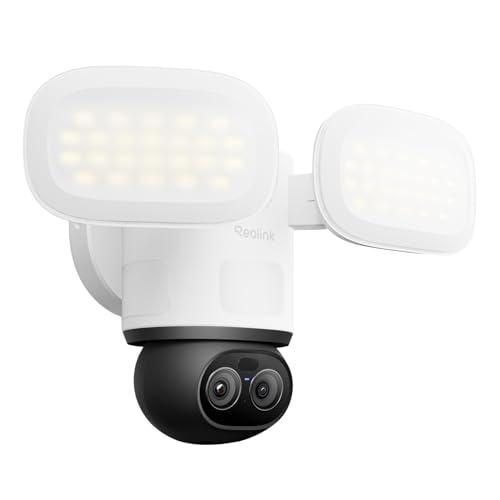
Reolink
TrackFlex Floodlight WiFi
- •360-degree PTZ, 6x hybrid zoom, 50-foot detection, 3,000 lumens — and no subscription fee
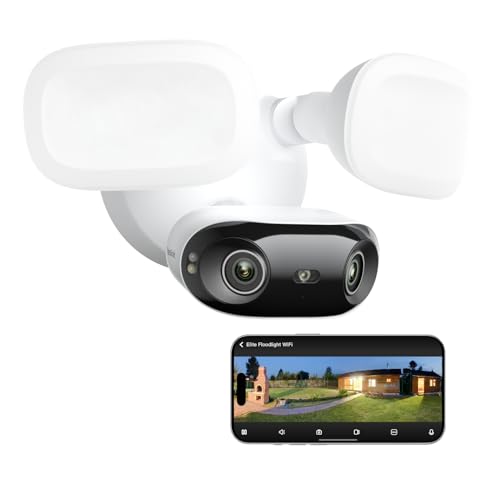
Reolink
Elite Floodlight WiFi
- •3,000-lumen 180-degree 4K with on-device AI
- •PCWorld Editors' Choice and no monthly bill
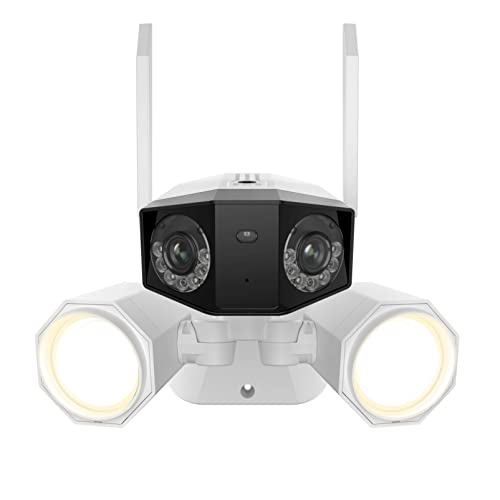
Reolink
Duo Floodlight WiFi 6 (2nd Gen)
- •Genuine 4K dual-lens under $180 with Wi-Fi 6 and free local person/vehicle detection
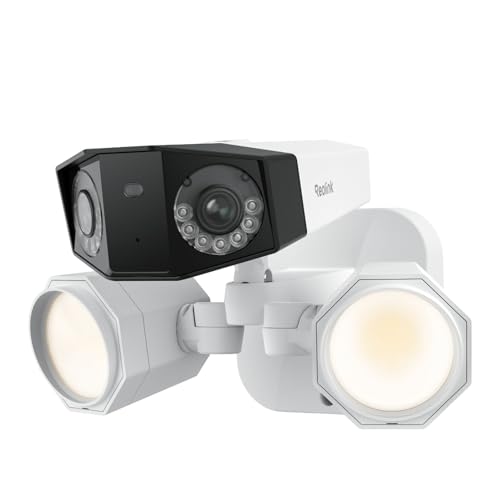
Reolink
Duo Floodlight PoE
- •One Cat6 cable carries power and 4K video — no Wi-Fi bandwidth worries at all
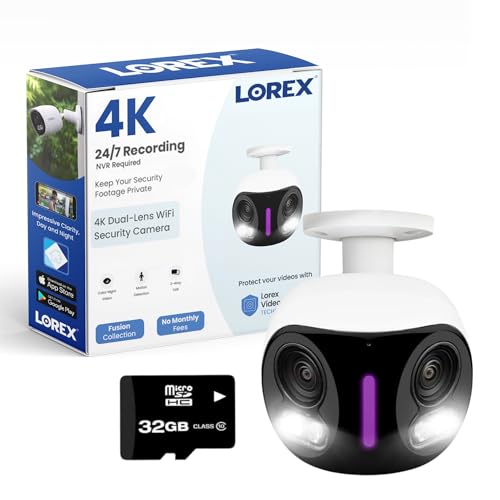
Lorex
4K Dual-Lens Wi-Fi Camera
- •Standalone 4K Wi-Fi with a 32GB card included and no recorder required, Alexa and Google ready
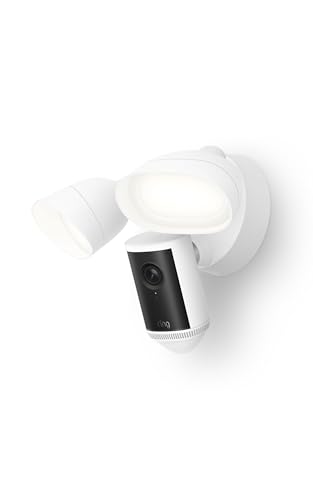
Ring
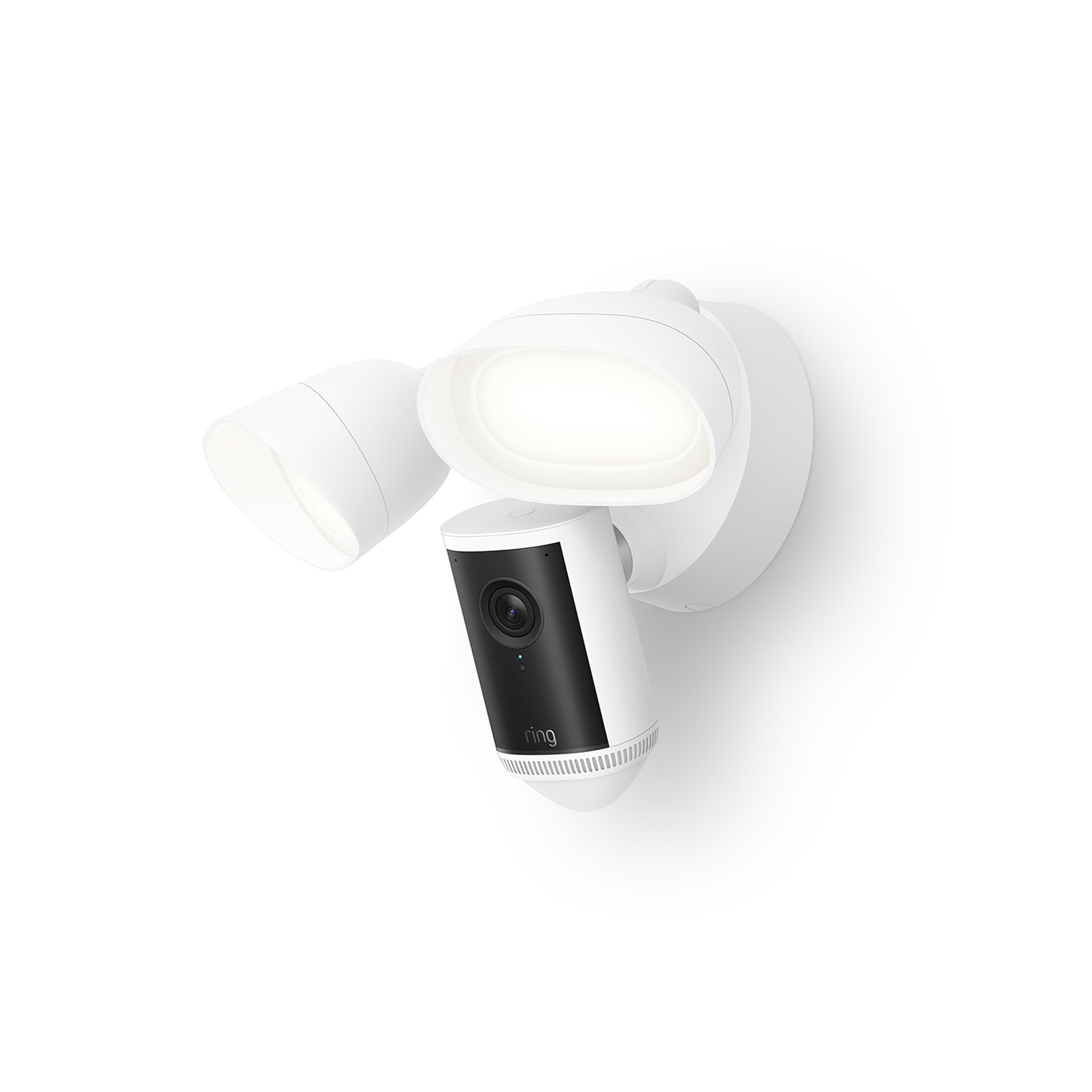
Floodlight Cam Pro (2nd Gen, Retinal 4K)
- •The only Alexa-native 4K floodlight with 10x zoom — but 4K storage is a paid Ring feature
Head-to-Head: Coverage, Power, Lumens, and Ongoing Cost
Security
Chart
 Smarthomeexplorer.com
What "4K" Actually Buys You on a Floodlight
The driveway camera you bought last year promised 4K, yet the footage still rendered a license plate as an unreadable smear the night an intruder reversed into your mailbox. PCWorld, Consumer Reports, and The Ambient, the outlets that genuinely lab-test this category, keep flagging that gap between packaging and playback, because makers began stamping "4K" onto 2K sensors with an upscaler around 2023. The six cameras in this guide genuinely output a 3840x2160 stream at 8.3 megapixels.
The resolution advantage materializes only under two conditions. The genuine benefit emerges when you zoom or crop — recovering a plate at 40 ft or a face at the frame edge — whereas a 2K sensor handles a wide daytime shot equivalently. The decisive variable is subscription cost: 4K is worthless when a fee gates storage. Our weighted formula ranks the Reolink TrackFlex first versus the Ring Floodlight Pro last.
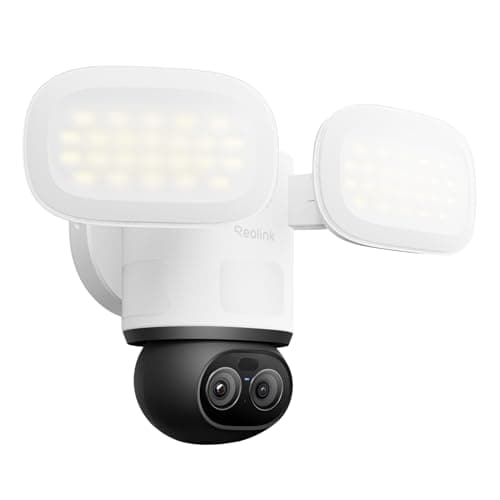
Best for large yards: Reolink TrackFlex Floodlight WiFi
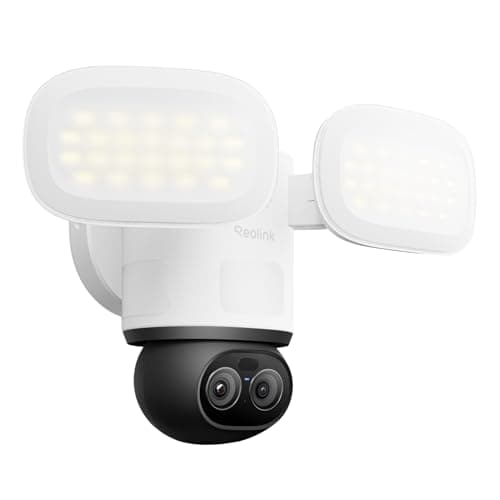
Reolink TrackFlex Floodlight WiFi
- 360-degree pan and tilt — the only floodlight cam in the 4K class that physically moves
- Motorized PTZ mechanism is a long-term wear point a fixed cam doesn't have
(Current price, subject to change)
The Reolink TrackFlex Floodlight WiFi is the right call for buyers whose property outruns a static lens, and the wrong one when a single 180-degree view already sees everything. Three facts decide it: a 50 ft detection range that leads this slate, a primary 4K sensor paired with a 2K telephoto lens for 6x hybrid zoom, and 360-degree pan with 50 degrees of tilt. On our weighted SHE Floodlight Coverage Value Score it normalizes to a composite 9.8, the highest here, because the lumens-times-range-times-resolution-per-dollar formula rewards its long range and $0 fees.
The tracking is the whole point. Where a fixed cam hopes its field caught the action, the TrackFlex motorizes the head to keep a person, vehicle, or animal centered, and the 3,000-lumen floodlights match the Elite for color night vision. Compared to a static feed, local AI video search runs on-device, so filtering costs $0 per month and Wi-Fi 6 keeps the heavier PTZ bitrate stable. A motor wears, and dual-lens-plus-PTZ recording consumes more card space than the Reolink Elite Floodlight WiFi. For a large yard that is a fair trade; for a tidy porch, the Elite is steadier at a near-identical price.
What We Love
- 360-degree pan and tilt — the only floodlight cam in the 4K class that physically moves
- 6x hybrid zoom built around the 4K frame for plate detail at distance
- Auto-tracking keeps a moving subject centered as it crosses the yard
- 3,000-lumen floodlights with local AI search and no subscription
What Could Be Better
- Motorized PTZ mechanism is a long-term wear point a fixed cam doesn't have
- Dual-lens plus PTZ footage eats more storage than a static 4K feed
- Auto-tracking can chase a swaying branch until you tune the motion zones
- Hardwired AC only — no plug-in or DC option
The Verdict
If you're covering anything bigger than a standard driveway, the Reolink TrackFlex Floodlight WiFi fits the brief — it's the only 4K floodlight that actually pans to follow a subject. At about $219.99 with 360-degree tracking, 6x zoom, and zero fees, you can stop the search here for a large yard. The honest trade is a motor that's a wear point and needs tuning to stop chasing shadows.
Ready to upgrade your home?
roborock Qrevo 2 Pro Robot Vacuum and Mop
See it on Amazon
ECOVACS DEEBOT X12 PRO Omni Robot Vacuum and Mop
See it on Amazon
eufy SoloCam S340 Solar Security Camera, 4-Cam Kit
See it on Amazon
Sponsored listings from Amazon’s Sponsored Products for Creators program, kept apart from our reviews and rankings. How we make money
Best no-fee fixed pick: Reolink Elite Floodlight WiFi
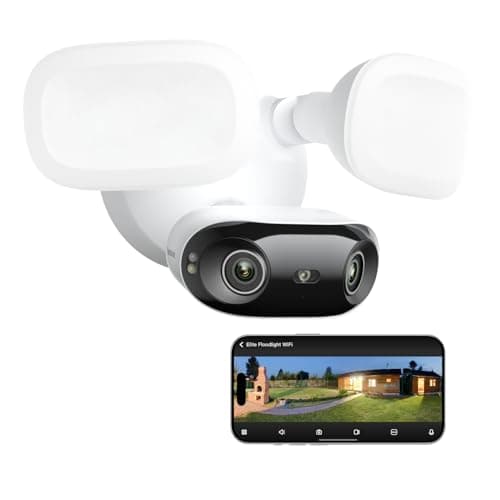
Reolink Elite Floodlight WiFi
- 3,000-lumen adjustable floodlight, the brightest in this 4K slate
- Hardwired only (100-240V AC) — not a plug-in unit
(Current price, subject to change)
The Reolink Elite Floodlight WiFi is the right pick for most no-fee buyers covering a single wide scene, and the wrong one if you need a moving camera. The decision facts: a dual-lens 4K stream Reolink rates at 5120x1552, an adjustable 3,000-lumen floodlight, and 40 ft of effective detection across a 180-degree field. Its weighted SHE Floodlight Coverage Value Score normalizes to a composite 8.2, second here, held just under the TrackFlex by a detection range 10 ft shorter.
The coverage genuinely earns its keep. PCWorld awarded an Editors' Choice and praised the "relatively distortion-free 180-degree field of view," noting no subscription is needed for storage or features, while Consumer Reports tested the unit and rated the daytime image about as sharp and clear as they've seen. Trusted Reviews called it an outstanding all-rounder for subscription-free security, with the caveat that its 20 fps capture makes motion look a touch stuttered.
Compared to the Reolink TrackFlex Floodlight WiFi it gives up active tracking; versus the Reolink Duo Floodlight WiFi 6 (2nd Gen) it gains 1,200 lumens and color night vision to 40 ft. For a fixed mount over a two-car driveway, that brightness makes it the steadiest no-fee default in the slate.
What We Love
- 3,000-lumen adjustable floodlight, the brightest in this 4K slate
- 180-degree panoramic 4K via dual-lens stitching with minimal fisheye distortion
- Local AI video search and 24/7 microSD recording with no monthly fee
- Dual-band Wi-Fi 6 handles the 4K bitrate without dropouts
What Could Be Better
- Hardwired only (100-240V AC) — not a plug-in unit
- Wall-mount only; no pole or soffit bracket in the box
- 20fps capture gives fast motion a slightly stuttered look, per Trusted Reviews
- No Ethernet option, so it shares router airtime with everything else
The Verdict
If you want maximum fixed coverage with no ongoing bill, the Reolink Elite Floodlight WiFi checks the boxes that matter for a standard driveway. PCWorld gave it an Editors' Choice and Consumer Reports rated its daytime picture among the sharpest they've seen — 180-degree 4K, 3,000 lumens, local AI. You can stop here unless you need PTZ or wired Ethernet.
Best value 4K pick: Reolink Duo Floodlight WiFi 6 (2nd Gen)
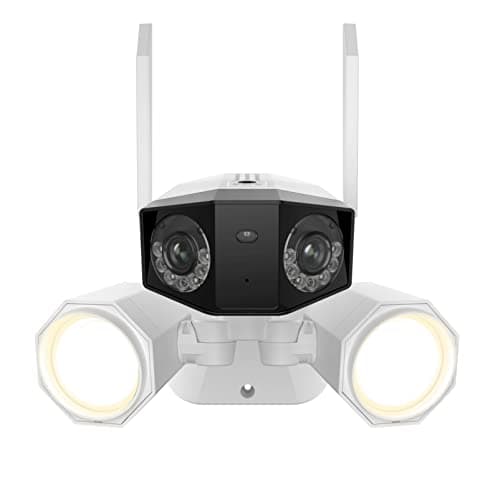
Reolink Duo Floodlight WiFi 6 (2nd Gen)
- Lowest entry price for true 4K dual-lens in this slate, under $180
- 1,800 lumens, the low end of the slate alongside the Duo PoE
(Current price, subject to change)
The Reolink Duo Floodlight WiFi 6 (2nd Gen) is the right buy for budget-minded 4K shoppers, and the wrong one if you need the brightness or range of the step-up models. The facts that decide it: a genuine 4K 8MP dual-lens sensor with a 180-degree field, an 1,800-lumen floodlight, and a sub-$180 street price that's the floor for real 4K here. Its weighted SHE Floodlight Coverage Value Score normalizes to a composite 6.4 — strong cost efficiency pulled down by the lower lumens and 40 ft range.
What it does not compromise is the sensor. This is the same 3840x2160 dual-lens resolution as the Reolink Elite Floodlight WiFi, so daytime detail and digital zoom hold up; you simply give up the Elite's extra 1,200 lumens and the Reolink TrackFlex Floodlight WiFi's motorized tracking and 6x zoom. Wi-Fi 6 keeps the 4K stream stable, and the local AI person, vehicle, and pet filtering carries no subscription.
For a standard residential driveway where the camera sits 20 ft to 40 ft from the action, the brightness gap rarely matters, and the savings are real. Compared to the Elite, you step up only when the yard is deep enough that 1,800 lumens leaves the far corners beyond 40 ft in IR black-and-white.
What We Love
- Lowest entry price for true 4K dual-lens in this slate, under $180
- Dual-band Wi-Fi 6 tames the 4K bitrate on a modern router
- Color night vision via the 1,800-lumen floodlight
- Local person, vehicle, and pet AI detection with no cloud fee
What Could Be Better
- 1,800 lumens, the low end of the slate alongside the Duo PoE
- No PTZ; a static 180-degree field only
- 40-foot detection trails the Elite and TrackFlex
- Reolink app is feature-dense and not the friendliest for first-timers
The Verdict
If you want genuine 4K floodlight coverage and a sub-$180 price, the Reolink Duo Floodlight WiFi 6 (2nd Gen) is a sensible pick for that setup. You get the same real 3840x2160 dual-lens sensor as the pricier Reolinks, just with fewer lumens and no PTZ. No need to overthink it as a first 4K floodlight — the trade is brightness and reach, not resolution.
Check price for the Reolink Duo Floodlight WiFi 6 (2nd Gen) →
Best for an NVR or PoE run: Reolink Duo Floodlight PoE
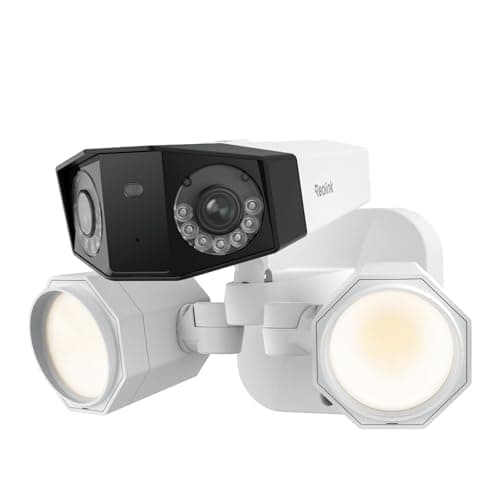
Reolink Duo Floodlight PoE
- One Ethernet cable carries both power and the 4K video stream
- 1,800 lumens, tied for the lowest output in the slate
(Current price, subject to change)
The Reolink Duo Floodlight PoE is the right call for households with Ethernet infrastructure, and the wrong one for a retrofit on a Wi-Fi-only network. Three facts anchor it: a 4K 8MP dual-lens 180-degree field with 40 ft detection, a single PoE cable that delivers power and video together, and an IP66 housing rated for direct rainfall. Its weighted SHE Floodlight Coverage Value Score normalizes to a composite 5.8, a touch behind the Wi-Fi 6 sibling because its first-year cost is slightly higher for the same 1,800 lumens and 40 ft range.
The case for it is reliability. At a sustained 4K bitrate, Wi-Fi is the weakest link, and running power plus data over one Cat6 sidesteps router contention entirely — which is why this is the model to pick once an NVR is in the picture. ONVIF support drops it into Blue Iris, Synology, UniFi Protect, or a Reolink recorder.
Compared to the Reolink Duo Floodlight WiFi 6 (2nd Gen) it trades a simpler plug-in install for cabled stability; versus the Lorex 4K Dual-Lens Wi-Fi Camera it gives up onboard microSD for true NVR integration. If you don't already own a PoE switch, factor that into the budget before choosing it over the Wi-Fi models.
What We Love
- One Ethernet cable carries both power and the 4K video stream
- 4K 8MP dual-lens with a stitched 180-degree ultra-wide field
- ONVIF-compatible with Blue Iris, Synology, UniFi, and Reolink NVRs
- IP66 weather rating and no subscription with local NVR storage
What Could Be Better
- 1,800 lumens, tied for the lowest output in the slate
- Needs a PoE switch or injector, which is not always included
- A Cat6 run to the eaves adds real install effort versus Wi-Fi
- No deep native Alexa or Google voice integration
The Verdict
If you already have a PoE switch or an NVR and Cat6 to the eaves, the Reolink Duo Floodlight PoE is a sensible pick for that setup — one cable for power and 4K data, no Wi-Fi bandwidth worries at all. You'll be well-served here for a rock-stable bitrate. The honest catch is the install: you supply the PoE gear and pull the cable.
Best standalone Lorex pick: Lorex 4K Dual-Lens Wi-Fi Camera
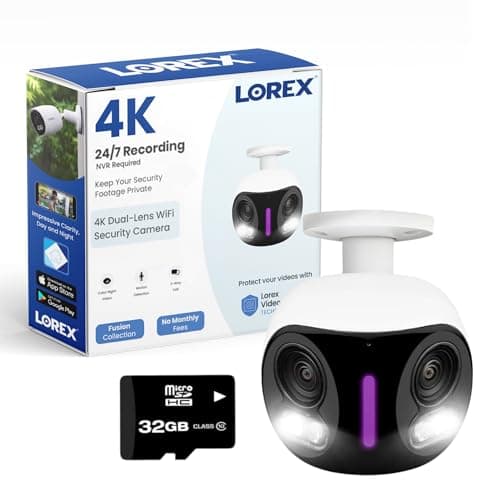
Lorex 4K Dual-Lens Wi-Fi Camera
- Standalone Wi-Fi camera — no NVR or recorder required to run it
- Floodlight lumens are not published by Lorex — treat the lighting as a deterrent
(Current price, subject to change)
The Lorex 4K Dual-Lens Wi-Fi Camera is the right pick for no-fee buyers who want a self-contained camera, and the wrong one if floodlight brightness is the deciding spec. The decision facts: a 4096x1856 dual-lens 4K field with 40 ft detection, a 32GB microSD preinstalled and expandable to 256GB, and standalone Wi-Fi that needs no recorder. Its weighted SHE Floodlight Coverage Value Score normalizes to a composite 6.0, lifted by real resolution and a low price but tempered by lumens Lorex never publishes.
Mainstream testing backs the core claim. Reviewed described the picture as crisp detail on par with competitors like Eufy and Ring and praised the preloaded local storage, while Consumer Reports tested the same standalone unit and rated daytime sharpness about as good as they've seen. Security.org credits Lorex with high-quality 4K and local storage at no monthly fee, the trade being self-install and no professional monitoring.
Compared to the Reolink Elite Floodlight WiFi it concedes a published 3,000-lumen flood and a 15 fps rate that softens fast motion; versus the Reolink Duo Floodlight PoE it gives up NVR integration for onboard-card simplicity. As a standalone that records locally at 40 ft out of the box, it earns its place even though the unlit floodlight keeps it mid-pack.
What We Love
- Standalone Wi-Fi camera — no NVR or recorder required to run it
- 4096x1856 dual-lens 180-degree panoramic 4K with color night vision
- Ships with a 32GB card and records locally, expandable to 256GB, no fees
- Smart Security Lighting, two-way talk, and auto-framing that follows a subject
What Could Be Better
- Floodlight lumens are not published by Lorex — treat the lighting as a deterrent
- 15fps 4K capture makes fast motion look slightly choppy
- IP66 housing, a step below the IP67 Reolink Duo units
- Reviewers flag fiddly install and no professional monitoring
The Verdict
If you want a standalone 4K Wi-Fi camera with storage in the box and no recorder to buy, the Lorex 4K Dual-Lens Wi-Fi Camera fits the brief. Reviewed found its detail on par with Eufy and Ring, and a 32GB card ships preloaded — at around $185 on sale, that's a clean no-fee entry. The honest constraints are unpublished lumens and a 15fps capture that softens fast motion.
Best for Ring/Alexa homes: Ring Floodlight Cam Pro (2nd Gen, Retinal 4K)
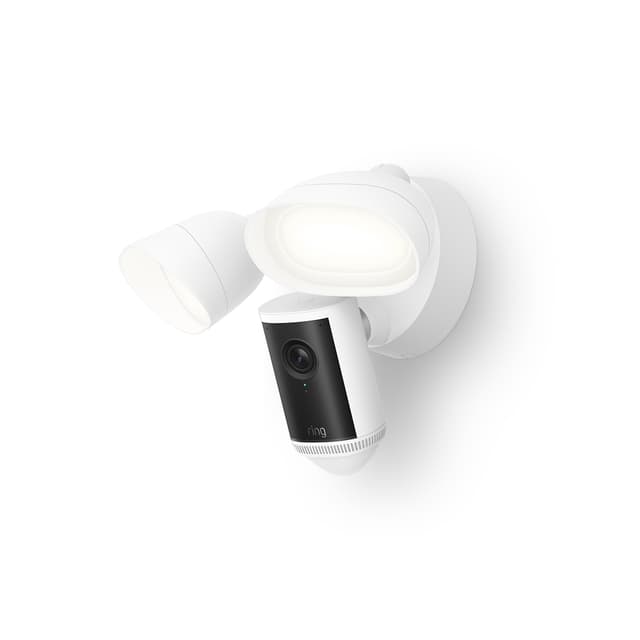
Ring Floodlight Cam Pro (2nd Gen, Retinal 4K)
- Genuine 3840x2160 Retinal 4K sensor, not an upscaled 2K stream
- Full 4K clip storage and AI alerts require a paid Ring Home plan
(Current price, subject to change)
The Ring Floodlight Cam Pro (2nd Gen, Retinal 4K) is the right buy for an Alexa-and-Ring household, and the wrong one for anyone who refuses a subscription. Three facts matter: a genuine 3840x2160 Retinal 4K sensor, 10x Enhanced Zoom that uses those real pixels, and a price that climbs by $60 per year once the Ring Home plan is added. Its weighted SHE Floodlight Coverage Value Score normalizes to a composite 3.0, last here — not because the hardware is weak, but because our first-year-cost formula prices in that fee no Reolink requires.
The resolution is real, and that is the honest case for it. The sensor genuinely outputs 3840x2160, and the 10x zoom recovers detail at 30 ft because the source pixels exist. Radar motion zones measure actual distance, so it alerts when someone crosses a line you draw, and it shares one timeline with a Ring doorbell and Ring Alarm.
The catch is structural. Compared to every no-fee Reolink, Ring gates the 4K clip storage and rich AI behind the Ring Home plan, so the resolution only fully works as a subscription product. For a committed Ring home that is worth it; for everyone else, the Reolink Elite Floodlight WiFi delivers more coverage with no fee.
What We Love
- Genuine 3840x2160 Retinal 4K sensor, not an upscaled 2K stream
- 10x Enhanced Zoom built around the 4K frame for plate detail
- Radar-based motion zones cut false alerts from swaying branches
- Native Alexa and Ring Alarm integration on a shared timeline
What Could Be Better
- Full 4K clip storage and AI alerts require a paid Ring Home plan
- $279.99 MSRP is the highest in the slate before the subscription
- Hardwired install only — needs an existing floodlight junction box
- Cloud-first storage with no local microSD option
The Verdict
If you already live in Ring's world — a Ring doorbell, Ring Alarm, an Echo Show — the Ring Floodlight Cam Pro (2nd Gen, Retinal 4K) fits the brief as the one pick that slots in without friction. It's the only Alexa-native 4K floodlight here, with a real 4K sensor and 10x zoom. Just know the Ring Home plan isn't optional for the advertised 4K storage and AI — it's effectively part of the price.
Check price for the Ring Floodlight Cam Pro (2nd Gen, Retinal 4K) →
How We Score: SHE Floodlight Coverage Value Score
SHE Floodlight Coverage Value Score
Score Formula
(Lumens × Detection_Range × Resolution_MP) ÷ Total_First_Year_Cost, normalized to a 0-10 scale across the slateScore Factors
- LumensManufacturer floodlight output, cross-checked against reviewer-cited brightness at PCWorld and Consumer Reports. Where a maker does not publish a figure — as with the Lorex standalone — we use a conservative estimate and flag it openly rather than inventing a spec.
- Detection Range (feet)The effective PIR or AI motion-detection distance, not the much longer 'visible image range' makers prefer to quote. Forty to fifty feet is solid residential coverage; under thirty is limiting.
- Resolution (megapixels)Raw effective megapixels of the full stitched sensor output — 8.3 MP for a genuine 3840x2160 single or dual-lens stream, and 7.6 MP for the Lorex's 4096x1856. Upscaled '4K' that isn't truly 8-megapixel does not qualify for this guide.
- Total First-Year CostVerified Amazon price plus twelve months of any mandatory subscription. That is $0 in fees for every Reolink and the Lorex, and $60 for the Ring Floodlight Cam Pro because full 4K storage and AI require a Ring Home plan — the single biggest separator in the slate.
- 0-10 NormalizationThe raw ratio runs into the thousands, so we min-max normalize the six results onto a readable 0-10 band. The raw figures appear in the rankings below for anyone who wants to replicate the math from a spec sheet.
SHE Floodlight Coverage Value Score — Ranked
Reolink TrackFlex Floodlight WiFi
SHE Floodlight Coverage Value Score9.8/10Raw ratio 5,659 — 3,000 lumens, 50-foot range, and no fee make it the value leader
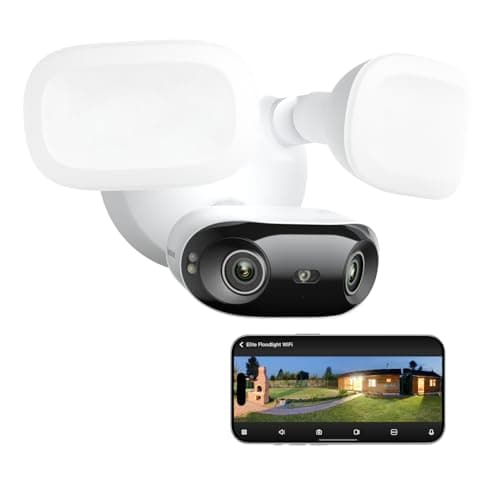
Reolink Elite Floodlight WiFi
SHE Floodlight Coverage Value Score8.2/10Raw ratio 4,559 — brightest fixed 4K, 180-degree coverage, zero subscription
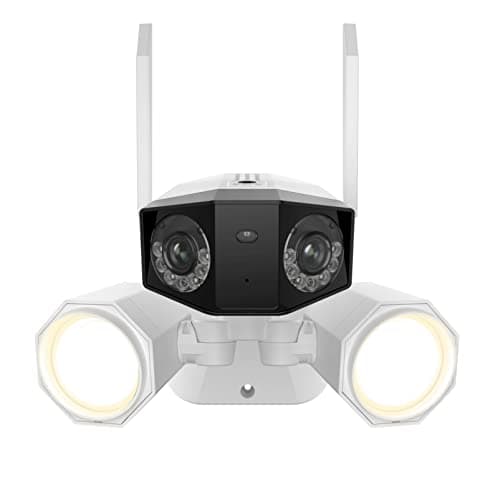
Reolink Duo Floodlight WiFi 6 (2nd Gen)
SHE Floodlight Coverage Value Score6.4/10Raw ratio 3,516 — same real 4K sensor under $180, fewer lumens and shorter range
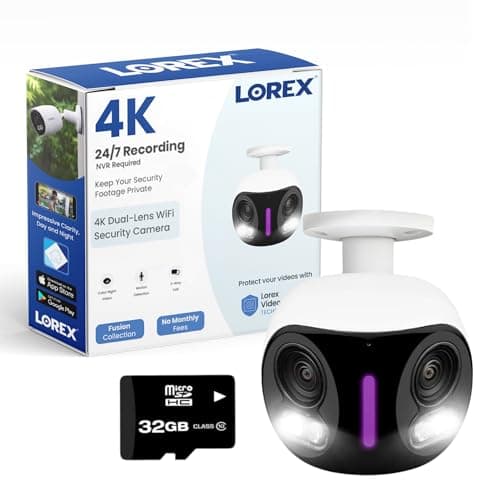
Lorex 4K Dual-Lens Wi-Fi Camera
SHE Floodlight Coverage Value Score6.0/10Raw ratio 3,287 — standalone 4K with local storage; lumens unpublished and estimated
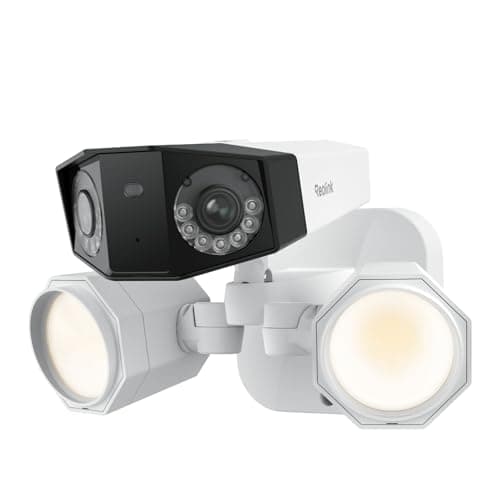
Reolink Duo Floodlight PoE
SHE Floodlight Coverage Value Score5.8/10Raw ratio 3,145 — wired 4K reliability, slightly higher cost for the same output
Ring Floodlight Cam Pro (2nd Gen, Retinal 4K)
SHE Floodlight Coverage Value Score3.0/10Raw ratio 1,465 — best ecosystem, dragged last by a $60-a-year subscription
Ecosystem Fit: Alexa, Google, ONVIF, and the HomeKit Gap
The platform split here is cleaner than in most camera categories, and it changes the buy more than any single spec. Ring is the Alexa-and-Ring story: arm the Ring Floodlight Cam Pro (2nd Gen, Retinal 4K) by voice and pull its feed onto an Echo Show, but accept there is no Google Home, no HomeKit, and a subscription gating the 4K. Every Reolink and the Lorex offer Alexa and Google Home live-view skills with on-device AI, so the person and vehicle filtering that Ring charges for runs free — the catch is that none of them speak Apple HomeKit either.
For local-first buyers, the Reolink Duo Floodlight PoE is the standout because its ONVIF support drops it into Blue Iris, Synology, UniFi Protect, or a Reolink recorder with no cloud at all, while the Lorex 4K Dual-Lens Wi-Fi Camera records to its own microSD out of the box. Genuine 4K HomeKit Secure Video floodlights effectively do not exist in 2026, so an Apple-first household should treat this whole category as off-platform — our Best Matter Security Cameras 2026: Aqara G350 Wins guide covers what little exists there, and the cheaper 2K tier sits in our Best Smart Floodlight Cameras 2026: Security + Lighting hub. Because the SHE Floodlight Coverage Value Score weights ongoing cost heavily, the no-fee Reolink and Lorex picks rank above Ring on value even though Ring's ecosystem is the most polished, and that fee-versus-features split, verified June 2026, is the real decision here.
| Product | Alexa | Google Home | HomeKit | ONVIF | Local Storage |
|---|---|---|---|---|---|
| Reolink TrackFlex Floodlight WiFi | ✓ | ✓ | ✕ | ✕ | ✓ |
| Reolink Elite Floodlight WiFi | ✓ | ✓ | ✕ | ✕ | ✓ |
| Reolink Duo Floodlight WiFi 6 (2nd Gen) | ✓ | ✓ | ✕ | ✕ | ✓ |
| Reolink Duo Floodlight PoE | ✓ | ✓ | ✕ | ✓ | ✓ |
| Lorex 4K Dual-Lens Wi-Fi Camera | ✓ | ✓ | ✕ | ✕ | ✓ |
| Ring Floodlight Cam Pro (2nd Gen, Retinal 4K) | ✓ | ✕ | ✕ | ✕ | ✕ |
When NOT to Buy
A 4K floodlight is the wrong purchase for a tight side-yard where the camera sits 10 to 15 feet from its subject, because at that distance a 2K floodlight produces equivalent usable footage at roughly a third the bandwidth and storage cost. It also disappoints anyone on a Wi-Fi 5 router with no upgrade path, since a sustained 4K bitrate stutters and drops frames on older hardware — the PoE model is the only clean workaround, and that's a real install change. And if you are committed to Apple HomeKit, skip the category outright: genuine 4K HomeKit floodlights don't exist in 2026, and forcing it leads only to frustration.
Who Should Buy What
Who Should Buy What
| If you are… | Recommended pick |
|---|---|
Large-property owner You have a corner lot, long driveway, or multi-zone yard and want active tracking plus 4K zoom with no subscription | Reolink TrackFlex Floodlight WiFi |
No-fee fixed-mount buyer You want the brightest subscription-free 4K floodlight for one wide 180-degree view and run a Wi-Fi 6 router | Reolink Elite Floodlight WiFi |
Budget 4K shopper You want genuine 4K dual-lens for the lowest price and don't need maximum lumens or PTZ | Reolink Duo Floodlight WiFi 6 (2nd Gen) |
Wired or NVR household You already have a PoE switch or NVR and Cat6 to the eaves and want rock-stable 4K with no Wi-Fi worries | Reolink Duo Floodlight PoE |
Ring ecosystem home You're committed to Ring and Alexa and accept a Ring Home plan to unlock full 4K storage and AI alerts | Ring Floodlight Cam Pro (2nd Gen, Retinal 4K) |
Frequently Asked Questions
Is 4K actually worth it on a floodlight camera, or is 2K enough?
4K is worth it only if you plan to zoom into footage, read a license plate at distance, or submit a usable still to police. For casual monitoring of a typical driveway with no intent to zoom, a good 2K floodlight delivers equivalent usable footage at lower storage and bandwidth cost. The 4K advantage shows up in digital zoom fidelity and long-range detail, not in a wide daytime shot. If you won't zoom, the 2K options in our smart floodlight cameras hub serve you for less.
What's the best 4K floodlight camera with no subscription?
The Reolink Elite Floodlight WiFi is the best no-subscription pick for a fixed view, with 3,000 lumens, 180-degree dual-lens 4K, and local AI for person, vehicle, and pet detection — PCWorld gave it an Editors' Choice and Consumer Reports rated its daytime image highly. For a large yard, the Reolink TrackFlex adds PTZ tracking, still with no fee. Every Reolink here and the standalone Lorex record locally with zero monthly cost.
Does the Ring Floodlight Cam Pro need a subscription to use 4K?
Effectively yes for the full experience. The sensor genuinely captures 3840x2160, but Ring gates the 4K clip storage, pre-roll, and rich AI notifications behind the Ring Home plan, which runs about $60 a year. Without it you still get the live 4K view and the local siren, but you lose the recorded 4K footage that makes the resolution worth buying. That recurring fee is why it ranks last on our coverage-value score despite the best ecosystem.
PoE or Wi-Fi for a 4K floodlight camera?
PoE is more reliable; Wi-Fi 6 is easier to install. At a sustained 4K bitrate of roughly 15 to 25 Mbps, a Wi-Fi 5 network struggles under shared airtime, while PoE delivers a rock-stable feed on one Cat6 run. If you already have a PoE switch or NVR and can pull cable, the Reolink Duo Floodlight PoE is the stronger long-term bet. For a finished retrofit on a modern Wi-Fi 6 router, the Wi-Fi models work fine and skip the wiring.
Does the Lorex 4K Dual-Lens camera require a recorder?
No. The Lorex 4K Dual-Lens Wi-Fi camera in this guide is a standalone unit that ships with a 32GB microSD card and records locally, expandable to 256GB, with no monthly fee. Consumer Reports and Reviewed both tested it as a standalone Wi-Fi camera. Some Lorex packaging references a Fusion NVR system, but this specific model runs on its own over Wi-Fi and stores footage on the card.
How many lumens do I need for color night vision?
About 1,800 lumens produces usable color night vision on most 4K floodlight sensors, and 2,000 is the residential sweet spot. The Reolink Elite and TrackFlex run 3,000 lumens, which is overkill for a small driveway but useful for a deep backyard. Under 1,500 lumens, the camera tends to fall back to infrared black-and-white in low light. Lorex does not publish a figure for its standalone unit, so treat its lighting as a deterrent rather than a primary flood.
How much storage does 4K floodlight footage use?
Roughly three times the storage of equivalent 2K footage. A 4K stream at about 20 Mbps consumes around 9 GB per hour of continuous recording, so a bundled 32GB card fills fast under 24/7 capture. With motion-triggered clips only, monthly storage drops to 30 to 100 GB depending on traffic, and a 256GB microSD covers several weeks of event-based retention for most homes. The PoE model sidesteps card limits by recording to an NVR.
Bottom Line
Get the Reolink TrackFlex Floodlight WiFi if you have a large yard or corner lot and want 360-degree PTZ tracking plus 4K zoom with no subscription.
Get the Reolink Elite Floodlight WiFi if you want the brightest no-fee fixed 4K floodlight for a 180-degree view and run a Wi-Fi 6 router.
Get the Reolink Duo Floodlight WiFi 6 (2nd Gen) if you want genuine 4K dual-lens at the lowest price and don't need maximum lumens or PTZ.
Get the Reolink Duo Floodlight PoE if you already have a PoE switch or NVR and Cat6 to the eaves and want wired 4K reliability.
Get the Ring Floodlight Cam Pro (2nd Gen, Retinal 4K) if you're committed to Ring and Alexa and accept a Ring Home plan to unlock full 4K storage.
The right call for most homes is the Reolink TrackFlex Floodlight WiFi for a large yard or the Reolink Elite Floodlight WiFi for a fixed driveway — both deliver real 4K with no recurring fee. Choose the Ring Floodlight Cam Pro (2nd Gen, Retinal 4K) only if Ring and Alexa already run your home and the subscription doesn't bother you. Skip 4K entirely if your yard is small, your router is Wi-Fi 5, and you never plan to zoom into footage.
Sources & Methodology
Methodology: SHE Floodlight Coverage Value Score — Formula: (Lumens × Detection_Range × Resolution_MP) ÷ Total_First_Year_Cost, normalized to a 0-10 scale across the slate. Factors: Lumens: Manufacturer floodlight output, cross-checked against reviewer-cited brightness at PCWorld and Consumer Reports. Where a maker does not publish a figure — as with the Lorex standalone — we use a conservative estimate and flag it openly rather than inventing a spec. | Detection Range (feet): The effective PIR or AI motion-detection distance, not the much longer 'visible image range' makers prefer to quote. Forty to fifty feet is solid residential coverage; under thirty is limiting. | Resolution (megapixels): Raw effective megapixels of the full stitched sensor output — 8.3 MP for a genuine 3840x2160 single or dual-lens stream, and 7.6 MP for the Lorex's 4096x1856. Upscaled '4K' that isn't truly 8-megapixel does not qualify for this guide. | Total First-Year Cost: Verified Amazon price plus twelve months of any mandatory subscription. That is $0 in fees for every Reolink and the Lorex, and $60 for the Ring Floodlight Cam Pro because full 4K storage and AI require a Ring Home plan — the single biggest separator in the slate. | 0-10 Normalization: The raw ratio runs into the thousands, so we min-max normalize the six results onto a readable 0-10 band. The raw figures appear in the rankings below for anyone who wants to replicate the math from a spec sheet.
Expert review sources used in this analysis:
- SmartHomeExplorer aggregates expert review data and manufacturer specifications to produce consensus-based buying guidance; we do not perform first-party product testing
- Dedicated mainstream coverage of genuine-4K floodlight cameras is thin, so verdicts lean on the outlets that actually reviewed each unit — PCWorld, Consumer Reports, and Trusted Reviews for the Reolink Elite, and Reviewed, Consumer Reports, and Security.org for the standalone Lorex — alongside manufacturer specifications from Ring, Reolink, and Lorex for the products no mainstream outlet has reviewed
- Prices were verified live via the Amazon Creators API on 2026-06-14
- The SHE Floodlight Coverage Value Score weights lumens, detection range, and resolution per first-year dollar, normalized to a 0-10 scale; no first-party measurements were conducted.
Nicholas Miles is the founder of SmartHomeExplorer and a longtime smart home enthusiast focused on helping everyday homeowners make better technology decisions. He researches, compares, and writes about products across security, climate, lighting, leak prevention, sensors, home energy, and automation, with an emphasis on real-world usefulness, ecosystem compatibility, reliability, privacy, and long-term value.
Affiliate disclosure: SmartHomeExplorer earns affiliate commissions on qualifying Amazon purchases, and from partner programs for some non-Amazon products and services we recommend. Our scoring methodology is independent of affiliate relationships.