
SHE Smart Astronomy Accessibility Score (0–10)
Ranks smart telescopes on setup ease, app quality, automation, image quality, and portability
$1,590 · Best Premium
$499 · Best Overall
$2,599 · Luxury Pick
$549 · Most Portable
$399 · Budget Pick
$429 · Best App-Assisted
SmartHomeExplorer editorial analysis. Formula: (Setup×0.25) + (App×0.20) + (Automation×0.20) + (ImageQuality×0.20) + (Portability×0.15)
Backyard astrophotography used to require a car full of equipment, a degree in patience, and a firm belief that star-finding charts printed on paper were somehow fun. The ZWO Seestar S50 ($499) changed that — and a wave of smart telescopes has followed that can capture galaxies from your patio with about as much effort as connecting a new speaker to Wi-Fi. We aggregated expert reviews from 8+ sources including astrobackyard, Space.com, and Digital Camera World to score six smart telescopes on our proprietary SHE Smart Astronomy Accessibility Index.
The short answer: The ZWO Seestar S50 ($499, SHE score 8.80) is the top pick — best balance of image quality, automation, and value, with the largest expert review pool of any smart telescope.
For a lifestyle context: if smart outdoor speakers are on your patio and you want to add a conversation-piece gadget for summer evenings, you're exactly who these products are built for. See our smart outdoor speaker guide for the audio side of the setup.
We compared six smart telescopes across 8+ expert review sources per product, scoring each on a weighted formula: Setup Ease (25%), App Quality (20%), Automation Level (20%), Image Quality (20%), and Portability (15%). No physical testing — these scores reflect aggregated expert consensus, not our own observations. The SHE Astrophotography Value Score adds a Price Value weight (20%) to help buyers compare across price tiers.
Smart Telescope
Chart
 Smarthomeexplorer.com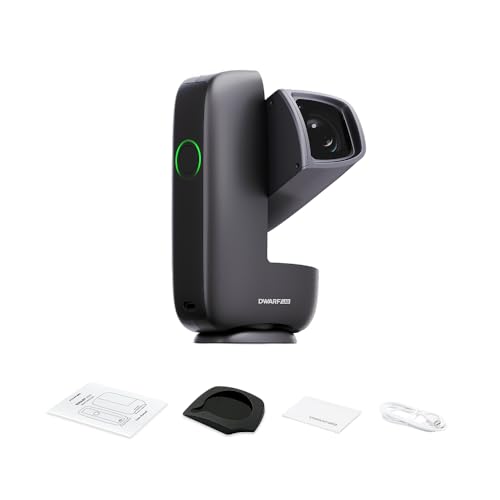
DwarfLab DWARF Mini Smart Telescope — Budget Pick
DwarfLab DWARF Mini Smart Telescope
(Current Price, subject to change)
Ready to upgrade your home?
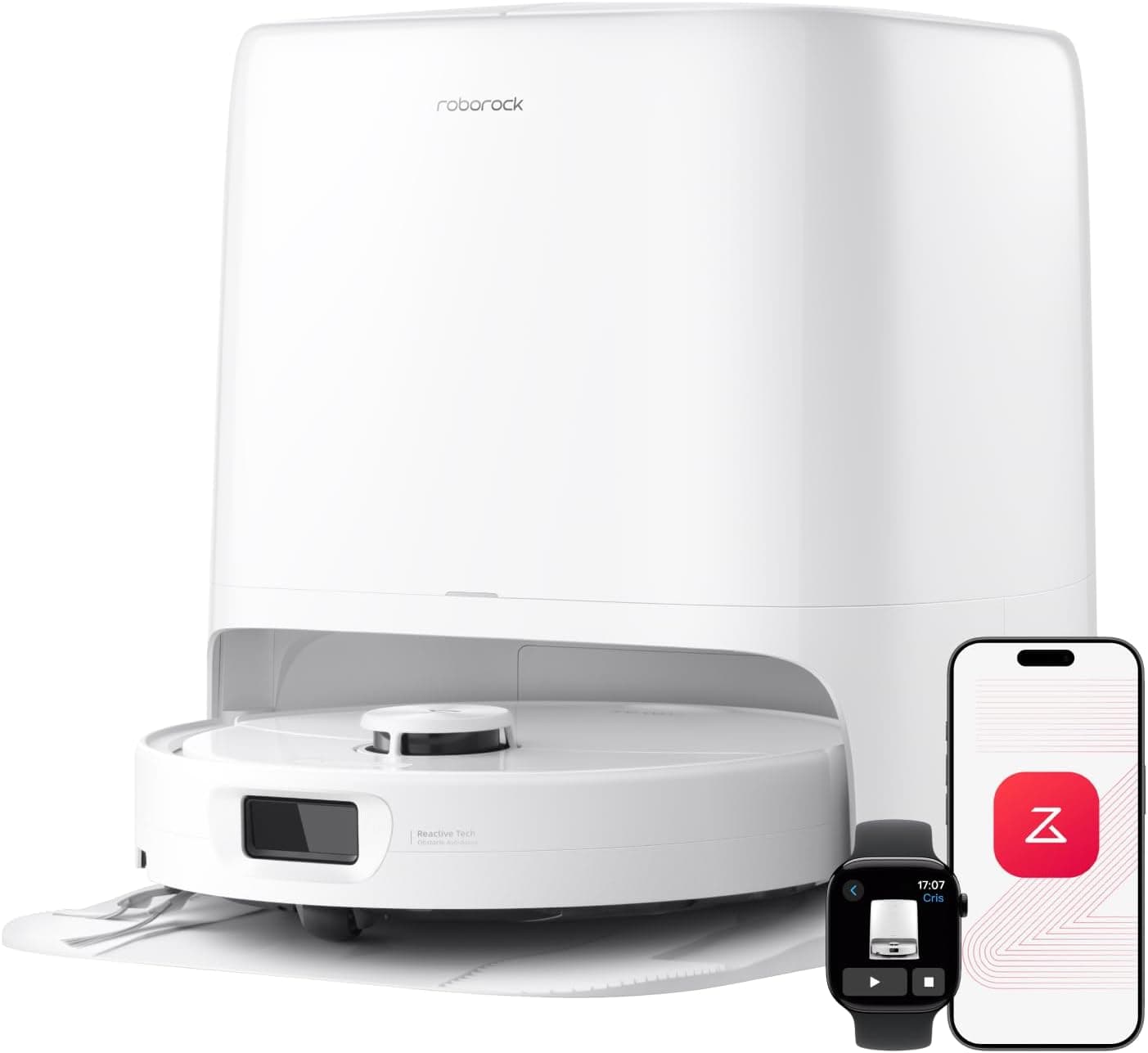
roborock Qrevo 2 Pro Robot Vacuum and Mop
See it on Amazon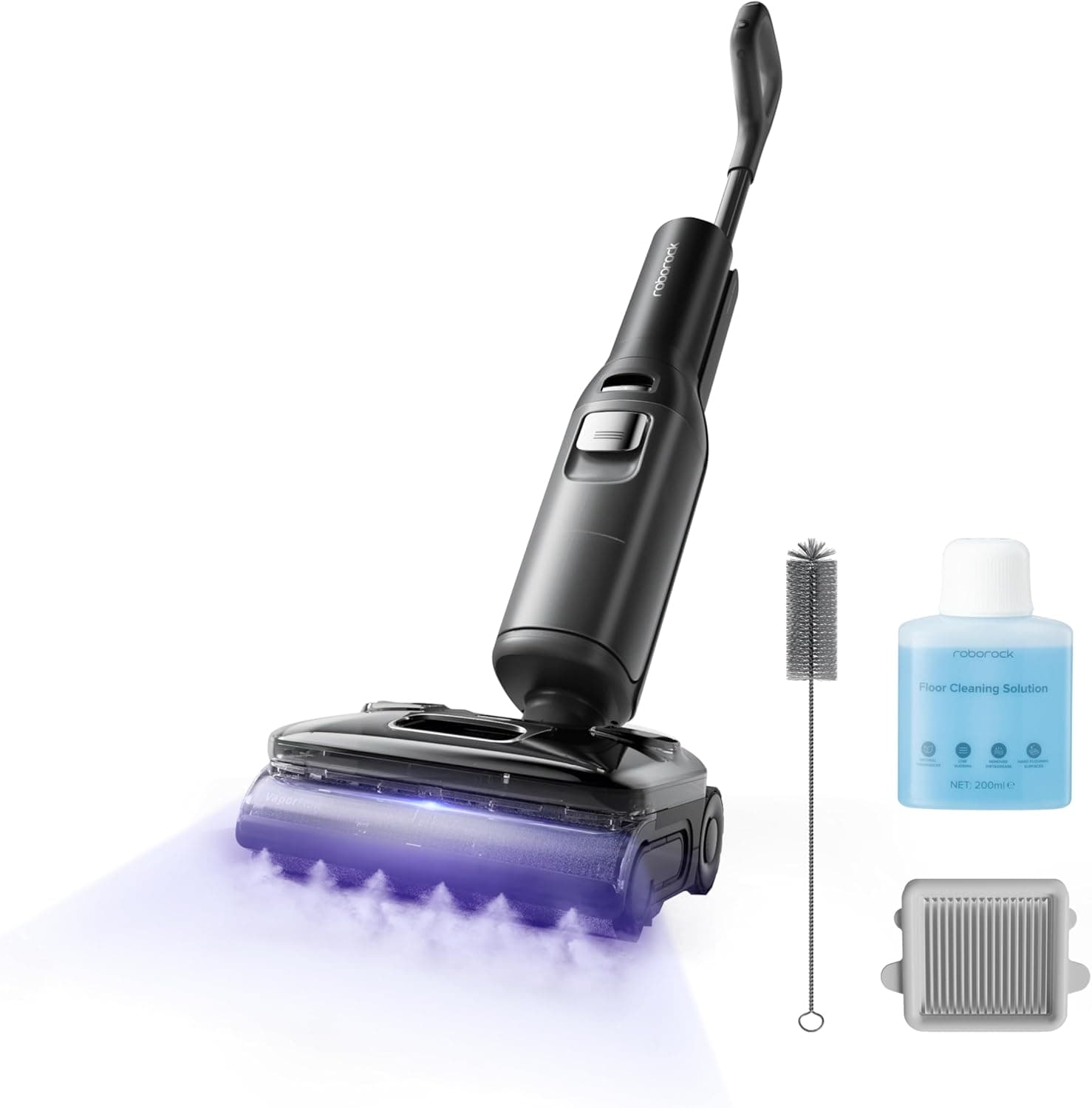
roborock F25 Ultra Steam Wet Dry Vacuum Mop
See it on Amazon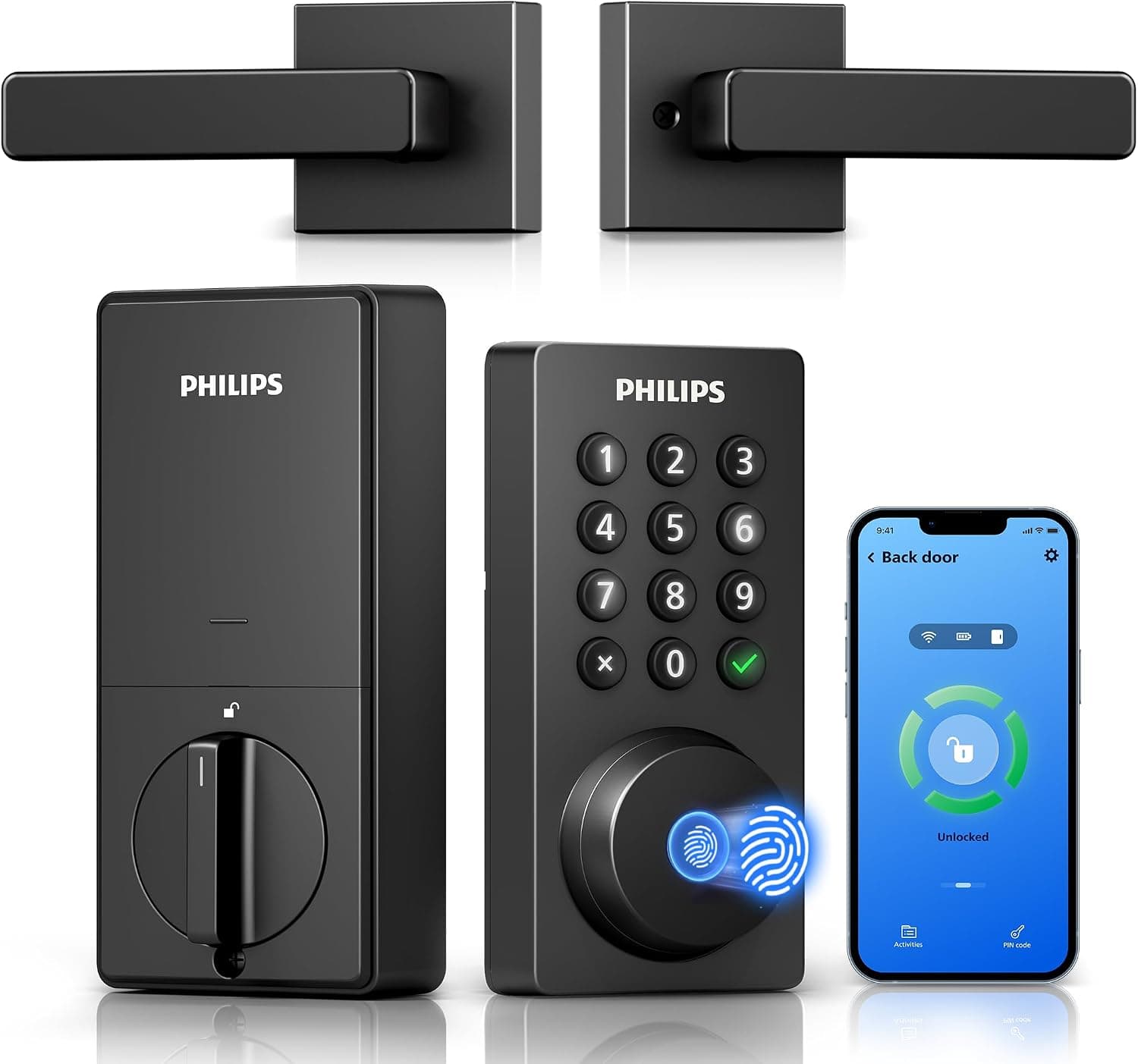
Philips Wi-Fi Keypad Deadbolt with Handle
See it on Amazon
Sponsored listings from Amazon’s Sponsored Products for Creators program, kept apart from our reviews and rankings. How we make money
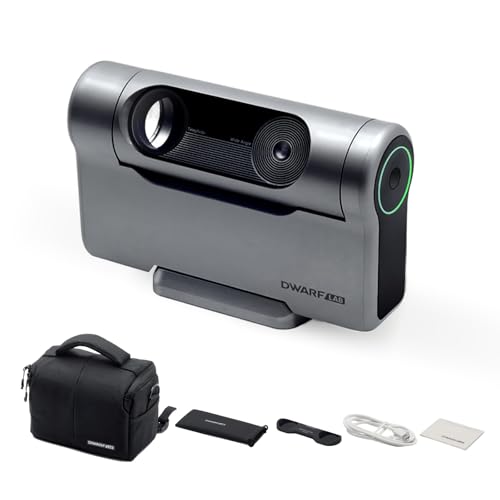
At 840g and priced at $399, the DwarfLab DWARF Mini Smart Telescope is DwarfLab's entry-level answer to the question of how small and cheap a smart telescope can get while still being genuinely useful. Reviewers at astrobackyard found the image quality "comparable to the S30 in a tiny package" — which is a real statement given the sensor constraints at this size. The built-in dual-band and light pollution filters mean you don't need to buy a $50-100 aftermarket filter to cut through suburban skyglow, which keeps the real-world value proposition stronger than the sticker price suggests.
The DwarfLab DWARF Mini Smart Telescope scores a 7.89 on the SHE Smart Astronomy Accessibility Index — the lowest automated-scope score in this group, mostly pulled down by its app quality rating (7.0 vs. the S50's 9.0) and a narrower image quality ceiling from its compact sensor. The SHE Value Score is 7.68. For a summer patio setup, this is the "just get something and see if I like it" pick — and that's not a knock.
"The DWARF Mini offers a lot of value for its price — astrophotography quality comparable to the S30 in a tiny package." — astrobackyard
What We Love
- Sub-900g total weight — the DwarfLab DWARF Mini Smart Telescope fits in a jacket pocket; the only smart telescope you'd actually carry on a hiking trail
- Filters included — dual-band narrowband and light pollution filters built in, no extra spend required
- Auto GOTO from a 100,000+ object catalog — point at a target automatically without fumbling through a star chart
What Could Be Better
- Smallest sensor in the group limits faint-galaxy detail — the Seestar S50 resolves more at $100 more
- No equatorial mode wedge included; tracking accuracy on faint targets suffers slightly on long sessions
- App quality lags the Seestar and Vaonis apps — Wi-Fi setup occasionally needs a second try
The Verdict
Get the DwarfLab DWARF Mini Smart Telescope if you want the lowest entry price into smart astrophotography and are willing to accept a smaller sensor in exchange for a unit that fits in a bag.
Skip the DwarfLab DWARF Mini Smart Telescope if your priority is deep-sky image quality — the Seestar S50 at $100 more scores noticeably better and has a larger, more active user community.
How We Score: The SHE Smart Astronomy Accessibility Index
(SmartHomeExplorer editorial analysis — methodology)
SHE Astrophotography Value Score
(SmartHomeExplorer editorial analysis — methodology)
See our Metrics Library for all proprietary SHE scores and detailed methodology.
Celestron StarSense Explorer DX 130AZ — Best App-Assisted Traditional
Celestron StarSense Explorer DX 130AZ
(Current Price, subject to change)
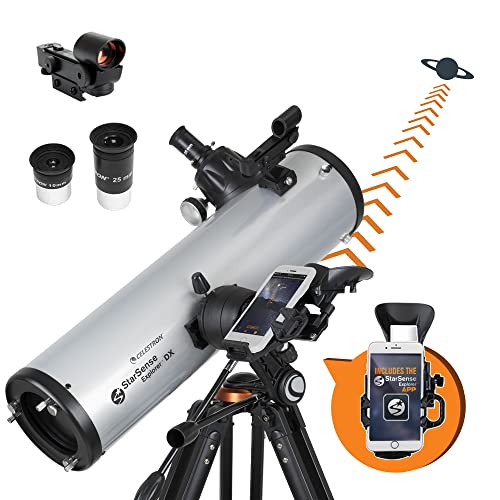
The Celestron StarSense Explorer DX 130AZ occupies a genuinely different category from the other five products in this guide. It's a traditional 130mm Newtonian telescope — meaning you look through it with your eyes and see objects in real-time — paired with a clever phone dock that lets Celestron's StarSense AI identify your sky position via the phone camera and guide you to objects. Space.com reviewers found the app-guided pointing "effortless." What it does not do is take photographs automatically, stack exposures, or produce processed images of galaxies. If you want visual stargazing with a large-aperture scope and AI-assisted navigation, this is the only product here that delivers that.
The Celestron StarSense Explorer DX 130AZ scores a 5.27 on the SHE Accessibility Index — by far the lowest in this comparison, primarily because it has zero image automation (score: 4.0). Its 130mm aperture gathers more light than any of the automated smart telescopes in this guide, but that light goes to your eye, not to a camera sensor. The SHE Value Score of 5.59 reflects the limited automation layer — not a flaw, just an accurate description of what this scope is.
"The StarSense Explorer makes finding objects effortless — the app tells you exactly which direction to push the scope." — Space.com
What We Love
- 130mm aperture — the Celestron StarSense Explorer DX 130AZ has the largest light-gathering optic in this group; Saturn's rings, Jupiter's moons, and double stars look stunning visually
- No subscription, no cloud dependency — StarSense app is free and works offline; nothing breaks if the company pivots its software model
- Real visual experience — seeing the Andromeda Galaxy with your own eyes at 130mm, however faint, is different from a processed image on a phone screen
What Could Be Better
- No astrophotography capability whatsoever — you cannot attach a camera and produce stacked images with this scope
- Manual alt-az mount requires you to physically push the telescope to follow objects as they drift across the sky
- App-alignment requires clear sight lines — trees or buildings near your horizon can block the phone-dock alignment process
The Verdict
Get the Celestron StarSense Explorer DX 130AZ if you want visual stargazing — actually putting your eye to the eyepiece and seeing the Orion Nebula — rather than producing processed images for sharing on your phone.
Skip the Celestron StarSense Explorer DX 130AZ if you came here for astrophotography. Every other telescope in this guide will produce shareable processed images automatically; this one will not.
ZWO Seestar S50 — Best Overall
ZWO Seestar S50
(Current Price, subject to change)
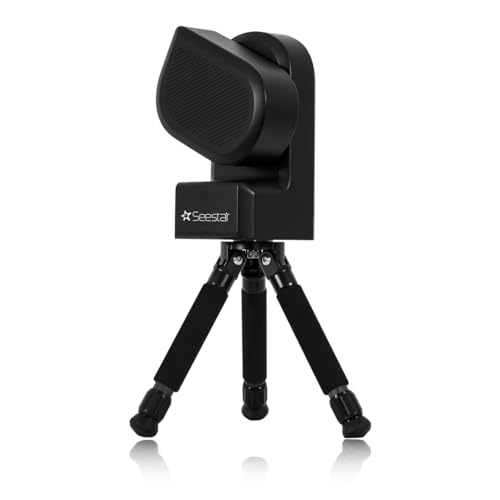
The ZWO Seestar S50 is the product this entire category gets measured against, and it holds that position because of a combination of factors that no competitor has fully matched: a 50mm APO doublet refractor, Sony IMX462 sensor, 30-second auto-alignment via plate solving, and the largest review pool (9 expert sources) of any smart telescope on the market. astrobackyard, the most respected independent voice in smart telescope reviewing, calls it "the smart telescope I recommend most." Space.com agrees it "brings astrophotography to the masses with genuine ease of use and surprisingly good results."
The ZWO Seestar S50 earns an 8.80 on the SHE Smart Astronomy Accessibility Index and an 8.50 on the SHE Astrophotography Value Score — the highest value score of any product in this guide. Its setup ease (9.5) and automation level (9.5) are matched only by the Vespera II, but at less than a third of the price. The active community forums and regular firmware updates from ZWO mean the product actually improves over time via software.
Summer evenings are the sweet spot for this scope: the Milky Way core rises from June through September, and the Seestar S50 with its built-in light pollution filter handles suburban conditions that would frustrate a traditional setup. One honest caveat: the fixed 250mm focal length means wide-field Milky Way panoramas aren't this scope's strength — for those you'd want the DwarfLab DWARF 3's wide-angle camera.
"A hugely enjoyable product that punches way above its price point — the Seestar S50 is the smart telescope I recommend most." — astrobackyard
"The Seestar S50 brings astrophotography to the masses with genuine ease of use and surprisingly good results." — Space.com
What We Love
- 8+ expert review sources — the ZWO Seestar S50 is the most-validated smart telescope in this guide; consensus is unusually strong
- 30-second auto-alignment — plate solving handles sky identification so you don't have to learn star patterns
- Built-in light pollution filter — works in suburban conditions without an aftermarket filter purchase
What Could Be Better
- Fixed 250mm focal length limits wide-field Milky Way shots — the DWARF 3 handles this better with its wide-angle camera
- No dual-band narrowband filter included — sold separately at roughly $50-100
- Battery runs about 3-4 hours in cold weather; plan for an external power bank on longer sessions
The Verdict
Get the ZWO Seestar S50 if you want the safest, most thoroughly-reviewed smart telescope at the mid-range price point — it's the default right answer for most people.
Skip the ZWO Seestar S50 if you need ultra-portability (go DWARF 3 or DWARF Mini), wide-field Milky Way shots (DWARF 3), or the absolute best image quality regardless of price (Vespera II).
DwarfLab DWARF 3 — Most Portable
DwarfLab DWARF 3
(Current Price, subject to change)
The DwarfLab DWARF 3 is the most interesting product in this guide if your use case extends beyond nighttime backyard sessions. At 3.3lb (1.3kg), it's the lightest full-featured smart telescope available, and its dual-camera system — 35mm telephoto for deep-sky targets plus a 3.4mm wide-angle for Milky Way wide-field shots — is something no other product in this comparison offers. Digital Camera World describes it as "an observatory in your pocket," and that dual-camera design is what earns that description. astrobackyard goes further: "The DWARF 3 reigns supreme as the most versatile smart telescope of 2026."
The DwarfLab DWARF 3 scores 8.25 on the SHE Accessibility Index, held back slightly by its app quality score (7.5) versus the Seestar's 9.0 — the DWARFLAB app is functional but not as polished. The Sony IMX678 8.3MP sensor is a meaningful upgrade over the ZWO Seestar S50's lower-resolution sensor, though the 35mm telephoto aperture (vs. 50mm on the Seestar) means the DWARF 3 gathers slightly less light per exposure. The tradeoff: the wide-angle camera captures Milky Way arch shots the Seestar simply cannot.
The 4K auto-tracking also works on daylight subjects — birds, wildlife, sports — making this the only smart telescope in this guide with a plausible year-round use case beyond astronomy. If you're already interested in what a wildlife camera can do for your backyard, the DWARF 3 covers some of that ground during daylight hours.
"DwarfLab releases the Dwarf 3 — an observatory in your pocket. The dual-camera system is genuinely clever." — Digital Camera World
"The DWARF 3 reigns supreme as the most versatile smart telescope of 2026." — astrobackyard
What We Love
- Dual-camera system — the DwarfLab DWARF 3 captures deep-sky images AND wide-field Milky Way shots with one device; unique in this class
- 3.3lb total weight — the lightest full-featured smart telescope; travels in a backpack
- Daytime tracking — works for wildlife and sports photography; genuinely extends the use case beyond astronomy
What Could Be Better
- 35mm telephoto aperture is smaller than the 50mm on the Seestar S50 and Vespera II — slightly less reach on faint targets
- DWARFLAB app occasionally struggles with initial Wi-Fi connection on first session; usually resolves with a second attempt
- Cloud processing dependency for best image results means slow or no internet degrades output quality
The Verdict
Get the DwarfLab DWARF 3 if you want the most portable option with dual-camera flexibility — especially if you'd use the wide-angle camera for Milky Way shots or daytime wildlife.
Skip the DwarfLab DWARF 3 if you want maximum deep-sky reach — the Seestar S50's 50mm aperture gathers more light per frame, and its app experience is noticeably smoother.
Vaonis Vespera II — Best Premium
Vaonis Vespera II
(Current Price, subject to change)
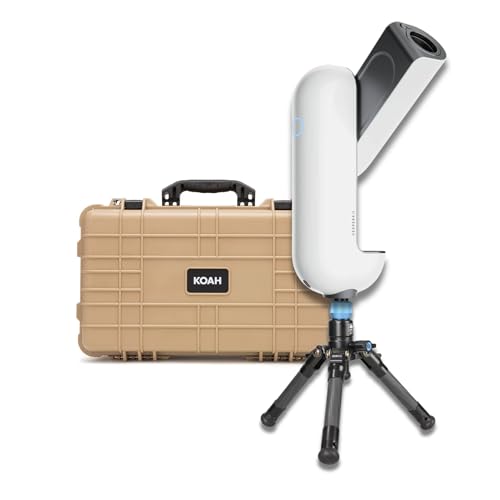
The Vaonis Vespera II is the product in this guide that makes the biggest argument for spending three times what the Seestar S50 costs, and it makes that argument reasonably well. Fstoppers reviewers found "the image quality at this aperture class is outstanding." Space.com concluded it "may be the best smart telescope for the average user." The 50mm quadruplet APO refractor with Sony IMX585 10MP sensor produces images noticeably sharper and more color-accurate than any other product in this comparison.
What earns the Vespera II the highest SHE Accessibility Score (8.88) is the combination of Vaonis's Singularity app quality (9.5) and Exploration Station mode — a fully automated sky tour that queues targets, captures images, and displays them across multiple devices simultaneously. This is a dinner-party telescope: set it up on the patio, let Exploration Station queue the night's targets, and your guests can watch the Orion Nebula build up on their phones while you pour wine. The Vaonis Vespera II also supports mosaic mode for ultra-wide panoramic captures — stitching multiple frames automatically into a single wide field.
The honest case against it: the Seestar S50 at $499 scores 8.80 on the same accessibility metric. The Vespera II's 8.88 score costs $1,100 more for 0.08 points. The image quality difference is real, but it's "clearly better in side-by-side comparison" rather than "night-and-day obvious to a new user." If you're spending this money, you're doing it for the premium experience and the social dimension of Exploration Station, not for marginal optical performance gains.
"The Vespera II is a smarter, simpler way to capture the night sky — the image quality at this aperture class is outstanding." — Fstoppers
"Vaonis has created what may be the best smart telescope for the average user." — Space.com
What We Love
- Highest image quality in the consumer smart telescope class — the Vaonis Vespera II 10MP Sony sensor and quadruplet APO optics are a step above the competition
- Exploration Station mode — automated sky tour works across multiple devices; the standout social feature
- Premium aluminum unibody design — looks like a piece of modern sculpture on your patio; worth noting given the price
What Could Be Better
- Three times the Seestar S50's price for incremental — not transformational — image quality gains
- 5kg weight is heavier than the DWARF 3 and DWARF Mini; not a travel scope
- Digital-only output; no eyepiece port for visual observing if you want to occasionally look through the scope
The Verdict
Get the Vaonis Vespera II if you want the best image quality, the most polished app experience, and a device that functions as an automated entertainment centerpiece for guests — and you're comfortable spending $1,500+ for that experience.
Skip the Vaonis Vespera II if you're measuring value per dollar — the Seestar S50 delivers 95% of the accessibility experience at 31% of the price.
Unistellar Odyssey — Luxury Pick
Unistellar Odyssey
(Current Price, subject to change)
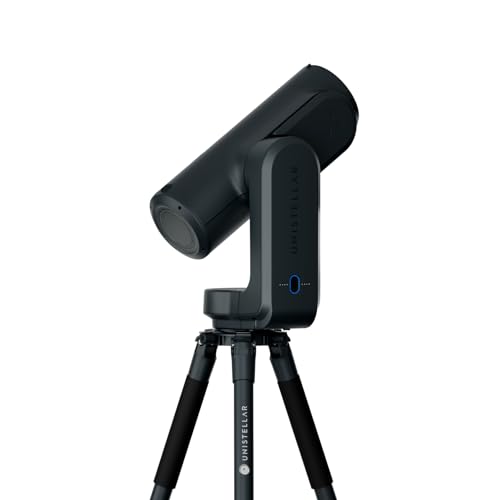
The Unistellar Odyssey occupies a category that didn't exist five years ago: the citizen science smart telescope. At $2,499-$2,599, it's the most expensive product in this guide by nearly $1,000, and the case for buying it rests on two things the Vespera II cannot offer: an 85mm aperture (the largest in this class by far) and integration with the SETI Institute's citizen science network, which lets you contribute observations of asteroid occultations, exoplanet transits, and other events to real ongoing research.
Space.com describes it as "a compact smart reflector built for grab-and-go simplicity with autofocus and sealed alignment." skiesandscopes.com confirms the citizen science angle: "Unistellar's citizen science features let you contribute to real astronomical research from your backyard." The sealed optical tube means no collimation — ever — and the autofocus system handles itself. At 85mm f/3.9, the Unistellar Odyssey gathers 2.9x more light than a 50mm scope, which shows in images of faint galaxies and nebulae.
The SHE Accessibility Score (8.47) reflects strong but not class-leading performance — the Vaonis Vespera II and ZWO Seestar S50 are both more accessible to a new user, partly because the Odyssey's deeper sky focus means its interface is optimized for serious observers. The SHE Value Score (6.92) is the lowest among the automated scopes — at $2,599, it's hard to argue value when the Seestar S50 costs 80% less and scores comparably on accessibility.
"The Odyssey is a compact smart reflector built for grab-and-go simplicity with autofocus and sealed alignment." — Space.com
"Unistellar's citizen science features let you contribute to real astronomical research from your backyard." — skiesandscopes.com
What We Love
- 85mm aperture — the Unistellar Odyssey is largest in this class; produces noticeably deeper and more detailed images of faint galaxies than any 50mm competitor
- Citizen science integration — the SETI Institute network sends alerts for events you can observe; your data contributes to real publications
- Sealed alignment + autofocus — genuinely maintenance-free; no collimation, no manual focus adjustments, ever
What Could Be Better
- At $2,599, it costs five times the Seestar S50; the image quality difference is real but doesn't fully justify that gap for casual observers
- Heavier than the DWARF 3 and less portable than any other product in this guide
- No wide-field camera for Milky Way panorama shots
The Verdict
Get the Unistellar Odyssey if you're a serious amateur astronomer who wants the deepest sky images possible from a smart telescope, and you're motivated by the citizen science angle — contributing to real research from your backyard.
Skip the Unistellar Odyssey if you're looking for value or portability — the Seestar S50 at $499 delivers an excellent experience at 20% of the price, and the DWARF 3 travels far more easily.
When NOT to Buy a Smart Telescope
Smart telescopes are compelling products, but they're not right for everyone. Skip this category if:
- You live under severe light pollution with no dark-sky access. Smart telescopes include light pollution filters, but Bortle 8-9 skies (downtown urban cores) will limit even the best of these products to a handful of bright objects. If you can't get to Bortle 5 skies within 45 minutes, a smart outdoor camera system is probably a better investment of $400-2,500.
- You want to see objects with your own eyes. Smart telescopes show you a processed image on your phone, not a live optical view through an eyepiece. If your image of "stargazing" involves putting your eye to a telescope, buy a traditional scope — the Celestron StarSense Explorer DX 130AZ is the only product here that serves that use case.
- You're buying for a child under 10. The app-based interfaces and delicate sensors aren't well-matched to small hands and short attention spans. A kid's first telescope should probably be a department-store Newtonian, not a $399+ smart device.
- You want to observe in winter cold. Most smart telescope batteries degrade significantly below 40°F (4°C), dropping to 2-3 hours from a rated 4-5. If your observing season is primarily winter, budget for external battery banks or limit expectations for session length.
Smart Telescope vs Traditional: Which Should You Choose?
Traditional telescopes — Newtonian reflectors, refractors, Dobsonians — gather more light per dollar than any smart telescope at equivalent aperture. A 6-inch Dobsonian at $300 will show you more detail in bright objects than any smart telescope in this guide. The tradeoff is everything else: you need to learn star-hopping or buy a GoTo mount separately, you need to manually collimate the optics periodically, and you will spend your first five sessions confused about why you can't find Jupiter.
Smart telescopes invert this equation. The learning curve drops to near-zero. You sacrifice some raw optical performance for complete automation — similar to how portable smart projectors simplified home theater by handling the technical setup for you. For a homeowner who wants to pull a device out on a summer evening, point it at a target from a phone catalog, and share the result on Instagram before the evening ends, the smart telescope is objectively better. For a retired physics teacher who wants to spend 300 hours a year building observing skills and sketching what they see, a traditional scope is probably more satisfying.
The honest framing: summer nights on the patio are a lifestyle purchase, much like the smart entertainment systems we've reviewed. These are gadgets for affluent homeowners who want something interesting to do after dinner, not tools for serious observers pushing the limits of aperture. If you'd feel embarrassed telling a friend you spent $499 on a stargazing gadget for patio use, get a traditional scope instead. If you're comfortable with that framing, smart telescopes actually deliver on the promise.
What Can You Actually See?
The question reviewers often avoid answering directly: what objects look good on these sensors, and what doesn't?
Targets that work well:
- Orion Nebula (M42) — the most-photographed object with smart telescopes; detailed and colorful at 50mm aperture
- Andromeda Galaxy (M31) — fits in the field of view with wide-field sensors; structure visible in 30-minute stacking sessions
- Whirlpool Galaxy (M51) — spiral arms resolvable with the Vespera II and Odyssey; faint but recognizable with the ZWO Seestar S50
- Pleiades star cluster — stunning at any aperture; good for testing wide-angle capability
- Saturn — rings clear and identifiable in planetary mode; best detail with the Odyssey's 85mm aperture
- Jupiter — cloud bands visible; Galilean moons trackable in real-time
- Lagoon Nebula (M8) — excellent target with narrowband filters; built-in filters on the DwarfLab DWARF Mini Smart Telescope and DwarfLab DWARF 3 help
What you won't get:
- Hubble-grade images. Expert astrophotographers with dedicated camera rigs and 8-10+ inch apertures produce images in a different class. Smart telescope images are impressive for the format, not for astronomy.
- Consistent results every session. Clouds, wind, humidity, and atmospheric turbulence (seeing conditions) affect every session. Summer humidity is real.
- Wide-field Milky Way arch photos with most models. Only the DwarfLab DWARF 3's wide-angle camera captures this type of shot.
Frequently Asked Questions
Do smart telescopes work in the city?
Yes, with caveats. Every smart telescope in this guide includes a built-in light pollution filter or a narrowband filter option. The ZWO Seestar S50 and DwarfLab DWARF Mini Smart Telescope have filters built in; they handle Bortle 6-7 skies (typical suburbs) reasonably well. Dense urban cores (Bortle 8-9) will still limit you mostly to bright showpiece objects — Orion Nebula, Andromeda, planetary targets. The honest answer is that even smart telescopes can't fully overcome truly dark skies being better, but they're far more effective in suburban conditions than a traditional unfiltered setup.
How long does setup actually take?
Reviewers consistently report 5-10 minutes from unboxing to first target for most products in this guide. The Vaonis Vespera II is fastest — place it on a level surface, power on, open Singularity app, done. The ZWO Seestar S50 and DwarfLab DWARF 3 take slightly longer because of the tripod deployment step. The Celestron StarSense Explorer DX 130AZ takes the most time because it requires traditional telescope assembly before the AI-assisted navigation kicks in. "First night" is typically longer as you learn the app; subsequent sessions are faster.
Can I use a smart telescope for astrophotography that I share online?
Yes — that's the primary use case. All five fully-automated products in this guide produce processed, shareable images within a single observing session. Live stacking builds up signal over 10-30 minutes, and the on-device or cloud processing produces a final image suitable for sharing. The DwarfLab DWARF Mini Smart Telescope and DwarfLab DWARF 3 handle cloud processing; the ZWO Seestar S50 processes on-device. Image quality is noticeably better than a phone camera pointed at the sky, and better than most untracked DSLR attempts. It won't match a dedicated astro imager with a 6-inch refractor, but it's impressive for the format.
Which smart telescope is best for a complete beginner?
The ZWO Seestar S50. It has the largest review community, the most app support resources, and the highest combination of automation and image quality at a mid-range price. If the Seestar S50 disappoints you, no other product in this guide at a similar price will do better. The runner-up for beginners who prioritize portability over everything is the DwarfLab DWARF Mini Smart Telescope — but accept that the app experience and image ceiling are slightly lower.
Do smart telescopes require a monthly subscription?
No. Every product in this guide is a one-time purchase with no mandatory ongoing subscription. The DwarfLab DWARF Mini Smart Telescope and DwarfLab DWARF 3 use cloud processing for image enhancement, but that service is included in the purchase price and has no announced limits. The ZWO Seestar S50 processes entirely on-device. The Unistellar app's citizen science features are free. The only ongoing cost to budget for is an external battery bank ($30-60) if you want sessions longer than 4-5 hours.
Is the Vaonis Vespera II worth three times the price of the Seestar S50?
For most people, probably not — if "worth it" means pure performance per dollar. The Vaonis Vespera II scores 8.88 on our accessibility metric vs. the Seestar S50's 8.80. The image quality difference is real and visible in side-by-side comparisons, but not transformational. The case for the Vespera II is the Singularity app's Exploration Station mode (a genuinely better social experience) and the premium build quality. If you're entertaining guests and want to set up an automated night sky tour on the patio, the Vespera II's experience is noticeably better. If you're solo imaging, the ZWO Seestar S50 is a smarter spend.
The Bottom Line
The summer patio is the natural habitat for a smart telescope, and the ZWO Seestar S50 is the one to get for most people — an 8.80 SHE Accessibility Score, $499 price, and the deepest expert review pool of any product here. It's the safe, well-validated default. If portability and dual-camera flexibility matter more, the DwarfLab DWARF 3 is the pick. If you're entertaining guests and want an automated sky tour, invest in the Vaonis Vespera II and treat it as the astronomy equivalent of a premium outdoor entertainment system.
If you're building out a full outdoor smart home setup for summer, pair your telescope with something from our smart home gifts guide for the guests who don't want to stargaze.
Get the ZWO Seestar S50 if you want the best-reviewed, safest choice at the mid-range price — maximum expert validation, excellent automation, and a strong community for support.
Skip the ZWO Seestar S50 if you need ultra-portability, dual-camera capability, or the deepest sky images money can buy — in which case the DwarfLab DWARF 3 or Unistellar Odyssey fit better.
Sources & Methodology
We aggregated expert reviews from 8+ sources per product including astrobackyard, Space.com, Digital Camera World, Fstoppers, skiesandscopes.com, astroforumspace.com, High Point Scientific, and agenaastro. Products were scored on the SHE Smart Astronomy Accessibility Index using five weighted factors: Setup Ease (25%), App Quality (20%), Automation Level (20%), Image Quality (20%), and Portability (15%). The SHE Astrophotography Value Score adds Price Value weighting (20%) to enable cross-tier comparison. All scores reflect editorial analysis of aggregated expert consensus — SHE does not conduct original product testing. Full methodology at /methodology.
Written by Nicholas Miles. Nick has covered smart home technology since 2024 and founded SmartHomeExplorer.com to aggregate consensus ratings from 1956 editorial sources across 1183 smart home products and 361 buying guides to surface the true consensus picks for every category.
Disclosure: SmartHomeExplorer.com earns affiliate commissions from qualifying Amazon purchases at no extra cost to you. This doesn't influence our rankings — our methodology is published at /methodology.