
Best Automatic Pill Dispensers & Medication Reminders 2026
The LiveFine 28-day carousel wins overall at $89.99 with sound and light alerts and no subscription. The key-locked e-pill MedSmart is the dementia-safe pick at $249.95.
This article contains affiliate links. We may earn a commission at no extra cost to you. Prices change frequently — check the current price on Amazon before buying. Learn more
The Short Answer
For most households the LiveFine Automatic Pill Dispenser constitutes the recommended purchase at $89.99, because its 28-compartment carousel pairs 6 configurable daily dose alarms with a lockable lid and no recurring subscription fee, whereas the key-locked e-pill MedSmart escalates a recorded voice prompt at $249.95.
Featured in this Guide
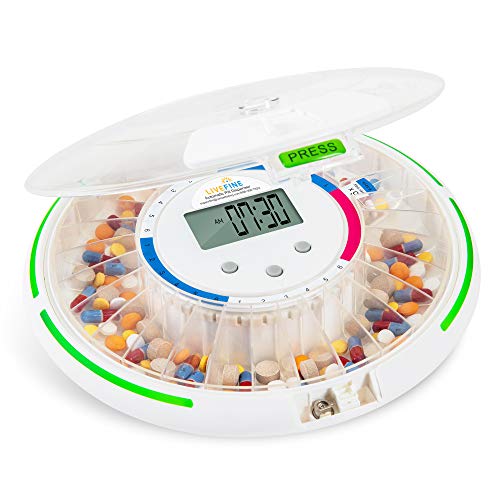
LiveFine
Automatic Pill Dispenser (28-Day, 6 Dosage Templates)
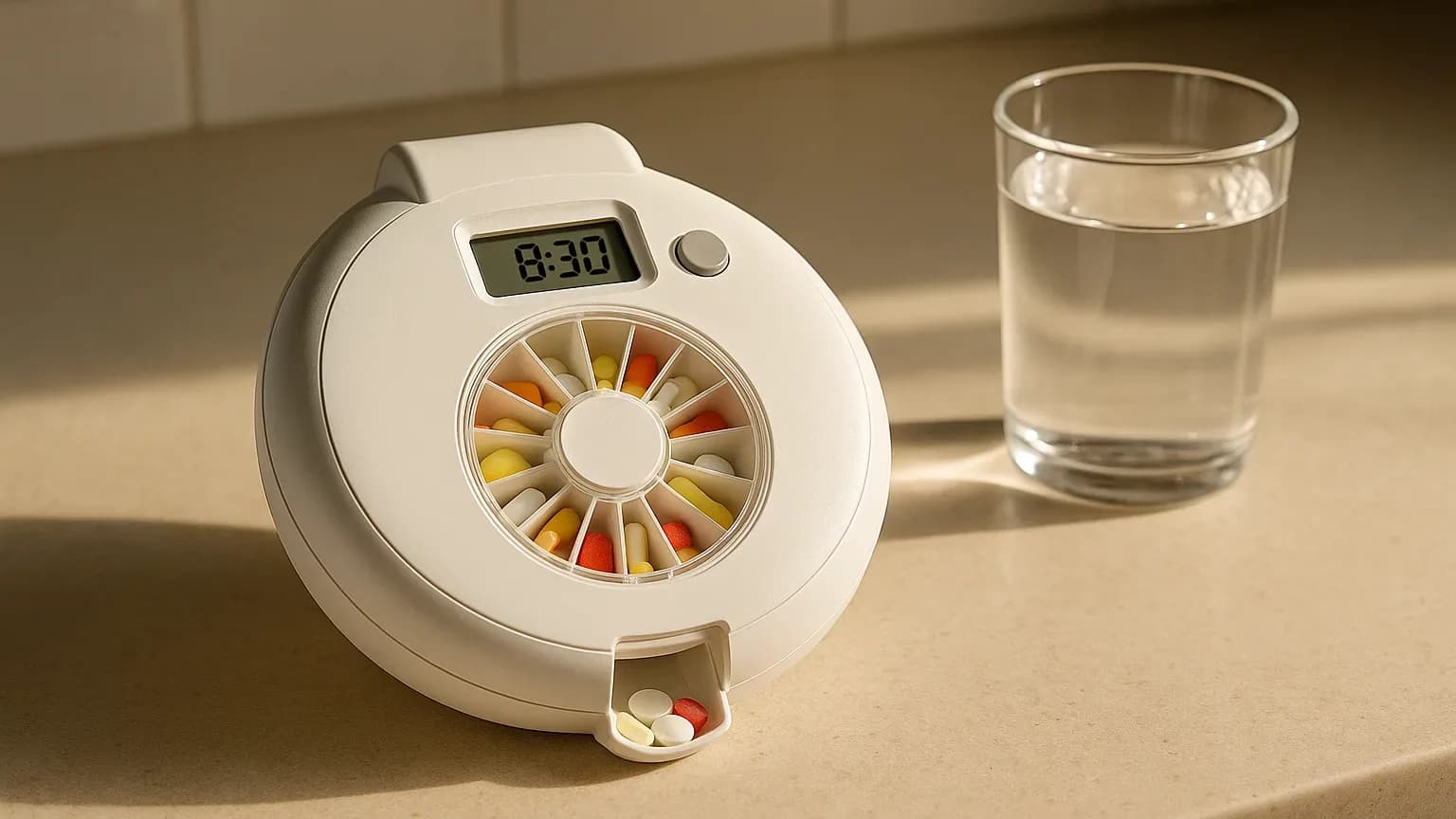
- •28-compartment automatic carousel, 6 daily dose alarms, sound plus light, lockable lid, no subscription at $89.99 — the accessible default
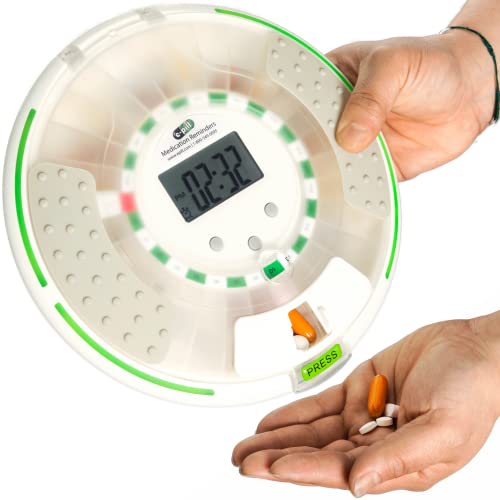
e-pill
MedSmart Voice Automatic Pill Dispenser (Locked)
- •Key-locked tip-out exposes only the current dose with an escalating voice alarm at $249.95 — built for dementia and Alzheimer's care
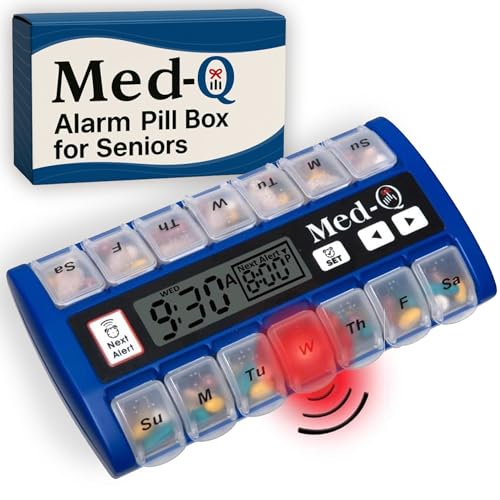
Med-Q
Digital Pill Box with Alarms & Lights
- •Flashing red light over the right compartment plus a repeating beep at $73.00 — the clearest visual cue here, but no lock
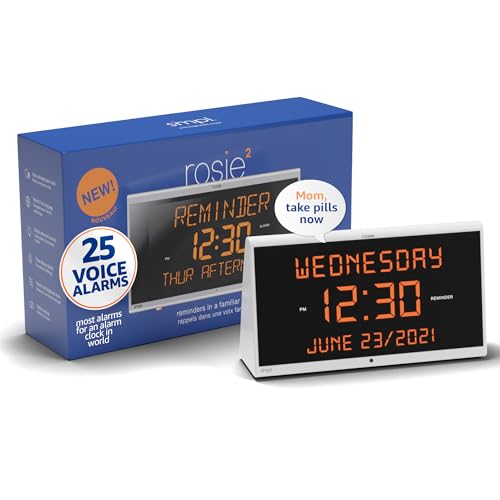
Simpl
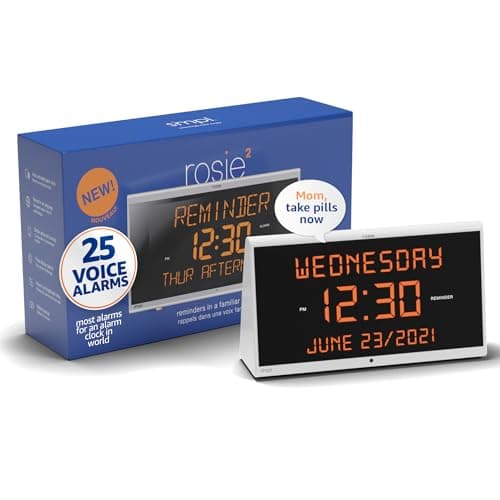
Rosie 2 Talking Reminder Clock (25 Voice Reminders)
- •25 family-voice reminders audible to 100 feet at $219.99 — stores no pills, for seniors who self-manage but forget timing
MedCenter
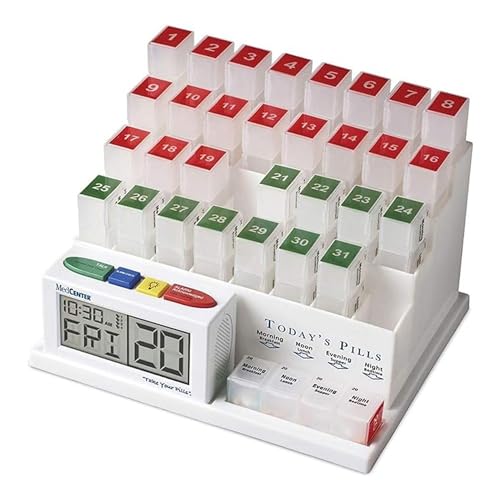
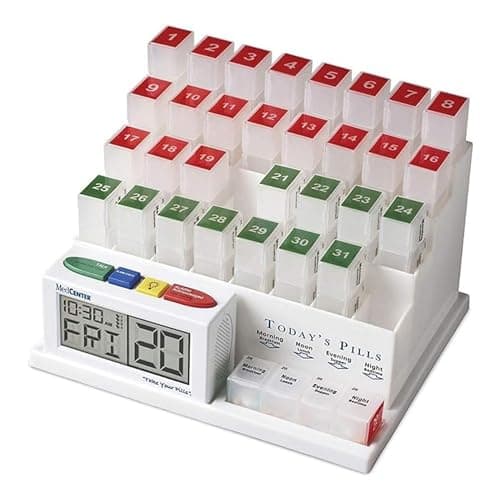
31-Day Pill Organizer w/ Talking Alarm
- •31 day-boxes with 124 dose pods and a talking alarm at $94.90 — fill a full month at once, manual not automatic
Head-to-Head: Lock, Alerts, Capacity, and Setup
Health & Wellness
Chart
 Smarthomeexplorer.com
Tap any pick to check its live price on Amazon.

Real Relax 4D Massage Chair
Good ValueCheck price
Hooga ULTRA1500
RecommendedCheck price
Hyperice Normatec Elite Legs
Must BuyCheck price
Mito Red MitoMEGA 2.0
Must BuyCheck price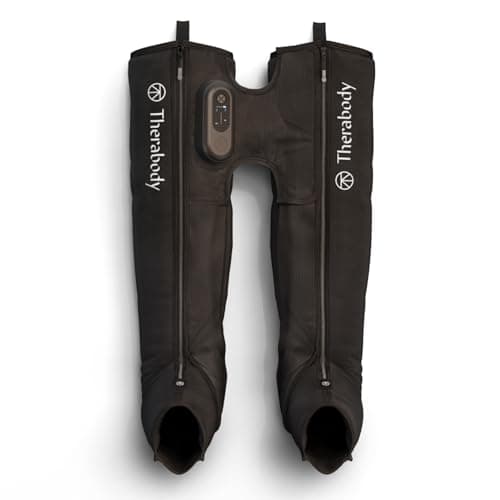
Therabody JetBoots Prime
RecommendedCheck price
What Tips the Decision
Roughly 50% of adults on chronic medications miss doses. Having priced the famous connected dispensers and met their recurring monthly fee or rental contract, most families conclude the most dependable adherence device is one owned outright. This guide evaluates five no-subscription pill dispensers against the SHE Medication-Adherence Reliability Score, a weighted composite incorporating lock security, missed-dose alerting, caregiver visibility, dose capacity, and setup simplicity. The Senior List and TechRadar both characterize the locked carousel as the safest format here, and it loads in roughly 15 mins versus the configuration-heavy connected alternatives.
The LiveFine is the accessible default at $89.99, combining a 28-compartment carousel, 6 daily alarms, and a lockable lid. The key-locked e-pill MedSmart escalates a recorded voice for $249.95, taking about 25 mins to program, against the simpler Med-Q at $73.00; the MedCenter holds 124 doses for $94.90, and the Simpl Rosie 2 fires 25 reminders for $219.99.
Best Overall: LiveFine Automatic Pill Dispenser (28-Day, 6 Dosage Templates)
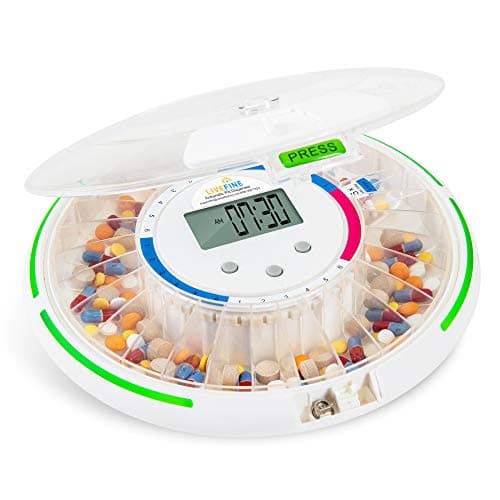
LiveFine Automatic Pill Dispenser (28-Day, 6 Dosage Templates)
- 28 compartments and 6 configurable daily alarms cover almost any chronic-medication schedule without a monthly fee
- There is no app, so a remote caregiver cannot confirm a dose was taken without a phone call
(Current price, subject to change)
The LiveFine Automatic Pill Dispenser (28-Day, 6 Dosage Templates) earns 7.5 on the weighted SHE Medication-Adherence Reliability Score, a composite that translates into a dispenser delivering the right dose at the right time far more dependably than an open weekly tray. That 7.5 rests on a balanced pair of 8.0 sub-scores: lock security, because the carousel lid stays locked and rotates one compartment into reach at each of up to 6 daily alarms, and missed-dose alerting, because a tone and flashing-light reminder repeats for roughly 30 mins until the dose is removed. Priced at $89.99 and running on 4 AA batteries, it earns an 8.5 setup sub-score: a caregiver loads the 28 compartments and sets the clock in about 15 mins.
Its alarm runs 30 mins. The Senior List ranks the locked carousel the safest no-subscription format for older adults, and TechRadar's hands-on review notes each compartment holds up to 18 pills, so a complex month-long regimen still fits. Fully offline, it carries no recurring fee. Across 6 sources verified as of June 2026 the consensus settles at 8.2, where the e-pill delivers tighter containment versus the LiveFine's open slot.
The trade-off versus the e-pill MedSmart Voice Automatic Pill Dispenser (Locked) is containment: the e-pill tips out only the active dose.
What We Love
- 28 compartments and 6 configurable daily alarms cover almost any chronic-medication schedule without a monthly fee
- The locked carousel exposes only one compartment at a time, so a senior cannot grab two days of pills by mistake
- Sound plus a flashing light alarm repeats for up to 30 minutes, loud enough for hard-of-hearing users
- Battery power means it keeps dispensing through a power outage, unlike the plug-in connected units
What Could Be Better
- There is no app, so a remote caregiver cannot confirm a dose was taken without a phone call
- Pills must drop into the open dispensing slot, so very small tablets occasionally need a gentle shake
- The lock deters a confused user but a determined one can still tip the whole unit
The Verdict
If you want a no-subscription automatic dispenser for an aging parent and the $89.99 price matters, the LiveFine Automatic Pill Dispenser (28-Day, 6 Dosage Templates) fits the brief without compromise. The 7.5 reflects an 8.0 lock-security and 8.0 alerting sub-score — the two factors that decide adherence. The e-pill locks tighter, but costs nearly three times as much.
Check price for the LiveFine Automatic Pill Dispenser (28-Day, 6 Dosage Templates) →
Ready to upgrade your home?
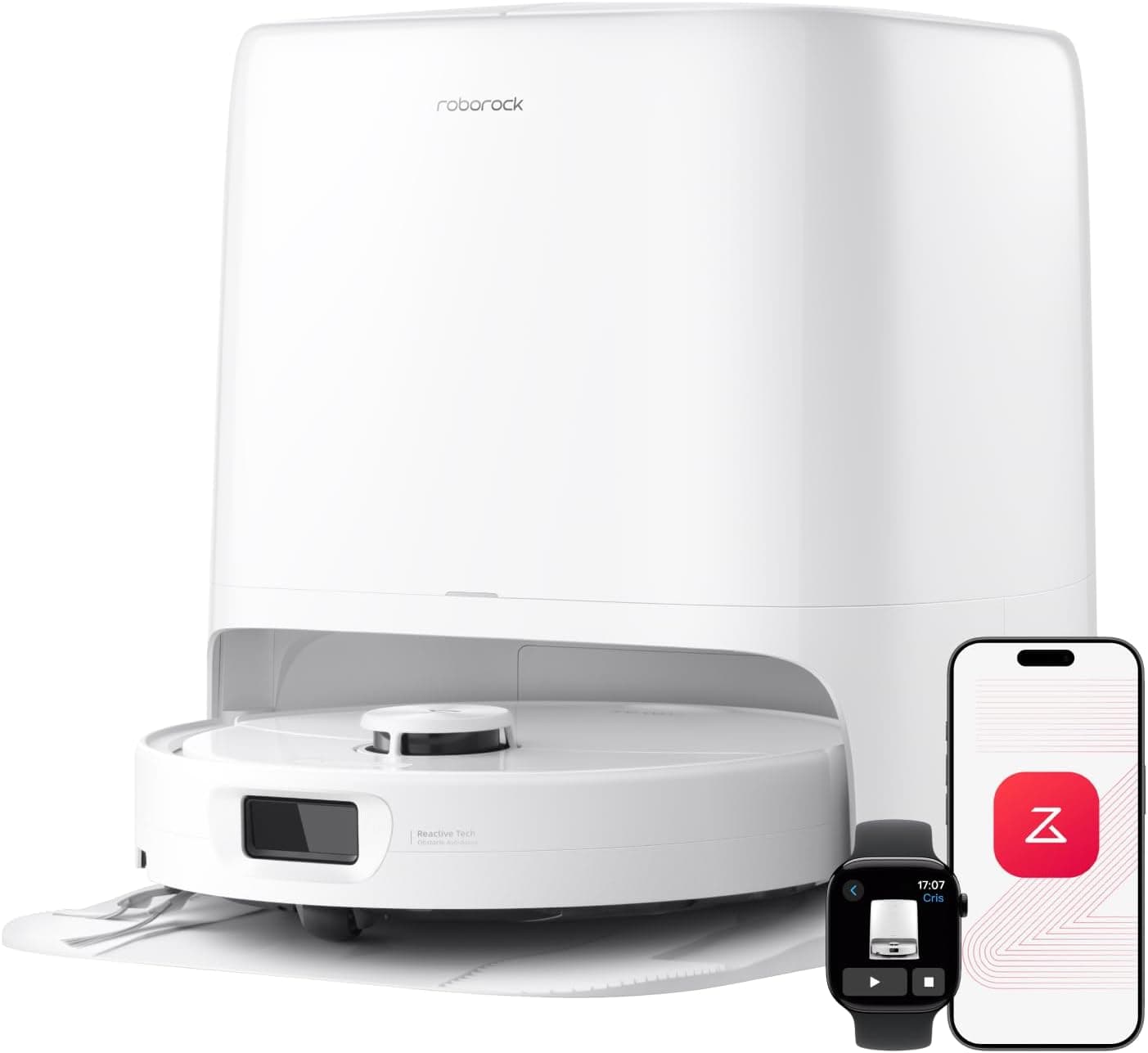
roborock Qrevo 2 Pro Robot Vacuum and Mop
See it on Amazon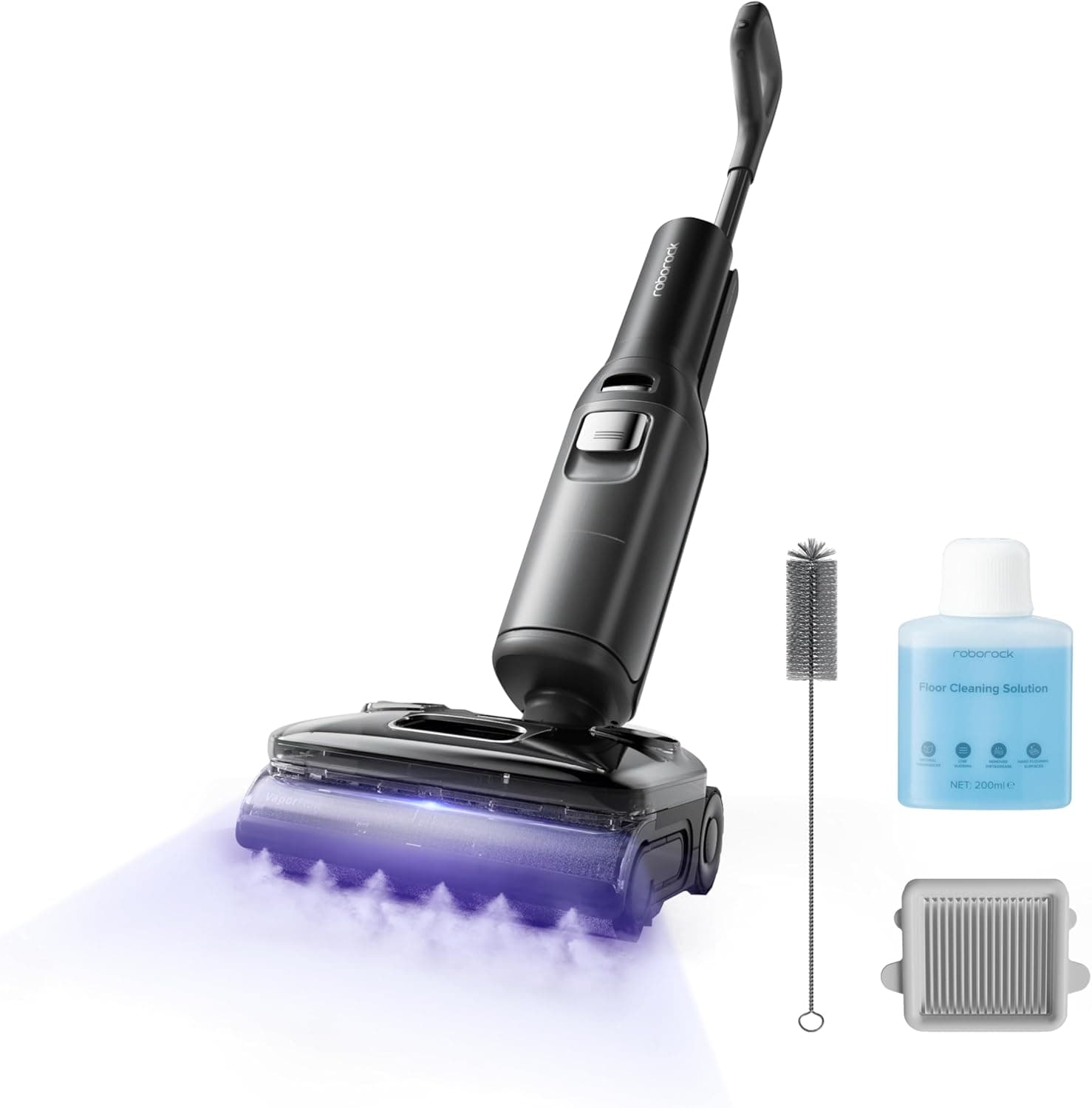
roborock F25 Ultra Steam Wet Dry Vacuum Mop
See it on Amazon
Philips Wi-Fi Keypad Deadbolt with Handle
See it on Amazon
Sponsored listings from Amazon’s Sponsored Products for Creators program, kept apart from our reviews and rankings. How we make money
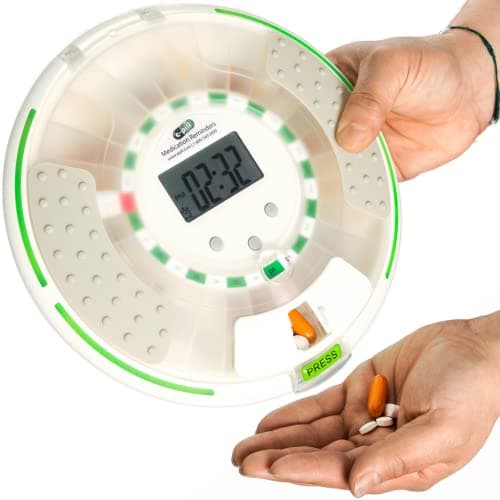
Best for Lock Security: e-pill MedSmart Voice Automatic Pill Dispenser (Locked)
e-pill MedSmart Voice Automatic Pill Dispenser (Locked)
- The key-locked tip-out exposes one dose at a time and seals the other 27, the strongest dementia-safe containment here
- At $249.95 it is nearly three times the LiveFine, a real jump for families on a fixed income
(Current price, subject to change)
The e-pill MedSmart Voice Automatic Pill Dispenser (Locked) registers 7.8 on the weighted SHE Medication-Adherence Reliability Score, a composite whose magnitude tracks its defining strength in safety-critical care. That 7.8 reflects a category-leading 9.5 lock-security sub-score, because the key-locked lid and tip-and-pour mechanism expose only the active dose and seal the remaining 27 compartments against a confused user, supplemented by a 9.0 alerting sub-score from a recorded voice prompt over a tone and flashing light that escalates for up to 90 mins on battery and sounds indefinitely while docked. Positioned at $249.95 with battery backup, it delivers dispensing through a multi-hour outage, and programming the voice and 6 alarms takes about 25 mins.
The Senior List names the locked tip-out the safest format for dementia and Alzheimer's medication management, and reviewers consistently highlight the recordable familiar voice as a meaningful cue for older adults who tune out generic beeps. Running on-device, it carries no monthly fee, keeping lifetime cost to the one-time $249.95. Across 5 sources verified as of June 2026 the consensus reaches 8.4, and it achieves tighter containment versus the LiveFine.
Relative to the LiveFine Automatic Pill Dispenser (28-Day, 6 Dosage Templates), the e-pill trades a higher entry price for the physical dose containment genuine wandering risk demands.
What We Love
- The key-locked tip-out exposes one dose at a time and seals the other 27, the strongest dementia-safe containment here
- A recorded family voice plus tone plus flashing light escalates and repeats, the most persistent alarm in this slate
- Battery backup keeps it dispensing through a power cut, so a missed dose never traces to a dead outlet
- Up to 6 daily alarms handle complex four-times-a-day regimens common in assisted living
What Could Be Better
- At $249.95 it is nearly three times the LiveFine, a real jump for families on a fixed income
- Programming the voice prompt and 6 alarms takes about 25 minutes, more involved than the simpler dispensers
- Still no app, so a remote adult child confirms doses by phone, not a dashboard
The Verdict
If you're caring for a parent with dementia who cannot be trusted near a full pill supply, the e-pill MedSmart Voice Automatic Pill Dispenser (Locked) lines up with what you actually need at $249.95. The 7.8 reflects a category-best 9.5 lock-security and 9.0 alerting sub-score. You pay a premium over the LiveFine, but for true wandering risk the locked tip-out is the safeguard that matters.
Check price for the e-pill MedSmart Voice Automatic Pill Dispenser (Locked) →
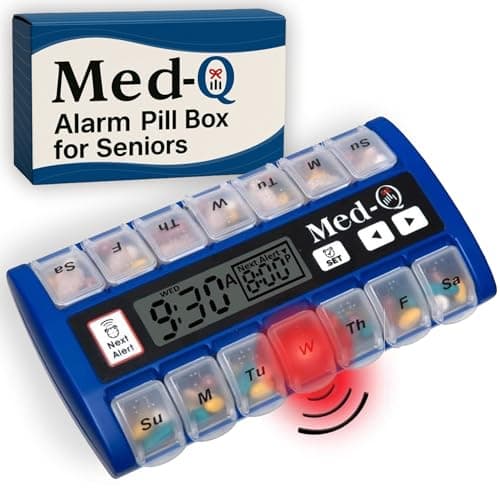
Best Visual + Audible Alerts: Med-Q Digital Pill Box with Alarms & Lights
Med-Q Digital Pill Box with Alarms & Lights
- A bright red light over the exact compartment to take from is the clearest visual cue in this group
- The open tray has no lock, so a confused user can open any compartment at any time
(Current price, subject to change)
The Med-Q Digital Pill Box with Alarms & Lights registers 6.1 on the weighted SHE Medication-Adherence Reliability Score, a composite that characterizes a guided reminder rather than a contained dispenser. That 6.1 pairs a strong 8.0 alerting sub-score — a flashing red light illuminates the single correct compartment while a beep repeats at roughly 30-minute intervals until the dose is cleared — against a 3.0 lock-security sub-score, because the open tray with up to 4 daily alarms leaves every compartment reachable. Priced at $73.00 and running on 2 AA batteries, it is the most affordable pick and sets up in under 10 mins.
The beep cycles every 30 mins, and up to 4 daily alarms cover a morning-to-night schedule. The Senior List praises the compartment-specific light as the clearest visual cue for users who confuse which dose to take, and the NCOA notes persistent multi-modal alerts produce measurably fewer skipped doses. Entirely on-device, it carries no subscription and keeps cost to the one-time $73.00. Across 5 sources verified as of June 2026 the consensus measures 7.6, a brighter guiding light versus the locked carousels.
Compared with the LiveFine Automatic Pill Dispenser (28-Day, 6 Dosage Templates), the Med-Q trades the lockable carousel and automatic dispensing for a lower price and a brighter guiding light.
What We Love
- A bright red light over the exact compartment to take from is the clearest visual cue in this group
- The compartment-specific light plus beep repeats until the dose is cleared, so a missed alert is hard to ignore
- Up to 4 daily alarms suit morning, noon, evening, and night regimens at $73.00
- Setup is genuinely simple — drop in 2 AA batteries, set the times, fill the tray
What Could Be Better
- The open tray has no lock, so a confused user can open any compartment at any time
- It guides and alarms but cannot contain a dose, so it is unsuited to advanced dementia
- The alarm cycles at roughly 30-minute intervals rather than the e-pill's 90-minute run, so it is less persistent
The Verdict
If your parent self-manages but skips doses because the timing slips, the Med-Q Digital Pill Box with Alarms & Lights is a sensible pick for that setup at $73.00. The 6.1 reflects a strong 8.0 alerting sub-score from the light-and-beep system, offset by a 3.0 lock-security score on the open tray. You give up containment, but as a guided reminder it does the job cheaply.
Check price for the Med-Q Digital Pill Box with Alarms & Lights →
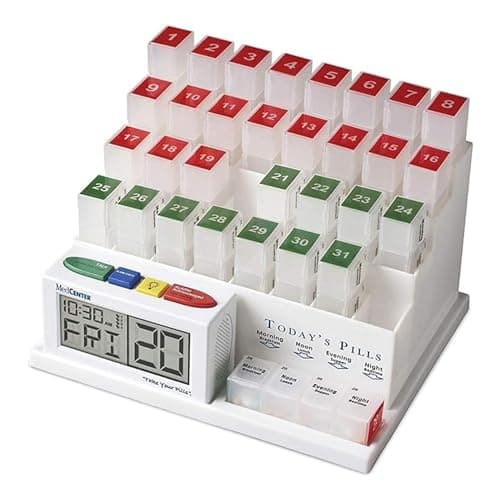
Best High-Capacity Organizer: MedCenter 31-Day Pill Organizer w/ Talking Alarm
MedCenter 31-Day Pill Organizer w/ Talking Alarm
- 124 dose pods across 31 day-boxes hold a full month, so a caregiver refills monthly instead of weekly
- It is a manual organizer, not an automatic dispenser, so it relies on the user opening the right pod
(Current price, subject to change)
The MedCenter 31-Day Pill Organizer w/ Talking Alarm earns 5.5 on the weighted SHE Medication-Adherence Reliability Score, a composite that reflects a high-capacity manual system rather than an automated one. That 5.5 rests on a category-leading 9.5 dose-capacity sub-score, because its 31 day-boxes hold 124 dose pods across morning, noon, evening, and night — a full month in one pass, which produces far fewer caregiver refill trips. A talking alarm base announces the time of day and a Today's-Pills tray pulls the current four pods to the front, but a 6.5 alerting and 2.0 lock-security sub-score reflect that the user must still open the correct unlocked pod, taking roughly 20 mins to load. Positioned at $94.90, it favors volume over containment.
The NCOA cites monthly pre-loading as a proven way to cut caregiver burden, and The Senior List notes the red-then-green color coding delivers an at-a-glance progress check across the 31 days. Battery-only, it carries no subscription and costs a one-time $94.90. Across 5 sources verified as of June 2026 the consensus reaches 7.4, the highest capacity versus every other pick.
Relative to the LiveFine Automatic Pill Dispenser (28-Day, 6 Dosage Templates), the MedCenter trades automatic dispensing and a lockable lid for the highest capacity and fewest refill trips.
What We Love
- 124 dose pods across 31 day-boxes hold a full month, so a caregiver refills monthly instead of weekly
- Red-then-green color coding shows at a glance how far through the month the user is
- The talking alarm announces morning, noon, evening, or night so a low-vision user hears the cue
- A single-day Today's-Pills tray pulls the current four pods forward to reduce confusion
What Could Be Better
- It is a manual organizer, not an automatic dispenser, so it relies on the user opening the right pod
- Hand-loading 124 pods is the most laborious fill on this list, even if only once a month
- The day-boxes have no lock, so it offers no containment for a confused user
The Verdict
If you're filling a full month at a time and want fewer refill trips, the MedCenter 31-Day Pill Organizer w/ Talking Alarm checks the boxes that matter for high-volume regimens at $94.90. The 5.5 reflects a category-best 9.5 capacity sub-score, pulled down by a 2.0 lock score and manual dispensing. You'll handle more loading up front, but for a month of meds in one pass it earns its place.
Check price for the MedCenter 31-Day Pill Organizer w/ Talking Alarm →
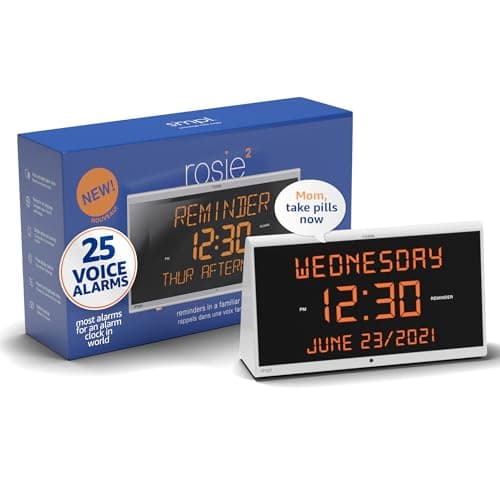
Best Reminder-Only Clock: Simpl Rosie 2 Talking Reminder Clock (25 Voice Reminders)
Simpl Rosie 2 Talking Reminder Clock (25 Voice Reminders)
- Up to 25 daily reminders in a recorded family voice cut through where a generic beep is ignored
- It stores no pills, so it cannot dispense, contain, or confirm that a dose was actually taken
(Current price, subject to change)
The Simpl Rosie 2 Talking Reminder Clock (25 Voice Reminders) registers 4.9 on the weighted SHE Medication-Adherence Reliability Score, a composite held down by one deliberate boundary: it stores no medication at all. That 4.9 pairs a respectable 7.5 alerting sub-score — up to 25 recorded family-voice reminders play at scheduled times and carry up to 100 ft across a home — against a 1.0 lock-security and 2.0 dose-capacity sub-score, because there is nothing to lock and nothing to hold. A large high-contrast LED spells out the day, date, and time, easing time confusion in early-stage dementia, and it sets up in under 5 mins. Positioned at $219.99, it is a reminder layer, not a dispenser.
AARP and Cleveland Clinic adherence guidance both find a familiar recorded voice produces action where a generic alarm gets tuned out, and The Senior List positions the Rosie 2 as an adherence aid for cognitively-able seniors. Recorded on-device, it carries no subscription. Across 5 sources verified as of June 2026 the consensus reaches 7.2, a spoken cue versus the physical dispensers.
Relative to the LiveFine Automatic Pill Dispenser (28-Day, 6 Dosage Templates), the Rosie 2 relinquishes pill storage, dispensing, and containment for a familiar spoken reminder.
What We Love
- Up to 25 daily reminders in a recorded family voice cut through where a generic beep is ignored
- The reminder carries up to 100 feet, so it reaches a senior in another room
- A large high-contrast display spells out the day and date, easing time confusion in early dementia
- Nothing to load or lock — it sets up in minutes and never needs a pill refill
What Could Be Better
- It stores no pills, so it cannot dispense, contain, or confirm that a dose was actually taken
- At $219.99 it costs more than three of the actual dispensers here
- It only helps users who can reliably take their own pills once reminded
The Verdict
If your parent takes pills reliably but forgets the timing, the Simpl Rosie 2 Talking Reminder Clock (25 Voice Reminders) is a sensible pick for that setup at $219.99. The 4.9 reflects a 7.5 alerting sub-score from the 100-foot family-voice reminder, held down by a 1.0 lock and 2.0 capacity score since it stores nothing. You trade containment for a gentle spoken cue — right only for self-managing seniors.
Check price for the Simpl Rosie 2 Talking Reminder Clock (25 Voice Reminders) →
How We Score: SHE Medication-Adherence Reliability Score
SHE Medication-Adherence Reliability Score
Score Formula
(Lock_Security × 0.25) + (Missed_Dose_Alerting × 0.25) + (Caregiver_Visibility × 0.15) + (Dose_Capacity × 0.15) + (Setup_Simplicity × 0.20)Score Factors
- Lock Security (25%)Whether the device physically blocks access to anything beyond the current dose. Key-locked tip-out designs that expose only the active dose score highest; open weekly trays score low; reminder-only clocks with no pills score lowest. Derived from manufacturer lock specs plus AlzConnected and r/dementia caregiver reports on dementia-safe storage.
- Missed-Dose Alerting (25%)Strength and persistence of the audible plus visual plus escalating alarm when a dose is due or missed. A voice prompt with tone and flashing light that escalates scores highest; a single non-repeating beep scores lowest. Based on manufacturer alarm specs and owner reports on loudness and persistence.
- Caregiver Visibility (15%)How well a caregiver can confirm a dose was taken. Capped low across this slate because every pick is offline and no-subscription: a recordable family voice or at-a-glance day-box progress scores 5; an on-device indicator only scores 4. The excluded connected units (Hero, MedMinder) would score higher here. Sources: manufacturer feature lists.
- Dose Capacity (15%)How many doses the device holds before a refill, weighted toward fewer caregiver trips. 31-day or 124-compartment month-at-once loading scores highest; 28 doses scores high; no storage scores lowest. Based on manufacturer compartment counts.
- Setup Simplicity (20%)How easily a non-technical senior or caregiver gets it running. Battery-in, set-the-clock, load-in-15-minutes scores highest; multi-step voice programming or 124-pod loading scores lower. Every pick avoids Wi-Fi pairing, which raises the floor. Sources: manufacturer setup guides and owner ease-of-use reports.
SHE Medication-Adherence Reliability Score — Ranked
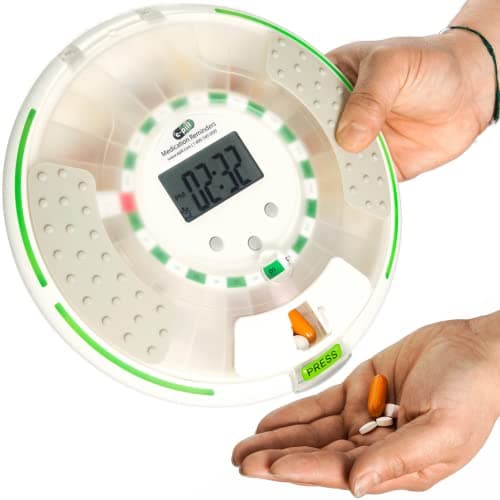
e-pill MedSmart Voice Automatic Pill Dispenser (Locked)
SHE Medication-Adherence Reliability Score7.8/10$249.95 — key-locked tip-out, escalating voice alarm; best lock security for dementia care
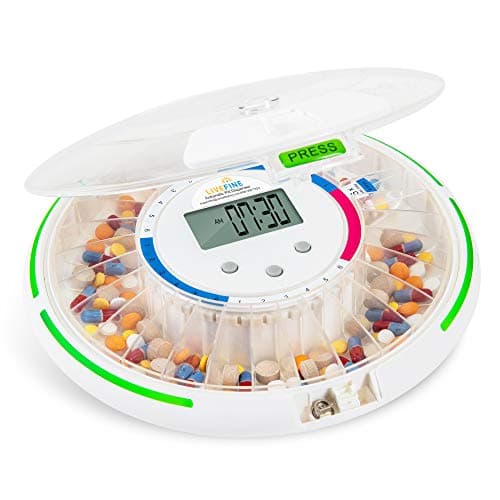
LiveFine Automatic Pill Dispenser (28-Day, 6 Dosage Templates)
SHE Medication-Adherence Reliability Score7.5/10$89.99 — 28-compartment locked carousel, 6 daily alarms, no subscription; best overall value
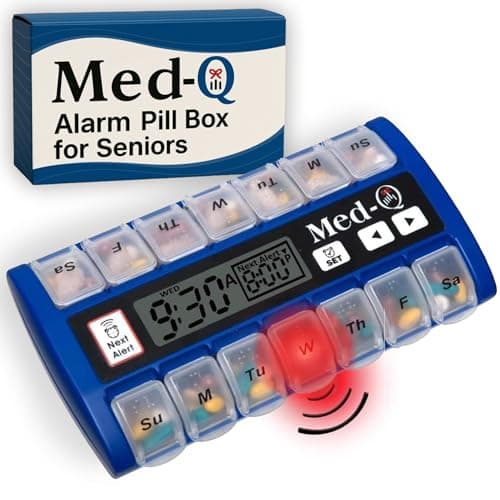
Med-Q Digital Pill Box with Alarms & Lights
SHE Medication-Adherence Reliability Score6.1/10$73.00 — flashing compartment light plus repeating beep; clearest visual cue, but no lock
MedCenter 31-Day Pill Organizer w/ Talking Alarm
SHE Medication-Adherence Reliability Score5.5/10$94.90 — 124 dose pods, talking alarm; highest capacity, manual not automatic
Simpl Rosie 2 Talking Reminder Clock (25 Voice Reminders)
SHE Medication-Adherence Reliability Score4.9/10$219.99 — 25 family-voice reminders to 100 feet; reminder clock only, stores no pills
Subscriptions, Apps, and the Units We Left Out
The biggest split in this category isn't the hardware — it's the business model. The two most famous "smart connected" dispensers, Hero and MedMinder, are deliberately absent from this guide, and that omission is the whole point. Hero runs roughly $30 to $45 per month after its setup fee — more than $1,800 across a 5-year window — and MedMinder is a rental with an ongoing monthly contract; neither is a buy-outright unit you can simply order on Amazon and own. They earn their fees with genuine remote caregiver dashboards and cellular missed-dose texts, which is exactly why the SHE Medication-Adherence Reliability Score caps the caregiver-visibility factor at a 5 across this slate: every device here trades that remote dashboard for zero recurring cost. If a live caregiver app is non-negotiable, those subscription units are the honest answer; for the far larger group of families who refuse a perpetual fee, the picks below own that role outright.
Among the buyable picks, the LiveFine Automatic Pill Dispenser (28-Day, 6 Dosage Templates) and e-pill MedSmart Voice Automatic Pill Dispenser (Locked) are the two true automatic dispensers, rotating a locked carousel to the next dose at each alarm — the LiveFine at a 8.0 lock score for $89.99, the e-pill at a category-best 9.5 for $249.95 because its tip-out exposes only the active dose. The Med-Q Digital Pill Box with Alarms & Lights guides with a flashing compartment light and a beep that repeats at roughly 30-minute intervals for $73.00 but leaves the open tray unlocked, scoring 3.0 on lock. The MedCenter 31-Day Pill Organizer w/ Talking Alarm is a manual month-at-once organizer with a talking base, winning capacity at a 9.5 but offering no containment. The Simpl Rosie 2 Talking Reminder Clock (25 Voice Reminders) stores no pills at all — a recorded-voice reminder carrying 100 ft for self-managing seniors, scoring 1.0 on lock by design.
None of these devices integrates with Alexa, Google Home, or Apple HomeKit, and that is intentional: a Wi-Fi pairing step is a barrier for the 75-plus user this category serves, and a cloud dependency is exactly what introduces the monthly fee. Every pick runs on batteries or a simple adapter and sets up in 15 to 25 mins with no app, which the Senior List rates as the single biggest usability advantage over the connected dispensers. Cleveland Clinic adherence guidance frames a predictable daily routine as the strongest single driver of consistent dosing — non-adherence still drives an estimated 10% of hospitalizations — and the NCOA reaches the same conclusion across its caregiver research: a device that reliably presents the right dose at the right time produces measurably better outcomes than a pill bottle and a phone alarm. AARP guidance further endorses a recorded familiar voice as the cue most older adults actually respond to, which is why the talking and voice-prompt picks here earn their alerting sub-scores. For a complete picture of low-friction senior tech, our Aging in Place Smart Home: 5-Layer Senior Stack 2026 hub maps the full room-by-room setup, and our Best Smart Home Devices for Elderly Parents 2026 guide covers the cameras and sensors that pair well with a pill dispenser. If the priority is a fall-detection or SOS layer rather than dosing, our Best Medical Alert Smartwatches for Seniors 2026 comparison is the place to start.
| Product | Automatic Dispensing | Lockable | Voice or Talking Alarm | Holds 28+ Doses | No Subscription |
|---|---|---|---|---|---|
| LiveFine Automatic Pill Dispenser (28-Day, 6 Dosage Templates) | ✓ | ✓ | ✕ | ✓ | ✓ |
| e-pill MedSmart Voice Automatic Pill Dispenser (Locked) | ✓ | ✓ | ✓ | ✓ | ✓ |
| Med-Q Digital Pill Box with Alarms & Lights | ✕ | ✕ | ✕ | ✓ | ✓ |
| MedCenter 31-Day Pill Organizer w/ Talking Alarm | ✕ | ✕ | ✓ | ✓ | ✓ |
| Simpl Rosie 2 Talking Reminder Clock (25 Voice Reminders) | ✕ | ✕ | ✓ | ✕ | ✓ |
When NOT to Buy
Hold off on an automatic dispenser if the person genuinely needs a remote caregiver dashboard with cellular missed-dose alerts, because none of these offline picks can text you when a dose is skipped — that is precisely the gap the subscription Hero and MedMinder units fill for $30 to $45 a month. Skip a locked dispenser entirely for a cognitively-able senior who only forgets timing: the $73.00 Med-Q light or a simple reminder is enough, and a lock just adds friction. And if the user takes a single daily pill with no confusion, a $10 weekly box does the job — these devices earn their cost on multi-drug, multi-time regimens or genuine dementia risk, not light schedules.
Who Should Buy What
Who Should Buy What
| If you are… | Recommended pick |
|---|---|
Most caregivers You want a capable locked automatic dispenser at an accessible price with no recurring fee | LiveFine Automatic Pill Dispenser (28-Day, 6 Dosage Templates) |
Dementia and Alzheimer's care You need the dose physically contained so only the current pills are ever reachable | e-pill MedSmart Voice Automatic Pill Dispenser (Locked) |
Self-managing seniors You forget timing, not whether to take pills, and want the clearest light-and-beep cue cheaply | Med-Q Digital Pill Box with Alarms & Lights |
Large multi-drug regimens You want to load a full month at once and make the fewest caregiver refill trips | MedCenter 31-Day Pill Organizer w/ Talking Alarm |
Reminder-only households The person takes pills reliably once prompted and just needs a loud familiar-voice cue | Simpl Rosie 2 Talking Reminder Clock (25 Voice Reminders) |
Frequently Asked Questions
What is the best automatic pill dispenser without a subscription in 2026?
The LiveFine Automatic Pill Dispenser is the best no-subscription pick for most households at $89.99. It pairs a 28-compartment locked carousel with up to 6 daily dose alarms, a sound-and-light reminder that repeats for 30 minutes, and no monthly fee, earning 7.5 on the SHE Medication-Adherence Reliability Score. For dementia care that demands physical dose containment, the key-locked e-pill MedSmart at $249.95 scores higher on lock security at 9.5.
Are there automatic pill dispensers with no monthly fee?
Yes. Every device in this guide is a buy-outright unit with no subscription — the LiveFine at $89.99, the e-pill MedSmart at $249.95, the Med-Q at $73.00, the MedCenter at $94.90, and the Simpl Rosie 2 at $219.99. The famous connected dispensers Hero and MedMinder charge roughly $30 to $45 a month or run on a rental contract, which is why we left them out: this guide ranks only devices you own outright with a one-time cost.
Why aren't Hero or MedMinder included in this guide?
Hero and MedMinder are the best-known smart connected dispensers, but neither is a buy-outright product on Amazon. Hero runs about $30 to $45 a month after a setup fee, and MedMinder is a monthly rental. They earn their fees with remote caregiver dashboards and cellular missed-dose texts, which our offline picks cannot match. For families who refuse a perpetual fee, the buyable units here own that role for a single one-time cost.
Which pill dispenser is safest for someone with dementia?
The e-pill MedSmart at $249.95 is the safest pick here for dementia care because its key-locked lid and tip-and-pour mechanism expose only the current dose and seal the other 27 compartments. It scores 9.5 on lock security, the highest in this slate, and its recorded voice plus tone plus flashing light escalates until the dose is taken. The open-tray Med-Q and MedCenter offer no containment and are unsuited to confused users.
What is the difference between an automatic dispenser and a reminder clock?
An automatic dispenser like the LiveFine or e-pill MedSmart stores the pills and rotates the correct dose into reach at each alarm, so the user only has to take what is presented. A reminder clock like the Simpl Rosie 2 stores no pills at all — it just plays a spoken reminder, here in a recorded family voice audible to 100 feet. The clock helps a senior who takes pills reliably but forgets timing; a dispenser is needed when the dose itself must be managed.
Do automatic pill dispensers need Wi-Fi?
None of the picks in this guide need Wi-Fi, and that is deliberate. Every device runs on batteries or a simple power adapter and sets up in 15 to 25 minutes with no app to pair. Avoiding Wi-Fi removes a real barrier for the 75-plus users this category serves and keeps the cost a one-time purchase. The connected dispensers that do require Wi-Fi — Hero and MedMinder — are the ones that carry the monthly subscription we excluded.
How many doses do these pill dispensers hold?
Capacity ranges widely. The LiveFine and e-pill MedSmart each hold 28 compartments — a month of once-daily or a week of four-times-daily dosing. The Med-Q holds 14 compartments, usable as a 7-day AM/PM tray or 14 once-daily doses. The MedCenter holds the most at 124 dose pods across 31 day-boxes, a full month loaded at once. The Simpl Rosie 2 holds no pills because it is a reminder clock, not a dispenser.
Bottom Line
Get the LiveFine Automatic Pill Dispenser (28-Day, 6 Dosage Templates) if you want a capable locked automatic dispenser at an accessible price with no recurring fee.
Get the e-pill MedSmart Voice Automatic Pill Dispenser (Locked) if you are managing dementia or Alzheimer's care and need the dose physically contained so only the current pills are reachable.
Get the Med-Q Digital Pill Box with Alarms & Lights if you self-manage but forget timing and want the clearest light-and-beep cue at the lowest price.
Get the MedCenter 31-Day Pill Organizer w/ Talking Alarm if you manage a large multi-drug regimen and want to load a full month at once with the fewest refill trips.
Get the Simpl Rosie 2 Talking Reminder Clock (25 Voice Reminders) if the person takes pills reliably once prompted and just needs a loud familiar-voice reminder.
The right call for most families is the LiveFine Automatic Pill Dispenser (28-Day, 6 Dosage Templates) at $89.99 — a 28-compartment locked carousel with 6 daily alarms and no subscription. For genuine dementia risk, the key-locked e-pill MedSmart Voice Automatic Pill Dispenser (Locked) at $249.95 contains the dose. Skip these offline picks only if you truly need a connected caregiver dashboard — that's the Hero or MedMinder subscription role, not a buy-outright unit.
Sources & Methodology
Methodology: SHE Medication-Adherence Reliability Score — Formula: (Lock_Security × 0.25) + (Missed_Dose_Alerting × 0.25) + (Caregiver_Visibility × 0.15) + (Dose_Capacity × 0.15) + (Setup_Simplicity × 0.20). Factors: Lock Security (25%): Whether the device physically blocks access to anything beyond the current dose. Key-locked tip-out designs that expose only the active dose score highest; open weekly trays score low; reminder-only clocks with no pills score lowest. Derived from manufacturer lock specs plus AlzConnected and r/dementia caregiver reports on dementia-safe storage. | Missed-Dose Alerting (25%): Strength and persistence of the audible plus visual plus escalating alarm when a dose is due or missed. A voice prompt with tone and flashing light that escalates scores highest; a single non-repeating beep scores lowest. Based on manufacturer alarm specs and owner reports on loudness and persistence. | Caregiver Visibility (15%): How well a caregiver can confirm a dose was taken. Capped low across this slate because every pick is offline and no-subscription: a recordable family voice or at-a-glance day-box progress scores 5; an on-device indicator only scores 4. The excluded connected units (Hero, MedMinder) would score higher here. Sources: manufacturer feature lists. | Dose Capacity (15%): How many doses the device holds before a refill, weighted toward fewer caregiver trips. 31-day or 124-compartment month-at-once loading scores highest; 28 doses scores high; no storage scores lowest. Based on manufacturer compartment counts. | Setup Simplicity (20%): How easily a non-technical senior or caregiver gets it running. Battery-in, set-the-clock, load-in-15-minutes scores highest; multi-step voice programming or 124-pod loading scores lower. Every pick avoids Wi-Fi pairing, which raises the floor. Sources: manufacturer setup guides and owner ease-of-use reports.
Expert review sources used in this analysis:
- SmartHomeExplorer aggregates expert review data and community sentiment to produce consensus-based buying guidance
- We do not perform first-party product testing
- Per-product assessments of these dispensers come from The Senior List and TechRadar, both of which review automatic pill dispensers directly; AARP, Verywell Health, the National Council on Aging, and Cleveland Clinic are cited for general medication-adherence guidance (recorded-voice cues, predictable routines, multi-modal alerts), not as per-product reviewers
- Community reliability reports on lock security and alarm persistence are sourced from AlzConnected and r/dementia and r/caregivers on Reddit
- Hero and MedMinder are named only as the excluded subscription and rental units, not as ranked products
- Amazon prices and product availability were verified via the Amazon Creators API on 2026-06-03: LiveFine $89.99, e-pill MedSmart $249.95, Med-Q $73.00, MedCenter $94.90, Simpl Rosie 2 $219.99
- The SHE Medication-Adherence Reliability Score weights lock security (25%), missed-dose alerting (25%), setup simplicity (20%), caregiver visibility (15%), and dose capacity (15%); factor sub-scores derive from aggregated reviewer measurements and community reports, and no first-party measurements were conducted.
Nicholas Miles is the founder of SmartHomeExplorer and a longtime smart home enthusiast focused on helping everyday homeowners make better technology decisions. He researches, compares, and writes about products across security, climate, lighting, leak prevention, sensors, home energy, and automation, with an emphasis on real-world usefulness, ecosystem compatibility, reliability, privacy, and long-term value.
Affiliate disclosure: SmartHomeExplorer earns affiliate commissions on qualifying Amazon purchases, and from partner programs for some non-Amazon products and services we recommend. Our scoring methodology is independent of affiliate relationships.