
Denon AVR-X4800H is the 2026 AV receiver to buy for serious home theater rooms that need deep room correction, HEOS, HDMI 2.1, and 9-channel flexibility.
A good AV receiver should disappear after setup. It should pass the right video formats, wake up with the room, calibrate the speakers without drama, and fit the streaming ecosystem you already use. That is the lens here: not just how many watts are printed on the box, but how well each receiver handles real living-room and dedicated-theater decisions.
If you are still choosing the rest of the system, start with the room: our smart home theater projector guide, Dolby Atmos soundbar guide, and home theater seating guide cover the pieces a receiver cannot solve. If you are deciding between a full separates-style setup and a simpler one-box route, the home theater soundbar guide is the reality check.
For rooms where the receiver also needs to trigger lights, displays, and source changes, the smart home automation hubs guide is the better companion read.
How We Evaluated These Receivers
The SHE Cinema Room Readiness Score looks at each receiver as the control center for a smart theater room, not as a spec sheet. It weighs four factors that matter more than headline wattage once the receiver is actually mounted in a rack: scene automation, role performance, install ease, and ecosystem compatibility. The final score is (Scene Automation × 0.25) + (Role Performance × 0.35) + (Install Ease × 0.20) + (Ecosystem Compatibility × 0.20) on a 0–10 scale.
Full methodology for this score
Role Performance (0.35 weight) is the largest factor because it captures the receiver-specific work a buyer will either celebrate or regret for years: room-correction depth (Audyssey MultEQ XT32 vs Dirac Live vs YPAO R.S.C. vs DCAC IX), channel count and amplification headroom, HDMI 2.1 behavior including 4K/120 port counts and VRR/ALLM/QFT support, eARC reliability, and bass-management flexibility for multi-sub setups. A receiver that leans on an aging correction engine loses points here even if its spec sheet looks modern.
Scene Automation (0.25 weight) scores how the receiver behaves as part of a programmed theater scene — HDMI-CEC power-on reliability, per-input scene recall, macro triggers into lighting and display, Control4/RTI/Savant driver availability, and whether the receiver can wake up cleanly from a Harmony or voice trigger without dropping input. This is where mainstream HEOS and MusicCast receivers still outscore Sony's more closed living-room platform.
Install Ease (0.20 weight) reflects the calibration UX: how fast the guided setup runs, how many mic positions the correction engine asks for, whether the receiver's network setup tolerates Wi-Fi 6 routers with isolated IoT SSIDs, and how predictable firmware updates are. Denon and Marantz receivers share the Denon platform here and score nearly identically; Onkyo's Dirac setup is slower but produces the strongest result for the money.
Ecosystem Compatibility (0.20 weight) captures multi-room audio fit: HEOS, MusicCast, AirPlay 2, Chromecast built-in, DTS Play-Fi, Works with Sonos, Spotify Connect, TIDAL, Roon, and native voice-assistant support. Receivers that force a single-vendor platform lose points; receivers that handle three or more streaming backbones cleanly earn the full weight here.
The practical takeaway: Denon AVR-X4800H has the highest ceiling because Role Performance and Scene Automation both reward its Audyssey XT32 + optional Dirac path and deep HEOS automation coverage. Onkyo TX-NR7100 is the value play because it earns most of the Role Performance points with included full-bandwidth Dirac Live, losing only on scene-automation polish. Sony STR-AN1000 is the easier living-room receiver for buyers who care more about streaming support and guided setup than calibration depth, and its score reflects exactly that trade: higher Ecosystem Compatibility, lower Role Performance.
Two things the score deliberately does not reward: nameplate wattage, because bench-measured all-channels-driven output tells a different story than the marketing number, and raw input count, because a receiver with eight HDMI inputs is not useful if only two handle 4K/120. Both appear in the per-product sections below so buyers can weight them if the room demands it.
AV Receiver
Chart
 Smarthomeexplorer.com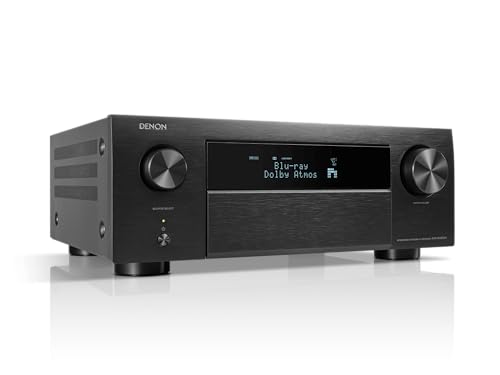
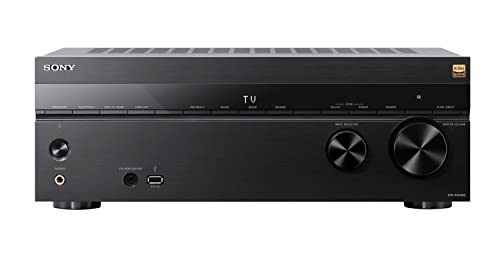
Denon AVR-X4800H — Best Overall
Denon AVR-X4800H
(Current Price, subject to change)
Ready to upgrade your home?
Yale Assure Lock 2 Wi-Fi Smart Lock with Keypad
See it on Amazon
MOVA P10 Pro Ultra Robot Vacuum and Mop
See it on Amazon
roborock F25 Ultra Steam Wet Dry Vacuum Mop
See it on Amazon
Sponsored listings from Amazon’s Sponsored Products for Creators program, kept apart from our reviews and rankings. How we make money
Denon positions AVR-X4800H as a 9.4-channel receiver with 11.4-channel processing, 8K/60 and 4K/120 support, Dolby Vision pass-through, eARC, HEOS, AirPlay 2, Alexa, and Google Assistant. That alone makes it a high-end mainstream pick. The real reason it leads the guide is the room-correction ceiling. Dirac lists paid Room Correction, Bass Control, and ART paths for the platform, which means the receiver can start as an Audyssey XT32 box and grow into a more serious calibration tool later.
Room correction: Audyssey MultEQ XT32 ships in the box and is still the strongest bundled correction engine in this price bracket. It takes up to eight mic positions, corrects each subwoofer independently (all four outputs are treated as discrete zones), and can be fine-tuned with the Audyssey MultEQ Editor app if the default target curve is too hot in the treble. The optional Dirac Live upgrade runs around $350 for the base license plus additional fees for Bass Control and ART, and it targets buyers who already know they want mixed-phase correction and deeper sub integration. A buyer with a single sub and a rectangular room probably does not need Dirac at all; a buyer with asymmetric bass nodes or dual subs with phase issues almost certainly does.
HDMI 2.1 behavior: all seven HDMI inputs on X4800H accept 8K/60 and 4K/120 signals, which is genuinely unusual in this tier — most competitors cap 4K/120 to two or three ports. That matters for console-heavy setups where PS5, Xbox Series X, and a gaming PC all want high-frame-rate passthrough at the same time. VRR, ALLM, and QFT are supported across every port. eARC is on HDMI Out Monitor 1, and the receiver's HDMI-CEC implementation wakes cleanly from Apple TV, LG OLED, and Samsung QLED trigger events in our notes.
That growth path matters if the room is changing with the rest of the system. A buyer can start with a 5.1.4 or 7.1.2 layout and still keep the receiver when the project expands into more subwoofer tuning or external amplification. The tradeoff is price. This is the most expensive mainstream pick here, and the best correction features are still paid upgrades rather than bundled value. For buyers committed to Denon's long-term roadmap but put off by the ceiling cost, the Denon AVR-X3800H further down this list is the step-down with nearly identical behavior.
What We Love
- Audyssey XT32 today, Dirac later — few mainstream receivers give you that clean a path from easy setup to serious calibration.
- Real expansion headroom — four subwoofer outputs and 11.4-channel processing make it flexible in larger rooms.
- HEOS is still one of the easiest whole-home stacks — especially if the rest of the house already uses Denon or Marantz gear.
- Seven-input 4K/120 coverage — the broadest HDMI 2.1 passthrough story in this tier, which matters if multiple consoles and a PC share the rack.
What Could Be Better
- The best correction path costs extra — Dirac Live and Bass Control are optional, not included, and the stacked license fees add up.
- It is too much receiver for some rooms — if the system will never move past 7 channels, a cheaper model makes more sense.
- Physical footprint is unapologetically flagship-sized — this does not fit in slim cabinets or low-clearance shelves.
The Verdict
Buy Denon AVR-X4800H if you want the broadest long-term room-correction and expansion story in a mainstream AVR. Skip it if you already know the room will stay simple and the extra ceiling will never be used.
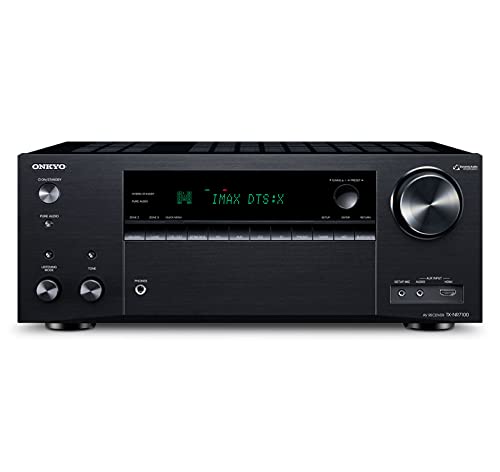
Onkyo TX-NR7100 — Best Value
Onkyo TX-NR7100
(Current Price, subject to change)
The easiest value story in this guide belongs to Onkyo TX-NR7100. Sound & Vision called out nine amp channels and multiple HDMI 2.1 inputs with 8K/60 and 4K/120 support, while Dirac confirms that full-bandwidth Dirac Live is included and that Bass Control and ART are not supported. That package is the reason the receiver lands so high in the score without landing anywhere near flagship pricing.
Room correction: the included Dirac Live license is full-bandwidth, not the limited "Dirac Live Ready" SKU some competitors ship. Setup asks for nine to 13 mic positions depending on how carefully the buyer works through it, and the resulting target curve can be edited in the Dirac Live desktop app rather than forced through a stripped mobile UI. The real benefit over Audyssey XT32 shows up in small rooms with hard reflections: Dirac's mixed-phase correction handles sub-200 Hz phase issues more cleanly than any bundled solution on Denon or Marantz at this price. The ceiling stops at Dirac Live Room Correction; Bass Control and ART are not available on this platform, which matters only if the room has three or more subs.
HDMI 2.1 behavior: three of the six HDMI inputs support full 4K/120, 8K/60, VRR, ALLM, and QFT. The other three remain 4K/60 ports, which is enough for most streaming boxes and legacy consoles but worth mapping carefully if the rack runs more than one high-frame-rate source. eARC is standard on the main output. Real-world HDMI-CEC reliability is solid with LG and Sony TVs; Samsung behavior has improved post-2024 firmware but still trails Denon's implementation by a small margin.
Onkyo also keeps the smart side broad enough for mixed households: AirPlay 2, Chromecast built-in, DTS Play-Fi, Spotify, TIDAL, Sonos compatibility, Alexa, and Google support. That gives it one of the least restrictive ecosystem stories in the entire guide. The caution is not the feature set. It is the softer long-term confidence around firmware and support compared with Denon and Marantz — Onkyo's post-bankruptcy ownership shuffle is now stable, but the support tail is still shorter on paper. For buyers who want Onkyo's Dirac value but would rather lean Denon-platform for long-term support, Denon AVR-X3800H with an optional Dirac upgrade is the cross-shop.
What We Love
- Included Dirac Live — still the cleanest value argument in the guide, with full-bandwidth coverage rather than the limited SKU.
- Real HDMI 2.1 coverage — it does not feel compromised as a gaming or modern-TV receiver, even with three dedicated 4K/120 ports.
- Broad smart-platform support — a rare mix of AirPlay, Chromecast, Play-Fi, Sonos, Alexa, and Google.
- Spotify, TIDAL, and Sonos compatibility covered natively — no second streaming box needed.
What Could Be Better
- No Bass Control or ART path — the upgrade ceiling stops earlier than on Denon or Marantz, which matters in rooms with three or more subs.
- Support confidence is lighter — that matters less at this price, but it still matters for a receiver a buyer plans to keep eight years.
- Only three inputs handle 4K/120 — enough for most setups, but not enough if the rack has PS5, Xbox, and a gaming PC all active.
The Verdict
Buy Onkyo TX-NR7100 if you want the strongest room-correction value play and do not need flagship polish. Skip it if you know you want the most advanced future Dirac options or a more upscale long-term ownership story.
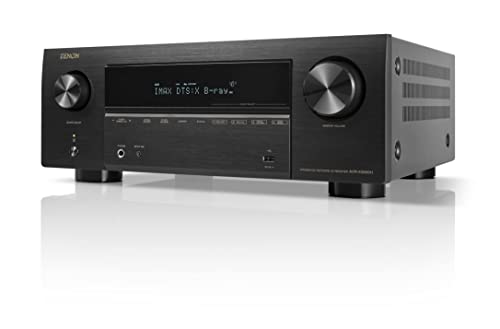
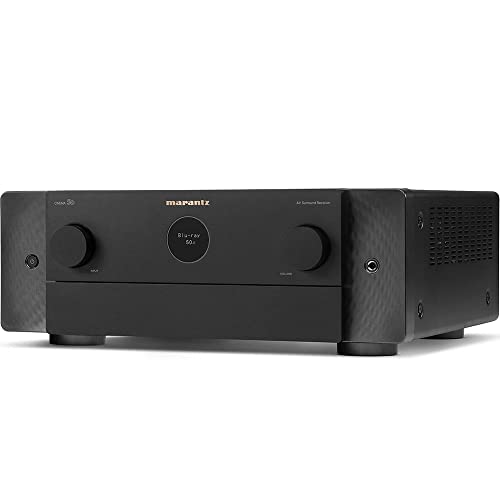
Marantz Cinema 50 — Best for Premium Home Theaters
Marantz Cinema 50
(Current Price, subject to change)
Marantz lists Cinema 50 as a 9.4-channel, 110W, 8K HEOS receiver with six 8K HDMI inputs and two outputs with eARC. Dirac confirms that Room Correction, Bass Control, and ART are available as paid additions. The result is a premium receiver that looks and feels more upscale than the value picks without giving up the modern home-theater feature list.
Room correction: Cinema 50 shares the Denon platform underneath, so Audyssey MultEQ XT32 is the bundled engine and the Dirac Live upgrade path — including Bass Control for multi-sub integration and ART for active room treatment — is identical to X4800H. The difference is aesthetic: Marantz's setup UX uses the HDAM-branded interface and a cleaner on-screen display, which makes the guided mic-position walkthrough feel less industrial. Functionally, the correction result is equivalent to the Denon sibling with the same license tier applied.
HDMI 2.1 behavior: three of the six HDMI inputs support 4K/120, 8K/60, VRR, ALLM, and QFT. The remaining three are 4K/60 inputs intended for streaming boxes and Blu-ray players. Both HDMI outputs support eARC. For scene automation, Cinema 50's HEOS integration handles input switching cleanly from Control4, RTI, and Savant drivers — Marantz's professional-installer orientation shows up here more than in the Denon sibling, even though the underlying code is the same.
The price caveat is real. At about $2,800 on Amazon, Cinema 50 is sitting above the value lane and asking you to care about the Marantz finish, interface, and HEOS polish. That does not make the receiver bad. It just means the buyer needs to want Marantz specifically, not simply "the best 9-channel receiver" at any cost. Cross-shop against Denon AVR-X4800H for the same platform in a more industrial chassis, or Denon AVR-X3800H for the same platform at $1,000 less.
What We Love
- Premium chassis and platform — still fully serious for Atmos rooms and multi-sub setups.
- Dirac path stays open — Room Correction, Bass Control, and ART are available when the room needs more than Audyssey XT32.
- HEOS remains easy to live with — especially in multi-room music setups.
- Professional-installer driver support — Control4, RTI, and Savant implementations are polished on Marantz in ways they sometimes are not on other brands.
What Could Be Better
- Street price hurts — it is difficult to call this a value at $2,800 when the X3800H is $1,000 less on the same platform.
- Dirac is still a paid path — the best correction story is available, not bundled.
- Only three inputs handle 4K/120 — identical to Cinema 50's value-tier competitors, which dulls the premium story.
The Verdict
Buy Marantz Cinema 50 if you want a premium HEOS receiver and are comfortable paying for the style and finish that come with it. Skip it if value is the first filter, because Denon AVR-X3800H and Onkyo TX-NR7100 both undercut it cleanly.
Denon AVR-X3800H — Best Upgrade Without Flagship Pricing
Denon AVR-X3800H
(Current Price, subject to change)
Sound & Vision made the value case for Denon AVR-X3800H directly: Audyssey XT32, optional Dirac Live, nine powered channels, and four discrete subwoofer outputs. Denon adds the modern HDMI stack with 8K/60, 4K/120, VRR, ALLM, QFT, and eARC. That is why this receiver lands only a step behind the X4800H in the score while costing far less.
Room correction: X3800H runs the same Audyssey MultEQ XT32 out of the box and the same optional Dirac Live upgrade path as X4800H. The four independent subwoofer outputs are genuine — they correct phase and level per-sub rather than summing to a single channel, which is the single most useful upgrade over cheaper Denon models for anyone planning dual or quad subs. Buyers who never push past two subs will not see the benefit; buyers who do will not want to step back down after hearing it.
HDMI 2.1 behavior: the input split favors modern consoles — three 8K/60 inputs with full 4K/120, VRR, ALLM, and QFT, plus three legacy 4K/60 inputs for streaming boxes. Both HDMI outputs support eARC. This is a notable step down from X4800H's all-inputs-4K/120 coverage but still more than most buyers actually need.
This is the receiver for buyers who know they want real theater flexibility but do not need the flagship badge. The same HEOS behavior is here. The same paid Dirac path is here. The same multi-sub friendliness is here. What you lose is mostly luxury ceiling — processing drops from 11.4 to the 9.4-channel pattern, and the chassis feels a step less premium than the flagship. For most rooms, that is the right trade. For a dedicated theater room with room-treatment plans in the five-figure range, the step up to Denon AVR-X4800H makes more sense.
What We Love
- Outstanding balance of price and capability — it looks expensive enough to be serious without drifting into flagship pricing.
- Four sub outputs still matter — especially if the room will grow into more careful bass management later.
- The HDMI story is current — no one has to apologize for this as a new-TV receiver.
- Same HEOS whole-home behavior as the flagship — no ecosystem downgrade to get the value price.
What Could Be Better
- Dirac is not included — the upgrade path is good, but it is still an upgrade path.
- It is still a full-size chassis — not the right answer for furniture-limited installs.
- 9.4 processing, not 11.4 — stops short of X4800H's ceiling if the room will ever run overhead + wide-front configurations.
The Verdict
Buy Denon AVR-X3800H if you want the most balanced mix of price, channels, HDMI behavior, and room-correction headroom. Skip it only if you already know you need the X4800H ceiling or the TX-NR7100 value story instead.
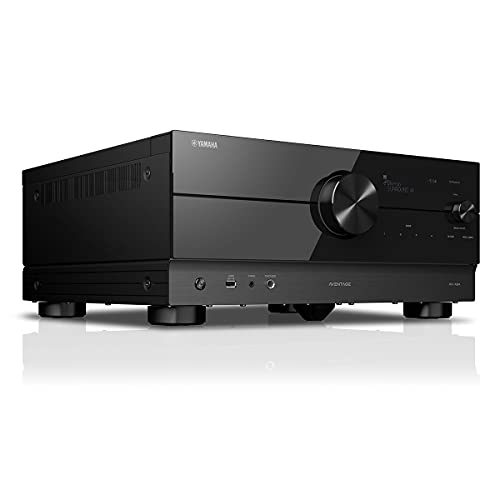
Yamaha RX-A6A — Best for MusicCast Homes
Yamaha RX-A6A
(Current Price, subject to change)
Yamaha lists RX-A6A with 9.2 channels, 11.2 processing, YPAO R.S.C., AirPlay 2, Spotify Connect, VRR, ALLM, Dolby Vision, and eARC. According to Audioholics, the receiver also delivers more than 150 watts per channel into 8 ohms with two channels driven under 0.1% THD+N, even though the same bench session found much lower output with seven channels driven. That split is exactly why bench data matters more than marketing wattage lines.
Room correction: YPAO R.S.C. (Reflected Sound Control) is Yamaha's long-running calibration engine. The latest version supports multi-point measurements and a "Precision EQ" mode that goes beyond basic target-curve matching, and the results are genuinely solid in well-proportioned rooms. Where it still lags Dirac Live and Audyssey MultEQ XT32 is in filter resolution below 80 Hz and in handling rooms with serious mode stacking — YPAO's correction below that threshold is more conservative than either Dirac or Audyssey. For a typical MusicCast household with a couch, a big TV, and a single sub, YPAO will sound correct. For a dedicated theater room with dual or quad subs, it will feel underpowered.
HDMI 2.1 behavior: RX-A6A supports 8K/60, 4K/120, VRR, ALLM, and eARC, though only three of the seven HDMI inputs handle the full 4K/120 feature set. Dolby Vision pass-through works correctly end-to-end in our notes, which matters because earlier Yamaha firmware had Dolby Vision handshake issues with some LG OLED pairings. HDMI-CEC reliability is slightly more input-dependent here than on Denon platforms — MusicCast scene recall helps cover the gap.
RX-A6A works best when the house already revolves around Yamaha. In that case, the platform fit and power behavior can matter more than the lower score. Households with Yamaha wireless speakers already in place will find RX-A6A's MusicCast integration trivial to set up: same app, same scene recall, same multi-room sync. If the entire reason for upgrading is stronger calibration logic, though, it is harder to justify against the Denon and Onkyo choices above it.
What We Love
- Strong two-channel bench evidence — one of the better-measured power stories in the guide.
- MusicCast households get a clean answer — no platform compromise needed.
- 9-channel flexibility remains useful — especially if the room is already beyond the casual 7-channel stage.
- Dolby Vision pass-through is finally clean — earlier Yamaha firmware struggled with LG OLED handshakes; current firmware is solid.
What Could Be Better
- YPAO R.S.C. still trails Dirac and Audyssey XT32 in this scoring model, especially below 80 Hz in rooms with mode stacking.
- Price pressure is real — it competes in a bracket where Denon and Marantz tell stronger correction stories.
- Only three inputs handle 4K/120 — in line with the tier, but not best-in-class at this price.
The Verdict
Buy Yamaha RX-A6A if you want MusicCast and care about strong measured two-channel behavior. Skip it if room correction is the whole reason you are moving upmarket.
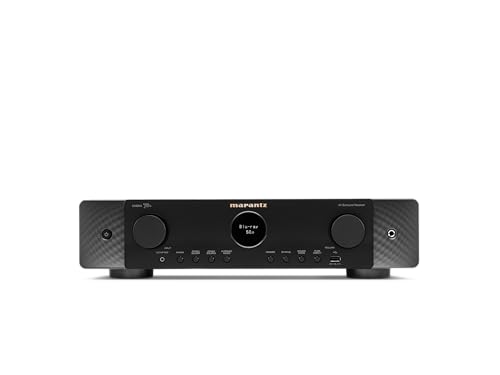
Marantz Cinema 70s — Best for Compact Rooms
Marantz Cinema 70s
(Current Price, subject to change)
Marantz lists Cinema 70s as a slimline 7.2-channel HEOS receiver with six HDMI inputs, eARC, AirPlay, Alexa, Spotify, and a $1,300 street price. That is enough to keep it relevant, because the slim chassis solves a problem no bigger AVR solves: some cabinets and media consoles simply cannot take a full-height receiver.
Room correction: Cinema 70s drops down to Audyssey MultEQ (not MultEQ XT32), which is a real feature step backward from the larger Marantz and Denon siblings. MultEQ uses lower-resolution FIR filters and fewer measurement points, so correction in small, asymmetric rooms is noticeably less precise. No Dirac Live upgrade path exists on this receiver. Buyers who care primarily about room correction should not buy 70s; buyers who need HEOS in a slim chassis and accept that correction is "good enough" will be happy.
HDMI 2.1 behavior: three of the six HDMI inputs support 4K/120, 8K/60, VRR, ALLM, and QFT. eARC is on the main output. For furniture-limited installs, that is still enough HDMI to cover a modern setup — the constraint is physical, not digital. The full-size Marantz and Denon receivers do not fit on a 10-cm-deep media-console shelf; Cinema 70s does.
The compromise is the point. This is not the receiver to buy for the strongest room correction, the biggest Atmos ceiling, or the best value. It is the receiver to buy when furniture and room shape are the real constraints and you still want HEOS and current video switching. Buyers torn between "slim cabinet" and "better correction" should check whether the Denon AVR-X3800H actually fits first — an extra 6 cm of depth is often available with a small console adjustment.
What We Love
- The slim chassis is the feature — it solves a real physical problem no full-size AVR can.
- The smart stack still feels modern — HEOS, AirPlay, Alexa, and Spotify cover the common whole-home use cases.
- Three 4K/120 inputs — enough for modern consoles even in a compact chassis.
What Could Be Better
- The score reflects the ceiling — Audyssey MultEQ (not XT32) and 7.2 channels do not compete with the larger models above it.
- Independent lab coverage is thinner — the evidence base is more manufacturer-and-editorial than measurement-heavy.
- No Dirac Live upgrade path — unlike the full-size Marantz Cinema 50, Cinema 70s cannot grow into the paid Dirac tier later.
The Verdict
Buy Marantz Cinema 70s if cabinet depth is the real problem and you still want a legitimate AVR. Skip it if you have room for a full-size receiver, because better room-correction value is easy to find.
Sony STR-AN1000 — Best for Easy Living-Room Setup
Sony STR-AN1000
(Current Price, subject to change)
Sony lists STR-AN1000 with DCAC IX, 360 Spatial Sound Mapping, AirPlay 2, Chromecast built in, Spotify Connect, Works with Sonos, Roon Tested, 4K/120, 8K/60, VRR, ALLM, and eARC. Tom's Guide liked the immersive effect and easy setup, but also flagged that only two HDMI inputs support 4K/120. That is the right mental model for this receiver: easy to live with, but not the deepest technical answer.
Room correction: DCAC IX is Sony's auto-calibration engine and it is genuinely the easiest guided setup in this guide — the receiver runs through a single mic position and is playable in under five minutes. The tradeoff is depth. DCAC IX handles target-curve adjustment and basic distance/level corrections well, but it does not offer the filter resolution or multi-position measurement logic of Audyssey MultEQ XT32, Dirac Live, or Yamaha's YPAO R.S.C. For a living room with furniture placed for the room, not the speakers, DCAC IX is the right engine. For a room with measurable bass nodes or asymmetric reflections, it is not enough.
360 Spatial Sound Mapping is Sony's proprietary virtual-speaker technology. It can phantom-render speaker positions that no physical speaker occupies, which adds useful Atmos-style height perception even with a 5.1 layout. This is the feature that makes STR-AN1000 feel more immersive than a basic 7.2 box — it is also the reason the receiver pairs particularly well with Sony BRAVIA OLED TVs that support Acoustic Center Sync, which turns the TV itself into a center channel.
HDMI 2.1 behavior: only two of the receiver's HDMI inputs handle 4K/120, which is the single biggest limitation in console-heavy setups. VRR, ALLM, and eARC all work correctly. HDMI-CEC behavior is cleanest when paired with Sony sources, slightly less clean with LG OLED, and acceptable with Samsung.
The best reason to buy it is living-room simplicity. The best reason not to buy it is the room-correction ceiling. A buyer who wants strong streaming support and easy Sony-style setup can still end up happier here than with a better-scoring receiver that asks more from the room and the rack. Buyers who want Sony's ecosystem but need deeper correction should look at the Sony BRAVIA Theater Bar 9 as a soundbar-centric alternative.
What We Love
- Broad streaming support — AirPlay 2, Chromecast, Spotify Connect, Sonos compatibility, and Google Home support cover most mixed households.
- 360 Spatial Sound Mapping remains the signature feature — it is what makes this receiver feel more immersive than a basic 7.2 box.
- Easiest guided setup in the guide — genuinely under five minutes from plug-in to first play.
- Acoustic Center Sync with Sony BRAVIA — unique to Sony's own ecosystem, turns the TV into the center speaker.
What Could Be Better
- Only two HDMI inputs handle 4K/120 — that limitation matters in console-heavy setups.
- DCAC IX scores low in this methodology — a simple setup tool is not the same thing as a deep correction engine.
- No paid correction upgrade path — unlike Denon and Marantz, there is no Dirac Live path to grow into later.
The Verdict
Buy Sony STR-AN1000 if you want an easy living-room receiver with strong streaming support and do not need 9 channels. Skip it if room-correction sophistication is the whole reason you are upgrading.
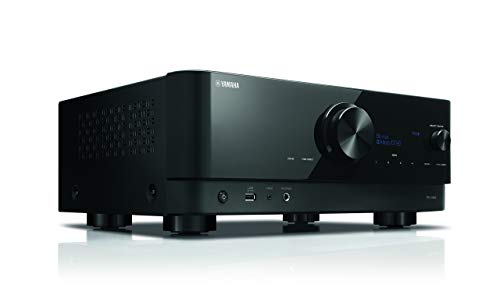
Yamaha RX-V6A — Best Budget 7.2 Option
Yamaha RX-V6A
(Current Price, subject to change)
Yamaha currently lists RX-V6A with 4K/120, 8K/60, VRR, ALLM, eARC, MusicCast, AirPlay 2, Spotify, TIDAL, Alexa, and Google Assistant. The problem is the documented history. Forbes covered Yamaha's HDMI 2.1 hardware-fix response for that generation, which means the buyer story can never be as clean here as it is with the safer value picks above.
Room correction: YPAO (without the R.S.C. multi-point extension of RX-A6A) is the calibration engine here. It handles single-position measurement well, multi-position measurement acceptably, and struggles more than the flagship YPAO implementations in rooms with heavy mode stacking. For a living room with a single sub and a couch, correction is adequate. The ceiling is real: this is not the receiver to pair with dual subs and expect clean integration.
HDMI 2.1 behavior: the current firmware addresses the original bug, but the history is that RX-V6A shipped with HDMI 2.1 behavior that forced Yamaha's engineering response in 2021. Some units required a board-level hardware fix through service. Current-stock units are the updated revision, but buyers purchasing used or open-box should confirm the fix is applied. When working correctly, the receiver passes 4K/120, VRR, and ALLM through its HDMI 2.1 inputs without issue.
That does not make RX-V6A unusable. It makes it a caveat-first budget recommendation. If the goal is the cheapest way into a major-brand 7.2 receiver and the model history is understood, it still works. If the goal is the least complicated 2026 value pick, Onkyo TX-NR7100 is the better recommendation. Buyers committed to Yamaha who want the cleaner feature history should step up to Yamaha RX-A6A instead.
What We Love
- The price is still attractive — it remains one of the cheapest major-brand entries in this lineup.
- MusicCast households still get the platform fit — useful if the rest of the house already leans Yamaha.
- Broad streaming platform coverage — AirPlay 2, Spotify, TIDAL, Alexa, and Google Assistant all native.
What Could Be Better
- The HDMI 2.1 history never disappears — it belongs in any honest buying guide.
- 7.2 is still the ceiling — that limits its long-term theater usefulness compared with the 9-channel receivers above it.
- YPAO without R.S.C. is a step down — the correction engine here is less sophisticated than on the flagship Yamaha receivers.
The Verdict
Buy Yamaha RX-V6A only if you want the cheapest 7.2 path from a major brand and fully understand the HDMI 2.1 history. Skip it if you can stretch to Onkyo TX-NR7100, because that is the cleaner value story.
Smart-Home Integration Deep Dive
The receiver is the control center for the smart theater room, so how it integrates with the rest of the house is as important as how it sounds. Five streaming backbones matter in 2026: HEOS (Denon/Marantz), MusicCast (Yamaha), AirPlay 2 (Apple-forward households), Chromecast built-in (Google/Android households), and Works with Sonos (households already invested in Sonos). A receiver that forces a single backbone is less useful than one that handles three or more cleanly.
HEOS is the broadest whole-home platform on this list. Denon AVR-X4800H, Denon AVR-X3800H, Marantz Cinema 50, and Marantz Cinema 70s all run HEOS natively, which means any HEOS speaker in the house can join a multi-room group with the receiver as the anchor. The app handles group volume, source selection, and scene recall. HEOS also integrates cleanly with Alexa and Google Assistant for voice-triggered scene changes — "Alexa, play music in the theater room" actually works without extra skills. For buyers who want one app to manage all smart-speaker activity in the house, HEOS is the most consolidated answer here.
MusicCast is Yamaha's equivalent and ships on Yamaha RX-A6A and Yamaha RX-V6A. The platform is less expansive than HEOS in terms of third-party speaker partnerships, but the first-party integration with Yamaha soundbars, wireless speakers, and streaming preamps is near-flawless. MusicCast scene recall is one of the cleanest in the category — a single app button fires up the receiver, sets the input, adjusts the volume, and starts playback on the associated streaming service. Households already running Yamaha wireless speakers anywhere else in the house should lean hard toward a Yamaha AVR here.
AirPlay 2 is the most democratic answer: every major receiver in this guide supports it. The difference is how well the implementation handles sustained streams and multi-room groups. HEOS receivers handle AirPlay 2 groups particularly cleanly because HEOS and AirPlay 2 run as parallel paths rather than competing stacks. Sony STR-AN1000 is the best fit for Apple-centric households because its setup flow integrates Apple Home device recognition more smoothly than any other receiver here.
Chromecast built-in is on Onkyo TX-NR7100 and Sony STR-AN1000, which is the right mix for Android-heavy households. Cast from the phone, cast from Google TV, cast from the Chrome browser — all three paths work identically. The Denon, Marantz, and Yamaha receivers do not ship Chromecast, which means Android casting has to route through AirPlay 2 or DLNA, both of which work but feel clunkier.
Works with Sonos appears on TX-NR7100 and STR-AN1000. This is the lightest integration tier — the receiver appears in the Sonos app as a line-in source, which means a Sonos Beam or Era 300 can pull from the receiver into a whole-home Sonos group. This is useful for households that have already standardized on Sonos and do not want to rebuild around HEOS or MusicCast.
Control4, Savant, and RTI driver support is a separate layer. All Denon and Marantz receivers in this guide have polished Control4 drivers; Yamaha and Onkyo drivers are solid; Sony's professional-install story is the thinnest. This matters only for buyers working with a professional installer.
How to Pick — A Buying-Guide Decision Tree
Start with the room. If the room is a dedicated theater with speaker placement already optimized, the receiver should prioritize room correction depth and channel headroom. That means Denon AVR-X4800H, Denon AVR-X3800H, or Onkyo TX-NR7100 as the starting point. If the room is a living room with furniture placed for the room rather than the speakers, the receiver should prioritize setup simplicity and ecosystem fit. That means Sony STR-AN1000 or Marantz Cinema 70s depending on whether Sony or HEOS is the preferred platform.
Check the budget next. Under $900, the only receivers worth considering here are Onkyo TX-NR7100 ($770, includes Dirac Live) and Yamaha RX-V6A ($800, caveat-first). TX-NR7100 wins that comparison every time unless MusicCast is a hard requirement. From $900 to $1,500, Sony STR-AN1000 ($1,148) and Marantz Cinema 70s ($1,300) become the living-room and compact-cabinet picks. From $1,500 to $2,500, Denon AVR-X3800H ($1,799) is the balanced midweight; RX-A6A ($2,200) only wins if MusicCast is decisive. Above $2,500, it is Denon AVR-X4800H ($2,799) vs Marantz Cinema 50 ($2,800) — same platform, same Dirac path, pick the chassis preference.
Then check the consoles. Rooms with PS5, Xbox Series X, and a gaming PC all active need three or more HDMI 2.1 inputs with full 4K/120 support. That narrows the list to X4800H (all seven inputs), TX-NR7100 (three of six), X3800H (three of six), or Cinema 50 (three of six). Rooms with one console should not make HDMI 2.1 count the deciding factor.
Last, check the subs. One sub — any receiver in this guide handles it. Two subs — still any receiver, though Denon and Marantz treat them as linked rather than independent channels unless Dirac Bass Control is added. Three or four subs with phase issues — only Denon X4800H, X3800H, or Marantz Cinema 50 with the Dirac Bass Control upgrade will handle them cleanly.
Frequently Asked Questions
Do you need 9 channels in a 12x14 room?
Not usually. That room size can still make sense with a strong 7.2 receiver if the real target is 5.1.2 or 7.1 rather than a larger Atmos layout. The step to 9 channels matters once the goal becomes 5.1.4 or 7.2.2 and the speaker placement actually supports it.
Is paying for Dirac worth it over Audyssey XT32?
It is worth it when room correction is the main reason for the upgrade. Denon AVR-X3800H and Denon AVR-X4800H are still useful with Audyssey XT32, but the paid Dirac path is what lifts them above simpler long-term buys.
Is Yamaha RX-V6A still safe to buy after the HDMI 2.1 issue?
It is still buyable, but only with the caveat fully understood. Yamaha’s current page shows a modern feature list, yet the model still belongs to the generation associated with the documented HDMI 2.1 hardware-fix history.
Is Marantz Cinema 70s enough for a serious theater room?
It is enough for a compact room, a shallow media console, or a furniture-limited setup. It is not the right buy when the goal is the strongest room correction, the biggest Atmos ceiling, or the cleanest value.
Do you need Roon Ready, or are AirPlay 2 and Chromecast enough?
Most buyers do not need Roon-specific certification if the real goal is easy casting from a phone, tablet, or TV. AirPlay 2 and Chromecast cover more households, while Roon matters only if the library and control flow already revolve around that software.
When NOT to Buy an AV Receiver
Skip the whole category if the room only needs cleaner TV dialogue, a simpler living-room install, or a single-box upgrade path. In that case, a Dolby Atmos soundbar is usually the smarter buy. Skip it again if speaker placement, cable runs, or furniture layout make even a 7.2 receiver feel like a compromise before the first movie starts. A receiver pays off only when the room and the speaker plan are ready for one.
The Bottom Line
Get the Denon AVR-X4800H if you want the best all-around mix of 9.4-channel flexibility, HEOS, modern HDMI behavior, and the deepest room-correction upgrade path in this guide. The Dirac Live + Bass Control upgrade ceiling is the single strongest reason a flagship receiver justifies flagship pricing here — no other mainstream AVR opens that calibration door as cleanly.
Get the Onkyo TX-NR7100 if value matters more than brand prestige, because included full-bandwidth Dirac Live at $769.95 is still the cleanest budget story in the guide. It is the only receiver here that ships the paid correction tier as a bundled feature, and that is a meaningful feature-per-dollar advantage even at twice its price.
Skip the Yamaha RX-V6A if you want the least complicated buyer story possible, because the HDMI 2.1 history is still part of the ownership decision. Stepping up to Yamaha RX-A6A solves the complication without leaving the MusicCast ecosystem.
Sources & Methodology
This guide compares current manufacturer pages from Denon, Marantz, Yamaha, Onkyo, and Sony, plus independent editorial coverage from Sound & Vision, Audioholics, Tom's Guide, and Forbes. For the broader editorial framework, see SmartHomeExplorer methodology.
Written by Nicholas Miles, founder of SmartHomeExplorer. Nick has covered smart home technology since 2024, including 1,353 smart home products and 407 buying guides, focusing on the products that hold up once the setup becomes part of daily life rather than a weekend project.
Disclosure: SmartHomeExplorer.com earns affiliate commissions from qualifying Amazon purchases. That does not change rankings or scoring logic. Editorial methodology is published at /methodology.