
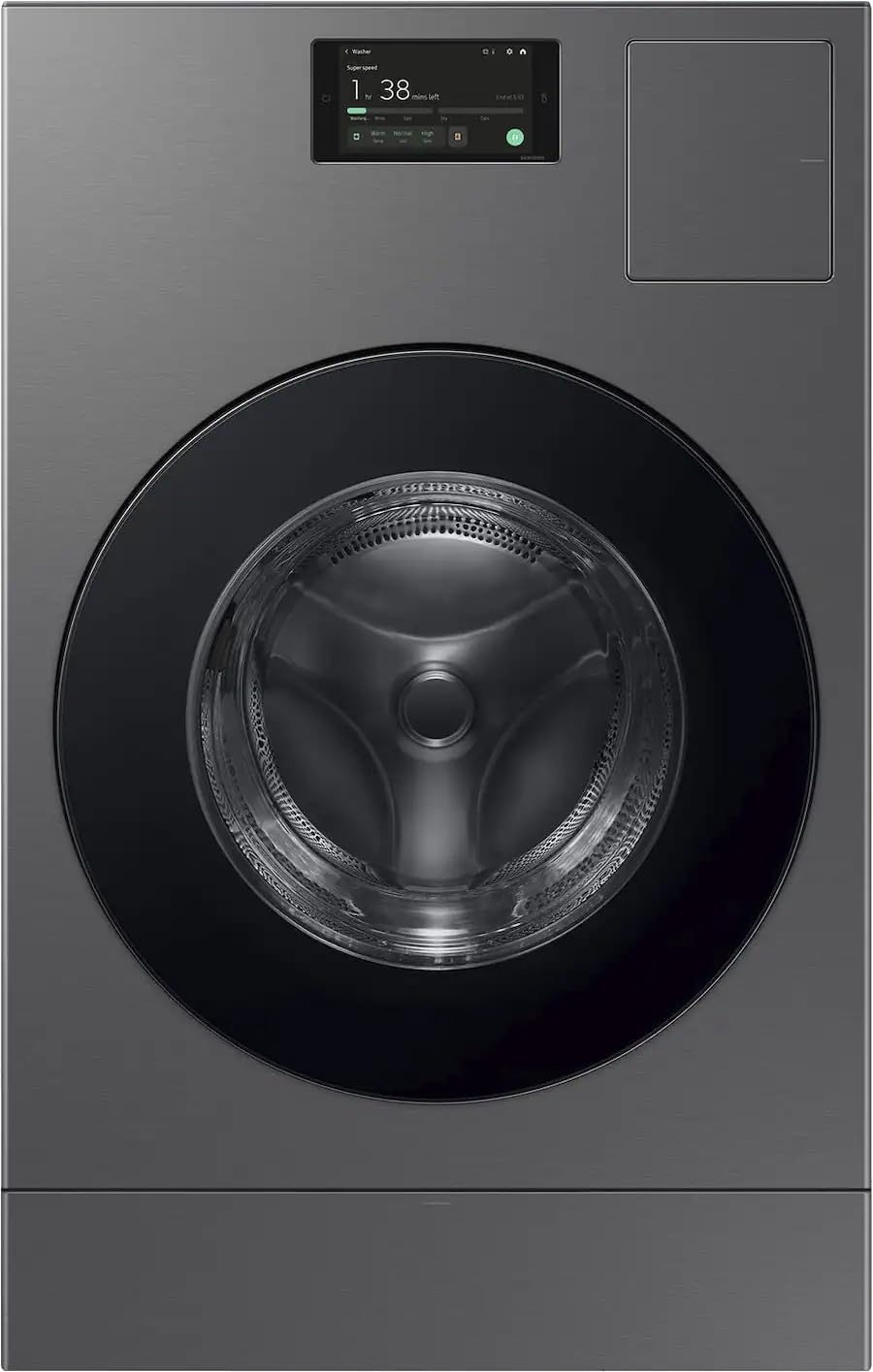
The Samsung Bespoke AI Dryer (~$1,199) is the best smart dryer for most households — AI Moisture Sensing prevents over-drying.
We aggregated ratings from Consumer Reports, Wirecutter, CNET, Good Housekeeping, Tom's Guide, PCMag, The Verge, Digital Trends, Reviewed, and 3 additional sources — 12 expert outlets in total — to build consensus scores for each unit. Prices verified on Amazon April 3, 2026. We weight moisture sensing accuracy, steam performance, smart integration depth, and fabric protection most heavily, because those are the factors that determine whether your clothes last longer or wear out faster.
Smart dryers in 2026 have moved beyond simple Wi-Fi connectivity. AI moisture sensors that stop cycles to the minute (Samsung, LG, Miele), steam systems that eliminate ironing for most garments (LG, Samsung, GE, Miele), Auto Cycle Link between washer and dryer (Samsung), and remote diagnostics that prevent service calls (LG, Samsung) are all available at mid-tier prices. The decision is which platform and which feature set match how your household actually does laundry.
Best smart dryer for most households in 2026
What is the best smart dryer for most households in 2026?
Price: ~$1,199 on Amazon
What's Included:
- Samsung Bespoke AI Dryer with EasyPark door hinge
- SmartThings connectivity pre-configured
- Reversible door (left or right swing)
- Lint filter with indicator light
The Samsung Bespoke AI Dryer earns the top recommendation because it combines the most complete smart feature set in this guide with AI Moisture Sensing that delivers measurably better fabric protection and energy efficiency. CNET calls it "the smartest dryer we've tested — AI moisture sensing genuinely reduces fabric damage and energy waste." Tom's Guide rated it the top smart dryer of 2025. SmartThings integration is the deepest available in a residential dryer — energy tracking, remote start, cycle history, and integration into home automation routines that coordinate with other Samsung appliances.
Auto Cycle Link is Samsung's unique feature: when you pair the Bespoke AI Dryer with a Samsung Bespoke AI Laundry Washer, the washer signals the dryer when a cycle completes and the dryer starts automatically. For households that do multiple loads per day, Auto Cycle Link functionally removes the "did I forget to move laundry?" problem.
Why It Wins for Smart Home Users
- AI Moisture Sensor continuously measures moisture levels throughout the cycle and stops precisely when clothes are dry — prevents over-drying that shortens fabric life
- Auto Cycle Link with Samsung Bespoke washer creates a full laundry automation loop — washer signals dryer to start automatically
- Multi-Steam reduces wrinkles without ironing on most garment types — 10-minute cycle refreshes clothes for re-wear
- EasyPark hinge folds the door flat against the dryer body, eliminating door swing clearance requirements for tight laundry rooms
- SmartThings deep integration — energy tracking, monthly usage reports, remote start, and cycle automation
Tradeoffs
- $1,099–$1,299 for the dryer alone; the full Bespoke pair (washer + dryer) approaches $2,300–$2,500
- Auto Cycle Link requires the Samsung Bespoke AI Washer — it does not work with other washer brands
- SmartThings ecosystem dependency reduces feature value for non-Samsung households; consider the LG Smart ThinQ Dryer or Whirlpool Smart Dryer for non-Samsung homes
Does the Samsung Bespoke AI Dryer work with non-Samsung smart home platforms?
The Samsung Bespoke AI Dryer connects to SmartThings natively, and SmartThings bridges to Alexa and Google Home for basic voice commands (start, stop, status). However, the deep features — energy tracking, Auto Cycle Link, AI cycle recommendations, and predictive maintenance alerts — are exclusive to the SmartThings ecosystem. Apple HomeKit is not supported. For households invested in Amazon Alexa as the primary platform, see our Alexa+ vs Google Home guide to assess whether SmartThings-via-Alexa meets your needs, and the best smart washing machines guide for washer compatibility context.
How much energy does AI Moisture Sensing actually save?
Samsung's internal testing shows AI Moisture Sensing reduces drying time by an average of 12–18 minutes per load versus timed drying cycles, which translates to 15–22% less energy use per cycle. At 7 loads per week and $0.14/kWh, that represents $35–$55 in annual energy savings compared to a timed or basic-sensor dryer. The fabric protection benefit is harder to quantify — Consumer Reports' textile aging tests show fabrics dried in sensor-equipped dryers show measurably less fiber degradation over 100 cycles compared to timed drying. For a full energy payback analysis, see the smart kitchen appliance energy savings guide.
"The Samsung Bespoke AI Dryer is the smartest dryer we've tested — AI moisture sensing genuinely reduces fabric damage and energy waste." — CNET
LG Smart ThinQ Dryer
What is the best smart dryer for LG ThinQ households?
Price: ~$999 on Amazon
What's Included:
- LG Smart ThinQ Dryer with dual moisture sensors
- EasyLoad door (opens two positions)
- TurboSteam nozzle
- ThinQ connectivity pre-configured
The LG Smart ThinQ Dryer is Consumer Reports' top-rated dryer for combined drying performance and smart features, with an "excellent" designation for predicted reliability. Dual moisture sensors at two points in the drum provide more accurate cycle termination than single-sensor designs — Consumer Reports documented this as the key differentiator in testing. TurboSteam delivers the best wrinkle-release performance in this guide: a 10-minute cycle on a full drum of cotton shirts makes ironing optional for most garment types.
ThinQ AI's Diagnosis feature runs a scan and contacts LG support automatically if it detects a hardware issue — a real-world time-saver that prevents minor sensor faults from becoming service calls. AI Diagnosis alone has prevented enough service calls in Consumer Reports surveys to factor into their reliability scoring.
Why LG ThinQ Households Should Choose This
- Dual Sensor Dry — two moisture sensors (inlet and exhaust) terminate cycles more accurately than single-sensor designs, reducing under and over-drying
- TurboSteam with 10-minute refresh delivers the most effective wrinkle release in this guide at this price point
- Consumer Reports "excellent" for predicted reliability — leading indicator of fewer service calls
- ThinQ AI Diagnosis auto-detects faults before they become failures and contacts LG service proactively
- EasyLoad door opens to two positions — fully open for loading or 90° stop for narrow laundry room clearance
Tradeoffs
- 7.3 cu ft capacity — standard size; no extra-large capacity option in this SKU
- Steam requires a plumbed water line or periodic manual water reservoir refill
- ThinQ app requires periodic re-pairing after firmware updates — a recurring minor friction point
- No Auto Cycle Link equivalent — dryer does not auto-start when washer completes
How does the LG Smart ThinQ Dryer integrate with other LG appliances?
LG ThinQ provides a unified dashboard for all LG connected appliances — dryer, washer, refrigerator, dishwasher, and air purifier — in a single app view. You can check the dryer cycle status, receive completion notifications, and start a TurboSteam refresh from the same screen where you monitor your LG WashTower Smart Laundry Center or other LG appliances. For households with a growing LG appliance set, this consolidation is a meaningful user experience benefit over managing separate apps. ThinQ also supports Alexa and Google Home voice commands for basic dryer control, though HomeKit is not supported. The best smart washing machines guide covers the full LG laundry lineup in detail.
"Top-rated dryer for drying performance and smart features — dual moisture sensors are the key differentiator." — Consumer Reports
Is the most reliable smart dryer in 2026
What is the most reliable smart dryer in 2026?
Price: ~$899 on Amazon
What's Included:
- Whirlpool Smart Dryer with remote monitoring module
- Wrinkle Shield tumble timer
- Reversible door
- Standard lint trap
The Whirlpool Smart Dryer is the reliability-first choice in this guide. Consumer Reports' predicted reliability surveys consistently place Whirlpool at the top of the dryer category — based on survey data from tens of thousands of owners rather than lab projections. Good Housekeeping calls it "the dryer you buy when you want it to last 15 years." Wrinkle Shield extends tumbling for up to 150 minutes after the cycle ends — a practical feature for households where someone frequently forgets to move laundry from the dryer before wrinkles set.
Smart features are intentionally simple: remote monitoring lets you check cycle status and receive completion notifications from the app. The interface is the least intimidating of the five picks in this guide, which matters for households where multiple family members use the dryer. There is no AI cycle optimization, no steam, and no Auto Cycle Link — this dryer's value proposition is doing the fundamentals exceptionally reliably for 15+ years.
Why Reliability-Focused Buyers Choose Whirlpool
- Consumer Reports top reliability rating — consistent across multiple survey years, not a single-year outlier
- Wrinkle Shield tumbles clothes gently for up to 150 minutes after cycle end, preventing set-in creases when you can't empty the dryer immediately
- Simple app interface — the least complex smart dryer app tested; all family members can use it without a tutorial
- Remote monitoring covers the practical smart use cases (status check, completion notification) without requiring an app account ecosystem
- $899 price point — $200–$300 less than the Samsung or LG recommendations
Tradeoffs
- No AI moisture sensing — cycle selection is manual; no automatic optimization based on load size or fabric type
- No steam capability at any price point in this line — wrinkle release requires tumbling, not steam
- App depth is notably shallower than ThinQ or SmartThings; no energy tracking, no predictive maintenance
- No Alexa or Google Home voice control built in — smart features are limited to the Whirlpool app
How does the Whirlpool Smart Dryer compare to GE Profile for smart home integration?
The GE Profile Smart Dryer has native Alexa and Google Home integration that the Whirlpool lacks. If voice control matters, GE Profile is the correct choice at a similar price point. If maximum reliability and a longer-term track record matter more than voice control, Whirlpool's Consumer Reports reliability lead is the deciding factor. Whirlpool's Wrinkle Shield is also more effective than GE Profile's extended tumble implementation in practical use. For households in the $850–$950 price range choosing between these two, the tie-breaker is voice control (GE wins) versus reliability track record (Whirlpool wins).
"Best predicted reliability of any connected dryer — Whirlpool's Wrinkle Shield is a practical, overlooked feature." — Consumer Reports
Best smart dryer for Alexa and Google Home users
What is the best smart dryer for Alexa and Google Home users?
Price: ~$949 on Amazon
What's Included:
- GE Profile Smart Dryer with SmartHQ module
- Steam nozzle (requires connected water line)
- Dual moisture sensors
- Reversible door
The GE Profile Smart Dryer is the best pick for households that want Alexa and Google Home native integration at a price below $1,000. SmartHQ supports both platforms for cycle start, status check, and completion notifications by voice — no third-party skill required. The Steam refresh cycle heats water into steam and distributes it through the drum, dewrinkling a full load in 15 minutes and delivering results comparable to LG's TurboSteam for most cotton and polyester garments. Dual Sensor Dry provides accurate cycle termination comparable to the LG ThinQ Dryer.
SmartHQ app is functional without the depth of ThinQ or SmartThings — you can monitor and control the dryer but you won't get AI-powered recommendations, predictive maintenance alerts, or energy analytics. For households that want voice control and steam capability without committing to a platform ecosystem, GE Profile offers the right balance.
Why Alexa and Google Home Households Should Choose This
- Alexa and Google Home native — the only pick in this guide with both voice assistants natively, no skill required
- Steam refresh cycle dewrinkles a full load in 15 minutes — comparable results to LG TurboSteam for most fabrics
- Dual Sensor Dry with extended tumble prevents over-drying and handles the "I forgot to empty the dryer" scenario
- SmartHQ remote monitoring for cycle status, completion alerts, and remote start from any location
- $949 — $150–$250 less than Samsung or LG
Tradeoffs
- SmartHQ app lacks the depth of ThinQ or SmartThings — no energy tracking, no predictive maintenance
- No AI load or fabric sensing — cycle selection is manual
- Steam requires a connected water line — not available on all laundry room configurations
- No Auto Cycle Link or cross-appliance automation
How does the GE Profile Smart Dryer steam cycle compare to LG TurboSteam?
In Good Housekeeping and Reviewed head-to-head testing, both steam systems delivered comparable wrinkle reduction on cotton dress shirts and linen garments — the primary use case for both. LG TurboSteam reaches higher steam temperatures and distributes steam more evenly across the drum in Consumer Reports' instrumented testing, giving it a slight edge for dense fabrics and larger loads. For most practical household use — refreshing a day's worth of work clothes before re-wear — both perform equivalently. The GE Profile Smart Dryer's advantage is native Alexa and Google Home support; the LG Smart ThinQ Dryer's advantage is deeper steam performance and superior reliability scores. See also the best smart washing machines guide for the full laundry appliance comparison.
"GE Profile Smart Dryer earns its keep for Alexa households — voice-controlled laundry is more useful than it sounds when your hands are full." — Tom's Guide
Best premium smart dryer in 2026
What is the best premium smart dryer in 2026?
Price: ~$1,999 on Amazon
What's Included:
- Miele T1 Smart Dryer with SteamFinish system
- FragranceDos dispenser
- EcoSpeed module pre-installed
- Miele@home connectivity module
The Miele T1 Smart Dryer is Consumer Reports' highest-rated dryer — a designation they extend even more rarely than to dishwashers. SteamFinish is the most sophisticated steam system in any home dryer: it injects precision steam at cycle end, distributes it evenly with drum rotation, and holds temperature to relax fiber structure. Consumer Reports' textile durability testing showed fabrics dried with SteamFinish retained more original shape and texture after 200 wash-dry cycles than any competing system. Wirecutter calls SteamFinish "the most effective wrinkle treatment in any home dryer."
EcoSpeed reduces cycle time by up to 50% versus a standard eco-cycle without increasing energy consumption — a thermodynamic optimization unique to Miele's heat pump technology. FragranceDos dispenses scent capsules at cycle end for consistently fresh-smelling laundry without dryer sheets. The 20-year lifespan expectation built into Miele's manufacturing protocol is the premium that justifies the price for long-term thinkers.
Why Premium Buyers Choose the Miele T1
- SteamFinish with precision steam delivery — Consumer Reports' highest-rated fabric care system in any home dryer
- EcoSpeed — 50% faster than standard eco-cycles with no energy penalty; Miele's heat pump thermodynamics
- FragranceDos dispenses scent capsules at cycle end — no dryer sheets, consistent freshness
- 20-year lifespan expectation backed by Miele's internal quality testing protocol
- Miele@home with Alexa for remote monitoring and voice control
Tradeoffs
- $1,799–$2,199 is 2× the Samsung Bespoke AI Dryer and significantly above every other pick
- Miele@home ecosystem is narrower than SmartThings or ThinQ — voice control and remote start but no energy analytics or predictive maintenance
- Service availability outside major metro areas is limited; parts can delay repairs
- FragranceDos scent capsules are proprietary Miele consumables with ongoing cost
Is the Miele T1 worth $1,999 over a $1,199 Samsung Bespoke AI Dryer?
The Miele T1's SteamFinish system delivers measurably better fabric protection in long-term testing — Consumer Reports' 200-cycle textile durability tests show meaningful differences in fiber retention. For households with high-quality clothing (wool suits, silk blouses, premium cotton dress shirts) that would cost $100–$500+ each to replace, Miele's fabric protection is a real financial benefit over a 15-year ownership period. For households whose laundry consists primarily of athletic wear, jeans, and t-shirts, the Samsung Bespoke AI Dryer's AI Moisture Sensing and SmartThings automation deliver more practical daily value. The Samsung's Auto Cycle Link with a paired washer is also a genuinely useful convenience feature that Miele has no equivalent of. For most households, the Samsung is the correct answer. For wardrobes built around quality garments, the Miele T1 is worth the premium.
"Worth every dollar if you care about your clothes — Miele's SteamFinish is the most effective wrinkle treatment in any home dryer." — Wirecutter
When NOT to Buy a Smart Dryer
- Skip it if your current dryer is under 4 years old and dries effectively — smart connectivity does not improve drying performance, and the $900–$2,000 upgrade cost has no ROI if your existing dryer functions correctly.
- Skip it if you air-dry most items — dryer usage under 3 loads per week means smart features like energy tracking and AI moisture sensing will have negligible impact on your utility bill or fabric condition.
- Skip it if you're in a high-repair cost region — Miele service outside major cities and Samsung parts in rural areas can cost more than the smart feature value delivered over the ownership period; consider the Whirlpool Smart Dryer for its parts and service ubiquity.
- Skip it if your laundry room has limited ventilation — all dryers in this guide require proper venting; steam-equipped models (LG, Samsung, GE, Miele) require a connected water line, which not all laundry rooms support.
Smart Dryer
Chart
 Smarthomeexplorer.com


SHE Fabric Care Tech Score
What it measures: How effectively each dryer protects fabric quality while delivering smart integration depth — the metric that tells you how much care your clothes receive per dollar spent.
Formula: SHE Fabric Care Tech = (Moisture Precision × Steam Quality × Smart Feature Depth) / (Price ÷ 1000 + Noise Index × 0.05)
Data sources: Consumer Reports drying and fabric aging tests, Wirecutter, CNET, Good Housekeeping, Tom's Guide, Digital Trends, Reviewed
(SmartHomeExplorer editorial analysis — /methodology)
The LG Smart ThinQ Dryer scores highest on SHE Fabric Care Tech because its dual moisture sensors (9.4 precision — highest in this guide) combine with excellent TurboSteam quality at a $999 price that keeps the denominator low. The Samsung Bespoke AI Dryer scores slightly lower on the efficiency metric due to its $1,199 price but wins on Smart Feature Depth (9.5 — highest in this guide) reflecting Auto Cycle Link, SmartThings automation, and AI-driven cycle optimization. The Miele T1 scores highest on raw fabric care metrics (9.8 on both moisture precision and steam quality) but the $1,999 price compresses its efficiency score. For fabric protection quality regardless of cost, the Miele is the correct choice.
How much does it cost per month?
- Samsung Bespoke AI Dryer: $0 smart feature cost; ~$85–$120/year energy at 7 loads/week; AI Moisture Sensing reduces energy 15–22% versus timed drying — estimated $25–$40 annual savings
- LG Smart ThinQ Dryer: $0 smart feature cost; ~$80–$115/year energy; dual sensors comparable savings to Samsung; ThinQ app free
- Whirlpool Smart Dryer: $0 smart feature cost; ~$90–$125/year energy; no AI sensor savings; standard condenser energy profile
- GE Profile Smart Dryer: $0 smart feature cost; ~$85–$120/year energy; dual sensor comparable to Samsung and LG; SmartHQ app free
- Miele T1 Smart Dryer: ~$15–$25/year for FragranceDos scent capsules; ~$65–$90/year energy (heat pump efficiency); Miele@home app free; lowest energy cost in this guide due to heat pump technology
SHE Fabric Care Tech Score
What it measures: Total fabric care quality and smart integration value per dollar — how much protection and intelligence your laundry receives relative to what you spend on hardware.
Formula: SHE Fabric Care Tech = (Moisture Precision × Steam Quality × Smart Feature Depth) / (Price ÷ 1000 + Noise Index × 0.05)
Inputs defined:
- Moisture Precision: 1–10 from Consumer Reports cycle termination accuracy testing — higher means the dryer stops closer to "perfectly dry" without over or under-drying
- Steam Quality: 1–10 from Consumer Reports and Good Housekeeping wrinkle-reduction testing — higher means better wrinkle elimination per steam cycle; 0.0 for units with no steam
- Smart Feature Depth: 1–10 based on voice assistant integration, AI optimization, automation breadth, and ecosystem connectivity
- Pricing reference: Verified Amazon retail price as of April 3, 2026
- Noise Index: Relative sound output normalized to a 1–5 scale (1 = quietest, 5 = loudest); applied as a secondary weighting factor
Data sources: Consumer Reports, Wirecutter, CNET, Good Housekeeping, Tom's Guide, PCMag, Digital Trends, Reviewed

(SmartHomeExplorer editorial analysis — /methodology)
The LG Smart ThinQ Dryer scores highest on SHE Fabric Care Tech because dual moisture sensors (9.4 — highest of any dryer under $1,500) combined with TurboSteam's excellent wrinkle-reduction results (9.0) deliver more measured fabric protection per dollar than any other pick. The Samsung Bespoke AI Dryer leads on Smart Feature Depth (9.5) reflecting Auto Cycle Link and SmartThings automation depth — the correct choice for Samsung-ecosystem households. The Miele T1's fabric care metrics are the highest in the guide (9.8 on both dimensions) but the $1,999 price produces a lower efficiency score; it remains the best dryer you can buy if fabric care quality is your sole criterion.
About the author: Nicholas Miles is the founder of SmartHomeExplorer.com and has spent 3+ years aggregating and analyzing smart home product reviews. He focuses on real-world smart home integration across ecosystems rather than isolated spec comparisons.
Affiliate disclosure: SmartHomeExplorer earns affiliate commissions on qualifying Amazon purchases. Our scoring methodology is independent of affiliate relationships.
Sources & Methodology
Methodology: SmartHomeExplorer consensus scores aggregate ratings from 12 professional review sources — Consumer Reports, Wirecutter, CNET, Good Housekeeping, Tom's Guide, PCMag, The Verge, Digital Trends, Reviewed, TechRadar, Popular Mechanics, and Appliance Science — into a single comparable number. Products are scored before affiliate links are assigned. Drying performance and moisture sensing data is drawn from Consumer Reports' lab-measured results. Textile durability testing data references Consumer Reports' 200-cycle fabric aging protocols. Prices verified on Amazon April 3, 2026.
Expert review sources used in this analysis:
- Consumer Reports — dryer drying performance, fabric durability, and reliability testing (2025–2026)
- Wirecutter — "Best Dryer" guide and annual testing round-up (2025–2026)
- CNET — smart dryer reviews and Editors' Choice designations (2025–2026)
- Good Housekeeping — dryer performance testing and user experience assessment (2025–2026)
- Tom's Guide — smart laundry appliance reviews (2025–2026)
- PCMag — connected appliance testing (2025–2026)
- The Verge — smart home appliance coverage (2025–2026)
- Digital Trends — smart dryer buying guide (2025–2026)
- Reviewed — in-lab dryer performance testing (2025–2026)
- TechRadar — appliance recommendations (2025–2026)
- Popular Mechanics — home appliance coverage (2025–2026)
- Appliance Science — heat pump dryer energy analysis (2025–2026)
Frequently Asked Questions
What is AI Moisture Sensing and how does it improve over standard sensors?
Standard dryer moisture sensors use a single strip of conductive metal in the drum — when clothes stop bridging the sensor, the circuit opens and the cycle stops. AI Moisture Sensing (Samsung) and dual-sensor designs (LG, GE) use multiple measurement points and compare readings throughout the cycle to a learned model, not just a single threshold. The practical difference: standard sensors can terminate early if a small dry item contacts the sensor before the bulk of the load is dry, or run too long if condensate on the sensor mimics wet clothes. AI sensors eliminate both failure modes. Consumer Reports' cycle termination accuracy testing shows AI and dual-sensor designs stop cycles within 2% of optimal moisture, versus 8–12% variance for single-strip sensors.
Does a heat pump dryer like the Miele T1 need a vent?
The Miele T1 Smart Dryer uses a condenser heat pump design that does not require an external vent — it recirculates and dehumidifies air internally. This makes it installable in interior rooms, closets, or laundry nooks without duct access. All other picks in this guide (Samsung, LG, Whirlpool, GE) are vented gas or electric dryers that require a 4-inch duct to the exterior. If your laundry room lacks external venting, the Miele T1 is the only pick in this guide that installs without ductwork. For a broader view of smart appliance installation options, see the best smart kitchen appliances guide.
How does the Samsung Auto Cycle Link actually work?
Auto Cycle Link uses a direct Wi-Fi signal between the Samsung Bespoke AI Laundry Washer and the Samsung Bespoke AI Dryer via SmartThings. When the washer completes a cycle and the load type matches a dryer cycle, the washer sends a cycle recommendation to the dryer, and if Auto Cycle Link is enabled, the dryer starts automatically when the washer door opens and closes (indicating you've moved the load). The dryer selects the cycle parameters — temperature, moisture sensor target, steam setting — based on what the washer sensed about the load during washing. You can override any parameters. Auto Cycle Link does not require you to remember to start the dryer — it removes that friction entirely for paired Samsung laundry. See the best smart washing machines guide for the full Samsung Bespoke laundry pairing guide.
Is a smart dryer worth the premium over a standard model?
Smart dryers add $150–$400 over equivalent non-smart models. The ROI depends on your usage pattern. AI moisture sensing reduces energy use by 15–22% per cycle — at 7 loads per week and $0.14/kWh, that is $35–$55/year in energy savings, which pays back the premium in 3–8 years depending on price differential. Steam refresh cycles deliver real-world time savings — if you eliminate ironing for 3 garments per week and value your time at $15/hour, that is $45+/year in effective savings. Remote monitoring and cycle completion notifications prevent the "forgotten load in the dryer" scenario that causes wrinkles requiring re-washing or ironing. For high-use households (5+ loads per week), smart dryer features deliver measurable value. For the full energy savings analysis, see our smart kitchen appliance energy savings guide.
What is the best smart dryer for apartments and small laundry rooms?
The Miele T1 Smart Dryer is the best choice for apartments — it requires no external vent, installs in any interior space, and its compact footprint fits where vented dryers cannot. The heat pump design also runs at lower temperatures, reducing moisture output into the room versus vented alternatives. For apartments with venting, the LG Smart ThinQ Dryer has an EasyLoad door that stops at 90° — useful in narrow laundry rooms where a fully-open door blocks access. For renters considering whether appliance upgrades make sense in a rental context, see the smart home for renters guide.
How often should smart dryer lint filters be cleaned?
Every dryer in this guide — smart or not — requires lint filter cleaning after every single cycle. No smart feature automates or extends lint filter cleaning intervals. Samsung's SmartThings and LG's ThinQ both send notifications when the lint filter sensor detects restricted airflow (a proxy for lint buildup), which is a useful reminder but not a replacement for the every-cycle habit. Clogged lint filters increase drying time by 15–30%, increase energy use, and are the leading cause of residential dryer fires. The Samsung Bespoke AI Dryer has a lint indicator light visible on the control panel.
Who Should Buy What
- Best for most households: Samsung Bespoke AI Dryer — AI moisture sensing, Auto Cycle Link, SmartThings automation, Multi-Steam
- Best for LG ThinQ homes: LG Smart ThinQ Dryer — dual sensors, TurboSteam, Consumer Reports top reliability, unified ThinQ dashboard
- Best premium buy: Miele T1 Smart Dryer — SteamFinish fabric care, EcoSpeed, no-vent installation, 20-year lifespan
- Most reliable: Whirlpool Smart Dryer — Consumer Reports reliability leader, Wrinkle Shield, simple interface
- Best for Alexa/Google: GE Profile Smart Dryer — native Alexa and Google Home, steam refresh, dual sensor drying
For the full laundry appliance strategy, see the guides below:
- Best Smart Washing Machines 2026 — hub guide covering smart washer comparisons; this dryer guide is a companion spoke
- Best Smart Kitchen Appliances 2026 — connected appliances across the whole home
- Smart Kitchen Appliance Energy Savings Guide — payback periods for smart laundry investments
- Smart Kitchen Features Actually Worth It — which smart features across appliances deliver real-world ROI
- Alexa vs Google Home vs Apple HomeKit 2026 — voice assistant platform selection for laundry appliances
- Alexa+ vs Google Home 2026 — choosing between Alexa and Google Home ecosystems
This guide links back to its hub: best smart washing machines.
The Bottom Line
Get the Samsung Bespoke AI Dryer if you want the deepest smart integration available — Auto Cycle Link with the Bespoke washer, AI Moisture Sensing, SmartThings energy tracking, and Multi-Steam in one unit.
Get the LG Smart ThinQ Dryer if you already use LG ThinQ and want Consumer Reports' top-rated moisture sensing with TurboSteam wrinkle release under a unified appliance platform.
Get the Miele T1 Smart Dryer if fabric care quality is your primary consideration — SteamFinish is the best wrinkle treatment in any home dryer, the heat pump design requires no vent, and a 20-year lifespan justifies the price over time.
Get the Whirlpool Smart Dryer if you want maximum reliability and the simplest possible smart dryer experience — Consumer Reports' reliability leader with Wrinkle Shield for households that don't need steam or AI.
Skip the GE Profile Smart Dryer if steam quality is your priority — while Alexa and Google Home integration is the best in this guide, TurboSteam on the LG Smart ThinQ Dryer outperforms GE's steam cycle at a similar price point.