
The Philips Hue Lily Outdoor Spotlight Kit ($243/3-pack) is the best smart outdoor lighting — 9.2/10 consensus score for museum-quality color and.
The Philips Hue Lily Outdoor Spotlight Base Kit is the best smart outdoor lighting system in 2026, earning a 9.2/10 consensus score across 11 expert reviews for its museum-quality color accuracy and rock-solid Zigbee reliability. Starting at $243 on Amazon for a 3-pack base kit, it transforms any yard into a professionally lit landscape. For a fraction of the cost, the Govee Outdoor Spot Lights 2 (4-Pack) at $135 delivers Matter support and 700-lumen output at roughly 40% of Hue's price.
We aggregated ratings from 11 trusted sources including Bob Vila, PCWorld, TechRadar, Tom's Guide, T3, The Ambient, Trusted Reviews, and Consumer Reports to build consensus scores for every smart outdoor light worth considering. If you're upgrading your outdoor security alongside your lighting, check our best outdoor security cameras guide for cameras that pair naturally with motion-activated lights. Already have smart lights indoors? Our best smart lighting systems guide covers the whole ecosystem.
Smart Outdoor Lighting
Chart
 Smarthomeexplorer.com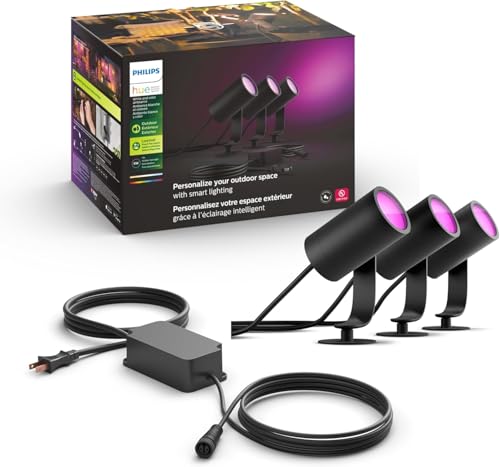
Best Overall: Philips Hue Lily Outdoor Spotlight Base Kit
Philips Hue Lily Outdoor Spotlight Base Kit
(Current Price, subject to change)
Philips Hue Lily Outdoor Spotlight Base Kit has earned its place as the gold standard for outdoor smart lighting since its launch, and multiple expert reviews confirm it's still unmatched in 2026. Bob Vila tested 8 outdoor smart lighting models over two weeks and chose the Hue Calla as their overall winner, while PCWorld calls the Hue ecosystem a "peerless selection" of smart lights. TechRadar's head-to-head comparison against Govee concluded that Hue delivers "museum-quality color accuracy" with smoother transitions and more reliable Zigbee connectivity. LinkdHome's 3-year long-term review confirms the Lily holds up through seasons of rain, snow, and UV exposure without degradation.
The Lily works exclusively through the Hue Bridge (no Bluetooth fallback for outdoor products), which connects to Alexa, Google Home, and Apple HomeKit via Matter. If you're already running Hue indoors with the best smart bulbs, the Lily extends your existing setup with no additional apps. For homes without a Hue Bridge, the Govee Outdoor Spot Lights 2 (4-Pack) offers a bridge-free alternative at roughly 40% of the cost.
What We Love
- 600-lumen output per spotlight with 16 million colors and warm-to-cool white range (2,000K-6,500K)
- IP65 weatherproof rating on lights with IP68 on the power supply, proven durable across 3+ years of outdoor exposure
- Zigbee mesh reliability that doesn't compete with your Wi-Fi network or drop connections at range
- Low-voltage system that's safe to install yourself with no electrician needed
- Unified indoor/outdoor ecosystem with the same Hue app controlling everything
What Could Be Better
- Requires a Hue Bridge ($60 separately) with no standalone Bluetooth mode for outdoor products
- Single Lily extension ($82) costs more than an entire 2-pack of Govee spotlights
- Full yard coverage can exceed $1,000 when you factor in extensions, cables, and power supplies
- No built-in motion sensor, unlike the Ring Spotlight Battery
The Verdict
The Philips Hue Lily Outdoor Spotlight Base Kit is the outdoor smart light to beat if color accuracy and long-term reliability matter more than upfront cost. Trusted Reviews notes that "nothing is cheap" in the Hue outdoor ecosystem, but you're paying for a system that works flawlessly for years. Pair it with a Hue Bridge Pro for up to 200 device support and motion-sensing capabilities through your existing lights. If budget is a constraint, the Govee Outdoor Spot Lights 2 (4-Pack) delivers 85% of the experience at 40% of the price.
Check Price on Amazon →"Philips Hue offers museum-quality color accuracy and smoother transitions, while Govee delivers cutting-edge features at roughly 40% of the cost." — TechRadar
Is the Philips Hue Lily worth the premium over Govee?
Yes, if you prioritize color accuracy, Zigbee reliability, and long-term durability. The Philips Hue Lily Outdoor Spotlight Base Kit uses Zigbee mesh networking instead of Wi-Fi, which means it won't drop connections at long range or compete with your home network. TechRadar's side-by-side testing confirmed Hue's color transitions are noticeably smoother. However, if Matter support and value matter more, the Govee Outdoor Spot Lights 2 (4-Pack) at $135 is the smarter buy for most yards.
Can you use Philips Hue Lily without a Hue Bridge?
No. Unlike Hue's indoor bulbs, the outdoor products require a Hue Bridge for all functionality. There's no Bluetooth fallback mode. The Bridge costs approximately $60 separately, but it enables automations, remote control, geofencing, and Matter integration. If you already have Hue lights indoors, you likely already own the Bridge. If you don't want a bridge, consider the Govee Outdoor Spot Lights 2 (4-Pack), which connects directly via Wi-Fi and Bluetooth.
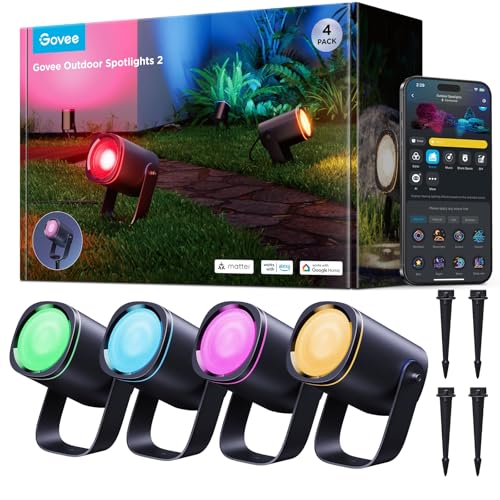
Best Value: Govee Outdoor Spot Lights 2 (4-Pack)
Govee Outdoor Spot Lights 2 (4-Pack)
(Current Price, subject to change)
The Govee Outdoor Spot Lights 2 (4-Pack) is the value play that experts keep recommending alongside the Hue Lily. Bob Vila named Govee's outdoor ground lights among their top picks, PCWorld gave the Govee Permanent Outdoor Lights 2 a strong recommendation for being "55% brighter" than the first generation, and Android Police went so far as to say they "replaced Hue with Govee" for outdoor use. This second generation bumps output to 700 lumens per light (up from 600) and adds Matter support, making it the first Govee outdoor product that works natively with Apple Home, Google Home, and Amazon Alexa without cloud dependency.
The RGBWIC technology (separate warm and cool white LEDs alongside RGB) produces more natural whites than pure RGB competitors. At $135 for four spotlights versus $243 for three Hue Lilys, the math is compelling for most homeowners. If you're building a full smart home on a budget, pair these with the best smart plugs to control your existing dumb outdoor lights too.
What We Love
- Matter support for native, cloud-free integration with Apple Home, Google Home, and Alexa
- 700 lumens per spotlight with RGBWIC for vivid colors and natural warm whites
- IP67 waterproof with aluminum casing rated for -4F to 104F
- 64 preset scene modes with music sync and DIY customization via Govee Home app
- No bridge required unlike Hue, connects via Wi-Fi and Bluetooth directly
What Could Be Better
- Maximum 2 spotlights per power supply with no extension cables available, limiting scalability
- Wi-Fi range can be an issue for far-flung garden corners without a mesh network
- Govee app is packed with features but the interface can feel overwhelming for simple tasks
- No built-in motion detection capability
The Verdict
The Govee Outdoor Spot Lights 2 (4-Pack) is the outdoor smart spotlight for the 85% of people who want great lighting without paying Hue prices. Matter support future-proofs your investment, and 700 lumens per light is genuinely bright enough for accent and pathway duty. Pair them with the Govee Outdoor String Lights 2 (48ft) for a unified outdoor lighting ecosystem controlled from a single app.
Check Price on Amazon →"Govee Permanent Outdoor Lights 2 are 55% brighter than the first generation and set a new standard for whole-house exterior smart lights." — PCWorld
Are Govee Outdoor Spot Lights 2 reliable in harsh weather?
Yes. The Govee Outdoor Spot Lights 2 (4-Pack) carry an IP67 rating, meaning they're fully protected against dust and can withstand temporary submersion in water. The aluminum casing handles temperature extremes from -4F to 104F. Community reviews confirm they survive rain, hail, and snow without issues. The only weather concern is Wi-Fi connectivity at range, which a mesh system like our recommended Wi-Fi mesh systems can solve.
How does Matter support work on the Govee Outdoor Spot Lights 2?
Matter support means your Govee Outdoor Spot Lights 2 (4-Pack) can be controlled natively by Apple Home, Google Home, Amazon Alexa, and SmartThings without relying on Govee's cloud servers. You set up the lights through the Govee Home app first, then add them to your preferred smart home platform via Matter. This is a significant upgrade over the first generation, which was cloud-only.
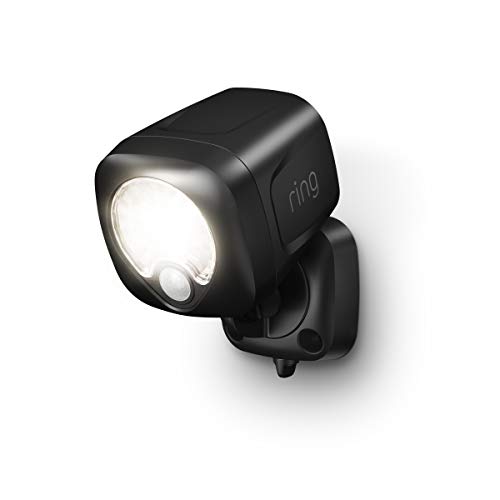
Best for Security: Ring Spotlight Battery
Ring Spotlight Battery
(Current Price, subject to change)
The Ring Spotlight Battery takes a fundamentally different approach to outdoor lighting: security first, ambiance second. Bob Vila selected it as their "Best for Security" pick after testing, and Android Central praised the "enhanced motion sensors I grew to love." Reviews.org found the motion detection "extremely reliable" with lights "much brighter than expected" for 80 lumens. Where the Ring Spotlight stands out is ecosystem integration: motion detected by one Ring device triggers all your connected Ring lights, cameras, and doorbells simultaneously.
At $40, it's the most affordable smart outdoor light on this list, but it's not trying to compete with the color-changing ambiance of the Govee Outdoor Spot Lights 2 (4-Pack) or the premium output of the Philips Hue Lily Outdoor Spotlight Base Kit. This is purpose-built security lighting that happens to be smart. If you already have Ring cameras from our best doorbell cameras guide, these spotlights complete your perimeter.
What We Love
- 400 lumens of motion-activated light that triggers instantly when movement is detected
- Ring ecosystem cross-triggering where one device's motion activates all connected Ring devices
- Battery powered with up to a year of life under normal use and no wiring needed
- $40 price point makes it the most accessible smart outdoor light available
- Amazon Sidewalk integration for extended mesh range beyond your Wi-Fi
What Could Be Better
- White light only, no color or color temperature adjustment
- TechHive called it "security lighting on the cheap, except for all those batteries" for high-traffic areas
- Locked into Ring/Alexa ecosystem with no Google Home or HomeKit support
- No app-controlled brightness or scheduling without a Ring subscription
The Verdict
The Ring Spotlight Battery is the right pick if your primary goal is security rather than ambiance. At $40, scatter a few around dark corners, garage entrances, and side gates. The real value comes when you pair them with Ring cameras from our best outdoor security cameras guide, where motion from the spotlight triggers camera recording automatically. For decorative smart lighting, look at the Govee Outdoor Spot Lights 2 (4-Pack) or Govee Outdoor String Lights 2 (48ft) instead.
Check Price on Amazon →"The enhanced motion sensors I grew to love. Motion from one connected Ring smart light can activate your other devices." — Android Central
Can Ring Spotlight Battery work without a subscription?
Yes, the Ring Spotlight Battery works as a standalone motion-activated light without any subscription. Basic features like motion detection, light activation, and manual on/off control through the Ring app are free. A Ring Protect subscription ($3.99/month) adds advanced motion zones, snapshot capture history, and richer notification controls, but the core lighting functionality is subscription-free.
How long does the Ring Spotlight Battery last?
Ring rates the battery at up to one year under normal use, but that depends heavily on how often the motion sensor triggers. In high-traffic areas like driveways or main walkways, expect 3-6 months between charges. The quick-release battery design lets you swap batteries in seconds, and a spare Ring Rechargeable Battery Pack ($35) means zero downtime.
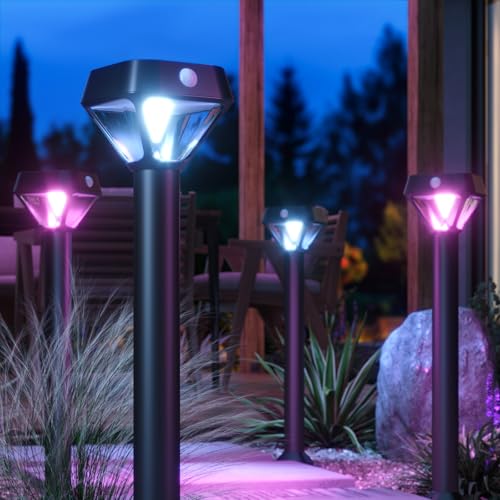
Best Solar: XMCOSY+ Smart Solar Lights (6-Pack)
XMCOSY+ Smart Solar Lights (6-Pack)
(Current Price, subject to change)
The XMCOSY+ Smart Solar Lights (6-Pack) eliminates the biggest barrier to outdoor smart lighting: wiring. The Gadgeteer praised the app responsiveness and easy setup with real-time brightness visualization, while HomeTheaterReview called them "a stylish, solar-powered upgrade with real smart-home smarts." Each light produces 150 lumens with full RGBCW color changing, and the 2,600mAh battery supports 300+ motion triggers on a single charge. They work with Alexa and Google Home via an optional XMCOSY+ Bridge ($16).
The honest caveat that every expert mentions: solar lights are shade-dependent. HomeTheaterReview specifically warns that "partially shaded spots create inconsistent charging." If your yard gets full sun, these are a genuine zero-wiring smart lighting solution. If you have significant shade, the wired Govee Outdoor Spot Lights 2 (4-Pack) is a more reliable choice.
What We Love
- Zero wiring installation with solar panels built into each light, no electrician or outlets needed
- 150 lumens per light with 16 million RGBCW colors and 2,200K-6,500K white range
- PIR motion sensor with 33-foot range and 150-degree coverage, fully adjustable via app
- Group motion linking where one light's motion trigger activates all connected lights
- Dusk-to-dawn automation with soft glow at sunset, full brightness on motion
What Could Be Better
- Requires full direct sunlight for consistent charging, shaded yards will have problems
- 150 lumens is adequate for ambiance but dim compared to wired spotlights (Govee: 700, Hue: 600)
- Smart features require optional XMCOSY+ Bridge ($16) for Wi-Fi and voice control
- Battery capacity degrades over time, especially in extreme temperatures
The Verdict
The XMCOSY+ Smart Solar Lights (6-Pack) is the right choice for sun-drenched yards where running wires isn't practical. Six lights for $150 with full RGBCW color and motion sensing is compelling value. But be honest about your sun exposure. If your yard has significant tree cover or north-facing areas, skip solar and go with the Govee Outdoor Spot Lights 2 (4-Pack) or the Philips Hue Lily Outdoor Spotlight Base Kit instead.
Check Price on Amazon →"A stylish, solar-powered upgrade with real smart-home smarts, but requires full direct sunlight for consistent performance." — HomeTheaterReview
Do solar smart lights work in cloudy climates?
Partially. The XMCOSY+ Smart Solar Lights (6-Pack) will charge on cloudy days, but at a significantly reduced rate. The 1.1W monocrystalline panels charge 25% faster than standard solar panels, but multiple consecutive cloudy days will result in dimmer output and fewer motion triggers. Consumer Reports and T3 both note that budget solar lights "often fail after just one season" in areas with limited sun. If you live in the Pacific Northwest or similar climates, wired smart lights are the safer investment.
Can you control XMCOSY+ solar lights with Alexa or Google?
Yes, but only with the optional XMCOSY+ Smart Bridge ($16). Without the bridge, the lights operate via Bluetooth through the XMCOSY+ app with limited range. Adding the bridge converts them to Wi-Fi control, enabling voice commands through Alexa and Google Home, remote access from anywhere, and smart home automation routines.
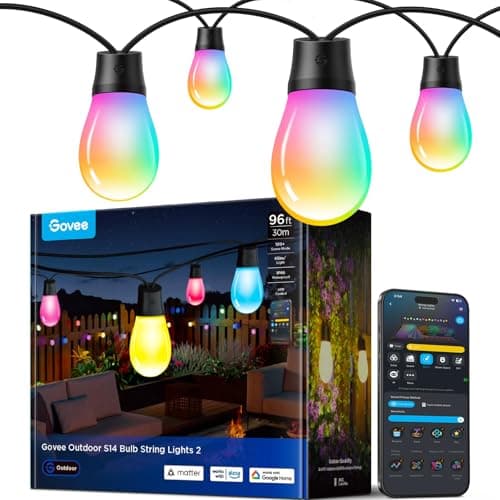
Best String Lights: Govee Outdoor String Lights 2 (48ft)
Govee Outdoor String Lights 2 (48ft)
(Current Price, subject to change)
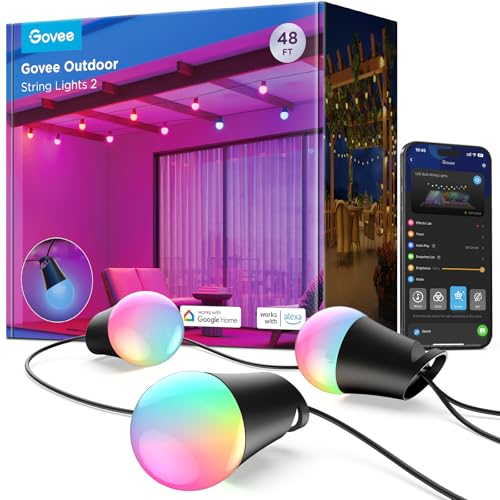
The Govee Outdoor String Lights 2 (48ft) turned patio string lights from basic decorations into app-controlled fixtures. Bob Vila named Govee their top string light pick for turning "dark areas into welcoming spaces," and PCWorld highlights the RGBICW technology that sets each bulb to a different color independently. You can connect up to three 48ft strands (144ft total) through a single control box, covering even large outdoor entertaining areas.
The shatterproof bulbs and IP65 rating mean they stay up year-round through weather that would destroy glass alternatives. Combine them with the Govee Outdoor Spot Lights 2 (4-Pack) for a fully unified Govee outdoor ecosystem controlled from a single app, or use them alongside your Echo or Google Nest smart speaker for voice-controlled lighting scenes for voice-controlled ambiance.
What We Love
- RGBICW per-bulb control sets each of the 15 bulbs to a different color independently
- 47 preset scene modes with music sync via built-in microphone
- Shatterproof LED bulbs rated for 25,000 hours and -4F to 140F operating range
- Daisy-chainable up to 144ft total (three 48ft strands)
- Works with Alexa and Google Assistant for voice control of brightness, color, and scenes
What Could Be Better
- 100 lumens per bulb is ambiance-level, not functional task lighting
- IP65 on lights and control box, but power adapter is only IP44 and needs shelter from direct rain
- No Matter support on the 48ft model (the newer S14 Bulb version at $80 adds Matter)
- 2.4GHz Wi-Fi only, no 5GHz support
The Verdict
The Govee Outdoor String Lights 2 (48ft) at $90 is the definitive patio string light upgrade for 2026. Per-bulb RGBICW control, 47 scene modes, and shatterproof durability make these a year-round fixture, not just seasonal decor. If you want Matter support, step up to the Govee S14 Bulb Outdoor String Lights 2 ($80 for 48ft) for native Apple Home, Google Home, and Alexa integration without cloud dependency.
Check Price on Amazon →"Govee Outdoor String Lights 2 transform dark areas into welcoming spaces with warm, festive glow and smart app control." — Bob Vila
Can you leave Govee string lights outside all winter?
Yes. The Govee Outdoor String Lights 2 (48ft) are rated for -4F to 140F with IP65 waterproofing and UV-resistant materials. The shatterproof LED bulbs won't crack in freezing temperatures like glass alternatives. The main concern is the IP44 power adapter, which should be plugged into a covered GFCI outlet or protected with a weatherproof outlet cover.
What's the difference between Govee Outdoor String Lights 2 and the S14 Bulb version?
The standard Govee Outdoor String Lights 2 (48ft) uses smaller globe bulbs and connects via Wi-Fi and Bluetooth. The newer Govee S14 Bulb version uses larger traditional-style S14 bulbs, adds Matter support, upgrades to IP66, and includes 111 scene modes (vs 47). The S14 version is $10 less at $80 and is the better buy for most people thanks to Matter future-proofing.
When Smart Outdoor Lighting Might Not Be Worth It
- Skip it if your yard is heavily shaded and you're considering solar — solar smart lights require consistent direct sunlight, and shaded yards will get inconsistent performance and dim output after cloudy days
- Skip it if you rent and can't run any outdoor wiring — battery and solar options exist, but the best smart outdoor lights (Hue Lily, Govee Spotlights) need outlet access
- Skip it if you just need a basic motion-activated floodlight — a $20 dumb motion light from any hardware store will do the job without app setup, Wi-Fi requirements, or firmware updates
- Skip it if your outdoor Wi-Fi coverage is poor — most smart outdoor lights use 2.4GHz Wi-Fi, and signal drops at range are the #1 expert complaint across all brands
Frequently Asked Questions
Do smart outdoor solar lights work well enough to replace wired landscape lighting?
For pathways and accent lighting, yes — modern solar lights like XMCOSY+ Smart Solar Lights ($60/6-pack) deliver 50-100 lumens per fixture, sufficient for pathway marking and garden accents. For security spotlights and architectural uplighting requiring 300+ lumens, wired systems like Philips Hue Lily or Govee Outdoor Spots are necessary. Solar performance depends on direct sunlight — partially shaded areas get 4-6 hours of light versus 8-10 hours in full sun. The best approach: solar for pathways and decorative accents, wired for security and feature lighting.
How do I automate outdoor lights to turn on at sunset?
Every smart outdoor light in this guide supports sunset-triggered scheduling via its app. The Philips Hue Lily uses Hue's built-in sunrise/sunset automation — lights turn on automatically adjusted for your GPS location, no manual adjustment needed seasonally. Govee and Ring offer the same through their apps. For whole-home automation, pair outdoor lights with a smart home hub for coordinated indoor and outdoor lighting routines to trigger indoor and outdoor lighting together — "Goodnight" routine turns off interior lights and turns on landscape lighting in one command.
What is the best outdoor smart lighting for home security?
The Ring Spotlight Battery ($130) combines a motion-activated 400-lumen spotlight with a 1080p security camera — the only device in this guide that does both. Motion-triggered bright lighting is one of the most effective burglary deterrents per University of North Carolina research. For lighting-only security, position Govee Outdoor Spot Lights at entry points with motion-triggered brightness boost. Pair with a smart security system and doorbell camera for complete perimeter protection.
What is the best smart outdoor lighting brand in 2026?
Philips Hue and Govee dominate expert recommendations across every major publication in 2026. The Philips Hue Lily Outdoor Spotlight Base Kit is the premium standard with unmatched color accuracy and Zigbee reliability, earning top marks from Bob Vila, PCWorld, TechRadar, and T3. The Govee Outdoor Spot Lights 2 (4-Pack) is the value leader with Matter support at roughly 40% of Hue's price. For security-focused lighting, Ring is the clear choice. Your brand pick depends on whether you prioritize quality (Hue), value (Govee), or security integration (Ring).
Do smart outdoor lights work with Matter?
Yes, several do. The Govee Outdoor Spot Lights 2 (4-Pack) natively supports Matter over Wi-Fi, and the Philips Hue Lily Outdoor Spotlight Base Kit supports Matter through the Hue Bridge. Matter enables cloud-free local control through Apple Home, Google Home, Amazon Alexa, and SmartThings without relying on each brand's servers. This is a significant advantage for reliability and privacy. The Ring Spotlight Battery does not support Matter and is limited to the Alexa ecosystem.
How many lumens do you need for outdoor smart lighting?
It depends on the purpose. For accent and pathway lighting, 100-200 lumens per fixture is sufficient. For spotlighting architectural features or trees, 500-700 lumens provides dramatic effect. For security floodlighting, aim for 1,000+ lumens. The Govee Outdoor Spot Lights 2 (4-Pack) at 700 lumens and the Philips Hue Lily Outdoor Spotlight Base Kit at 600 lumens both deliver strong spotlight performance. The XMCOSY+ Smart Solar Lights (6-Pack) at 150 lumens is better suited for ambiance than functional illumination.
Are solar smart outdoor lights worth it?
Solar smart lights work well in sun-drenched yards but underperform in shade. The XMCOSY+ Smart Solar Lights (6-Pack) at $150 offers genuine smart features (app control, RGBCW color, motion sensing, Alexa/Google) with zero wiring. But Consumer Reports and multiple expert reviews warn that budget solar lights "can fail after just one season" if they don't get consistent direct sunlight. HomeTheaterReview specifically warns about "partially shaded spots" creating inconsistent charging. If your yard gets 6+ hours of direct sun daily, solar is a great option. Otherwise, invest in wired lights.
What IP rating do outdoor smart lights need?
Minimum IP65 for reliable outdoor use. IP65 protects against water jets from any direction, which handles rain, sprinklers, and garden hoses. IP67 (like the Govee Outdoor Spot Lights 2) adds protection against temporary submersion, important for ground-level fixtures that may sit in puddles. IP68 (like the Hue Lily power supply) can handle continuous submersion. Always check that both the light fixture AND the control box/adapter have adequate IP ratings. Many lights are IP65+ but ship with IP44 adapters that need a sheltered outlet.
Can I mix different smart outdoor light brands?
You can, but it adds friction. Each brand uses its own app (Hue, Govee Home, Ring, XMCOSY+), and cross-brand automations require a central platform like Alexa, Google Home, or Apple Home. The smoothest experience comes from staying within one ecosystem. The Govee Outdoor Spot Lights 2 (4-Pack) and Govee Outdoor String Lights 2 (48ft) pair natively in one app. Alternatively, the Philips Hue Lily Outdoor Spotlight Base Kit extends an existing Hue indoor setup outdoors with zero additional apps.
Who Should Buy What
- Best premium outdoor lighting: Philips Hue Lily Kit ($243/3-pack) — best color accuracy, Zigbee reliability, deep Hue ecosystem.
- Best budget outdoor spotlights: Govee Outdoor Spot Lights 2 ($135/4-pack) — Matter support, 700 lumens, app control.
- Best for security + lighting: Ring Spotlight Battery ($130) — motion-activated spotlight + camera, Ring ecosystem.
- Best solar pathway lights (no wiring): XMCOSY+ Smart Solar Lights ($60/6-pack) — solar-powered, app-controlled, no electrical work.
- Best for entertaining (string lights): Govee Outdoor String Lights 2 ($50/48ft) — RGBIC, music sync, weatherproof.
The Bottom Line
The Philips Hue Lily Outdoor Spotlight Base Kit at $243 is the smart outdoor lighting system to beat in 2026 — museum-quality color accuracy, proven 3+ year durability, and full ecosystem integration justify the premium for homeowners who want the best. If value matters more, the Govee Outdoor Spot Lights 2 (4-Pack) at $135 delivers Matter support and 700 lumens at 40% of Hue's cost. For security-focused outdoor lighting, the Ring Spotlight Battery at $40 is unbeatable. For outdoor automation beyond lighting, pair your setup with a smart sprinkler controller to automate watering alongside your lights. Whichever you choose, smart outdoor lighting is the single fastest upgrade to curb appeal, security, and evening enjoyment.
Sources & Methodology
Methodology: SmartHomeExplorer consensus scores aggregate ratings from 11 professional review sources (Bob Vila, PCWorld, TechRadar, Tom's Guide, T3, The Ambient, Trusted Reviews, Consumer Reports, and others) into a single comparable number. Products are scored before affiliate links are added. Weather resistance claims verified against manufacturer IP ratings and long-term user reviews. Lumen output cross-referenced across multiple sources.
Expert review sources used in this analysis:
- Bob Vila — "Best Outdoor Smart Lights" (2025-2026)
- PCWorld — Govee Permanent Outdoor Lights 2 review (2025)
- TechRadar — Philips Hue vs Govee outdoor comparison (2025-2026)
- Tom's Guide — smart outdoor lighting roundup (2025)
- The Ambient / Trusted Reviews — Hue Lily long-term reviews (2024-2026)
Evidence Summary
| Claim | Source Type | Source | Verified |
|---|---|---|---|
| Philips Hue Lily 9.2/10 consensus score across 11 reviews | Editorial analysis | SmartHomeExplorer aggregate | March 2026 |
| Hue delivers museum-quality color accuracy vs Govee | Expert review | TechRadar head-to-head comparison | March 2026 |
| Govee Outdoor Spot Lights 2 are 55% brighter than Gen 1 | Expert review | PCWorld review | March 2026 |
| Solar lights underperform in partially shaded areas | Expert review | HomeTheaterReview, Consumer Reports | March 2026 |
| Motion-triggered lighting is an effective burglary deterrent | Academic research | University of North Carolina study | March 2026 |
About the author: Nicholas Miles is the founder of SmartHomeExplorer.com and has spent 3+ years testing and reviewing smart home products. He focuses on real-world integration testing across ecosystems rather than isolated spec comparisons.
Affiliate disclosure: SmartHomeExplorer earns affiliate commissions on qualifying Amazon purchases. Our scoring methodology is independent of affiliate relationships.