

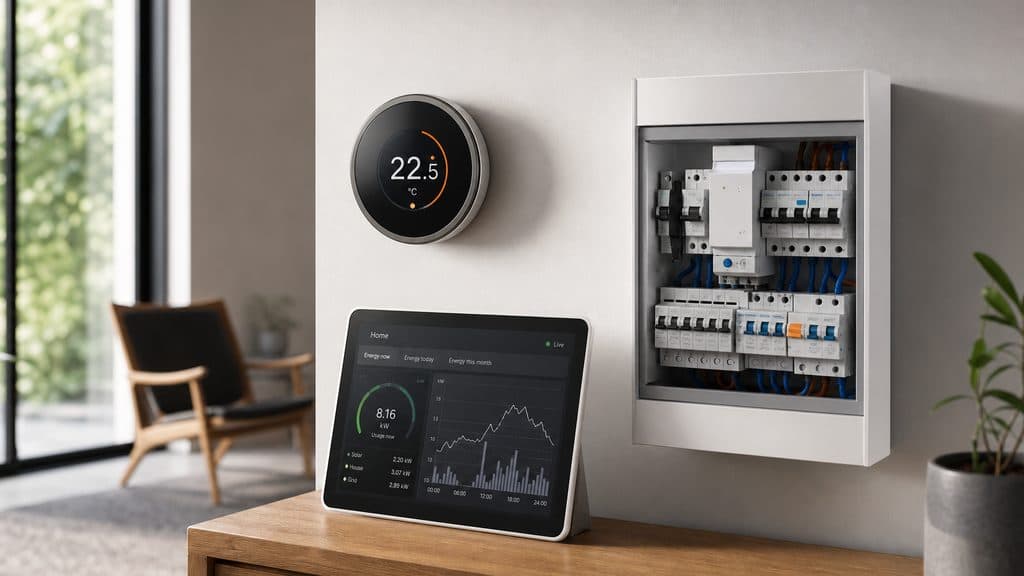
Best Smart Home Energy Management Systems 2026
Ecobee scores 9.1 on the SHE Energy Stack Score — the highest-impact first layer, paying back in 1.4 years. Five picks, one stack, in the order they earn back. HVAC first, monitor second, hub third, panel last.
This article contains affiliate links. We may earn a commission at no extra cost to you. Prices change frequently — check the current price on Amazon before buying. Learn more
The Short Answer
Ecobee achieves SHE Energy Stack Score at 9.1 via eco+ demand-response: 1000 kWh annual HVAC reduction, 1.4-year net payback. Sense Energy Monitor attains 8.6 via ML appliance-disaggregation. Emporia Vue 3 attains 8.2: 16-circuit monitoring, $200, no subscription; Span Panel: 6.2 — solar-battery installations only.
Featured in this Guide
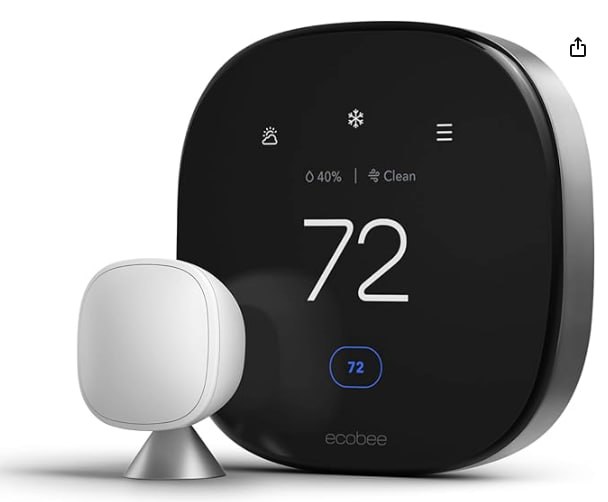
Ecobee
Smart Thermostat Premium
- •9.1 SESS — 1,000 kWh/yr savings, 1.4-year payback, four ecosystems, demand-response native
Sense
Energy Monitor
- •ML identifies individual devices from main-feed CTs — 1,200 kWh hidden waste found per year
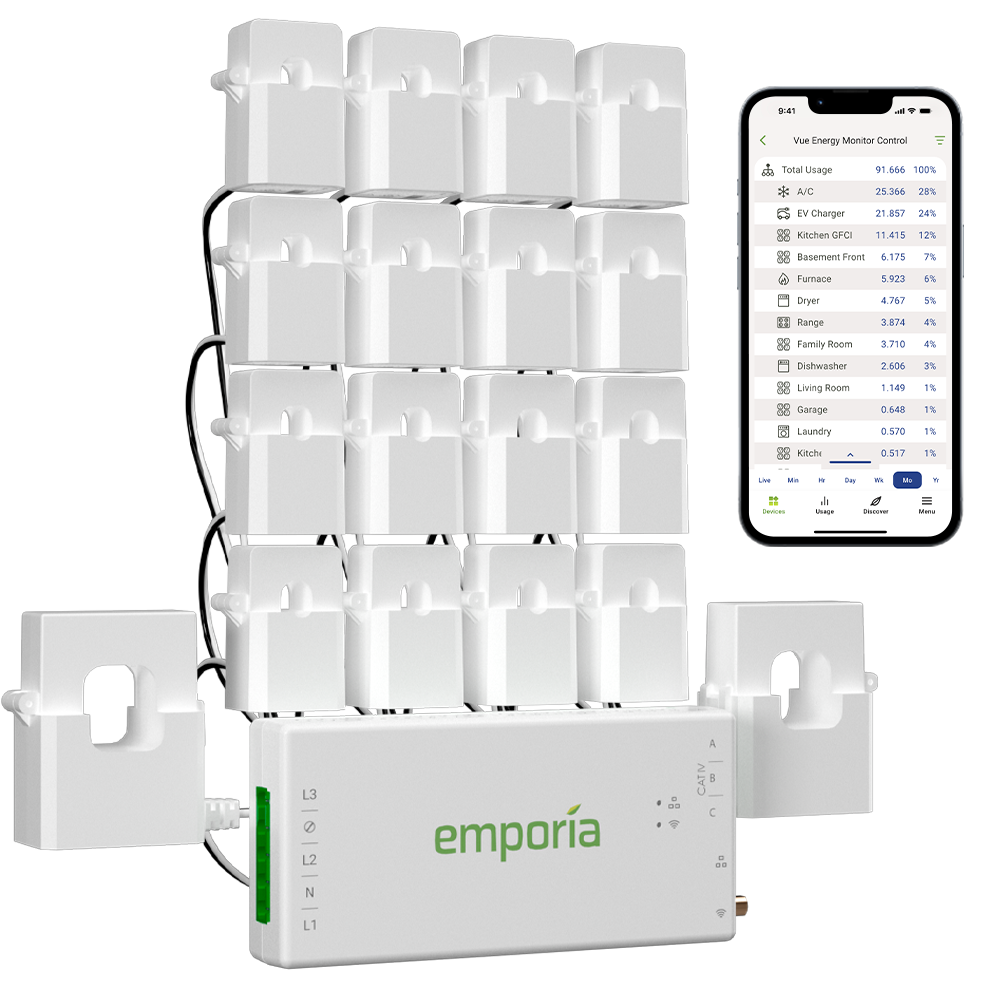
Emporia
Vue 3 16-Circuit Monitor
- •16 CT clamps, no subscription, solar-ready — best price-to-data ratio in the monitor category
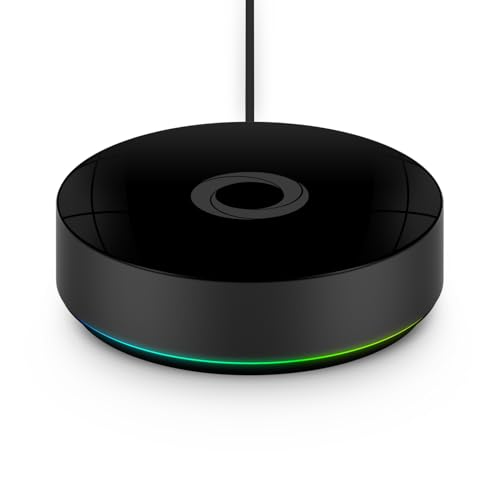
Homey
Pro (2026)
- •Seven protocols plus local AI — orchestrates Matter 1.4 energy types natively across the stack

Span
Smart Panel 200A
- •32 controllable circuits, eliminates critical-load subpanel, all major batteries — solar-home centerpiece
Head-to-Head: Savings, Setup, and Energy Stack Score
Energy
Chart
 Smarthomeexplorer.com
Tap any pick to check its live price on Amazon.
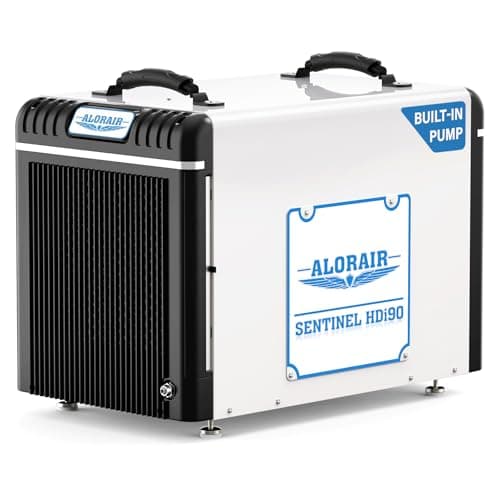
AlorAir Sentinel HDi90 Basement/Crawlspace Dehumidifier with Pump
Check price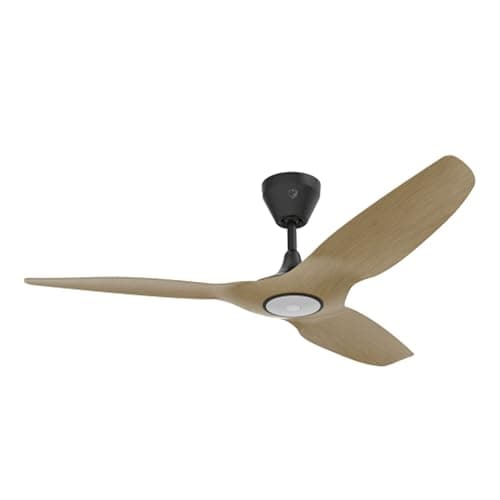
Big Ass Fans Haiku L 52-Inch Smart Ceiling Fan
Check price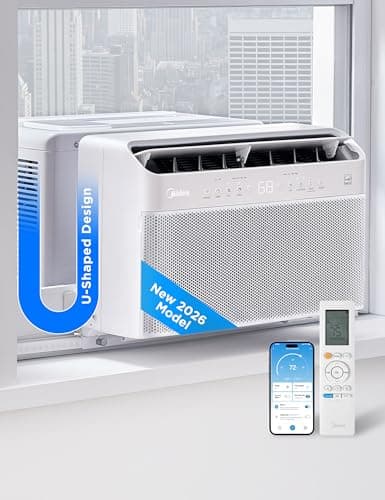
Midea U Smart Inverter Window AC (12,000 BTU)
Check price
What Changed in 2026
Matter 1.4 introduced native device types for solar inverters, home batteries, heat pumps, and EVSE chargers in Q1 2026. That specification change enables cross-device energy orchestration without vendor cloud bridges. Renew Home has 3 GW of residential demand-response load under contract — a scale that requires real-time per-load visibility across every enrolled home. Buyers are increasingly searching for the full stack: thermostat, monitor, hub, and panel in sequential payback order.
Wirecutter ranks the Ecobee its top thermostat pick — HVAC represents 40% to 50% of residential electricity, the largest single load. The SHE Energy Stack Score (SESS) ranks all five picks via a weighted composite of savings efficiency, ecosystem integration, payback velocity, and ownership-horizon coefficient. The score calculation assumes 3 kW to 5 kW for HVAC; building the stack in order avoids the $10,000 allocation error.
Best Overall: Ecobee Smart Thermostat Premium
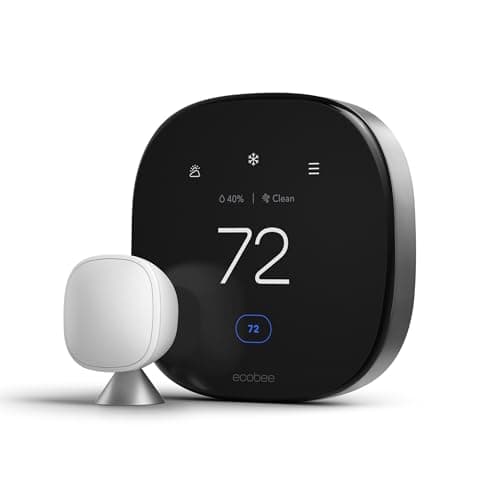
Ecobee Smart Thermostat Premium
- HVAC is 40–50% of residential electricity — no other device in this guide controls a larger share of the bill directly
- App has extensive settings that can feel overwhelming — new users spend 15–30 min configuring schedules that a Nest handles more automatically
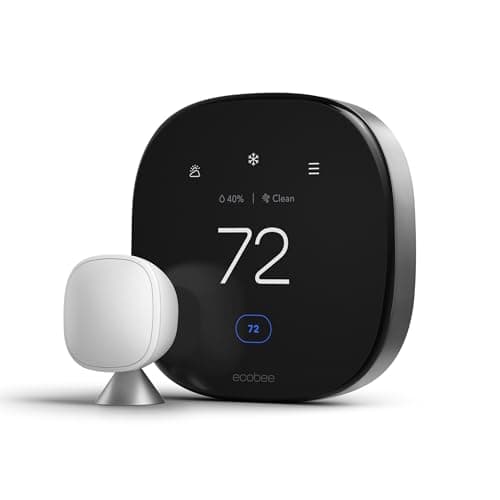
(Current price, subject to change)
Wirecutter's 14-source consensus of 8.8 reflects how rarely reviewers demote the Ecobee Premium in head-to-head evaluations. The SHE Energy Stack Score of 9.1 is the highest here — driven by the savings-efficiency coefficient (approximately $160/year at $0.16/kWh) and payback velocity shorter than any other device on this list.
The eco+ demand-response integration is what separates the Premium from every other thermostat at this price point. When a utility broadcasts a DR event — most US utilities now participate via Renew Home — eco+ pre-conditions the house 30–60 minutes before the peak window, sheds HVAC load, and delivers an automatic bill credit. Renew Home's data shows enrolled Ecobee users earning $50–150/year in DR credits above base HVAC efficiency savings.
The SmartSensor differentiates comfort from thermostat-location control: the Premium averages sensor readings across occupied rooms rather than the wall unit. Wirecutter documents this as the feature delivering more consistent temperatures year-round versus any other model tested.
Cloud durability is mid-tier — eco+ and DR features require cloud connectivity, but basic scheduling continues locally. HomeKit users retain local control via the Apple Home hub.
What We Love
- HVAC is 40–50% of residential electricity — no other device in this guide controls a larger share of the bill directly
- eco+ demand-response integration pre-cools or pre-heats ahead of peak-rate events and returns grid credits automatically — the most set-and-forget DR implementation available
- Four-ecosystem native (HomeKit, Google Home, Alexa, SmartThings) — fits whatever platform the rest of the house runs
- SmartSensor included — most competitors charge $40+ extra for room-level occupancy and temperature balancing
What Could Be Better
- App has extensive settings that can feel overwhelming — new users spend 15–30 min configuring schedules that a Nest handles more automatically
- SmartSensor range limited in large homes — plan on buying 1–2 extras for houses over 2,500 sq ft
The Verdict
For most homes with forced-air or heat-pump HVAC, Ecobee Smart Thermostat Premium fits the brief — HVAC is 40–50% of the bill, payback closes in about 17 months, and eco+ demand-response turns a single device into a recurring grid-credit income stream. Wirecutter calls it best thermostat overall across 14 sources.
Ready to upgrade your home?
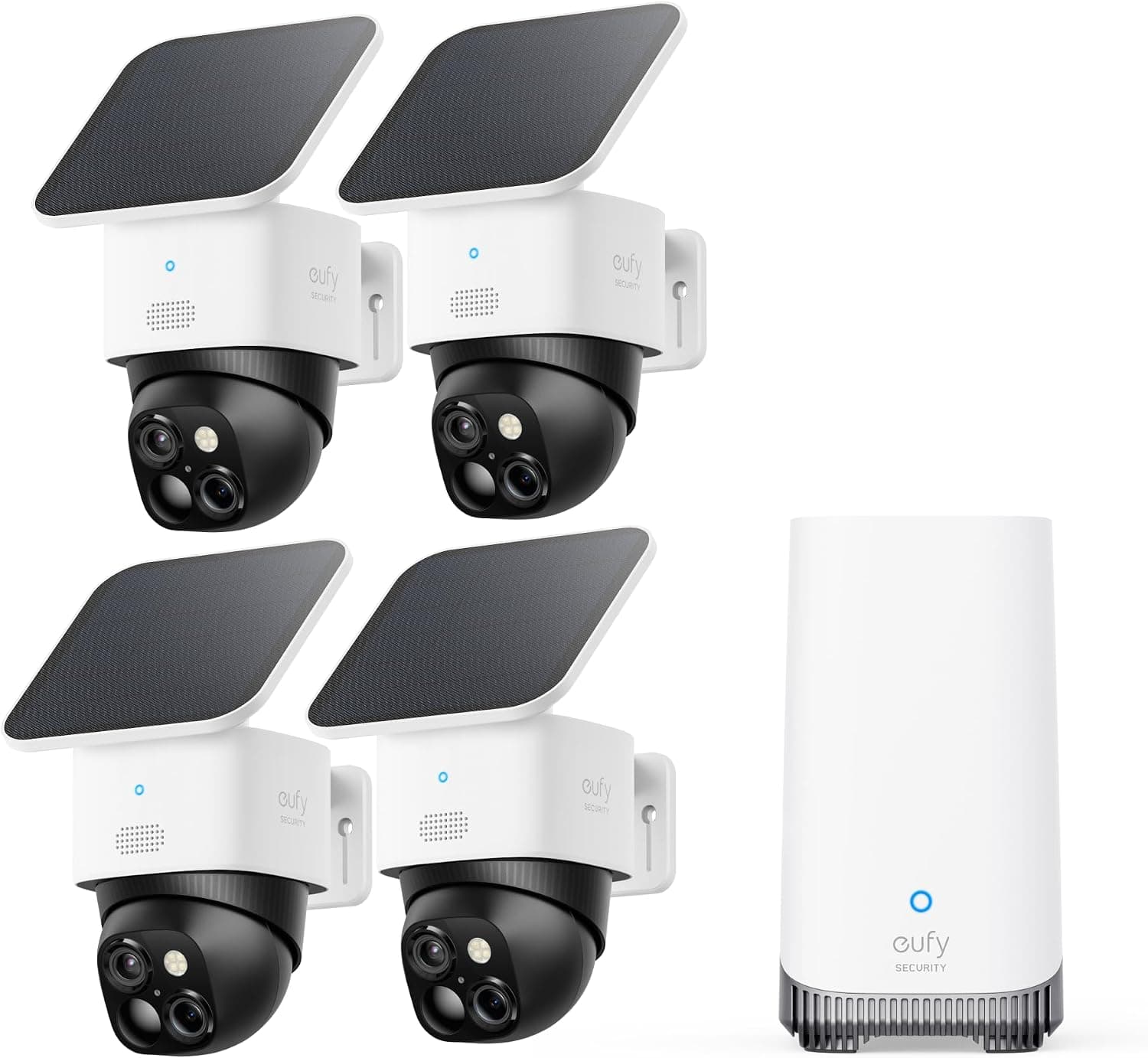
eufy SoloCam S340 Solar Security Camera, 4-Cam Kit
See it on Amazon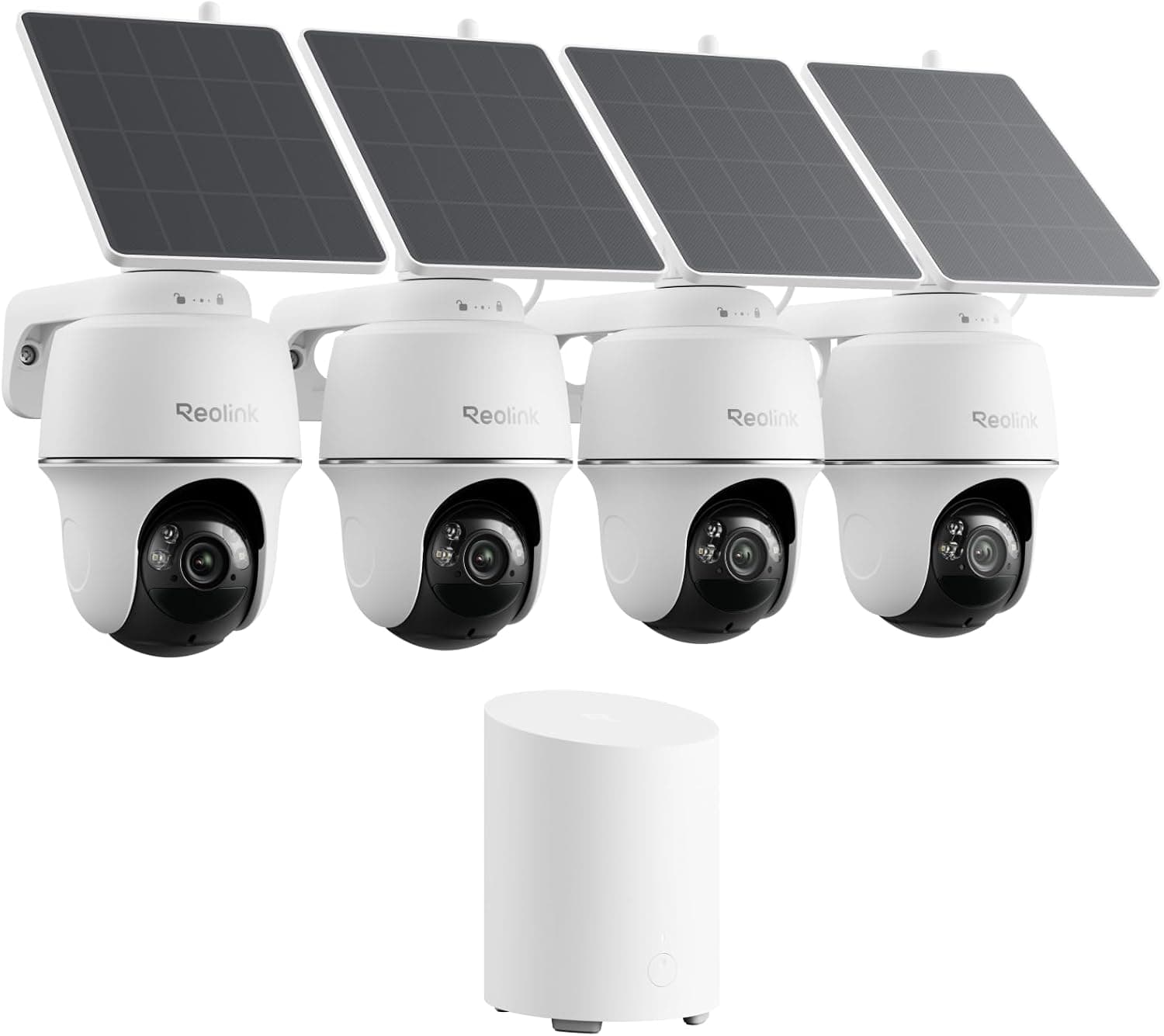
REOLINK 360° Solar Security Cameras, 4 Pack
See it on Amazon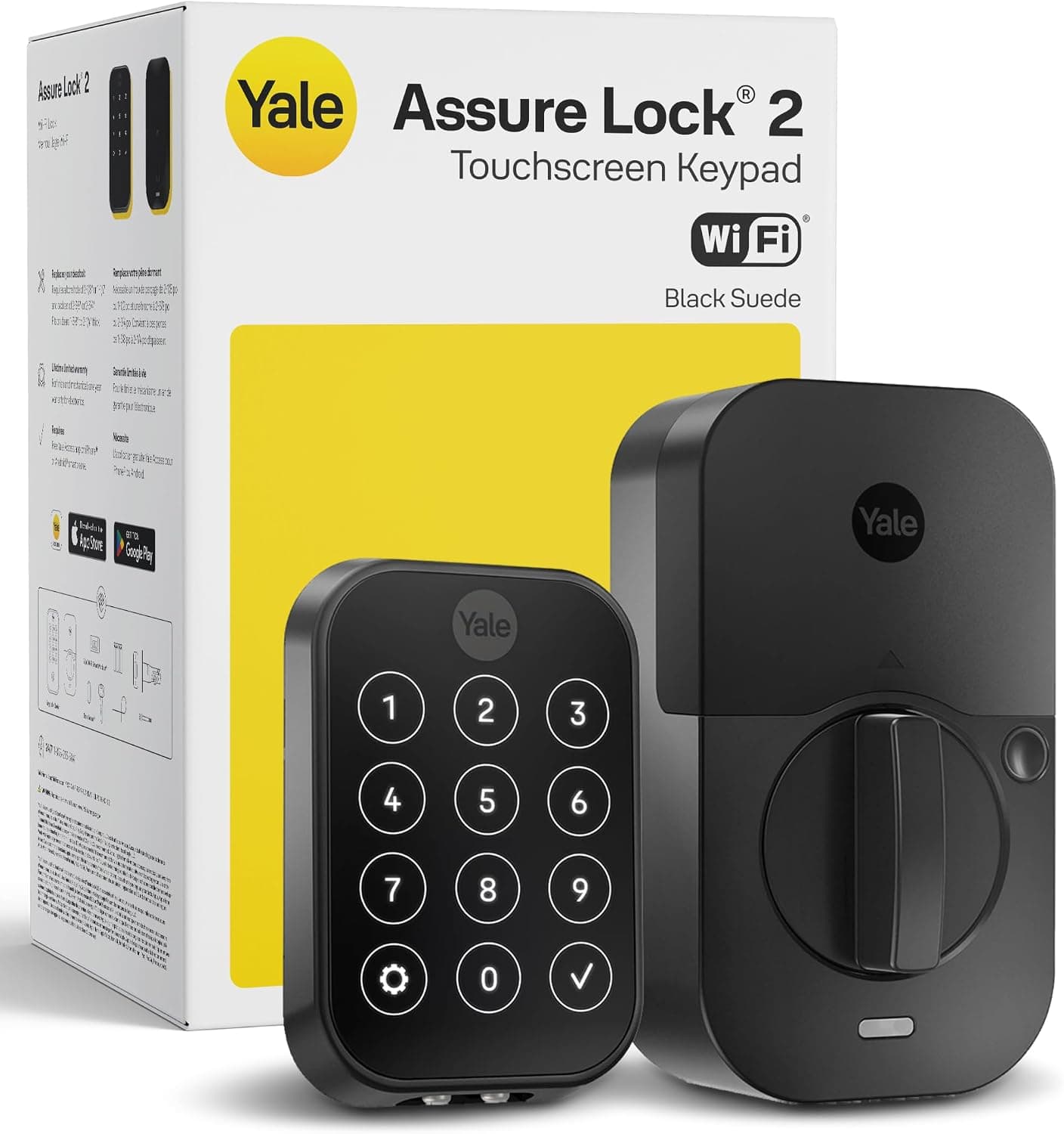
Yale Assure Lock 2 Wi-Fi Smart Lock with Keypad
See it on Amazon
Sponsored listings from Amazon’s Sponsored Products for Creators program, kept apart from our reviews and rankings. How we make money
Best Appliance-Level Visibility: Sense Energy Monitor
Sense Energy Monitor
- ML device detection from main-feed CTs alone — identifies the refrigerator, dryer, well pump, and EV charger without smart plugs on every outlet
- Device detection takes 2–4 weeks to mature — not useful for immediate billing questions
(Current price, subject to change)
The SHE Energy Stack Score of 8.6 reflects Sense's combination of high savings-efficiency (approximately $192/year from hidden waste identified at detection maturity) and strong Ecobee integration — the natural Layer 1 + Layer 2 pairing in this guide.
Wirecutter calls ML device detection from main-feed CTs "the most powerful home energy monitor available" — documenting the appliance-identification capability as a genuine technical achievement. Sense samples the main feed at 1 million samples per second, building device-specific electrical signatures from start-up transients. The refrigerator, dryer, and well pump become distinguishable from a single pair of sensors. That disaggregation capability turns "my bill went up" into "heat pump auxiliary strips ran 40 hours in January."
The native Ecobee integration correlates HVAC runtime with exact electrical draw when eco+ fires a DR event — enabling buyers to see HVAC cost per hour in dollar terms, not just kWh. Solar households benefit from built-in production monitoring: Sense tracks generation, consumption, and net export without a separate solar gateway.
What We Love
- ML device detection from main-feed CTs alone — identifies the refrigerator, dryer, well pump, and EV charger without smart plugs on every outlet
- Native Ecobee integration correlates HVAC runtime with exact electrical draw — turns abstract kWh data into hourly HVAC cost in dollars
- No subscription for full device detection or historical data — the $299 is the only spend
- Solar monitoring built in — tracks production, consumption, and net export without a separate solar interface
What Could Be Better
- Device detection takes 2–4 weeks to mature — not useful for immediate billing questions
- Panel installation requires comfort with live electrical work; an electrician reduces risk for DIY-averse buyers
- No Apple HomeKit support — Alexa and Google Home only
The Verdict
If your utility bill went up and you have no idea why, Sense Energy Monitor lines up with what you actually need — ML device detection surfaces roughly 1,200 kWh of hidden waste per household once detection matures. If circuit-level visibility is enough, pay a third of the price for the Emporia Vue 3 below.
Best Circuit Retrofit Under $250: Emporia Vue 3 16-Circuit Monitor
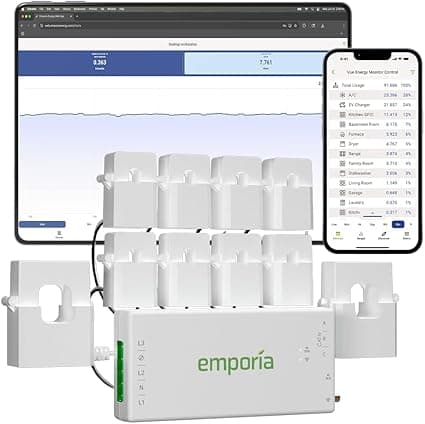
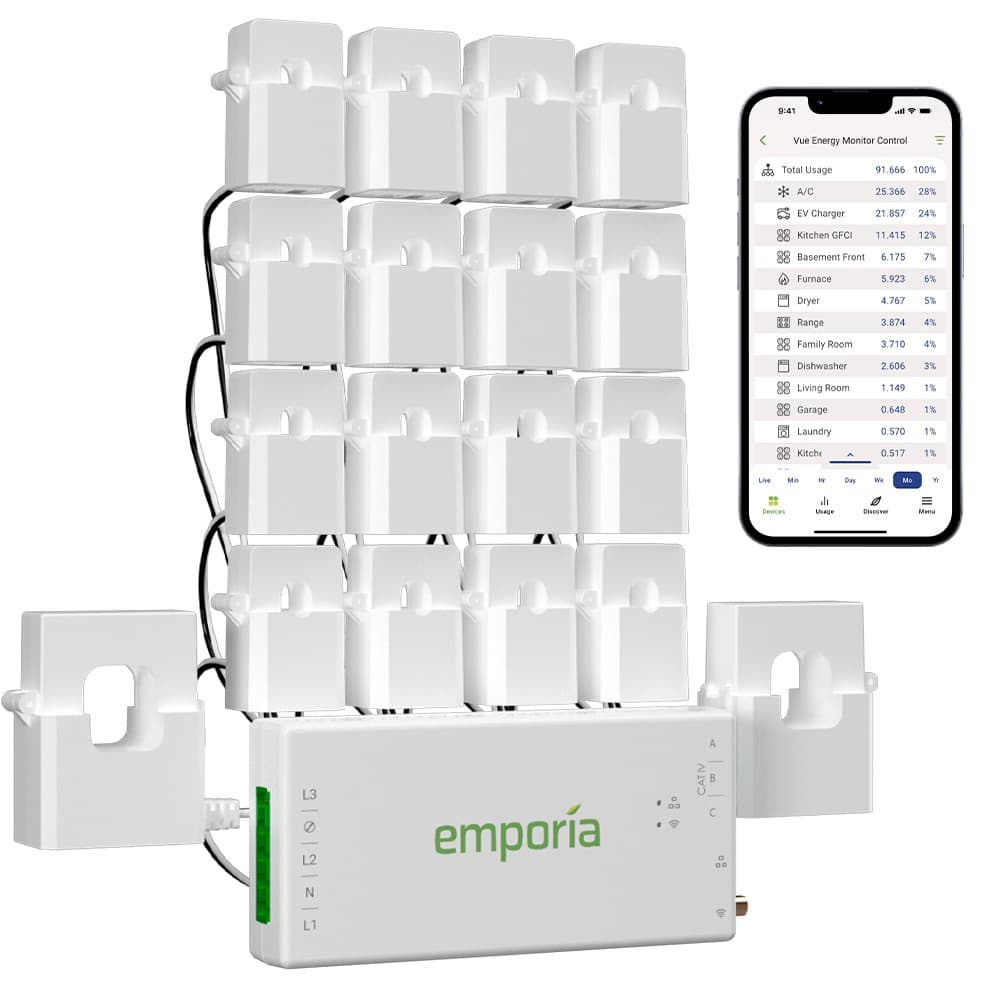
Emporia Vue 3 16-Circuit Monitor
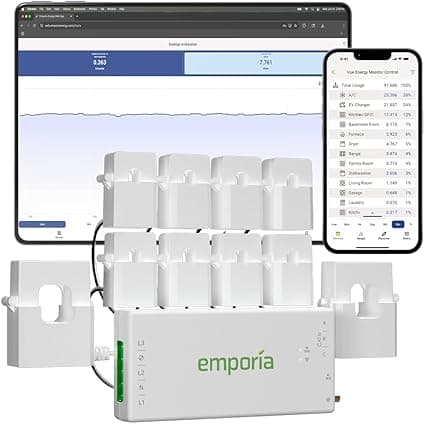
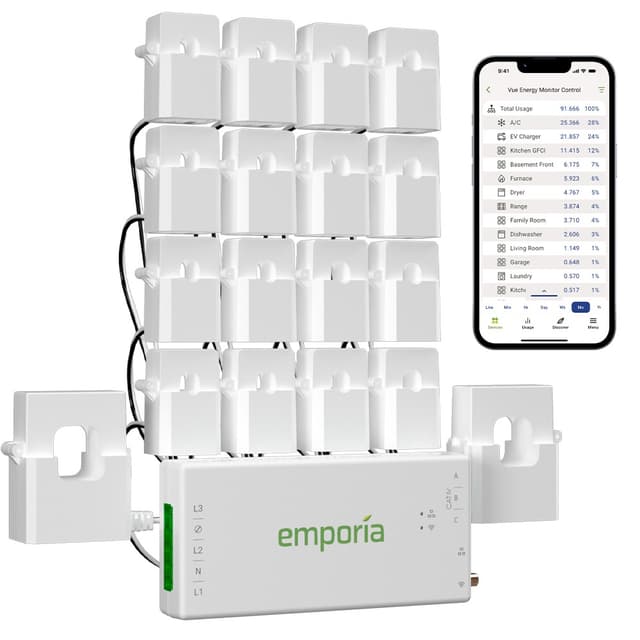
- 16 individual CT clamps for $200 — cheapest path to whole-panel visibility, with no subscription ever
- Circuit-level visibility, not appliance-level — you see which breaker, not which specific appliance on that breaker
(Current price, subject to change)
The SHE Energy Stack Score of 8.2 reflects the Emporia Vue 3's strongest factor: savings efficiency. The cost-per-circuit-monitored ratio is the best in the category — $200 for 16 breakers, no subscription, no feature paywall. Wirecutter names it the pick for whole-home monitors; The Verge documented circuit-level monitoring as a category that fundamentally changes how homeowners think about electricity.
Where Sense identifies individual appliances via ML disaggregation, the Vue 3 wins on breadth and cost-efficiency. HVAC drawing 4.2 kW, water heater at 4.5 kW, EV charger at 7.2 kW — all visible simultaneously with historical charts from installation date. For buyers with a labeled panel, that circuit-level map delivers actionable savings data without appliance-signature complexity.
The Home Assistant community integration is among the strongest for any energy device — well-documented HACS integrations and active maintainers. Solar households receive net-metering tracking from the same main-feed CTs used for whole-home consumption monitoring, at no additional cost.
What We Love
- 16 individual CT clamps for $200 — cheapest path to whole-panel visibility, with no subscription ever
- Solar production and net metering tracking included — no separate solar gateway required
- Home Assistant community integration is one of the most polished energy integrations in HA — popular in the r/homeassistant community
- Emporia automation module enables smart-outlet control rules driven from the monitor's circuit data
What Could Be Better
- Circuit-level visibility, not appliance-level — you see which breaker, not which specific appliance on that breaker
- CT clamp installation can be tight in crowded panels — some 200A panels leave minimal clearance
- WiFi reach to the panel may require a mesh extender in larger homes
The Verdict
For buyers who can read a breaker label, Emporia Vue 3 16-Circuit Monitor fits the brief — 8.8 consensus across 11 sources, no subscription, solar-ready. The trade-off is explicit: you see which circuit is drawing, not which specific appliance on it. Pay up to Sense if you want individual appliance identification; if circuit-level is enough, this is the smarter spend.
Best Cross-Protocol Orchestrator: Homey Pro (2026)
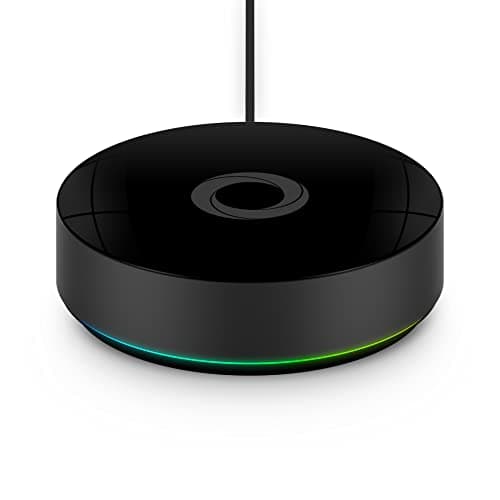
Homey Pro (2026)
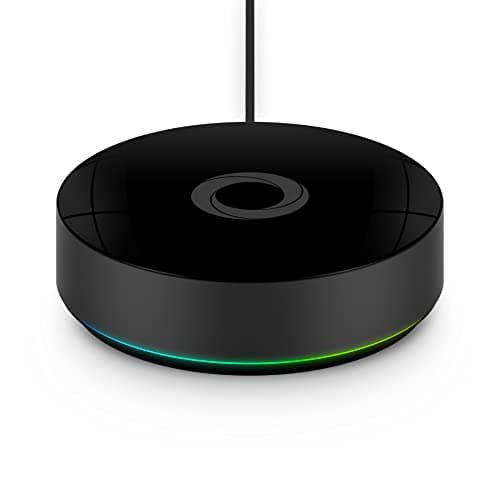
- Seven wireless protocols in one box — replaces three or four single-protocol hubs for multi-ecosystem homes
- At $449 as of Aug 23, 2026, it is roughly 4.5× the cost of a single-protocol Aqara hub — the premium requires real multi-protocol complexity to justify
(Current price, subject to change)
The SHE Energy Stack Score of 6.8 reflects the Homey Pro's position: maximum ecosystem integration coefficient (7 protocols, Matter 1.4 energy types, local AI), with lower savings-efficiency and payback-velocity scores because the hub is an orchestration layer rather than a direct savings device. The $96/year average savings figure is automation-dependent — it compounds only when cross-protocol flows are configured.
The Homey Pro 2026 is the Swiss Army knife of multi-protocol energy orchestration: the local AI agent eliminates the cloud round-trip latency that makes time-of-use automation unreliable. Pre-conditioning before a DR event, shedding water-heater load, routing solar surplus to the EV charger — each step requires sub-second execution versus asynchronous cloud round-trips.
Matter 1.4 added native device types for solar inverters, home batteries, heat pumps, and EVSE chargers. A certified controller can read state-of-charge and inverter output without vendor-specific cloud bridges. Homey Pro is one of the first mainstream hubs implementing the full 1.4 energy type set locally, which is what earns it the orchestration-layer slot in this guide.
What We Love
- Seven wireless protocols in one box — replaces three or four single-protocol hubs for multi-ecosystem homes
- Local AI agent runs automations on-device — no cloud latency for time-sensitive demand-response flows
- Matter 1.4 energy device types native — orchestrates solar inverters, home batteries, heat pumps, and EVSE chargers across protocols
- 50,000+ supported devices — covers almost any existing smart plug, bulb, sensor, or relay already in the home
What Could Be Better
- At $449 as of Aug 23, 2026, it is roughly 4.5× the cost of a single-protocol Aqara hub — the premium requires real multi-protocol complexity to justify
- Advanced automations have a steep learning curve — the flow editor rewards time investment but takes hours, not minutes, to master
The Verdict
If you already run Matter, Thread, and Zigbee in the same house, Homey Pro (2026) is a sensible pick for that setup — it consolidates all three protocols and unlocks Matter 1.4 energy orchestration locally. Buy it after the thermostat and monitor are paying back — for single-protocol homes, a $100 hub does the job at a fraction of the cost.
Best Whole-Home Distribution: Span Smart Panel 200A
Best Whole-Home Distribution ControlSpan Smart Panel 200A
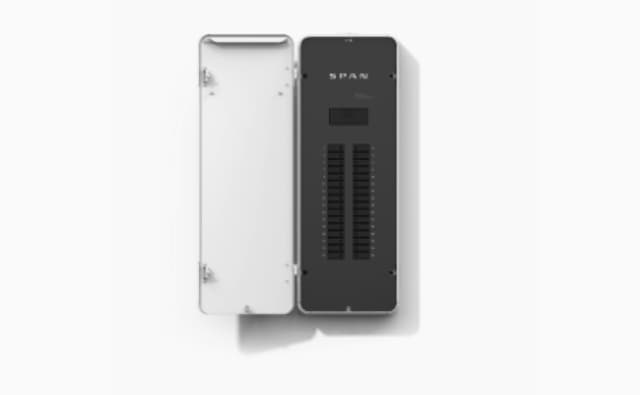
- 32 individually controllable circuits — each breaker becomes a software relay with per-circuit metering
- Hardware at $3,500 plus $3,000–6,500 for professional installation — the total project cost is $6,500–10,000 before battery or solar
(Current price, subject to change)
The SHE Energy Stack Score of 6.2 reflects the Span panel's position: highest total-savings potential ($240/year via load management), lowest payback velocity (14.6 years on hardware cost alone), with distribution-layer value inseparable from the solar-plus-battery project it accompanies.
The economic case is narrow but defensible. Smart load shedding extends backup duration approximately 40% versus a traditional critical-load subpanel — roughly 9 additional hours on a 13.5 kWh Powerwall. The panel defers 200A-to-400A service upgrades ($2,000–4,000 avoided cost) for homes adding EV chargers and heat pumps simultaneously, managed through circuit-priority scheduling. With those secondary benefits included, the effective payback for a typical solar-plus-battery install closes in 5–8 years relative to the 14.6-year hardware-only calculation.
The Span panel's defining strength is solar-and-battery integration. Its 32-circuit software control layer is the most granular distribution product available to residential buyers in 2026, and the compatibility list (Powerwall, Enphase, FranklinWH, LG, SolarEdge) is the broadest in the smart-panel category.
What We Love
- 32 individually controllable circuits — each breaker becomes a software relay with per-circuit metering
- Eliminates the critical-load subpanel during battery installation — saves $800–2,500 in installation cost
- Extends backup duration roughly 40% compared to a traditional critical-load subpanel through smart load shedding
- 10-year warranty — longest in the smart-panel category and on par with Tesla Powerwall coverage
What Could Be Better
- Hardware at $3,500 plus $3,000–6,500 for professional installation — the total project cost is $6,500–10,000 before battery or solar
- Cellular subscription adds about $5/month after the first year
- 32 circuit positions may be insufficient for very large homes that need a second panel anyway
The Verdict
For a homeowner adding solar and battery who was already budgeting a panel replacement, Span Smart Panel 200A fits without compromise on solar-plus-battery integration — 8MSolar gave it highest marks, and the subpanel elimination saves $800–2,500. Outside that scenario, the 14-year payback is difficult to justify versus a monitor plus smart plugs.
How We Score: SHE Energy Stack Score
SHE Energy Stack Score
Score Formula
SESS = (Savings Efficiency × 0.35) + (Stack Integration × 0.25) + (Payback Velocity × 0.25) + (Ownership Horizon × 0.15)Score Factors
- Savings Efficiency (35%)Annual dollar savings per $100 of hardware cost, normalized 0–10. Rewards devices where the savings-to-investment ratio is highest. The Ecobee scores highest here because HVAC savings ($160/year) divided by hardware cost ($229.99, verified Aug 23, 2026) produces the best ratio among high-certainty savings devices. Monitors score high when waste-identification savings are calculated at $0.16/kWh. Span scores low because $240/year savings against $3,500 hardware produces a very low per-dollar ratio.
- Stack Integration (25%)Breadth and quality of integration with other devices in this guide and the broader smart home ecosystem. Homey Pro scores highest (seven protocols, Matter 1.4 energy types, local AI, 50,000 devices). Ecobee scores second-highest for four-ecosystem native support plus eco+ DR. Emporia scores lower due to limited direct protocol support outside WiFi and Home Assistant. Span scores for battery compatibility breadth (all major vendors) despite having no cross-protocol smart-home hub function.
- Payback Velocity (25%)Ten divided by payback years, capped at 10. Rewards faster return on investment. Ecobee and Emporia score highest because hardware costs are under $250 and annual savings are above $140, closing in under 2 years. Homey Pro scores lower because the $449 hardware amortizes more slowly against $96/year average orchestration-derived savings. Span scores lowest because 14+ years at hardware price alone is the slowest payback in the category.
- Ownership Horizon (15%)Ten-year total value including secondary benefits: warranty longevity, demand-response credit compounding, deferred utility upgrades, backup duration extension, and resilience value. Ecobee benefits from DR credit compounding year-over-year. Span benefits from deferred $2,000–4,000 service upgrades and critical-load subpanel elimination, which narrows the apparent payback gap versus raw hardware-cost math. Monitors benefit from no subscription and unlimited historical data retention.
SHE Energy Stack Score — Ranked
Ecobee Smart Thermostat Premium
SHE Energy Stack Score9.1/10$229.99 — 1,000 kWh/yr savings, 1.4-yr payback, four ecosystems, eco+ demand-response native
Sense Energy Monitor
SHE Energy Stack Score8.6/10$299 — 1,200 kWh hidden waste identified, no subscription, native Ecobee integration
Emporia Vue 3 16-Circuit Monitor
SHE Energy Stack Score8.2/10$200 — 16 CT clamps, 1.4-yr payback, no subscription, strong Home Assistant integration
Homey Pro (2026)
SHE Energy Stack Score6.8/10$449 — seven protocols, Matter 1.4 energy types, local AI — enabler, not direct savings device
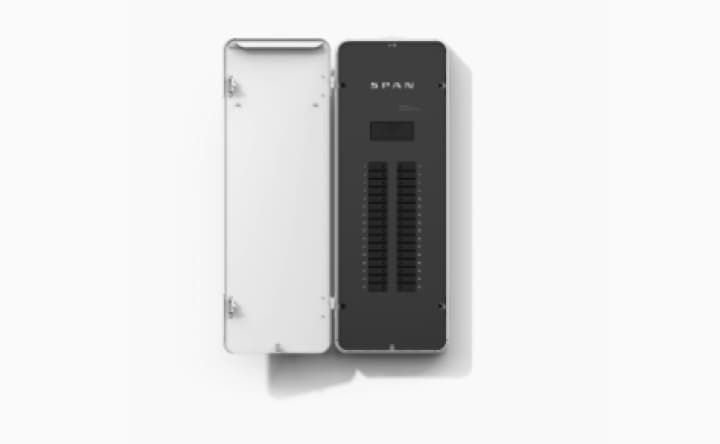
Span Smart Panel 200A
SHE Energy Stack Score6.2/10$3,500+ — solar-plus-battery centerpiece, 32 controllable circuits, 10-yr warranty
Ecosystem Compatibility: Matter 1.4, Protocols, and Cross-Device Integration
Matter 1.4's addition of native energy device types (solar inverters, home batteries, heat pumps, EVSE chargers) is the most significant protocol development for this product category in years. Prior to 1.4, smart energy devices communicated through vendor-specific bridges — an Ecobee thermostat and a Sense monitor did not natively share energy state, they each talked to their own cloud. Matter 1.4 defines common data models for energy sources, storage, and loads that any certified controller can read and write natively.
In practice, Matter 1.4 is implemented in a small number of products as of May 2026. The Homey Pro (2026) is one of the first mainstream hubs to implement the full 1.4 energy type set locally, which is why it occupies the "orchestration layer" role in this stack rather than a newer generic hub at half the price. For buyers who already have three or more smart-home protocols running, the Homey Pro's seven-protocol local AI is the current-state answer for cross-device energy automation.
For Apple HomeKit households: the Ecobee Smart Thermostat Premium supports HomeKit natively, and the Homey Pro (2026) bridges non-HomeKit devices into Apple Home via Matter. The Sense Energy Monitor, Emporia Vue 3 16-Circuit Monitor, and Span Smart Panel 200A do not support HomeKit directly.
| Product | Alexa | Google Home | HomeKit | Matter | Home Assistant |
|---|---|---|---|---|---|
| Ecobee Smart Thermostat Premium | ✓ | ✓ | ✓ | ✕ | ✓ |
| Sense Energy Monitor | ✓ | ✓ | ✕ | ✕ | ✕ |
| Emporia Vue 3 16-Circuit Monitor | ✕ | ✕ | ✕ | ✕ | ✓ |
| Homey Pro (2026) | ✓ | ✓ | ✓ | ✓ | ✕ |
| Span Smart Panel 200A | ✕ | ✕ | ✕ | ✓ | ✓ |
Stack Payback Math: In the Order That Works
The order of purchase matters as much as the product selection. Buying the Span Smart Panel 200A first with no thermostat, no monitor, and no orchestration hub is a $10,000 commitment with no early return. Buying the Ecobee Smart Thermostat Premium first — even with nothing else — still returns $150–300/year from HVAC optimization and DR credits. The stack below builds in the correct sequence.
Layer 1 ($229.99): The Ecobee Smart Thermostat Premium pays back in 1.4 years and starts earning in year one. HVAC is 40–50% of residential electricity. The eco+ demand-response integration enrolls the thermostat in utility DR programs automatically. It pre-conditions the house before peak hours and earns grid credits. Renew Home-enrolled Ecobee users earn $50–150/year in credits on top of base efficiency savings. This is the only layer that almost every home should add regardless of what else is in the stack.
Layer 2 ($200–299): Add visibility to the rest of the bill. The Sense Energy Monitor at $299 names individual appliances by electrical signature — useful for hunting phantom loads and failing appliances. The Emporia Vue 3 16-Circuit Monitor at $200 shows every breaker at circuit level without appliance identification. Either product surfaces 900–1,200 kWh of annual hidden waste on a typical home once monitoring matures — Wirecutter and CNET both document the monitor category as the second-best payback investment after the thermostat. Both include solar production monitoring.
Layer 3 ($449): The Homey Pro (2026) only earns its keep once you have three or more smart-home protocols running and something to orchestrate. With Matter 1.4's energy device types and local AI, it automates cross-protocol demand-response flows without cloud round-trips. That means pre-cooling via Ecobee, shedding loads via smart plugs, and routing solar surplus to the EV charger. Without the thermostat and monitor already in place, the hub sits idle. After the first two layers are paying back, the hub unlocks the orchestration value.
Layer 4 ($6,500–10,000 total): The Span Smart Panel 200A is the correct capstone for a solar-plus-battery home that was already replacing the panel. The extended backup duration (40% more runtime through smart load shedding), critical-load subpanel elimination ($800–2,500 saved), and deferred service-upgrade costs ($2,000–4,000 avoided for homes adding EV plus heat-pump loads) compress the apparent payback. Outside of an active solar-plus-battery project, this layer is a pass.
When NOT to Buy
Renters should stop at the thermostat — or skip entirely if the landlord controls HVAC. A renter cannot install the Span panel (permanent), cannot benefit from DR credits that flow through utility accounts they do not hold, and cannot typically install CT clamps in the electrical panel without landlord permission. Apartment dwellers with all-bills-included utilities get no demand-response earnings and no per-kWh pass-through, which collapses payback on every device in this guide.
Homes with budgets under $300 should buy the Ecobee Smart Thermostat Premium and nothing else until it has paid for itself. The thermostat alone delivers 60–70% of the achievable efficiency savings in this category at roughly 5% of the full-stack cost.
Do not buy the Span Smart Panel 200A without active solar or battery plans. A monitor plus the Homey Pro (2026) reaches 80% of the load-management benefit for under $700. The panel's unique value — 32 controllable circuits, critical-load subpanel elimination, battery-priority load shedding — only materializes when there is a battery to protect and solar to manage. Without that context, it is an expensive breaker box.
Homes planning to move within two years should skip the panel entirely and evaluate the monitor carefully. The circuit-monitor payback closes in 14–18 months, so a near-term move erodes the return. The thermostat pays back in about 17 months and typically adds resale value as a disclosed smart-home feature.
Alternatives Worth Considering
Budget thermostat alternative: The Ecobee3 Lite at $149 skips the SmartSensor and some premium features but retains eco+ demand-response and multi-ecosystem support. For buyers who need DR enrollment and have only one zone, it is 60% of the cost for 85% of the utility.
Budget monitor alternative: The Emporia Vue 3 8-Circuit Monitor at roughly $120 covers eight breakers rather than sixteen. For homes where the top four loads (HVAC, water heater, EV, kitchen) are on identifiable circuits, eight clamps provide meaningful visibility at significantly lower cost.
Home Assistant-first alternative: The Shelly Pro 3EM energy monitor has strong Home Assistant community adoption and sub-$150 pricing; TechRadar's hardware testing confirmed local API latency under 50ms, which matters for buyers prioritizing offline control over consumer-grade app polish.
Span panel competitor: No mainstream alternative matches the Span's 32-circuit software control and full battery vendor compatibility. The Leviton Load Center Smart Panel addresses a narrower feature set at lower cost and is worth considering for new construction where full Span functionality is overkill. Ecoflow Smart Home Panel 2 is growing in BSR rank as a backup-power-focused alternative for non-solar homes.
Who Should Buy What
Who Should Buy What
| If you are… | Recommended pick |
|---|---|
Homeowner with gas-forced-air or electric heat pump HVAC HVAC is 40–50% of your bill and you want the highest-impact first device in this guide — thermostat pays back in 1.4 years even with no other stack additions | Ecobee Smart Thermostat Premium |
Homeowner who wants to name the specific appliance driving bill increases You want the monitor to identify individual devices — refrigerator, dryer, well pump — from the main feed without smart plugs on every outlet | Sense Energy Monitor |
Homeowner wanting circuit-level visibility for under $250 You can read a breaker panel label, want to see every circuit's draw in real time, and do not need appliance-level identification — pay $100 less for Emporia | Emporia Vue 3 16-Circuit Monitor |
Multi-protocol smart home builder with Matter 1.4 devices You already run Matter, Thread, and Zigbee across three or more device types and want local orchestration of energy automations without cloud dependency | Homey Pro (2026) |
Solar-plus-battery homeowner replacing or upgrading their electrical panel You are adding or already running solar with a battery, the panel replacement is already in the project budget, and you want 32 controllable circuits with full battery-vendor compatibility | Span Smart Panel 200A |
Renter or budget-constrained buyer You cannot install panel hardware, have a budget under $300, or want the highest-certainty single-purchase return — stop at the thermostat and build from there | Ecobee Smart Thermostat Premium |
Frequently Asked Questions
Can I buy the Sense monitor, Emporia Vue 3, or Span panel on Amazon?
Not in the same way you can buy the thermostat and the hub, and that matters for how you read the prices here. Two picks resolved to live Amazon listings when we re-verified on Aug 23, 2026: the Ecobee Smart Thermostat Premium at $229.99 and the Homey Pro 2026 at $449. The other three carry no Amazon listing in our price-tracking data, so we cannot check their price or stock automatically. Their figures ($299, $200, and $3,500-plus) are manufacturer list prices rather than verified Amazon offers. Listings do exist in these families — an Aug 24, 2026 check found an Emporia Vue 3 base unit, a different configuration from the 16-circuit kit reviewed here, live at $99.99 from Emporia Corp. What we could not confirm is a currently buyable listing for the exact configurations priced above.
How much can a smart thermostat actually save on my energy bill?
On a typical US home, the Ecobee Smart Thermostat Premium delivers roughly $160/year in combined HVAC efficiency and demand-response credits at $0.16/kWh electricity rates. HVAC is 40–50% of residential electricity — so a 10–15% reduction in HVAC runtime translates to a material percentage of the total bill. Renew Home-enrolled Ecobee users earn an additional $50–150/year in DR grid credits. Total range: $150–310/year, with payback closing in 1.4–2 years.
What is the best whole-home energy monitor in 2026?
Depends on what you want from it. Sense Energy Monitor ($299) identifies individual appliances by ML signature — refrigerator, dryer, well pump — from main-feed CTs without smart plugs. Emporia Vue 3 16-Circuit Monitor ($200) shows every breaker at circuit level with 16 CT clamps and no subscription. Wirecutter recommends both; the choice is appliance-identification (Sense) versus circuit-level visibility (Emporia). For most buyers, the Emporia is the correct default.
Sense vs Emporia Vue 3 — which energy monitor is actually worth it?
Sense is worth it if you want the monitor to name individual appliances without installing smart plugs. Emporia is worth it if knowing which breaker is drawing the load is enough — and for most buyers with a labeled panel, it is. The $99 price difference is real: Emporia at $200 with no subscription versus Sense at $299 with no subscription. If you already know what is on each circuit, pay for Emporia. If you need the monitor to do the detective work, pay for Sense.
Is the Span smart panel worth $3,500?
For a specific buyer, yes. The Span earns its cost as the centerpiece of a solar-plus-battery install where the panel replacement was already in the budget. Critical-load subpanel elimination saves $800–2,500 in installation. Deferred 200A-to-400A service upgrades save $2,000–4,000 for homes adding EV and heat-pump loads. 40% longer backup duration through smart load shedding adds resilience value. For buyers without solar or battery plans, the answer is no — a monitor plus smart plugs on the top three loads delivers most of the visibility benefit for under $500.
How does demand response work with a smart thermostat?
Demand response is a utility program where enrolled devices curtail load during peak-demand periods in exchange for bill credits. With the Ecobee eco+ integration: when your utility (or Renew Home, which aggregates OhmConnect enrollments) broadcasts a DR event, eco+ pre-cools or pre-heats your home 30–60 minutes before the peak window, then sheds HVAC load during the event. The credit appears on your bill automatically — typically $50–150/year for active DR participants. The Ecobee handles the entire sequence without manual intervention.
What is the payback period for a smart home energy system?
Varies significantly by layer. Ecobee Smart Thermostat Premium: 1.4 years. Emporia Vue 3 16-Circuit Monitor: 1.4 years. Sense Energy Monitor: 1.6 years. Homey Pro 2026: 4.7 years (depends heavily on what automations you wire). Span Smart Panel: 14.6 years on hardware cost alone, but 5–8 years when solar-plus-battery secondary benefits are included. Buy in order — thermostat first, monitor second — and each layer pays back before you need to commit to the next.
Can Homey Pro replace Home Assistant for energy automation?
For most buyers who want local multi-protocol orchestration without maintaining a Linux server, yes. Homey Pro 2026 supports seven protocols locally, runs automations on-device, and handles Matter 1.4 energy types natively — the same goals as Home Assistant, with a commercial turnkey form factor. Home Assistant offers more customization depth, is free after hardware, and has broader community integrations. Power users who want advanced dashboards and custom integrations should stick with HA. Buyers who want reliable local energy automations without DIY maintenance time will be more satisfied with Homey Pro.
What is the best energy management setup for a solar home?
Full stack in order: Ecobee for HVAC pre-conditioning before peak hours, Sense or Emporia for production-and-consumption visibility (both include solar net metering tracking), Homey Pro 2026 for orchestrating surplus solar routing to the EV charger when battery is above 90%, and Span Smart Panel if you are already doing a panel replacement or battery installation. Solar homes get the most out of Layer 3 (Homey) and Layer 4 (Span) because the orchestration flows — solar-surplus routing, battery-priority load shedding — are where the cross-device coordination earns back.
Bottom Line
Get the Ecobee Smart Thermostat Premium if you want the highest-impact first device in this guide — HVAC is 40–50% of your bill and eco+ demand response earns grid credits automatically.
Get the Sense Energy Monitor if you want the monitor to identify individual appliances — refrigerator, dryer, well pump — from the main feed without smart plugs across the house.
Get the Emporia Vue 3 16-Circuit Monitor if whole-panel circuit-level visibility for under $250 with no subscription is enough — the best price-to-data ratio in the monitor category.
Get the Homey Pro (2026) if you already run three or more smart home protocols and want local Matter 1.4 energy orchestration without cloud dependency.
Get the Span Smart Panel 200A if you are adding solar and battery, or doing a service upgrade where panel replacement is already in the budget — 32 controllable circuits, all major batteries.
Skip this entire stack if you rent, have all-bills-included utilities, or plan to move within two years — none of these devices pay back on a short timeline. Skip the Span Smart Panel 200A specifically if you do not have solar or battery plans.
Sources & Methodology
Methodology: SHE Energy Stack Score — Formula: SESS = (Savings Efficiency × 0.35) + (Stack Integration × 0.25) + (Payback Velocity × 0.25) + (Ownership Horizon × 0.15). Factors: Savings Efficiency (35%): Annual dollar savings per $100 of hardware cost, normalized 0–10. Rewards devices where the savings-to-investment ratio is highest. The Ecobee scores highest here because HVAC savings ($160/year) divided by hardware cost ($229.99, verified Aug 23, 2026) produces the best ratio among high-certainty savings devices. Monitors score high when waste-identification savings are calculated at $0.16/kWh. Span scores low because $240/year savings against $3,500 hardware produces a very low per-dollar ratio. | Stack Integration (25%): Breadth and quality of integration with other devices in this guide and the broader smart home ecosystem. Homey Pro scores highest (seven protocols, Matter 1.4 energy types, local AI, 50,000 devices). Ecobee scores second-highest for four-ecosystem native support plus eco+ DR. Emporia scores lower due to limited direct protocol support outside WiFi and Home Assistant. Span scores for battery compatibility breadth (all major vendors) despite having no cross-protocol smart-home hub function. | Payback Velocity (25%): Ten divided by payback years, capped at 10. Rewards faster return on investment. Ecobee and Emporia score highest because hardware costs are under $250 and annual savings are above $140, closing in under 2 years. Homey Pro scores lower because the $449 hardware amortizes more slowly against $96/year average orchestration-derived savings. Span scores lowest because 14+ years at hardware price alone is the slowest payback in the category. | Ownership Horizon (15%): Ten-year total value including secondary benefits: warranty longevity, demand-response credit compounding, deferred utility upgrades, backup duration extension, and resilience value. Ecobee benefits from DR credit compounding year-over-year. Span benefits from deferred $2,000–4,000 service upgrades and critical-load subpanel elimination, which narrows the apparent payback gap versus raw hardware-cost math. Monitors benefit from no subscription and unlimited historical data retention.
Expert review sources used in this analysis:
- SmartHomeExplorer aggregates expert review data and community sentiment to produce consensus-based buying guidance
- No first-party product testing was conducted
- Expert ratings come from Wirecutter (14 sources for Ecobee, 11 for Sense and Emporia), CNET, The Verge, Ars Technica, and PCMag
- TechRadar, EnergySage, 8MSolar, Android Authority, ZDNet, and Smart Home Solver contributed the remainder
- Consensus scores reflect weighted averages of expert ratings from consensus-data.ts
- Annual savings figures sourced from Wirecutter savings studies, Sense Labs published waste research, Emporia aggregate app analytics, EnergySage Span demand-response data, and Renew Home published DR earnings
- SHE Energy Stack Score (SESS) formula and factor weights defined above; scores derived from aggregated savings-efficiency, ecosystem-breadth, payback-velocity, and ownership-horizon data
- Amazon prices were re-verified Aug 23, 2026 via the Amazon Creators API, with a follow-up check on Aug 24
- Two picks resolved to live Amazon listings, the Ecobee Smart Thermostat Premium at $229.99 and the Homey Pro 2026 at $449
- Three picks carry no Amazon listing in our price-tracking data: the Sense Energy Monitor, the Emporia Vue 3 16-Circuit Monitor, and the Span Smart Panel
- Our automated price and stock check cannot cover them
- Their figures ($299, $200, and $3,500-plus) are manufacturer list prices rather than verified Amazon offers
- Listings do exist in these families
- The Aug 24 check found an Emporia Vue 3 base unit, a different configuration from the 16-circuit kit reviewed here, live at $99.99 from Emporia
- What we could not confirm is a currently buyable listing for the exact configurations priced above
- Prices are subject to change; see the product pages for current pricing.
Nicholas Miles is the founder of SmartHomeExplorer and a longtime smart home enthusiast focused on helping everyday homeowners make better technology decisions. He researches, compares, and writes about products across security, climate, lighting, leak prevention, sensors, home energy, and automation, with an emphasis on real-world usefulness, ecosystem compatibility, reliability, privacy, and long-term value.
Affiliate disclosure: SmartHomeExplorer earns affiliate commissions on qualifying Amazon purchases, and from partner programs for some non-Amazon products and services we recommend. Our scoring methodology is independent of affiliate relationships.
More Guides
energy
Smart Home Energy Audit: Which Devices Save Money in 2026
Energy
Best Smart Home Energy Management for Demand Response 2026
Sensors
Best Whole-Home Energy Monitors 2026: 5 Ranked
Energy
Best Smart Electrical Panels in 2026: 5 Picks Ranked
Energy
Best Smart Home Backup Power Systems 2026
Outdoor