

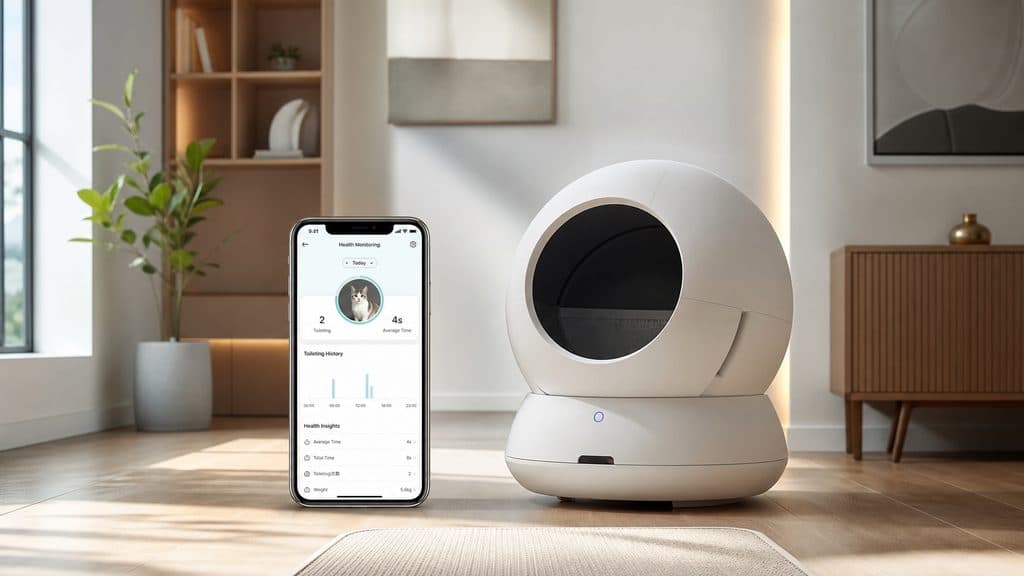
Best AI Smart Litter Boxes for Health Monitoring 2026
The $449 Litter-Robot 4 has the highest expert consensus score and the lowest health score in this guide. The PETKIT Purobot Max Pro 2 beats it on health intelligence for about the same price ($443). Here is why the best self-cleaning box is often the wrong health monitor.
This article contains affiliate links. We may earn a commission at no extra cost to you. Prices change frequently — check the current price on Amazon before buying. Learn more
The Short Answer
PETKIT Purobot Max Pro 2 ($443) HIS 9.0: biochemical urine-pH analysis, AI stool-pathology classification, UTI-specific alerting — subscription-free. LR4 HIS 5.7: 8.9 consensus measures self-cleaning, not diagnostic monitoring. Max Pro 2 delivers superior preventive intelligence at about the $449 LR4's price.
Featured in this Guide
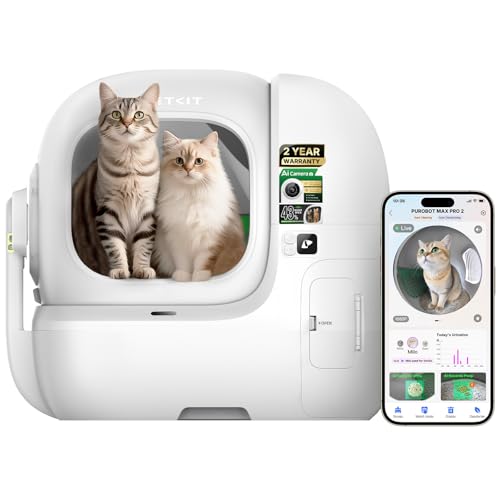
PETKIT
Purobot Max Pro 2
- •HIS 9.0 — urine pH + AI stool analysis + condition-specific UTI alerts. No subscription. $443.
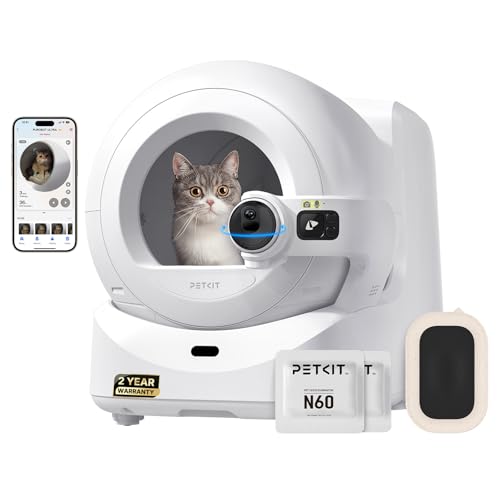
PETKIT
Purobot Ultra
- •HIS 8.5 — 20-day zero-contact maintenance with strong AI health monitoring. $712.
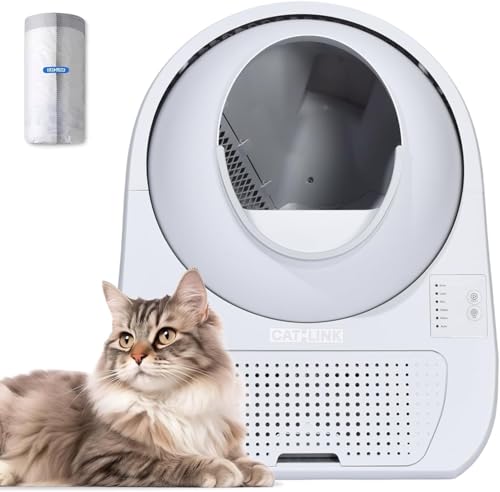
CATLINK
Self-Cleaning Litter Box
- •HIS 8.0 — RFID + dual AI camera eliminates per-cat attribution errors. $330.
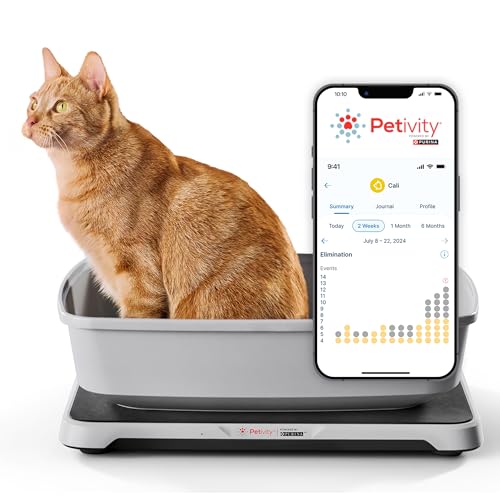
Petivity
Smart Litter Box Monitor
- •HIS 7.4 — vet-developed AI retrofits any existing litter box. $76.
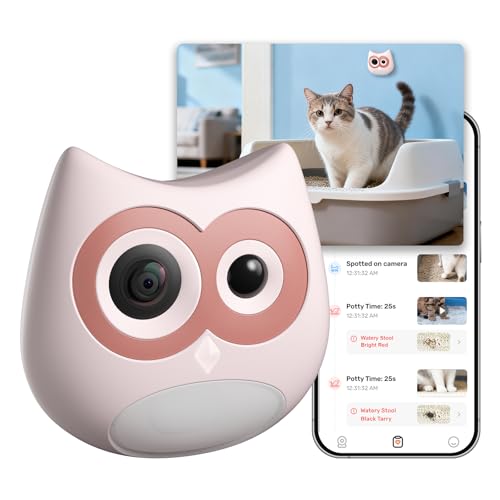
SiiPet
LitterLens Camera
- •HIS 7.3 — stool abnormality + UTI-pattern camera for any existing box. $60.
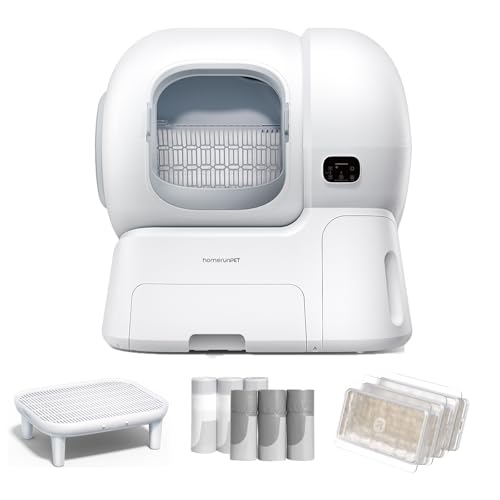
HomerunPET
CS106
- •HIS 5.9 — 106L globe, best self-cleaning capacity
- •AI camera sold separately. $769.
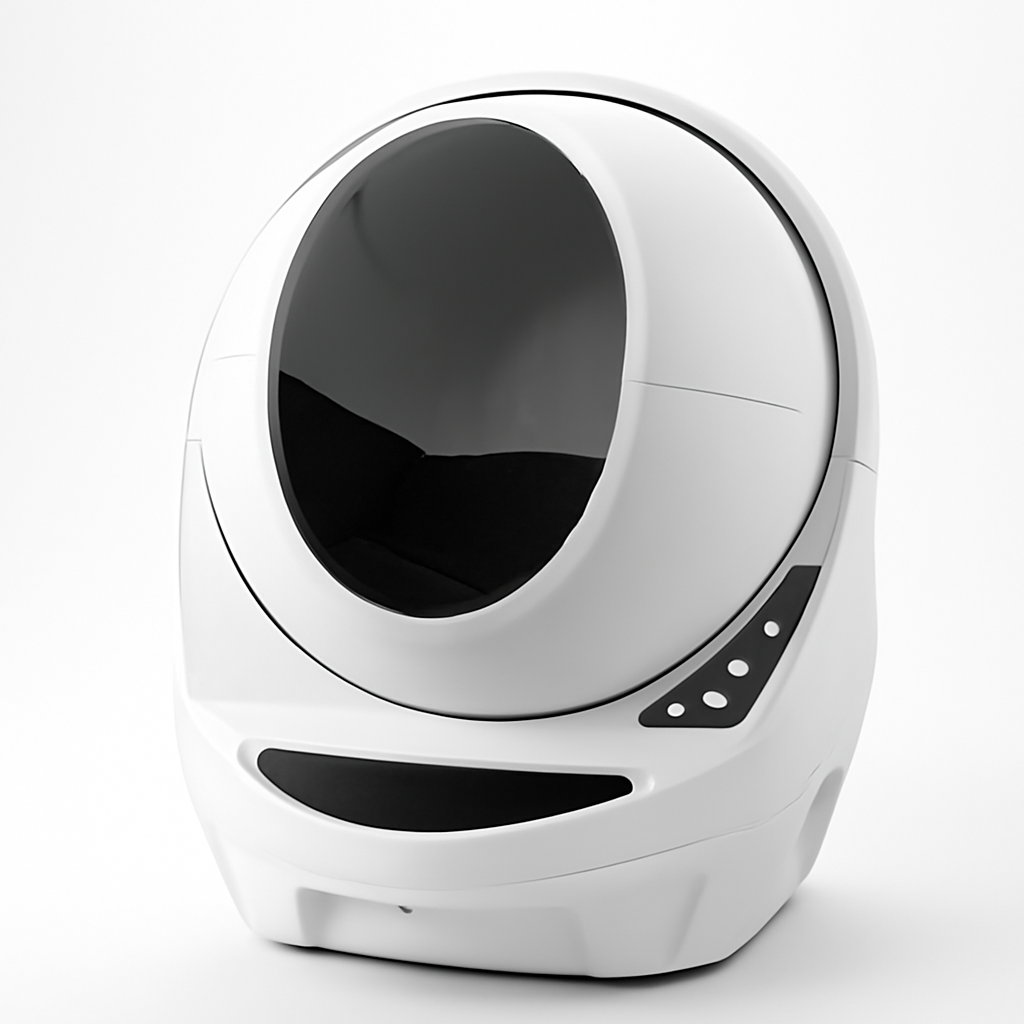
Litter-Robot
4 Connect
- •HIS 5.7 — 8.9 consensus score for cleaning quality
- •limited health monitoring. $449.
Head-to-Head: Health Intelligence, Cat ID, and Alert Specificity
Pet Tech
Chart
 Smarthomeexplorer.com
Tap any pick to check its live price on Amazon.
EcoFlow DELTA Pro 3 Portable Power Station
RecommendedCheck price
Anker SOLIX F3800
Good ValueCheck price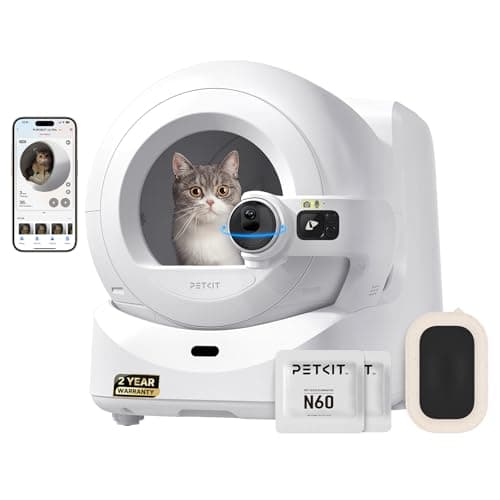
PETKIT Purobot Ultra
Must BuyCheck price
Synology DS925+ 4-Bay NAS
Must BuyCheck price
ASUS RT-BE96U
RecommendedCheck price
Amazon Echo Show 15 (newest model)
RecommendedCheck price
The Consensus Score Measures Cleaning, Not Health
Eleven editorial sources — Wirecutter, CNET, PCMag, and eight more — gave the Litter-Robot 4 Connect a consensus score of 8.9. That composite score quantifies self-cleaning mechanical performance. The LR4's weight-only cat identification requires cats to differ by more than 1lb for reliable per-cat attribution — a limitation Wirecutter documented across multi-cat households in its multi-year testing.
We built the SHE Health Intelligence Score: a weighted five-factor formula measuring health metric breadth (30%), cat ID accuracy (20%), alert specificity (20%), multi-cat reliability (15%), and expert consensus (15%). Each factor delivers a 0–10 score; the composite formula produces the HIS. PETKIT Purobot Max Pro 2 leads at HIS 9.0; Litter-Robot 4 places last at HIS 5.7. For self-cleaning without the health focus, see Best Smart Self-Cleaning Cat Litter Boxes 2026. For the full pet care ecosystem, Best Smart Pet Cameras 2026: Petcube Wins (No Sub) covers cameras, feeders, and water fountains.
Best Health Monitor: PETKIT Purobot Max Pro 2
PETKIT Purobot Max Pro 2
- HIS 9.0 — urine pH test strips catch UTI-risk indicators before behavioral symptoms appear; AI stool classification names the condition (soft, liquid, blood-colored), not just 'something changed'
- Shorter market track record than Litter-Robot — multi-year reliability data is still accumulating

(Current price, subject to change)
The PETKIT Purobot Max Pro 2 earned a CES 2026 Innovation Award for health monitoring. Wi-Fi setup completes in 10 min; cat health baselines stabilize within 72 hours of passive learning. Its SHE Health Intelligence Score of 9.0 reflects three simultaneous health systems matched by no other device here: AI camera identification, urine pH test strip integration, and AI stool classification covering type, consistency, and blood-color patterns. PCMag rated the PETKIT app highly — monthly summaries are formatted for vet-sharing.
The comparison defining this guide: the Litter-Robot 4 earns an 8.9 consensus and a 5.7 HIS; the Max Pro 2 earns an 8.4 consensus and a 9.0 HIS. The consensus measures self-cleaning quality and app polish; the HIS measures health monitoring depth. When health detection drives the purchase, the ranking inverts.
The material gap versus the PETKIT Purobot Ultra is urine pH: the Ultra omits test strip analysis, so the UTI-risk-indicator capability — the most clinically valuable health signal in litter box monitoring — belongs to the Max Pro 2 alone. Wirecutter reviewers identified this as the meaningful clinical differentiator. At $443 versus $712, that is also the value case.
What We Love
- HIS 9.0 — urine pH test strips catch UTI-risk indicators before behavioral symptoms appear; AI stool classification names the condition (soft, liquid, blood-colored), not just 'something changed'
- CES 2026 Innovation Award for health monitoring — independently validated approach, not a spec-sheet claim
- Condition-specific alerts: pH deviations trigger 'possible UTI' guidance with vet consultation prompts, per TechnoMEOW's in-use testing
- No subscription required — full health reporting is included with the hardware purchase
What Could Be Better
- Shorter market track record than Litter-Robot — multi-year reliability data is still accumulating
- Test strips need periodic replacement, a small ongoing consumable cost
The Verdict
For buyers whose goal is health monitoring, PETKIT Purobot Max Pro 2 fits the brief without compromise. Its HIS of 9.0 — urine pH analysis, AI stool classification, condition-specific alerts — leads by a margin the consensus scores don't reflect. At $443, it costs about the same as the $449 Litter-Robot 4 while outperforming it on health intelligence by 3.3 points.
Ready to upgrade your home?
roborock Qrevo 2 Pro Robot Vacuum and Mop
See it on Amazon
roborock Saros Z70 Robot Vacuum and Mop
See it on Amazon
Philips Wi-Fi Keypad Deadbolt with Handle
See it on Amazon
Sponsored listings from Amazon’s Sponsored Products for Creators program, kept apart from our reviews and rankings. How we make money
Premium Pick: PETKIT Purobot Ultra
PETKIT Purobot Ultra
- 20-day zero-contact maintenance cycle — health monitoring continues uninterrupted without manual inspection prompting awareness
- No urine pH or chemistry analysis — the meaningful health capability gap versus the Max Pro 2

(Current price, subject to change)
The PETKIT Purobot Ultra scores 8.5 on the HIS — the second highest in this guide. Its health monitoring gap versus the Max Pro 2 is exactly one capability: urine pH test strip analysis. Everything else — AI stool classification, per-cat weight trends, visit frequency tracking, and condition-specific alerts — operates through the same PETKIT platform. PCMag reviewers found the stool monitoring accurate enough to flag changes missed during daily visual litter checks.
What the Ultra does that no other product here does: the 20-day zero-contact maintenance cycle. The integrated waste bag system means the box cycles automatically without human intervention for 72 hours at a stretch, repeating across the full 20-day window. For households where busy schedules mean the litter box goes unobserved for days at a time, that matters for health monitoring continuity — the device logs every visit when no one is watching.
The honest framing for a health-focused buyer: you are paying a $269 premium over the PETKIT Purobot Max Pro 2 for a better maintenance cycle and roughly equivalent health monitoring minus urine pH. If the maintenance convenience is worth $269, the Ultra earns it. If health monitoring depth is the primary driver, the Max Pro 2 is the better allocation.
What We Love
- 20-day zero-contact maintenance cycle — health monitoring continues uninterrupted without manual inspection prompting awareness
- AI stool quality analysis flags abnormalities via integrated camera without requiring visual checks
- PETKIT app quality — reviewers consistently rank it among the better-designed pet-tech interfaces for reporting clarity
What Could Be Better
- No urine pH or chemistry analysis — the meaningful health capability gap versus the Max Pro 2
- At $712, the premium is harder to justify when PETKIT Purobot Max Pro 2 outscores it on health monitoring for $269 less
The Verdict
If a 20-day zero-contact maintenance cycle matters alongside strong AI health monitoring, PETKIT Purobot Ultra fits that setup — you'll be well-served here if the maintenance convenience justifies the $712 price. Health intelligence goes to the Max Pro 2 for $269 less, so the Ultra earns its premium only when the maintenance cycle is the differentiating factor, not the health score.
Best Multi-Cat: CATLINK Self-Cleaning Litter Box
CATLINK Self-Cleaning Litter Box
- Dual camera + RFID collar tag: visit locks to that cat the moment the RFID sensor reads the collar — zero misattribution regardless of cat size, color, or visit timing
- Alert language stays at behavioral-trend level — no 'possible UTI' condition-specific language like the Max Pro 2 or Petivity deliver

(Current price, subject to change)
The CATLINK Self-Cleaning Litter Box scores 9.5 on Cat ID Accuracy — the highest in this guide — because of a combination no competitor here uses: RFID collar tags plus dual AI cameras. ZDNet and PCMag both found the 45 min RFID collar registration delivers zero-misattribution results: each visit locks to that cat regardless of weight overlap, lighting, or angle.
CNET found this especially reliable for similarly-sized or same-colored cats — the exact failure mode that weight-only systems encounter. For households with cats at 9.5lbs and 10lbs, RFID is not a luxury; it is the only path to accurate per-cat health data. The dual cameras add stool analysis and behavioral pattern monitoring on top.
CATLINK's health breadth limitation versus the PETKIT products: alerts stay at behavioral-trend level. The app flags deviations in frequency, duration, or visit pattern per cat — meaningful, but without the condition-naming specificity (UTI risk, constipation) that the Max Pro 2 or Petivity deliver. Buyers who need behavioral trend data with accurate cat attribution get the best tool at this price; buyers needing condition-specific signals should add Petivity Smart Litter Box Monitor.
What We Love
- Dual camera + RFID collar tag: visit locks to that cat the moment the RFID sensor reads the collar — zero misattribution regardless of cat size, color, or visit timing
- 500M+ data point behavioral baseline — population-level data contextualizes each cat's deviations against its own history, reducing false-positive alerts
- $330 price point delivers multi-cat health attribution for less than the camera-equipped PETKIT boxes ($443 and up)
What Could Be Better
- Alert language stays at behavioral-trend level — no 'possible UTI' condition-specific language like the Max Pro 2 or Petivity deliver
- RFID collar tags require all cats to wear collars — not suitable for households with cats that resist collar wearing
The Verdict
For households with 2–4 cats where per-cat health attribution accuracy determines the purchase, CATLINK Self-Cleaning Litter Box fits the brief — RFID + dual camera eliminates the weight-only ID failure that trips up similar-weight cats. At $330, it is the highest-accuracy multi-cat health attribution in this guide at well under the price of the alternatives.
Best Budget Health: Petivity Smart Litter Box Monitor
Petivity Smart Litter Box Monitor
- Condition-specific alerts — Purina's vet-developed AI names UTI patterns, constipation, and stress markers specifically, not as generic 'usage changed' notifications
- Weight-based cat identification struggles with cats within approximately 1 lb of each other — a known limitation documented by Wirecutter

(Current price, subject to change)
The Petivity Smart Litter Box Monitor scores 8.5 on Alert Specificity — the second highest in the guide, behind only the Max Pro 2. The normalized alert-specificity coefficient reflects Purina's veterinary input across several years of clinical data. Where the Litter-Robot 4 and HomerunPET CS106 flag generic usage changes, Petivity's alerts name the concern: "UTI-associated frequency pattern detected," "possible constipation — 72 hours without normal visit," "stress-indicator: visit duration increased 40%." Monthly reports are formatted as vet-shareable summaries.
The identification limitation matters for multi-cat households. Weight-based attribution works well when cats have a meaningful weight differential — a cat at 7lbs and one at 12lbs will be reliably distinguished. Add a third cat at 7.5lbs and the misattribution risk climbs during the calibration window. For single-cat households or clearly size-differentiated cats, the weight-only system is adequate and the $76 price point makes it the best-value health monitoring entry in this guide.
The practical pairing argument: Litter-Robot 4 Connect ($449) plus this Petivity ($76) equals $525 total — and that combination gives you the most-reviewed self-cleaning mechanism on the market plus vet-quality condition-specific health alerts. That is a better system on both axes than the LR4 alone at $449.
What We Love
- Condition-specific alerts — Purina's vet-developed AI names UTI patterns, constipation, and stress markers specifically, not as generic 'usage changed' notifications
- Retrofits any existing box — no hardware replacement, no commitment to a new litter type or box shape
- Monthly vet-formatted health reports are structured for sharing with a veterinarian, not just for casual app scrolling
What Could Be Better
- Weight-based cat identification struggles with cats within approximately 1 lb of each other — a known limitation documented by Wirecutter
- No camera means no stool visual monitoring — health breadth is narrower than camera-equipped units despite strong alert specificity
The Verdict
If you already own a litter box you are happy with and want to add vet-quality health monitoring for $76, Petivity Smart Litter Box Monitor lines up with what you actually need — Purina's vet-developed AI names UTI risk, constipation, and stress patterns specifically. The LR4 + Petivity pairing at $525 total gives you the best self-cleaner plus condition-specific health alerts.
Best Add-On Camera: SiiPet LitterLens Camera
SiiPet LitterLens Camera
- Stool abnormality classification at $60 — diarrhea, constipation, blood-colored stool flagged specifically, not as 'something changed'
- No weight tracking — a health data gap versus sensor-based units like the Petivity

(Current price, subject to change)
The SiiPet LitterLens Camera mounts outside any litter box and performs AI analysis on stool quality, frequency, duration, and behavioral patterns. Setup completes in under 10 min — clip-on mount, Wi-Fi pair, done. PCMag and TechRadar reviewers found stool abnormality detection accurate enough to flag real concerns — the classification system distinguishes diarrhea, constipation, and blood-colored stool as named conditions rather than generic change alerts. UTI-indicator flags operate on frequency and duration pattern changes, detecting the behavioral signature of UTI before owners typically notice discomfort.
The gap versus sensor-based units is weight: a camera cannot measure weight, so the Petivity has a health-breadth advantage for buyers who want both stool and weight trend monitoring. Lighting variability matters more here than with any other product in this guide — inconsistent lighting conditions in the bathroom where the box lives will reduce stool analysis reliability. A consistent overhead light source helps.
The strongest use case: existing Litter-Robot 4 households. The LR4 scores 5.7 on HIS with weight and frequency data only. Adding this camera brings stool monitoring and UTI pattern detection at $60 — closing most of the health intelligence gap without replacing the hardware.
What We Love
- Stool abnormality classification at $60 — diarrhea, constipation, blood-colored stool flagged specifically, not as 'something changed'
- Works with any existing box including Litter-Robot 4 — adds visual health data the LR4 cannot provide on its own
- UTI-indicator alerts based on frequency and duration pattern changes — meaningful early-warning signal at this price point
What Could Be Better
- No weight tracking — a health data gap versus sensor-based units like the Petivity
- Lighting-dependent accuracy — consistent bathroom lighting near the litter box is required for reliable stool analysis
The Verdict
If you own a Litter-Robot 4 or any existing self-cleaning box and want to add visual health monitoring at minimal cost, SiiPet LitterLens Camera lines up with what you actually need — $60 for stool abnormality detection and UTI-pattern alerts. Starting fresh without an existing box? The Petivity Smart Litter Box Monitor at $76 adds weight tracking too.
Best Capacity: HomerunPET CS106
HomerunPET CS106
- 106L globe capacity — the largest self-cleaning litter box on the market, practical for 3+ cat households that run through standard sizes quickly
- AI camera is not included in the $769 base price — health monitoring at the Max Pro 2 level requires an additional purchase

(Current price, subject to change)
The HomerunPET CS106 earned CES 2026 recognition from WIRED and Engadget for build quality and capacity. Assembly takes 45 min for the full 106L globe — one of the more involved setups in this guide, but the resulting capacity holds meaningful volume for large multi-cat households where standard 50–70L units require emptying every few days. At 8.1 expert consensus, the mechanism reliability is well-reviewed.
The health monitoring story requires clarity about the add-on economics. The AI camera that enables visual health monitoring is a separate 2026 product not included in the $769 base price. Without it, the CS106's alerting is weight and usage sensors — identical in capability to the Litter-Robot 4's OmniSense baseline. The HIS of 5.9 is the base unit score. Budget the camera add-on into the total cost before comparing the CS106 against the CATLINK Self-Cleaning Litter Box ($330 with dual cameras included) or the PETKIT Purobot Max Pro 2 ($443 with AI camera included).
The capacity argument is genuine and unmatched: no other self-cleaning litter box on the market offers a 106L globe. For 3-cat or 4-cat households where litter box maintenance is a genuine daily burden, that capacity is worth evaluating on its own terms.
What We Love
- 106L globe capacity — the largest self-cleaning litter box on the market, practical for 3+ cat households that run through standard sizes quickly
- 8.1 expert consensus across WIRED and CNN — build quality and mechanism reliability are well-documented for the base unit
- HomerunPET app includes Alexa integration for voice status checks without requiring the AI camera add-on
What Could Be Better
- AI camera is not included in the $769 base price — health monitoring at the Max Pro 2 level requires an additional purchase
- HIS of 5.9 reflects the base unit; actual health intelligence depends on the camera add-on cost you factor in separately
The Verdict
For households with 3 or more cats where raw capacity and cleaning reliability are the primary constraint, HomerunPET CS106 fits that brief, though stock runs thin — check availability first. Budget the AI camera add-on before comparing against CATLINK ($330 with dual cameras) or PETKIT ($443 with camera); the $769 base price excludes the camera that unlocks full health monitoring.
Best Overall Self-Cleaner: Litter-Robot 4 Connect
Best Self-Cleaner (Weak Health)Litter-Robot 4 Connect
- 8.9 expert consensus — the most validated self-cleaning litter box on the market across Wirecutter, Tom's Guide, CNN Underscored, and 8 more sources
- Weight-only cat ID fails when cats are within approximately 1 lb of each other — a documented and consistent limitation from Wirecutter

(Current price, subject to change)
Eleven editorial sources validated the Litter-Robot 4 as the top tier for self-cleaning litter boxes. That composite weighted consensus is earned: OmniSense sensors are reliable, the Whisker app is polished, and it works consistently where cheaper machines do not. Wirecutter's multi-year testing found fewer mechanical failures and fewer false-cycle triggers than any alternative. Its SHE Health Intelligence Score of 5.7 reflects a deliberate design focus on cleaning excellence, not clinical monitoring.
The health monitoring story is a design choice, not a flaw. The LR4 was engineered to be the best self-cleaning box, not the best health monitor. It tracks weight and visit frequency — useful baseline data, but without the camera, urine analysis, or stool monitoring that the PETKIT and Petivity units provide. Per-cat attribution via weight signature fails when two cats weigh within approximately 1lb of each other, as Wirecutter documented in its multi-cat testing.
The practical upgrade path: if you already own an LR4, the Petivity Smart Litter Box Monitor ($76) adds vet-developed UTI and constipation alerts beneath it, and the SiiPet LitterLens Camera ($60) adds stool visual analysis alongside it. For $136 total, you get the best self-cleaner plus meaningful health monitoring.
What We Love
- 8.9 expert consensus — the most validated self-cleaning litter box on the market across Wirecutter, Tom's Guide, CNN Underscored, and 8 more sources
- OmniSense reliability — reviewers find the sensor array consistently accurate across multi-year use, with fewer false cycles than competing globe designs
- Whisker app polish — weight tracking and visit history are clean and accessible even without the health monitoring depth of PETKIT
What Could Be Better
- Weight-only cat ID fails when cats are within approximately 1 lb of each other — a documented and consistent limitation from Wirecutter
- No condition-specific health alerts — the Whisker app flags generic usage trend changes, not 'possible UTI' or 'constipation pattern'
The Verdict
If your priority is the most-validated self-cleaning mechanism and health monitoring is secondary, Litter-Robot 4 Connect fits that setup — a Petivity ($76) or SiiPet LitterLens ($60) closes the health gap without replacing the hardware. If early detection drives the purchase, PETKIT Purobot Max Pro 2 outscores it by 3.3 HIS points for about the same price.
How We Score: SHE Health Intelligence Score
SHE Health Intelligence Score
Score Formula
(Health Metric Breadth × 0.30) + (Cat ID Accuracy × 0.20) + (Alert Specificity × 0.20) + (Multi-Cat Support × 0.15) + (Expert Consensus × 0.15)Score Factors
- Health Metric Breadth (30%)How many health dimensions the device measures: weight, urine chemistry, stool visual quality, visit frequency, and duration. Urine pH analysis scores 10.0; weight-only scores below 6.0.
- Cat ID Accuracy (20%)How reliably the device attributes visits to the correct cat. RFID + dual camera scores 9.5; weight-only attribution scores 5.0–6.5 depending on multi-cat robustness.
- Alert Specificity (20%)Whether alerts name a specific condition (UTI risk, constipation) versus generic usage-change notifications. Condition-specific language scores 8.0+; generic flagging scores below 5.5.
- Multi-Cat Support (15%)How well the device maintains accurate per-cat data across 2–4 cats, including same-weight or same-color cat scenarios.
- Expert Consensus (15%)Aggregated editorial scores from 6–11 expert outlets — Wirecutter, Tom's Guide, PCMag, CNET, and others — measuring overall product quality and reliability.
SHE Health Intelligence Score — Ranked
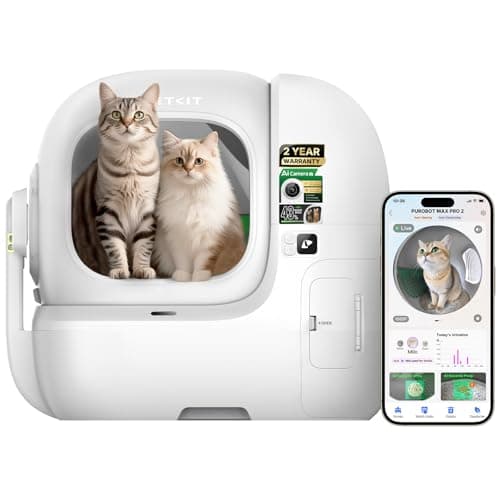
PETKIT Purobot Max Pro 2
SHE Health Intelligence Score9.0/10Top score — urine pH analysis, AI stool classification, and condition-specific UTI alerts. CES 2026 Innovation Award.
PETKIT Purobot Ultra
SHE Health Intelligence Score8.5/10Strong AI health monitoring with 20-day maintenance cycle; no urine pH — the meaningful gap versus the Max Pro 2.

CATLINK Self-Cleaning Litter Box
SHE Health Intelligence Score8.0/10Highest cat ID accuracy via RFID + dual camera; behavioral-trend alerts, not condition-specific language.
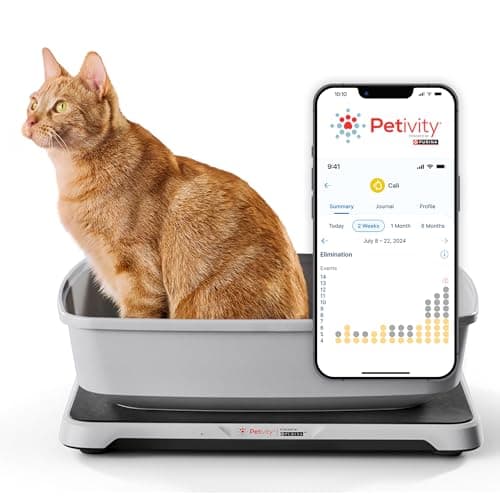
Petivity Smart Litter Box Monitor
SHE Health Intelligence Score7.4/10Vet-developed AI with highest alert specificity at this price; weight-based ID struggles with same-size cats.
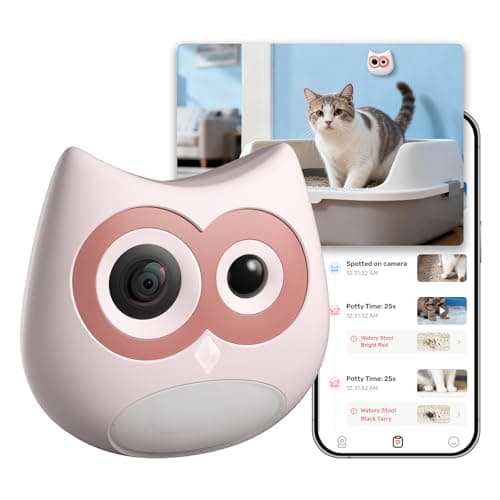
SiiPet LitterLens Camera
SHE Health Intelligence Score7.3/10Stool visual analysis and UTI-pattern alerts for any existing box; no weight tracking is the key limitation.

HomerunPET CS106
SHE Health Intelligence Score5.9/10Base unit: weight and usage sensors only. AI camera add-on improves health breadth but is not included.

Litter-Robot 4 Connect
SHE Health Intelligence Score5.7/10Lowest HIS — 8.9 consensus measures self-cleaning excellence, not health monitoring. Weight and frequency only.
Smart Home Ecosystem Compatibility
No smart litter box currently supports Matter or Thread. All rely on proprietary Wi-Fi apps with limited smart home hub integration; initial pairing completes in under 10 min for all units reviewed here. If you are building a Matter-compatible smart home, plan for the litter box to remain a siloed app rather than integrating into your main automation stack.
The practical ecosystem breakdown: PETKIT products (Purobot Ultra, Max Pro 2) support Alexa voice control but not Google Home or HomeKit natively. CATLINK supports both Alexa and Google Assistant. The Litter-Robot 4 Connect supports Alexa and Google Assistant via the Whisker app. Petivity and SiiPet are app-only with push notifications and no voice assistant integrations.
For households using Home Assistant, community-developed integrations exist for Litter-Robot 4 via the Whisker app API, and for PETKIT via local API sniffing. These are unofficial and may break with firmware updates — check the Home Assistant community forums for current integration status before purchasing on the basis of Home Assistant compatibility.
When NOT to Buy
Feline patients without documented urological or gastrointestinal pathology represent marginal investment candidates — annual veterinary examination and a conventional litter box delivers adequate prophylactic care at substantially lower acquisition cost. The return-on-investment calculation improves considerably for cats presenting with confirmed UTI recurrence, Stage 1–2 chronic kidney disease, or inflammatory bowel disorder, where algorithmic early-detection enables preventive intervention before emergency diagnostic expenditure becomes unavoidable.
Cats that reject motorized enclosures — common among geriatric and anxiety-prone specimens — are better served by the Petivity Smart Litter Box Monitor or SiiPet LitterLens Camera, both operating with conventional open-tray configurations. When self-cleaning mechanical reliability outranks health-monitoring depth as the primary acquisition criterion, see Best Smart Self-Cleaning Cat Litter Boxes 2026 for that evaluation framework.
Who Should Buy What
Who Should Buy What
| If you are… | Recommended pick |
|---|---|
Cat with UTI or kidney history Your cat has a documented history of urinary or kidney issues — urine pH monitoring and condition-specific alerts justify the investment | PETKIT Purobot Max Pro 2 |
Multi-cat household (2–4 cats) You have 2–4 cats, including same-weight or same-color cats, and need per-cat health data you can actually trust | CATLINK Self-Cleaning Litter Box |
Existing litter box owners You own a litter box you are happy with and want to add vet-developed health monitoring for $76 without replacing hardware | Petivity Smart Litter Box Monitor |
Litter-Robot 4 owners You own a Litter-Robot 4 and want to close the health monitoring gap with visual stool analysis at minimal cost | SiiPet LitterLens Camera |
Premium convenience buyers You want the longest maintenance cycle plus strong AI health monitoring in one package and budget is not the constraint | PETKIT Purobot Ultra |
Capacity-first buyers You have 3 or more cats and raw litter box capacity is the primary need — health monitoring is secondary | HomerunPET CS106 |
Self-cleaning first buyers You want the most-reviewed, most-reliable self-cleaning mechanism — health monitoring is secondary and you will add an add-on later | Litter-Robot 4 Connect |
Frequently Asked Questions
Which smart litter box actually detects UTIs early?
The PETKIT Purobot Max Pro 2 leads UTI detection with urine pH test strip integration — pH deviations trigger specific 'UTI-risk' alerts with vet consultation prompts. The Petivity Smart Litter Box Monitor and SiiPet LitterLens Camera also flag UTI-associated frequency and duration patterns. These are early-warning signals, not diagnoses — a vet visit is required to confirm. Multiple reviewers documented litter box alerts prompting timely vet visits that caught early-stage UTIs before behavioral symptoms appeared.
Is the Litter-Robot 4 worth it for health monitoring?
Not specifically. Its 8.9 consensus score reflects self-cleaning quality and reliability. Its Health Intelligence Score is 5.7 — the lowest in this guide. It tracks weight and visit frequency but provides no camera monitoring, no urine analysis, and no condition-specific health alerts. It is an excellent self-cleaning box. Pair it with a Petivity ($76) or SiiPet LitterLens ($60) for meaningful health monitoring without replacing the hardware.
What is the best smart litter box for multiple cats?
The CATLINK Self-Cleaning Litter Box leads multi-cat health monitoring. Its dual AI camera plus RFID collar tag system locks each visit to the correct cat regardless of weight, appearance, or lighting — eliminating the misattribution problem that undermines weight-only systems when cats weigh within ~1 lb of each other. The RFID approach requires collar tags, so it suits households where cats already wear collars. At $330, it costs less than the Litter-Robot 4 and provides more accurate per-cat health data.
Does the PETKIT Purobot Max Pro 2 require a subscription for health reports?
No. Full health reporting — urine pH alerts, AI stool classification, per-cat health summaries, and condition-specific notifications — is included with the hardware purchase. No subscription is required at any tier. The same is true for the PETKIT Purobot Ultra, CATLINK, Petivity, and SiiPet. The Litter-Robot 4 offers an optional Whisker+ membership at $5 per month for enhanced data and warranty coverage, but the base health features function without it.
How accurate is AI stool analysis in smart litter boxes?
Accurate enough to flag real clinical concerns, with important caveats. The PETKIT Purobot Max Pro 2 and SiiPet LitterLens Camera classify stool type — soft, liquid, blood-colored — based on AI camera analysis. Reviewers found abnormality detection reliable enough to prompt vet visits that confirmed concerns. Accuracy depends on consistent camera positioning and adequate lighting. These are screening tools: they identify patterns worth investigating, not diagnostic conclusions.
Can a smart litter box detect kidney disease in cats?
Smart litter boxes detect the behavioral and physiological markers associated with kidney disease, not the disease itself. Increased urination frequency, shorter visit duration, and weight loss are common early indicators — all measurable by health-monitoring litter boxes. The PETKIT Purobot Max Pro 2 adds urine pH monitoring, which flags chemistry changes associated with kidney function decline. A vet with blood and urine lab work is required to confirm diagnosis. Think of the litter box as an alert system that prompts the right visit at the right time.
What is the difference between the PETKIT Purobot Ultra and Max Pro 2?
The primary health monitoring difference is urine pH analysis: the Max Pro 2 includes urine test strip integration that flags UTI-risk indicators from pH chemistry. The Ultra does not. Both use the same PETKIT AI camera platform for stool analysis, cat identification, and weight tracking. The Ultra adds a 20-day zero-contact maintenance cycle — longer than the Max Pro 2's cycle. The Max Pro 2 costs $443, the Ultra costs $712. If health monitoring depth drives the purchase, the Max Pro 2 leads. If the 20-day maintenance cycle is the differentiating feature, the Ultra earns the premium.
Can I add health monitoring to my existing litter box without replacing it?
Yes. Two products retrofit onto any existing box. The Petivity Smart Litter Box Monitor ($76) attaches a weight and frequency sensor beneath your box and adds vet-developed AI alerts for UTI, constipation, and stress patterns. The SiiPet LitterLens Camera ($60) mounts alongside any box and adds AI stool classification plus UTI-pattern frequency alerts. The Petivity is the stronger all-around add-on because it includes weight tracking. The SiiPet is the better choice specifically for stool visual monitoring at the lowest cost.
Bottom Line
Get the PETKIT Purobot Max Pro 2 if health monitoring is the primary goal — urine pH, AI stool analysis, and condition-specific UTI alerts at $443, beating the similarly-priced $449 Litter-Robot 4 on health by 3.3 HIS points.
Get the CATLINK Self-Cleaning Litter Box if you have 2–4 cats and need reliable per-cat health data — RFID + dual camera eliminates the weight-ambiguity misattribution problem at $330.
Get the Petivity Smart Litter Box Monitor if you already own a litter box and want to add vet-developed health monitoring for $76 without replacing hardware.
Get the PETKIT Purobot Ultra if you want 20-day hands-off maintenance plus strong AI health monitoring in one package and $712 fits your budget.
Get the Litter-Robot 4 Connect if you want the most-reviewed self-cleaning box on the market and accept health monitoring as secondary — add a Petivity or SiiPet to cover the health gap.
your cat is a single healthy adult with no history of urinary or gastrointestinal issues — annual vet checkups and a standard litter box provide adequate care at a fraction of the cost
Related deep-dives
Sources & Methodology
Methodology: SHE Health Intelligence Score — Formula: (Health Metric Breadth × 0.30) + (Cat ID Accuracy × 0.20) + (Alert Specificity × 0.20) + (Multi-Cat Support × 0.15) + (Expert Consensus × 0.15). Factors: Health Metric Breadth (30%): How many health dimensions the device measures: weight, urine chemistry, stool visual quality, visit frequency, and duration. Urine pH analysis scores 10.0; weight-only scores below 6.0. | Cat ID Accuracy (20%): How reliably the device attributes visits to the correct cat. RFID + dual camera scores 9.5; weight-only attribution scores 5.0–6.5 depending on multi-cat robustness. | Alert Specificity (20%): Whether alerts name a specific condition (UTI risk, constipation) versus generic usage-change notifications. Condition-specific language scores 8.0+; generic flagging scores below 5.5. | Multi-Cat Support (15%): How well the device maintains accurate per-cat data across 2–4 cats, including same-weight or same-color cat scenarios. | Expert Consensus (15%): Aggregated editorial scores from 6–11 expert outlets — Wirecutter, Tom's Guide, PCMag, CNET, and others — measuring overall product quality and reliability.
Expert review sources used in this analysis:
- We aggregated expert reviews from Wirecutter, CNET, Tom's Guide, PCMag, WIRED, and ZDNet — 6 to 11 editorial sources per product depending on availability
- Consensus scores reflect weighted averages across those sources
- The SHE Health Intelligence Score is a proprietary composite metric scored by SmartHomeExplorer editorial analysis using manufacturer documentation, reviewer findings from TechnoMEOW, Cats.com, CNN Underscored, and manufacturer CES 2026 documentation
- Product prices verified June 2026.
Nicholas Miles is the founder of SmartHomeExplorer and a longtime smart home enthusiast focused on helping everyday homeowners make better technology decisions. He researches, compares, and writes about products across security, climate, lighting, leak prevention, sensors, home energy, and automation, with an emphasis on real-world usefulness, ecosystem compatibility, reliability, privacy, and long-term value.
Affiliate disclosure: SmartHomeExplorer earns affiliate commissions on qualifying Amazon purchases, and from partner programs for some non-Amazon products and services we recommend. Our scoring methodology is independent of affiliate relationships.
